
ScanTitan’s website vulnerability scanner tests your web apps, APIs, JavaScript SPAs, and internal networks the way an attacker would, then confirms what is actually exploitable. It detects known CVEs, security misconfigurations, and exposed attack vectors, scores each finding by CVSS severity, and ships it with the exact HTTP request, response, and screenshot as proof. You see what is broken, how urgent it is, and how to fix it, with no false-positive guesswork.
New vulnerability every 18 minutes
29,000+ CVEs published in 2023
68% of breaches exploit known, patchable flaws
PCI DSS · ISO 27001 · SOC 2 · GDPR
New vulnerability every 18 minutes
29,000+ CVEs published in 2023
68% of breaches exploit known, patchable flaws
PCI DSS · ISO 27001 · SOC 2 · GDPR
A website vulnerability scanner tests your web apps, APIs, and infrastructure for exploitable weaknesses. It sends attacker-style HTTP requests, reads the responses, and confirms which flaws are real — SQL injection, XSS, misconfigurations, and known CVEs. Each finding returns scored by severity (CVSS 0–10) with the exact request, response, and screenshot as proof. You learn what’s broken, how urgent it is, and how an attacker would exploit it before one does.
ScanTitan is a website security company registered in the Netherlands and operated by an ISO 27001-certified security team. We built the platform for one specific gap: SMBs and mid-market companies face the same automated attackers as enterprises — scrapers probing internet-facing assets for unpatched CVEs around the clock — without an enterprise budget or a dedicated security hire to respond.
The platform covers three layers in one dashboard: vulnerability scanning (authenticated DAST with 15,000+ CVE-mapped checks across the OWASP Top 10), malware detection and removal handled end-to-end by our analysts, and external attack surface management that keeps a live inventory of every domain, subdomain, and cloud asset you expose. Teams across the US, EU, and Middle East use ScanTitan to pass PCI DSS, SOC 2 Type II, and NIS2 reviews without hiring a security department.
Seven stages — from asset discovery to verified remediation. Every stage feeds the next, and every finding is confirmed before it reaches you.
Enter your domain and ScanTitan enumerates subdomains, crawls your sitemap, identifies API endpoints, and builds a complete inventory of everything internet-facing — including shadow assets most businesses didn't know existed.
ScanTitan's headless browser engine executes JavaScript, follows client-side routing in React, Angular, and Vue.js applications, and maps every application state reachable through user interaction — then queues all of it for testing.
10,000+ crafted payloads sent to every discovered endpoint — testing for SQL injection, XSS, SSRF, command injection, IDOR, authentication bypass, and the full OWASP Top 10 (2021). Available in Light (passive-safe) and Deep (authenticated, full payload) modes.
Runs simultaneously with active scanning — analyzing HTTP headers, cookies, response codes, and server behavior for misconfigurations, information disclosure, and weak security policies without sending attack payloads.
ScanTitan fingerprints every software component — web server versions, CMS installations, plugin versions, JS libraries, frameworks — and cross-references them against CVE databases updated daily. Newly disclosed CVEs are matched against your stack automatically.
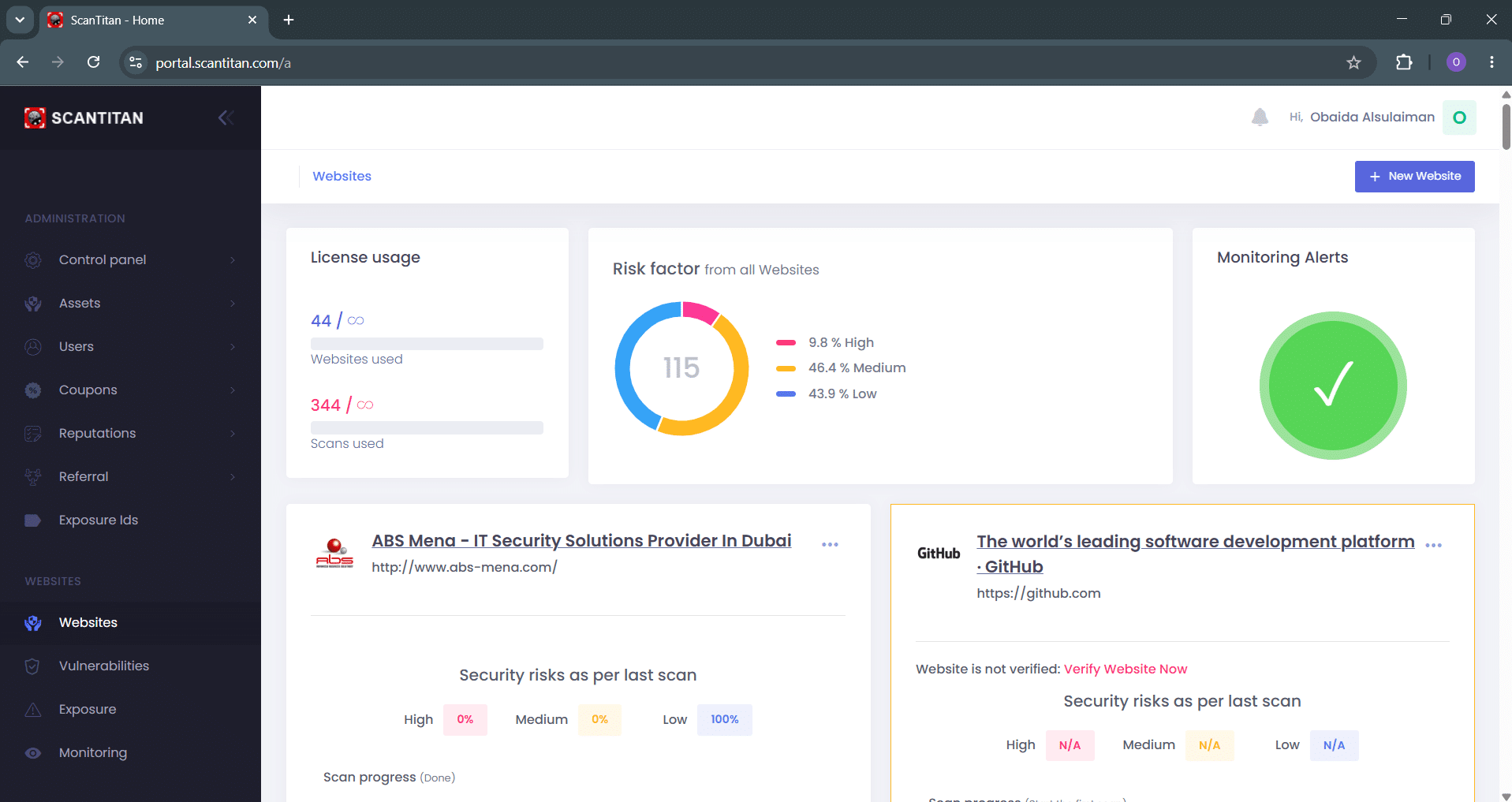
Real result — A 45-person e-commerce retailer ran their first scan two days before a major sale. ScanTitan found a WooCommerce plugin running CVE-2024-9821 (CVSS 9.8) and an exposed .env file with full database credentials. Both fixed in under 6 hours using the step-by-step guides. 12,000 customer records protected.
ScanTitan’s ML-powered false positive classifier analyzes every potential finding against behavioral patterns from millions of previous scan results before triggering an alert. The result: over 50% reduction in noise compared to raw scanner output.
Every finding that reaches your dashboard includes: the exact HTTP request sent, the HTTP response that confirmed the vulnerability, a screenshot where applicable, and a reproducible attack vector your team can verify independently before remediating.
The difference — A B2B SaaS team was drowning in 200+ weekly alerts from their previous scanner. 80% were false positives requiring manual verification. After switching to ScanTitan, the verified finding rate dropped alert volume to under 40 per week — all real, all actionable.
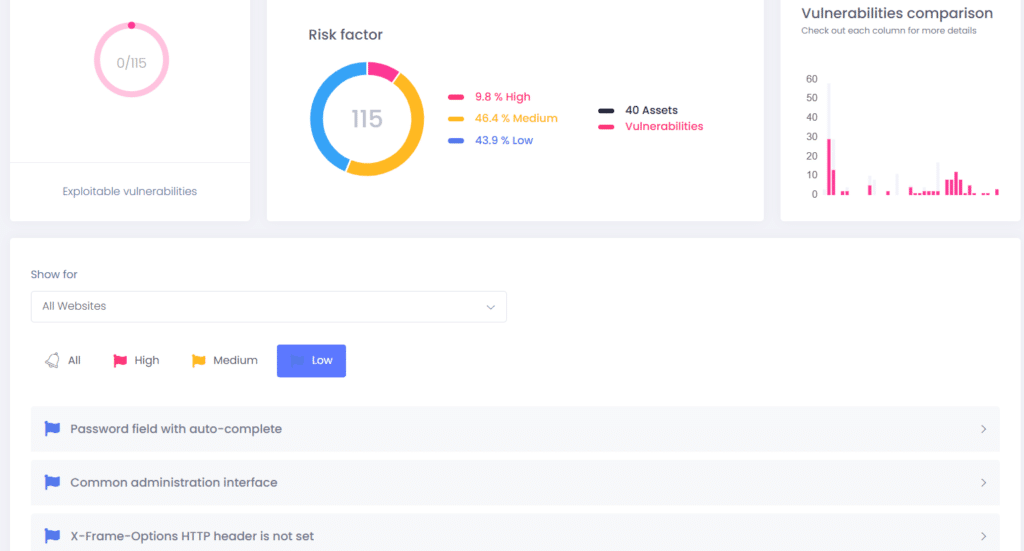
Every finding ships with plain-language remediation instructions tailored to your exact platform — WordPress, custom PHP, Node.js, Python, or cloud infrastructure. Not a generic CVE link. A specific, sequenced fix.
After you apply the fix, trigger a targeted re-scan in one click. ScanTitan verifies the finding is closed and attaches a clean-scan certificate to the issue — audit-ready evidence that the vulnerability was identified and remediated.
71% faster — A 120-person SaaS company cut average high/critical remediation time from 23 days to 6.7 days using CVSS-prioritized alerts and automated re-scan verification. Their security backlog cleared in 8 weeks.
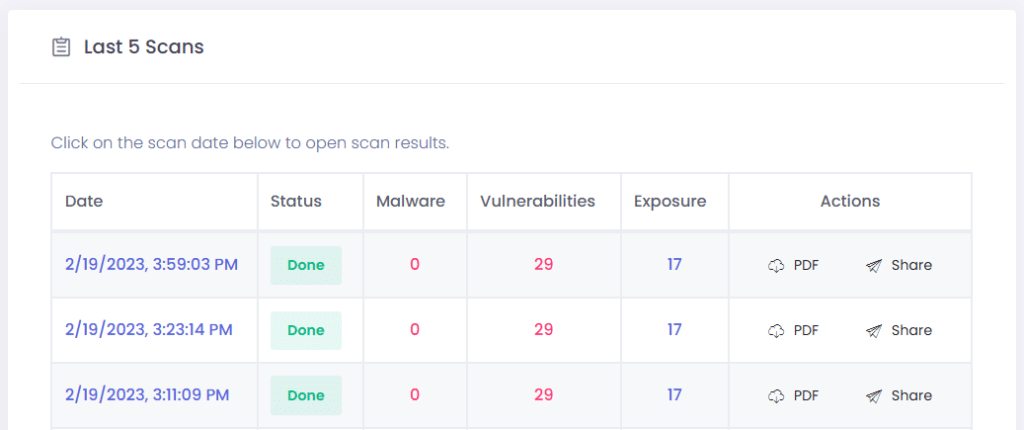
Our ML-powered classifier has been trained on millions of scan results. It distinguishes confirmed vulnerabilities from scanner noise before any alert fires — so your team isn’t chasing ghosts at 2am.
Every confirmed finding includes the HTTP request that triggered it, the server response that confirmed it, and a reproducible attack vector. Proof-based — not probability-based.
The exact request payload sent to trigger the vulnerability — reproducible by your team or your auditor.
Browser screenshot captured at the moment of confirmed exploitation — visual confirmation attached to every critical and high finding.
Full server response annotated to show exactly what changed — the evidence your developers need to reproduce and fix the issue.
Trained on millions of scan results across web app types, tech stacks, and deployment environments. Continuously updated.
Not a bundle of open-source tools duct-taped together. A single, integrated scanning engine with a proprietary DAST layer, ML accuracy, and unified reporting.
10,000+ test cases. SQL injection, XSS, SSRF, command injection, IDOR, authentication bypass — the full OWASP Top 10 (2021) and SANS CWE Top 25.
ScanTitan is a WordPress vulnerability scanner that fingerprints your core, every plugin, and every theme.
Headless browser engine crawls React, Angular, and Vue.js apps — executing JavaScript, following client-side routes, and scanning every dynamic endpoint.
Open port detection, service fingerprinting, CVE matching, weak credentials, cloud misconfigurations — across your entire IP range and cloud infrastructure.
REST and GraphQL testing via OpenAPI/Swagger import. BOLA, excessive data exposure, missing rate limiting, and injection in API parameters — the OWASP API Top 10.
Lightweight agent or network bridge connects to your private infrastructure — scanning intranet apps, internal servers, and private APIs without exposing assets publicly.
Expired certificates, weak cipher suites, POODLE/BEAST-class misconfigurations — with 30-day expiry alerts before users see a browser warning.
Scan any single IP, range, or full CIDR block across IPv4 and IPv6 — with reverse DNS and hostname resolution, geolocation and ASN ownership, and blacklist and reputation checks that flag whether your address is already flagged as malicious or spam.
Open S3 buckets, public RDS instances, exposed cloud metadata endpoints, weak IAM policies — across AWS, Azure, and GCP.
Outdated core and contrib modules, SA-CORE advisories, access bypass, SQL injection and unpatched security releases — across Drupal 7, 9, and 10.
Vulnerable core, components, modules and templates, Joomla Security Announcements, exposed configuration.php and backups, plus CVSS, EPSS and CISA KEV context — across Joomla 3, 4, 5, and 6.
10,000+ test cases. SQL injection, XSS, SSRF, command injection, IDOR, authentication bypass — the full OWASP Top 10 (2021) and SANS CWE Top 25.
Headless browser engine crawls React, Angular, and Vue.js apps — executing JavaScript, following client-side routes, and scanning every dynamic endpoint.
REST and GraphQL testing via OpenAPI/Swagger import. BOLA, excessive data exposure, missing rate limiting, and injection in API parameters — the OWASP API Top 10.
Expired certificates, weak cipher suites, POODLE/BEAST-class misconfigurations — with 30-day expiry alerts before users see a browser warning.
WordPress, Drupal, and Joomla — real-time database of vulnerable plugin and theme versions, cross-referenced against WPScan and CVE feeds. Plugin name, version, patch, CVE.
Open port detection, service fingerprinting, CVE matching, weak credentials, cloud misconfigurations — across your entire IP range and cloud infrastructure.
Lightweight agent or network bridge connects to your private infrastructure — scanning intranet apps, internal servers, and private APIs without exposing assets publicly.
Open S3 buckets, public RDS instances, exposed cloud metadata endpoints, weak IAM policies — across AWS, Azure, and GCP.
Maps findings to PCI DSS Req. 11.3, ISO 27001 Annex A.8.8, SOC 2 Type II, and GDPR Article 32. Audit-ready PDF and JSON exports formatted for QSA submission.
Every finding is scored on the CVSS 0–10 scale. ScanTitan maps each score to an alert tier — so critical findings wake someone up immediately, and low-severity informational items stay in the monthly digest where they belong.
| CVSS Score | Severity | Typical Vulnerability Class | ScanTitan Response | Alert Channel |
|---|---|---|---|---|
| 9.0 – 10.0 | ● Critical | RCE, authentication bypass, SQL injection with data exfil | Immediate alert + dedicated remediation guide + re-scan trigger | Email + Slack + Jira ticket |
| 7.0 – 8.9 | ● High | XSS, SSRF, broken access control, exposed sensitive files | Same-day notification + fix guidance | Email + Slack |
| 4.0 – 6.9 | ● Medium | Missing security headers, outdated libraries (no known exploit) | Weekly digest | Email digest |
| 0.1 – 3.9 | ● Low | Verbose error messages, non-critical info disclosure | Monthly report | Report only |
| 0.0 | ● Informational | Best-practice observations, non-security items | Logged, no alert | Dashboard only |
Every finding is scored on the CVSS 0–10 scale. ScanTitan maps each score to an alert tier — so critical findings wake someone up immediately, and low-severity informational items stay in the monthly digest where they belong.
Overall risk score, critical/high/medium/low counts, trend vs previous scan. One page, board-ready.
CVE ID, CVSS score, affected URL/endpoint, confirmed status, and remediation priority.
Request sent, response received, screenshot. Every finding fully reproducible — your QSA won't question it.
Not a CVE link. A sequenced fix guide for your actual platform — WordPress, Node.js, PHP, Python, cloud.
Every finding mapped to its OWASP Top 10 category and CWE identifier for compliance frameworks.
PCI DSS Req. 11.3, ISO 27001, SOC 2, GDPR Article 32 — formatted for auditor submission.
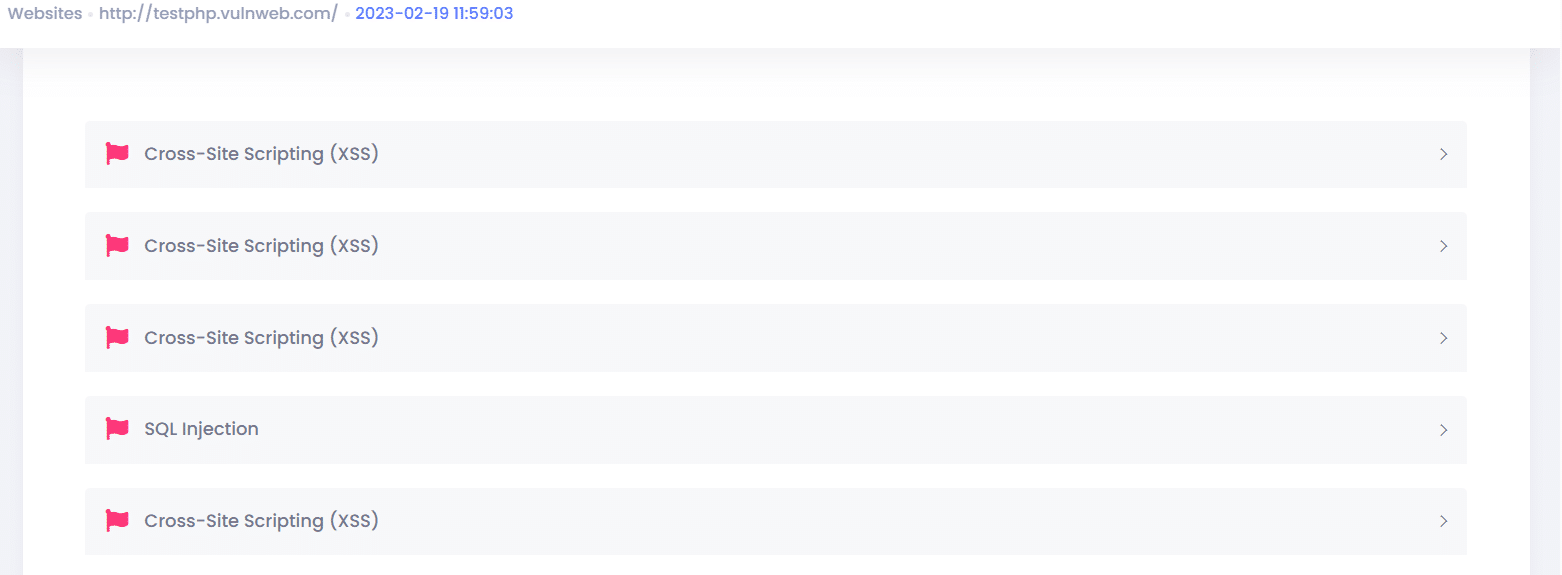
Trigger scans from CI/CD, pull findings into Jira, fail deploys on critical CVEs. ScanTitan’s REST API and native integrations mean security runs with your workflow — not around it.
# Trigger a deep scan on staging curl -X POST https://api.scantitan.com/v1/scans \ -H "Authorization: Bearer YOUR_API_KEY" \ -H "Content-Type: application/json" \ -d '{ "target": "https://staging.yourapp.com", "scan_type": "deep", "notify": ["slack","jira"] }' # Response { "scan_id": "sc_9fk2ab", "status": "queued", "eta_seconds": 420 }- name: ScanTitan security gate uses: scantitan/scan-action@v2 with: target: https://staging.yourapp.com api_key: ${{ secrets.SCANTITAN_KEY }} fail_on: critical,high min_cvss: 7.0PR comments + Actions gate
Instant critical alerts
Auto-create + close tickets
Asset discovery + cloud scan
VNet + cloud misconfigs
GKE + storage exposure
Compliance evidence
SIEM finding export
Any tool via JSON
March 2026
Recorded and automatic login flows now use an AI fallback when standard detection fails on complex or dynamic SPA login pages. Reduces authentication scan failures by over 80% on modern JavaScript-heavy applications.
January 2026
Full introspection query support added, with automated schema extraction and mutation-level injection testing for GraphQL APIs. Covers all 10 OWASP API Security Top 10 categories.
November 2025
The lightweight internal scanning agent is now available on all paid plans. One-click deployment for AWS VPCs, Azure VNets, and on-premise networks via Docker container.
September 2025
Retrained on an expanded dataset of 50M+ scan results. False positive rate on web application findings reduced to under 8% across the full test suite — a 50%+ improvement over v1.
| ScanTitan | Pentest-Tools | Intruder | HostedScan | |
|---|---|---|---|---|
| Web app DAST | ✓ | ✓ | Cloud+ only | ✓ |
| JavaScript / SPA scanning | ✓ | ✓ | ✗ | ✓ |
| Internal network scanning | ✓ | ✓ | ✓ | ✓ |
| ML false positive reduction | ✓ 50%+ cut | ✓ | Basic filter | ✗ |
| Proof-based evidence (HTTP + screenshot) | ✓ | ✓ | ✗ | ✗ |
| CVSS severity table + alert tiers | ✓ | Partial | Partial | ✓ |
| CMS-specific scanning | ✓ WP/Drupal/Joomla | ✓ | ✗ | ✗ |
| CI/CD pipeline integration | ✓ | ✓ | ✓ | API only |
| Compliance reports (PCI/ISO/SOC2) | ✓ | ✓ | Partial | ✓ |
| Plain-language CVE/CVSS explainer | ✓ | ✗ | ✗ | ✗ |
| Entry plan price | Free scan | Paid only | $101+/mo | $29/mo |
A website vulnerability scanner is an automated security tool that tests your web application, APIs, and infrastructure for exploitable weaknesses. It sends crafted HTTP requests simulating attacker techniques and records any insecure responses. Modern scanners like ScanTitan also fingerprint software versions to detect known CVEs, crawl JavaScript-rendered routes for SPA coverage, and scan internal networks from behind the perimeter. Results are mapped to CVE identifiers and CVSS scores so you know which vulnerabilities are critical and which are low-risk.
A vulnerability scanner is automated, continuous, and broad — it finds known vulnerabilities and CVEs at scale with reproducible evidence for every finding. A penetration test is manual and deep — a human security professional chains vulnerabilities together to achieve a specific objective like database access or privilege escalation. Use ScanTitan as your continuous baseline; run a pentest at least annually or after major architecture changes. ScanTitan closes the known-vulnerability gap before a pentest begins, reducing scope and cost.
CVE stands for Common Vulnerabilities and Exposures — a publicly maintained dictionary of known software vulnerabilities managed by MITRE. Each CVE gets a unique ID (e.g. CVE-2021-44228 for Log4Shell) and a CVSS score. When ScanTitan detects a vulnerable software version, it maps the finding to its CVE ID so you can look up the exact vulnerability, available patch, and any public exploit code. CVE-listed vulnerabilities with public exploits can be used by anyone with a search engine — this is not theoretical risk.
Continuous monitoring with weekly full scans is the modern standard — not monthly, because 79 new CVEs are documented every single day. Monthly scanning leaves a 29-day window of blind exposure to any newly disclosed vulnerability. ScanTitan's continuous layer watches for new CVEs matching your detected software stack and re-assesses automatically. PCI DSS mandates quarterly scans as a minimum floor, not a ceiling.
No. ScanTitan rate-limits and spreads scan requests across the scan window to avoid triggering load spikes. Light scans (passive only) are safe to run at any time, including peak traffic hours. Deep scans can be scheduled during maintenance windows via the dashboard or API. Our scanner uses non-destructive probes — it confirms exploitability without modifying data or submitting destructive payloads.
Yes — both. For authenticated web scanning, record a login flow once and the scanner replicates it every scan, reaching member areas, admin panels, and user-role-gated features. For internal networks, the lightweight ScanTitan agent or network bridge connects your private infrastructure without exposing internal assets to the internet. Both capabilities are available on all paid plans and required for most compliance frameworks.
All four are cloud-based scanners targeting SMBs and mid-market companies. Pentest-Tools is powerful for professional pentesters running client engagements but is structured around on-demand use rather than continuous internal security management. Intruder's entry plan ($101+/month) excludes web application scanning and asset discovery — it's intentionally limited to upsell. HostedScan bundles open-source engines (OpenVAS, ZAP, Nmap) at low cost but relies entirely on those tools' detection rates with no ML accuracy layer. ScanTitan runs a proprietary DAST engine with ML-powered false positive reduction, covers all scanning layers in one platform, and provides proof-based evidence for every finding.
Yes. ScanTitan's free scan runs real tests against your domain and surfaces your most critical findings — not a paywalled teaser list. No credit card required, no time limit. The free scan covers OWASP Top 10 basics, exposed sensitive files, SSL/TLS misconfigurations, and software version detection. Paid plans unlock deep scanning, authenticated scanning, continuous monitoring, and compliance reports.
CISSP · GXPN · GCIH · GWAPT · CISA · CEH · EnCE · ISO 27001 Lead Auditor · COBIT 5 · 12+ years