
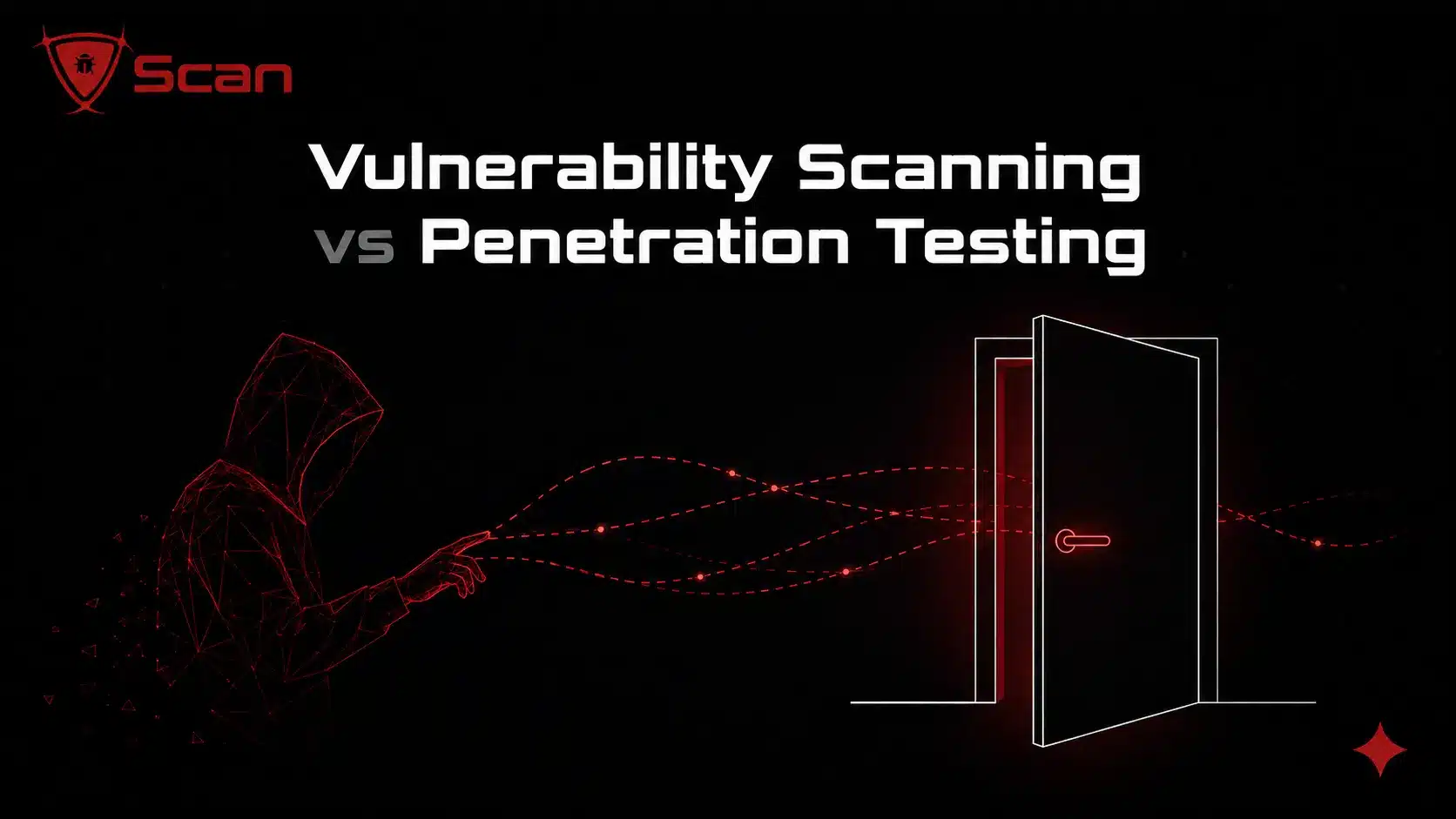
Choosing between vulnerability scanning vs penetration testing trips up a lot of teams, and picking the wrong one either wastes budget or leaves real holes open. A vulnerability scan is an automated, broad sweep that flags known weaknesses across your whole environment. A penetration test is a human-led, deep attack that proves which of those weaknesses an attacker could actually exploit. Most organizations need both, layered deliberately, and several compliance frameworks now demand each one for very different reasons.
Vulnerability Scanning vs Penetration Testing: The Short Answer
Here is the distinction in one line: a vulnerability scanner tells you what might be broken; a penetration test proves what an attacker can actually do about it. Scanning is automated, wide, and cheap enough to run weekly. Pentesting is manual, narrow, expensive, and usually annual. Scanners find the known CVEs across hundreds of assets; a pentester chains two “medium” findings into a full account takeover no scanner would ever flag. You do not choose one over the other; you sequence them. Scan continuously to shrink the attack surface, then pay a human to test what is left.
| Vulnerability scan | Penetration test | |
|---|---|---|
| Method | Automated tool | Manual, human-led |
| Breadth | Wide, whole surface | Deep, targeted scope |
| Finds | Known CVEs, misconfigs | Logic flaws, chained exploits |
| Frequency | Continuous / weekly | Quarterly / annual |
| Typical cost | $100 to $3,500 / year | $4,000 to $70,000+ per engagement |
| Proves exploitability? | No | Yes |
What Is Vulnerability Scanning?
A vulnerability scanner is an automated tool that inventories your assets and checks each one against a database of known weaknesses: published CVEs, missing patches, weak TLS configurations, and common misconfigurations. It reports what it finds, ranked by severity. What it does not do is prove that any finding is exploitable; that judgment call still belongs to you or a pentester.
For public-facing web applications, a website vulnerability scanner automates these checks across pages, software versions, configurations, and common web security weaknesses.
How Automated Scanners Work (Crawling, Fingerprinting, CVE Matching)
A scanner runs the same loop every time, and understanding it tells you where the tool is strong and where it goes blind. First it discovers your assets, then it identifies the software on each, then it matches that software against known vulnerabilities.
- Discover: the scanner maps what you own: domains, subdomains, IP ranges, open ports, and the services listening on each. Assets you forgot about are exactly the ones attackers find first.
- Fingerprint: it identifies the exact software and version behind each service (for example, nginx 1.18 or WordPress 6.4 running WooCommerce), because the version is what decides which CVEs apply.
- Match: it compares every fingerprint against its vulnerability database, flagging matching CVEs, expired certificates, and misconfigurations like default credentials or an exposed admin panel.
- Report: it scores each finding, usually with a CVSS (Common Vulnerability Scoring System) rating, and hands you a prioritized list to act on.
Good to knowA vulnerability assessment is the wider process of running scans and interpreting results in context. Scanning is the automated step inside it, not the whole thing. The report and the human triage are where the real value lives.
What a Scan Report Includes
The scan itself is cheap; the report is where the money is. A raw scanner can list 50,000+ possible checks, so a good report does the sorting for you. Expect a severity ranking (critical, high, medium, low), a CVSS score per finding, the affected asset and port, a plain-language description of the risk, and step-by-step remediation guidance. The weak reports stop at detection. The strong ones separate signal from noise, flagging which findings are internet-facing, which have a public exploit, and which sit on the CISA Known Exploited Vulnerabilities (KEV) list. That context is what turns 300 findings into the three your team should fix today.
Scan immediately after these eventsAfter any code deployment · after adding or updating a plugin or dependency · after infrastructure changes · whenever a named CVE hits the news for software you run. Quarterly scanning alone leaves weeks of exposure.
Vulnerability Scanning Tools (Nessus, OpenVAS, ScanTitan)
The tool you pick shapes what you catch, and the market splits into network scanners, web application scanners, and continuous platforms. Below are the ones practitioners actually reach for, and what each is good at.
- Nessus (network and host scanner): Tenable’s scanner is the long-standing default for internal infrastructure and credentialed checks across thousands of plugins.
- OpenVAS (open-source network scanner): a capable choice when you can trade polish for zero licence cost.
- ScanTitan (continuous web, network, and API scanner): layers EPSS and CISA KEV on top of raw CVSS, so your team fixes what is genuinely exploitable instead of drowning in raw scores.
The quality gap between scanners lives almost entirely in asset discovery and prioritization. Accurate discovery means fewer blind spots; intelligent prioritization means your team fixes the three findings that matter instead of drowning in three hundred that don’t.
Read More: What Are Vulnerabilities in Cyber Security?
What Is Penetration Testing?
A penetration test is a manual, human-led engagement where an ethical hacker actively tries to break into your systems the way a real attacker would. Where a scanner asks “is this weakness present?”, a pentester asks “can I actually exploit it, and how far can I get?” They chain findings, bypass defenses, and prove real business impact, the difference between a theoretical risk and a demonstrated breach path.
How Pentesters Simulate Real Attacks
A pentester follows a deliberate kill chain rather than a checklist, which is exactly why they find what scanners miss. They start with reconnaissance, mapping your exposed surface and harvesting details a scanner ignores. Then they move to exploitation, actively attacking a weakness: cracking a password hash with John the Ripper, firing an SQL injection payload, or abusing an insecure direct object reference (IDOR) to read another user’s data. Finally comes post-exploitation: pivoting from that first foothold toward sensitive data, testing how far a single compromise spreads. Along the way they document every step with evidence, so you get a reproducible attack path, not just a vulnerability ID.
Never test an asset you don’t own or aren’t authorized to testRunning an unauthorized scan or exploit against a third-party system can be illegal under computer-misuse law, even with harmless intent. Confirm written authorization and a signed scope before any engagement begins.
Types of Pentests (Network, Web App, Social Engineering)
Not every pentest tests the same thing, and picking the wrong type is a common way to waste the budget. Choose the engagement by the attack surface you actually need validated.
- Network Penetration Testing: probes firewalls, servers, and internal segmentation, split into external (attacker over the internet) and internal (attacker already inside) perspectives.
- Web Application Penetration Testing: hunts OWASP Top 10 flaws such as SQL injection, cross-site scripting (XSS), and broken access control in your apps and APIs.
- Social Engineering Testing: measures the human layer through phishing emails, pretext calls, or cloned access cards that bypass every technical control you own.
Pentesting Tools (Burp Suite, Metasploit, Kali Linux)
Pentesters lean on a shared toolkit, and knowing the names helps you read a pentest report without a translator. These are the staples that show up in almost every engagement, each serving a different phase of the attack. A credible tester wields them with judgment: the tool finds the door, the human decides whether and how to walk through it.
- Burp Suite (web proxy): intercepts, inspects, and tampers with the HTTP traffic between a browser and a web app, the backbone of web application testing.
- Metasploit (exploitation framework): develops, tests, and fires exploit code against confirmed vulnerabilities to validate whether a weakness is truly exploitable.
- Kali Linux (testing distribution): the ready-made operating system that bundles hundreds of these offensive tools in one place.
Side-by-Side Comparison
The headline difference is automated breadth versus human depth, but three practical factors decide how you actually budget and schedule the two. Cost, frequency, and the automation-versus-expertise trade-off are where the choice becomes concrete for a lean team weighing every dollar and hour.
Cost Comparison
The price gap is the first thing most teams notice, and it is wide. A vulnerability scan runs from roughly $100 per IP per year on the low end up to about $3,000 to $3,500 annually for a solid managed scanning program. A penetration test, by contrast, typically costs between $4,000 and $70,000 per engagement, and complex or highly regulated environments push higher. Building the capability in-house costs even more: expect $80,000 to $130,000 per year for each experienced tester on payroll, plus tooling. That economics is exactly why scanning carries the continuous load and pentesting is reserved for periodic, high-value validation.
Frequency: Weekly Scans vs Annual Pentests
Cadence follows cost and effort directly. Because scanning is automated and cheap, you should run it continuously or at least weekly, and always after a deployment, a new dependency, or a fresh CVE hitting software you run. A single scan takes minutes to a few hours. Penetration testing is heavier: a typical engagement runs one to three weeks and is performed once or twice a year, plus after any significant infrastructure change. The gap between those two rhythms is the whole argument for layering: attackers do not wait for your annual test, so continuous scanning covers the 51 weeks a pentest cannot.
Practical prioritization rulePrioritize by severity × exposure × exploitability, not by CVSS alone. A CVSS 7.0 on your public login page outranks a CVSS 9.0 on an isolated internal box with no known exploit code.
Automation vs Human Expertise
This is the difference that actually matters, and it is not about which is “better.” Automation gives you scale, consistency, and speed: a scanner checks thousands of assets the same way every time and never gets bored on finding number 400. Human expertise gives you creativity and context: a tester chains an information leak into a password reset into full admin access, reasoning across systems in a way no automated tool can. Scanners also generate false positives that a human rules out. The honest framing: scanning is your always-on baseline, and a pentester is the specialist you bring in to think like the attacker your scanner cannot imagine.
Read More: What Is a Vulnerability Assessment in Cyber Security? Process, Types & Tools.
Which Compliance Standards Require Which
This is where most comparison guides go quiet, and it is the question auditors actually ask. The requirement to scan, to pentest, or to do both is not uniform: it changes by framework, and getting it wrong means a failed audit. The table below maps the major standards to what each expects. Treat it as a practical starting point and always confirm against the current version of each standard and your auditor’s interpretation, because the specifics shift between releases.
| Standard | Vulnerability scanning | Penetration testing | Notes |
|---|---|---|---|
| PCI DSS | Required: quarterly external scans by an ASV (Req 11.3) | Required: at least annually and after significant change (Req 11.4) | The most prescriptive: both are explicit line items with set frequencies. |
| SOC 2 Type II | Expected as evidence for monitoring controls | Strongly expected, though not a named line item | Auditors look for regular scanning plus periodic pentests to satisfy CC7.1. |
| ISO 27001 | Expected via Annex A 8.8 (technical vulnerability management) | Recommended as assessment evidence | Not word-for-word mandated, but hard to pass without both. |
| HIPAA | Accepted method for the required risk analysis | Accepted and commonly expected | The Security Rule names neither directly but requires you to assess risk. |
| NIS2 (EU) | Expected under Article 21 risk-management measures | Expected as security testing of effectiveness | Broad wording; regulators read it as ongoing scanning plus testing. |
The pattern is clear once you line them up. PCI DSS is the strict one: it names quarterly ASV scans and annual pentests outright. Everything else expects both as evidence rather than spelling out a cadence, which means the burden of proof is on you to show a consistent program. If you only remember one thing: continuous scanning is the baseline every framework assumes, and a documented annual pentest is what turns “we think we’re secure” into evidence an auditor will accept.
Read more: How to Check Vulnerability of a Website Manually? (Step-by-Step)
Do You Need Both? Building a Layered Testing Program
For almost every organization, the answer is yes, and the two are complementary, not redundant. Scanning without pentesting leaves you blind to the logic flaws and chained exploits automation cannot see. Pentesting without scanning means paying a human premium to find low-hanging CVEs a $100 scanner would have caught in minutes. The smart move is to let each do the job it is built for, on the cadence it is built for.
- Scan continuously: run automated scanning across your full external and internal surface, weekly at minimum and after every change, to keep the known-CVE count low.
- Triage ruthlessly: prioritize findings by exploitability and exposure using EPSS and CISA KEV, and remediate the genuine risks fast.
- Pentest periodically: bring in a human tester once or twice a year, and after major releases, to attack what scanning cannot reach.
- Re-scan and re-test: confirm every fix closed the hole, then feed the lessons back into your scanning rules.
Run that loop and you cover both the breadth attackers automate and the depth they exploit by hand, without burning a pentest budget on work a scanner does for pennies.
Read More: 12 Types of Website Security Vulnerabilities (and How to Fix Each One).
Common Questions
Is vulnerability scanning the same as a penetration test?
No. A vulnerability scan is automated and broad, identifying known weaknesses across your whole surface quickly and repeatedly. A penetration test is manual and deep, with a human actively trying to exploit and chain those weaknesses to prove real impact. Most organizations need both.
Which is more expensive, scanning or pentesting?
Penetration testing costs far more. A managed vulnerability scanning program runs roughly $100 per IP up to about $3,500 a year, while a single penetration test typically costs $4,000 to $70,000 or more per engagement because it depends on skilled human hours.
How often should I run a vulnerability scan?
Run automated scans weekly at minimum, and always after a code deployment, a new plugin or dependency, an infrastructure change, or a newly disclosed CVE affecting software you use. Continuous scanning closes the exposure gaps that quarterly-only scanning leaves open.
Does PCI DSS require both a scan and a penetration test?
Yes. PCI DSS requires quarterly external vulnerability scans performed by an Approved Scanning Vendor (Requirement 11.3) and a penetration test at least annually and after any significant change (Requirement 11.4). They are separate, explicit obligations.
Can a vulnerability scan replace a penetration test for compliance?
No. Scanning proves a weakness exists; it never proves exploitability or business impact, which is what pentests and most frameworks expect. Standards like PCI DSS name both separately, and SOC 2, ISO 27001, HIPAA, and NIS2 all expect evidence of scanning plus testing.
How ScanTitan Fits Into Your Testing Strategy
ScanTitan owns the continuous half of the equation: the always-on scanning layer that keeps your known-vulnerability count low between pentests. It discovers your full external footprint automatically, tests web apps, networks, and APIs against known CVEs and OWASP-class flaws, and layers EPSS and CISA KEV on top of raw CVSS so your team fixes what is genuinely exploitable. That gives your annual penetration test a clean surface to work against, so you pay human experts to find the deep, chained flaws instead of the low-hanging CVEs a scanner catches for pennies. Scan continuously with ScanTitan; pentest periodically; cover both breadth and depth.