
ScanTitan is an API vulnerability scanner that reads your OpenAPI, Swagger, or Postman spec to map every endpoint, then runs authenticated tests against the full OWASP API Security Top 10, from BOLA and broken authentication to injection and SSRF, with proof for every finding.
REST · GraphQL · SOAP · gRPC covered
Import OpenAPI, Swagger, or Postman
95% of organizations running APIs reported a security incident
Authenticated · CI/CD · proof for every finding
REST · GraphQL · SOAP · gRPC covered
Import OpenAPI, Swagger, or Postman
95% of organizations running APIs reported a security incident
Authenticated · CI/CD · proof for every finding
An API vulnerability scanner tests your API endpoints for the flaws a generic web crawler never sees: broken authorization, broken authentication, injection, and the rest of the OWASP API Security Top 10. It reads your API specification to map every endpoint and parameter, then tests each one, including those behind a login.
A website scanner crawls links and finds pages. Your API endpoints are not linked from any page, so a crawler walks straight past them. ScanTitan reads your OpenAPI, Swagger, or Postman spec, authenticates as a real user, and tests the authorization logic where most API breaches actually happen.
Whether you ship a REST, GraphQL, SOAP, or gRPC API, ScanTitan gives you attacker-perspective testing with proof for every finding, on demand or on every pull request.
Upload an OpenAPI or Swagger file, a Postman Collection, or point ScanTitan at a GraphQL endpoint, so it maps every documented endpoint, method, and parameter instead of guessing from a crawl.
Add the tokens your API expects, a Bearer JWT, an API key header, or OAuth, so the scanner reaches the protected endpoints where the real flaws live.
Each endpoint is tested against the full OWASP API Security Top 10, from BOLA and BFLA authorization checks to injection, SSRF, and security misconfiguration.
ScanTitan requests objects across user and ID boundaries to find the business-logic flaws, BOLA and BFLA, that a payload-only scanner cannot detect.
Every finding ships with the request and response that confirmed it plus a one-click cURL recreation, so nothing reaches your queue as an unproven guess.
Findings are ranked by severity and exploitability, each with a plain-language fix and a re-scan to verify closure, wired into CI/CD to catch flaws on every pull request.
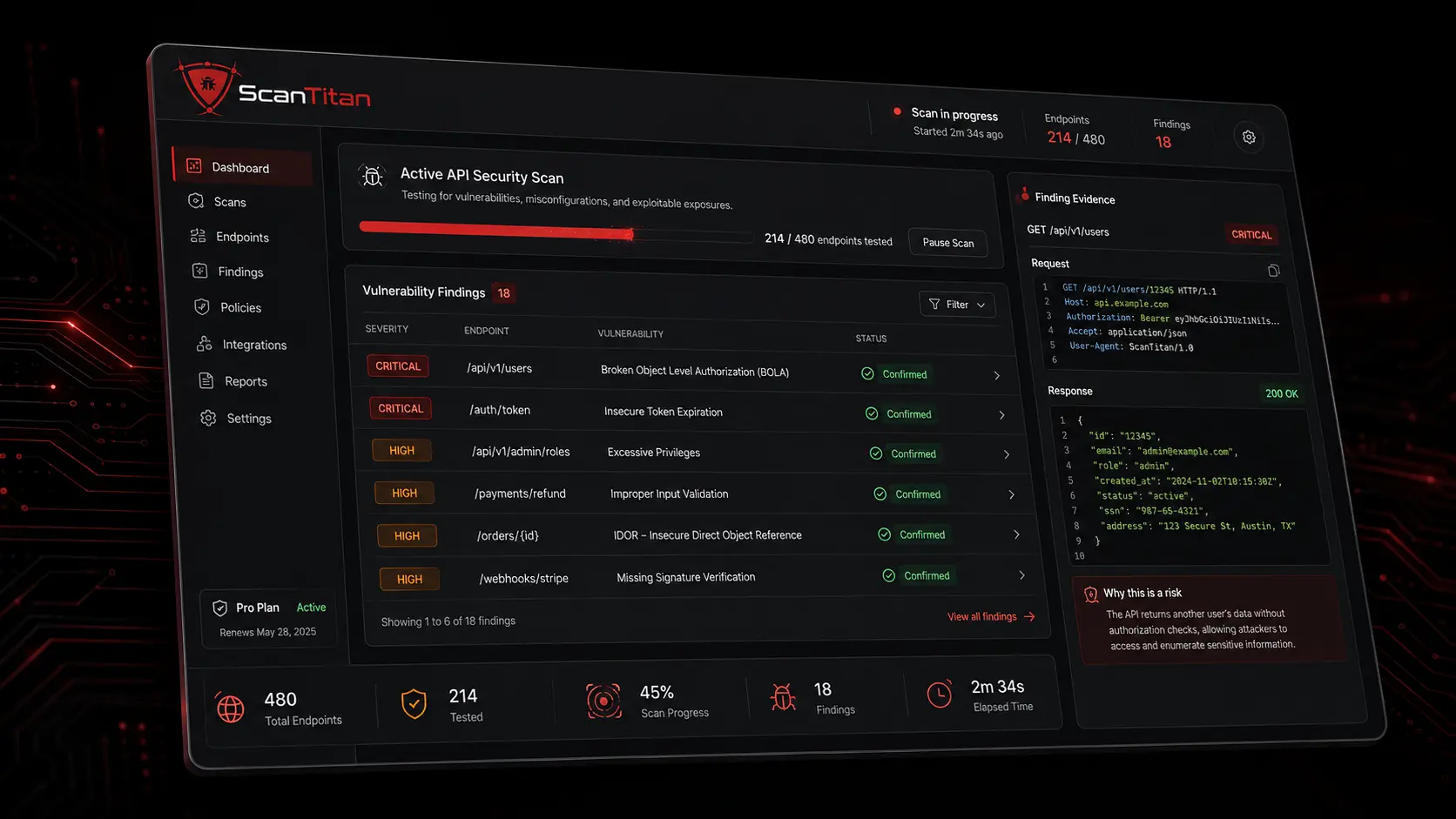
A fintech shipping a REST API imported its OpenAPI spec and, on the first authenticated scan, found a BOLA flaw on the /accounts/{id} endpoint that returned any user’s balance by changing the ID. Fixed and re-verified in a day, before any bug bounty report.
Most API vulnerabilities live behind the login. An unauthenticated scan sees only the front door, so ScanTitan carries the exact credentials your API expects into every request, a Bearer JWT, an API key, basic auth, or OAuth.
Authenticated scanning is also what makes authorization testing possible: to prove a BOLA flaw, the scanner needs one valid session requesting another user’s object. ScanTitan supports multiple credential sets so it can compare what one role can reach against another, the core mechanic of finding a missing authorization check.
All four styles, REST via OpenAPI or Swagger, a Postman Collection, GraphQL by schema introspection, and SOAP and gRPC, are covered from one scanner, so a mixed API estate does not need four different tools.
Finding an API flaw in production is expensive; finding it on the pull request is nearly free. ScanTitan runs in your CI/CD pipeline so API security testing happens while the code is still in front of the developer who wrote it.
Trigger a scan on every pull request, fail the build on new critical or high findings, and route each one to a ticket in Jira, GitHub, or GitLab with the request, response, and cURL recreation attached. A re-scan after the fix verifies closure.
Shift-left, This turns API security from a gate at the end into a check at every step, the only way a lean team keeps up with an API surface that changes on every deploy.
An API finding you cannot reproduce is a finding your developers will argue with. ScanTitan attaches the exact request and response that triggered each one, plus a cURL recreation, so anyone can reproduce it in seconds.
Every finding carries its OWASP API category and, where applicable, a CWE identifier and CVSS score, so it slots straight into your existing triage. Validated before it reports, not after. Proof-based, not probability-based.
The exact call that triggered the finding, with the response that confirmed it. Reproducible by any developer or auditor.
A ready-to-run command that reproduces the finding, so triage takes seconds instead of a back-and-forth.
Every finding classified by its OWASP API category and CWE with a CVSS score, ready for your existing workflow.
ScanTitan confirms exploitability first, so a lean team gets a short, real list instead of a wall of maybes.
Requests objects across user and ID boundaries to catch endpoints like /orders/1043 that return someone else's data without an ownership check. The number one cause of API breaches.
Tests whether protected endpoints enforce auth, whether JWTs are validated or accept a tampered signature, and whether tokens expire, using the credentials you provide.
Flags endpoints that return internal fields like password hashes or another user's data, and mass assignment where a client can set fields such as isAdmin. OWASP API3.
Attempts admin-only actions as a standard user to find the missing role check, the BFLA flaw (API5) that lets a normal account reach privileged functions.
Tests every documented parameter for SQL injection, OS command injection, code injection, XXE, and Server-Side Request Forgery where an endpoint fetches attacker-controlled URLs.
Checks security headers, CORS policy, verbose errors that leak stack traces, exposed backup files, and HTTP methods that should be disabled. OWASP API8.
Probes missing rate limiting and pagination controls (API4) that let an attacker scrape or overwhelm an endpoint, enabling abuse and denial of service.
Surfaces undocumented endpoints that exist in traffic but never made the spec (API9), like the forgotten v1 still live after v2 shipped. Pairs with ScanTitan attack surface management.
Emerging checks for prompt-injection and data-disclosure flaws in AI-integrated API endpoints, plus unsafe consumption of upstream third-party APIs (API10).
Requests objects across user and ID boundaries to catch endpoints like /orders/1043 that return someone else's data without an ownership check. The number one cause of API breaches.
Tests whether protected endpoints enforce auth, whether JWTs are validated or accept a tampered signature, and whether tokens expire, using the credentials you provide.
Flags endpoints that return internal fields like password hashes or another user's data, and mass assignment where a client can set fields such as isAdmin. OWASP API3.
Attempts admin-only actions as a standard user to find the missing role check, the BFLA flaw (API5) that lets a normal account reach privileged functions.
Tests every documented parameter for SQL injection, OS command injection, code injection, XXE, and Server-Side Request Forgery where an endpoint fetches attacker-controlled URLs.
Emerging checks for prompt-injection and data-disclosure flaws in AI-integrated API endpoints, plus unsafe consumption of upstream third-party APIs (API10).
Checks security headers, CORS policy, verbose errors that leak stack traces, exposed backup files, and HTTP methods that should be disabled. OWASP API8.
Probes missing rate limiting and pagination controls (API4) that let an attacker scrape or overwhelm an endpoint, enabling abuse and denial of service.
Surfaces undocumented endpoints that exist in traffic but never made the spec (API9), like the forgotten v1 still live after v2 shipped. Pairs with ScanTitan attack surface management.
| # | OWASP API Top 10 (2023) | What ScanTitan tests |
|---|---|---|
| API1 | Broken Object Level Authorization (BOLA) | Requests objects across user and ID boundaries to find records returned without an ownership check |
| API2 | Broken Authentication | Tests token handling, weak or missing auth, and JWT flaws on protected endpoints |
| API3 | Broken Object Property Level Authorization (BOPLA) | Checks for excessive data exposure and mass assignment on returned and accepted fields |
| API4 | Unrestricted Resource Consumption | Probes missing rate limiting and pagination controls that enable abuse and denial of service |
| API5 | Broken Function Level Authorization (BFLA) | Attempts privileged functions as a lower-privileged user to find missing role checks |
| API6 | Unrestricted Access to Sensitive Business Flows | Flags sensitive flows exposed without anti-automation controls |
| API7 | Server Side Request Forgery (SSRF) | Sends crafted URLs to find endpoints that fetch attacker-controlled resources |
| API8 | Security Misconfiguration | Checks headers, CORS, verbose errors, and exposed debug or backup artifacts |
| API9 | Improper Inventory Management | Surfaces undocumented and shadow endpoints that widen the attack surface |
| API10 | Unsafe Consumption of APIs | Reviews trust placed in third-party and upstream API responses |
Every tested endpoint with its method, parameters, and authentication status from the imported spec.
Each finding named with its OWASP API category, CWE, CVSS score, and confirmed status.
The exact call and response for every finding, plus a one-click cURL recreation.
Findings ordered by severity and real-world exploitability so remediation starts where it matters.
A specific fix per finding, followed by a re-scan that verifies closure.
Mapped to PCI DSS, SOC 2, ISO 27001, and HIPAA, formatted for auditors.
# Authenticated scan from an OpenAPI spec curl -X POST https://api.scantitan.com/v1/api-scans \ -H "Authorization: Bearer YOUR_API_KEY" \ -H "Content-Type: application/json" \ -d '{ "spec_url": "https://app.example.com/openapi.json", "auth": { "type": "bearer", "token": "$API_JWT" }, "notify": ["slack","jira"] }' # Response { "scan_id": "api_5c1e8b", "status": "queued", "endpoints": 48 }- name: ScanTitan API test uses: scantitan/api-scan-action@v2 with: spec: ./openapi.json auth_token: ${{ secrets.API_JWT }} fail_on: critical,highv2 & v3, JSON or YAML
Schema introspection
PR scans + gate
Pipeline testing
Import a Collection
Auto-create tickets
Finding alerts
Any tool via JSON
VNet + cloud misconfigs
Real outcomes from real scans.
The /accounts/{id} endpoint returned any user's balance by changing the ID, a classic BOLA flaw. Imported from the OpenAPI spec, it was fixed and re-verified in a day.
1
1day
0
A GraphQL mutation accepted a tampered JWT with the signature stripped. ScanTitan caught it on the pull request and failed the build before it reached production.
1
PR
0
A /users endpoint returned password_hash and internal fields the front end simply hid. ScanTitan flagged the BOPLA flaw with the exact response body as evidence.
1
33
2h
Three API styles across a dozen services meant three separate tools and gaps at the seams. ScanTitan tested all of them against the OWASP API Top 10 from one platform.
12
3-in-1
1
ScanTitan ships detection and coverage improvements on a rolling basis. This page is updated every 90 days.
July 2026
ScanTitan now runs early checks for prompt-injection and data-disclosure flaws in AI-integrated API endpoints, alongside unsafe consumption of upstream third-party APIs (OWASP API10).
May 2026
GraphQL scans now introspect the full schema to test individual queries and mutations, rather than treating the endpoint as a single opaque POST.
March 2026
Supply multiple credential sets and ScanTitan compares what one role can reach against another, the core mechanic for finding BOLA and BFLA authorization flaws.
January 2026
Every API finding now ships with a ready-to-run cURL command that reproduces it, so developers can validate in seconds instead of a back-and-forth.
| ScanTitan | StackHawk | Pentest-Tools | Intruder | Escape | |
|---|---|---|---|---|---|
| Spec import (OpenAPI, Postman) | ✓ | ✓ | ✓ | ✓ | ✓ |
| REST, GraphQL, SOAP, gRPC | ✓ | ✓ | Partial | Partial | ✓ |
| BOLA / BFLA authorization testing | ✓ | ✓ | Partial | Partial | ✓ |
| Authenticated scanning | ✓ | ✓ | ✓ | ✓ | ✓ |
| CI/CD shift-left testing | ✓ | ✓ | Partial | ✓ | ✓ |
| Proof evidence + cURL recreation | ✓ | ✓ | ✓ | Partial | ✓ |
| Web + network + CMS in one platform | ✓ | ✗ | ✓ | ✓ | ✗ |
| Entry point | Free scan | Free tier | 7-day trial | Paid tiers | Demo / quote |
An API vulnerability scanner is an automated tool that tests API endpoints for security weaknesses, focusing on the OWASP API Security Top 10: broken authorization (BOLA and BFLA), broken authentication, excessive data exposure, injection, SSRF, and misconfiguration. Instead of crawling a website, it reads your API specification, an OpenAPI, Swagger, or Postman file, to map every endpoint and parameter, then tests each one including endpoints behind authentication. Because API flaws are mostly about authorization logic rather than classic web payloads, it finds vulnerabilities a generic web scanner walks straight past.
Import your API specification into ScanTitan, an OpenAPI or Swagger file, a Postman Collection, or a GraphQL endpoint, so it maps every endpoint and parameter. Add the authentication your API expects, a Bearer JWT, an API key, or OAuth, so the scanner reaches protected endpoints. ScanTitan then tests each endpoint against the OWASP API Top 10, including BOLA and BFLA checks that require a valid session, and reports each finding with the request, response, and a cURL recreation. Run it on demand or in CI/CD on every pull request.
BOLA, Broken Object Level Authorization, is the number one API vulnerability on the OWASP API Security Top 10. It happens when an endpoint returns an object, such as /accounts/1043, without checking whether the requesting user actually owns it, so changing the ID in the URL returns someone else's data. It is the flaw behind many of the largest API breaches, including the Optus incident that exposed 11 million customer records. BOLA cannot be found by throwing payloads at a URL; it requires reasoning about who should reach which object, which ScanTitan does by requesting objects across user and ID boundaries with valid authentication.
A traditional website scanner starts at a URL and crawls by following links, so it discovers only what a browser renders. Your API endpoints, the ones your mobile app and single-page app call directly, usually are not linked from any page, so the crawler never finds them, and even when it does, it does not know what a valid request looks like. An API scanner reads your specification to map every documented endpoint, authenticates as a real user, and tests authorization logic, which is where most API breaches occur. The two are complementary, and ScanTitan runs both from one platform.
ScanTitan scans REST, GraphQL, SOAP, and gRPC APIs. For REST it imports OpenAPI or Swagger definitions (versions 2 and 3, in JSON or YAML) or a Postman Collection. For GraphQL it introspects the schema to test queries and mutations rather than treating the endpoint as a single opaque POST. Covering all four styles from one scanner matters because a modern estate rarely uses just one, and stitching together separate tools leaves gaps at the seams. Whichever style an endpoint uses, ScanTitan tests it against the same OWASP API Top 10 and reports findings in one place.
Yes. ScanTitan integrates with CI/CD tools like GitHub, GitLab, and Azure DevOps to test APIs on every pull request or merge, so a new or changed endpoint is scanned while the code is still in front of the developer. You can configure the build to fail on new critical or high findings, keeping known-vulnerable endpoints out of production, and route each finding to a ticket with the request, response, and cURL recreation attached. After the fix, a re-scan verifies closure. This shift-left approach catches API flaws at the cheapest possible moment.
Web application scanning tests the rendered app a browser sees, focusing on the OWASP Web Top 10: XSS, SQL injection, CSRF. API scanning tests the endpoints your clients call directly, focusing on the OWASP API Top 10, where the dominant risks are authorization flaws like BOLA and BFLA rather than classic injection. The methods differ too: web scanning crawls, API scanning reads a spec and authenticates per endpoint. You need both, because a modern app is a web front end and an API back end, and a flaw in either breaches the whole. ScanTitan covers both from one platform.
Yes. For GraphQL, ScanTitan introspects the schema and tests individual queries and mutations, including authorization on nested resolvers, rather than treating the single endpoint as opaque. For gRPC and SOAP it works from the service definition to reach each method. This matters because GraphQL in particular hides a lot of surface behind one URL, and a scanner that only sends a generic POST will miss almost all of it. Testing each operation against the OWASP API Top 10 is the only way to get real coverage of a modern, mixed API estate.
CISSP · GXPN · GCIH · GWAPT · CISA · CEH · EnCE · ISO 27001 Lead Auditor · COBIT 5 · 12+ years in information security · Author profile →