
ScanTitan is a website security scanner covering three layers of defence: vulnerability scanning that finds SQLi, XSS, and CVE-mapped weaknesses before attackers do; malware removal that cleans infections and removes Google blocklist flags; and external attack surface management that monitors every domain, subdomain, and cloud asset you own including the ones you forgot about. One dashboard. No dedicated SOC required.
ScanTitan is a website security company registered in the Netherlands and operated by an ISO 27001-certified security team. We built the platform for one specific gap: SMBs and mid-market companies face the same automated attackers as enterprises — scrapers probing internet-facing assets for unpatched CVEs around the clock — without an enterprise budget or a dedicated security hire to respond.
The platform covers three layers in one dashboard: vulnerability scanning (authenticated DAST with 15,000+ CVE-mapped checks across the OWASP Top 10), malware detection and removal handled end-to-end by our analysts, and external attack surface management that keeps a live inventory of every domain, subdomain, and cloud asset you expose. Teams across the US, EU, and Middle East use ScanTitan to pass PCI DSS, SOC 2 Type II, and NIS2 reviews without hiring a security department.
ISO 27001-Certified Team
Security operations run by certified practitioners, not a support queue.
Registered in the Netherlands
EU-based operations. GDPR-compliant handling with a DPA on request.
3-in-1 Platform
Vulnerability scanning, malware removal, and EASM — one vendor, one dashboard.
US · EU · Middle East
Serving SMB and mid-market teams across three regions, aligned to PCI DSS and NIS2.
A website security scanner checks a live site for the weaknesses attackers actually use: known CVEs, malware and injected code, missing security headers, weak SSL/TLS, outdated CMS and plugins, and server misconfigurations. ScanTitan runs these checks across three layers in one scan and confirms each finding with HTTP evidence.
SQL injection, XSS, and CVE-mapped flaws across the OWASP Top 10.
PHP backdoors, card skimmers, and obfuscated scripts.
Security headers
CSP, HSTS, X-Frame-Options, and Referrer-Policy gaps.
Whether Google or other authorities flag your domain.
Expired certificates, weak ciphers, and protocol issues.
Version detection mapped to known advisories.
Exposed files, readable backups, and directory listing.
Forgotten subdomains and public cloud assets, through EASM.
ScanTitan’s DAST engine signs in to your application and tests every endpoint, including admin panels, APIs and payment flows, for SQL injection, XSS, broken access control and known CVEs. Every finding ships with a CVSS score and HTTP evidence.
Unauthenticated scanners stop at your login page. Broken access control tops the OWASP Top 10, and it mostly shows up behind a login. An authenticated scan is how you find the flaws that matter most.
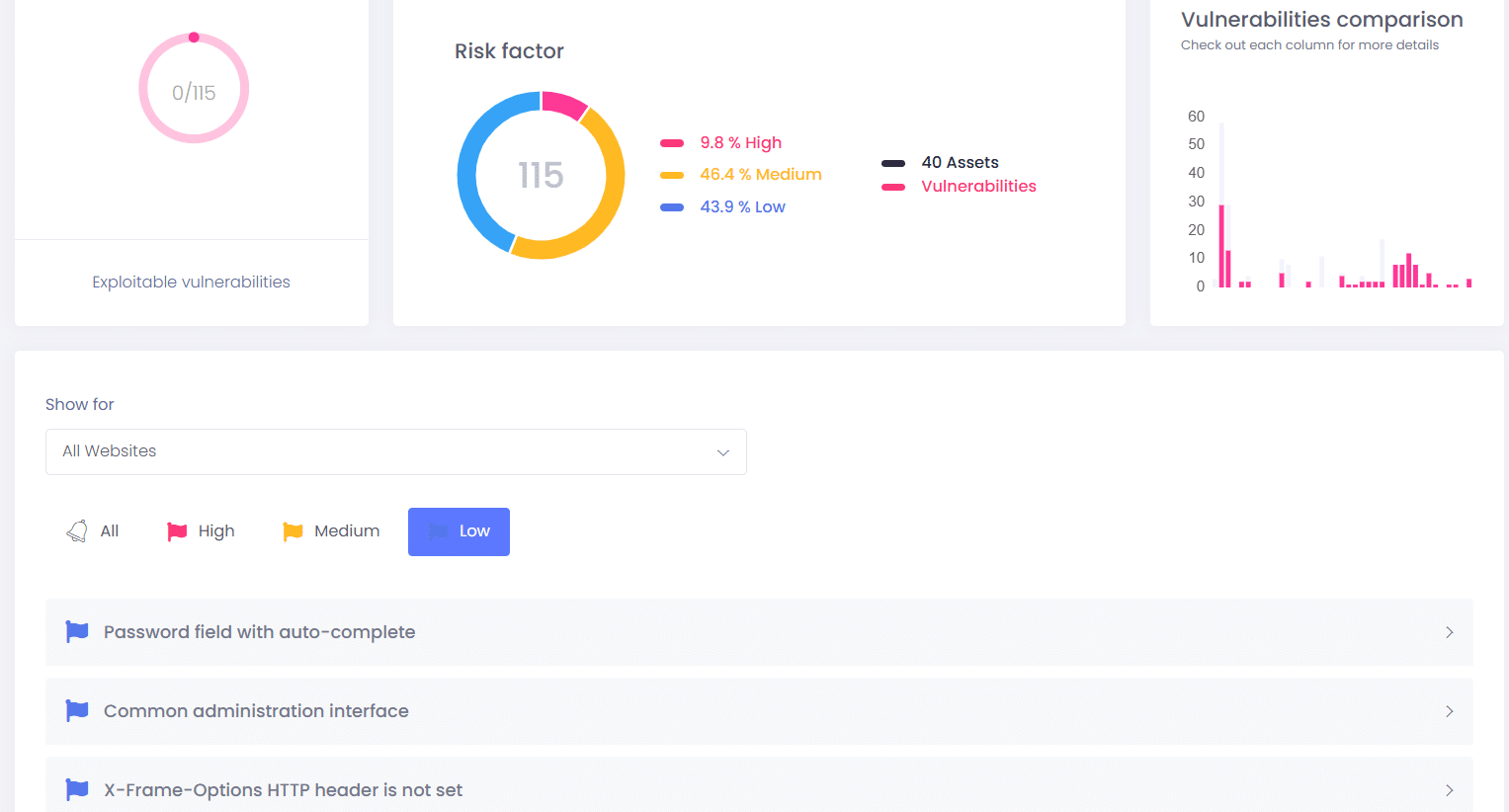
One online scanning engine covers your web app, your CMS and the infrastructure behind it, with one report and one set of CVSS, EPSS and CISA KEV priorities.
Tests React, Angular and Vue apps, including client-side routes.
See the scanner →Checks PHP version, end of life status and known CVEs, including PHP2Shell.
See the scanner →Tests REST and GraphQL APIs for broken access and injection.
See the scanner →Checks core, plugins and themes for known vulnerabilities.
See the scanner →Checks core and modules against Drupal security advisories.
See the scanner →Checks core, extensions and templates for known vulnerabilities.
See the scanner →Finds open ports and matches services to known CVEs.
See the scanner →Scans single IPs, ranges and CIDR blocks.
See the scanner →Finds public buckets, exposed endpoints and weak access policies.
See the scanner →
A PHP backdoor in your wp-content/uploads folder gives attackers persistent access regardless of how many times you change your password. A credit card skimmer in checkout.js harvests payment data invisibly for weeks. Your hosting provider won’t flag these — they require server-side file integrity analysis.
ScanTitan runs remote scanning and server-side file analysis simultaneously. When malware is found, our analysts handle the full cleanup — and most infections are resolved within 24 hours.
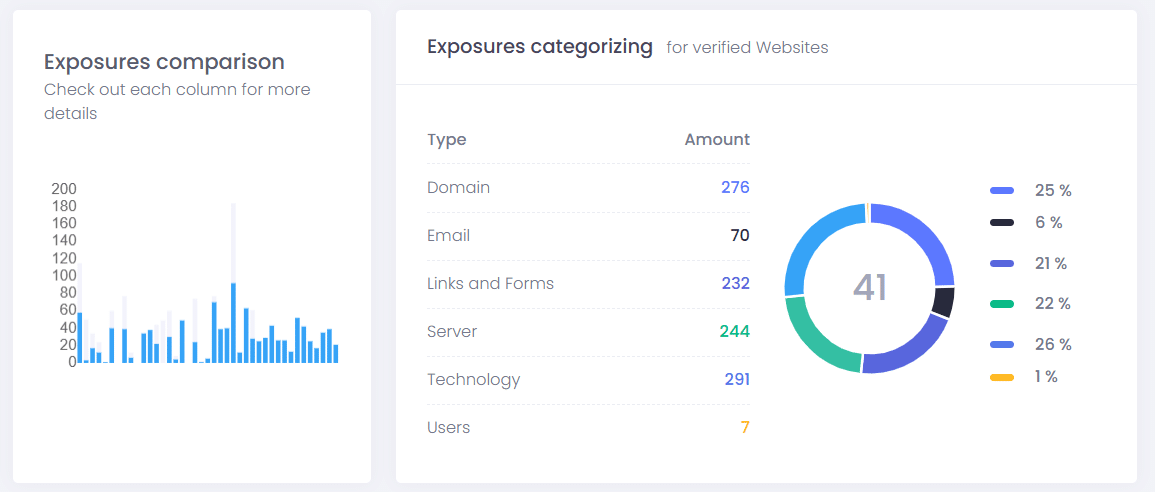
EASM (External Attack Surface Management) continuously discovers and monitors every internet-facing asset in your digital footprint — including the ones your IT team has no record of. Forgotten subdomains. Dev environments left running. S3 buckets with public read access. APIs that were “only used during testing.” Every unmonitored asset is a gap in your security posture.
Gartner, the NCSC, and NIS2 all recommend continuous external asset monitoring as a baseline control — not an enterprise luxury. ScanTitan makes it accessible for SMBs.
Compare
They overlap, and mixing them up leaves gaps. A vulnerability scanner finds weaknesses before an attacker gets in. A malware scanner finds what is already on the site. A website security scanner runs both, plus exposure checks, in one scan.
| Feature | Website security scanner | Vulnerability scanner | Malware scanner |
|---|---|---|---|
| Main question | Is my whole site exposed? | Where are my weaknesses? | Is my site infected? |
| When it helps | Before and after an attack | Before an attacker gets in | Once something malicious is on the site |
| Finds known vulnerabilities | ✓ Yes | ✓ Yes | Not its job |
| Finds malware and injected code | ✓ Yes | Not its job | ✓ Yes |
| Maps exposed assets | ✓ Yes | Not its job | Not its job |
| Best used for | One combined security view | Patching and application security | Cleanup and incident response |
How we compare
How ScanTitan's online scan compares with other website scanners. Based on each vendor's own product pages, checked on 20 October 2026. A dash means the page we checked does not list the feature.
| Feature | ScanTitan | Pentest-Tools | Sucuri SiteCheck |
|---|---|---|---|
| Free scan | ✓ Yes | ✓ Limited | ✓ Yes |
| Authenticated scanning | ✓ Yes | ✓ Deep scans | — |
| CMS scanners | ✓ WordPress, Drupal, Joomla | ✓ WordPress, Drupal | Outdated CMS only |
| Attack surface discovery | ✓ Yes | ✓ Yes | — |
| Malware detection | ✓ Yes | — | ✓ Remote only |
| Server-side file analysis | ✓ Yes | — | Paid platform only |
| Malware cleanup by analysts | ✓ Yes | — | Separate paid service |
Sources: Pentest-Tools Website Scanner page, Sucuri SiteCheck page and ScanTitan service pages. Vendors change their products, so check their sites for the latest.
Scan nowSOC 2 Type II audit in 90 days with zero current vulnerability scan results. No dedicated security staff. No prior scanning history to show auditors.
ScanTitan continuous scanning ran for the full 90-day audit window. 23 vulnerabilities identified and remediated before the audit date. Zero critical findings on audit day. SOC 2 Type II passed on first attempt. Auditors accepted the ScanTitan scan history as evidence of Requirement CC7.1 (vulnerability management).
Google Safe Browsing warning appeared on a Monday morning — 60% of organic search traffic gone overnight. Malware source unknown. Store processing AED 180,000/month in revenue.
ScanTitan server-side scan identified a JavaScript credit card skimmer in checkout.js and a PHP backdoor in wp-content/uploads/. Both removed within 6 hours of engagement. Site reinstated on Google Safe Browsing within 72 hours. WAF rules and file permission hardening deployed. Zero reinfection in 6 months of post-cleanup monitoring.
NIS2 Directive compliance review required a current asset inventory. IT manager believed the company had one website and two subdomains. EASM scan told a different story.
ScanTitan EASM scan discovered 4 unknown subdomains — two pointing at decommissioned AWS instances with public S3 buckets containing exported customer records. One subdomain was vulnerable to takeover via a dangling Heroku CNAME. All exposed assets were secured or deprovisioned within 1 week. Continuous monitoring now alerts the team within minutes of any new asset appearing.
If you don’t see your question here, our team can answer it directly — book a demo or reach out.
ScanTitan runs authenticated DAST scans covering the OWASP Top 10 and 15,000+ CVE-mapped checks — SQL injection, XSS, broken access control, and API vulnerabilities — alongside server-side malware detection and continuous external attack surface discovery across your domains, subdomains, and cloud assets.
Free scanners are almost always unauthenticated, which means they stop at your login page. Broken access control — the #1 risk on the OWASP Top 10 — only shows up once a scanner logs in and tests what an authenticated user can reach. ScanTitan scans authenticated by default.
Both. When our scan flags an infection — a PHP backdoor, a card skimmer, obfuscated code — our analysts handle the cleanup directly. Most infections are resolved within 24 hours, including Google Safe Browsing blocklist removal.
It's continuous discovery of every internet-facing asset your company owns — including the ones your team has lost track of, like an old staging subdomain or a public S3 bucket. Gartner and the NCSC treat this as a baseline security control, not an enterprise-only luxury.
Yes. ScanTitan's scan history and CVSS-prioritised reports are commonly accepted as evidence for PCI DSS Requirement 11.3, SOC 2 Type II (CC7.1), and NIS2 asset-inventory requirements. Several clients have used our reports directly with auditors.
No. ScanTitan is built for lean IT teams and founders without a dedicated security hire. Findings come with plain-language explanations and HTTP evidence, and our analysts handle malware cleanup end-to-end.
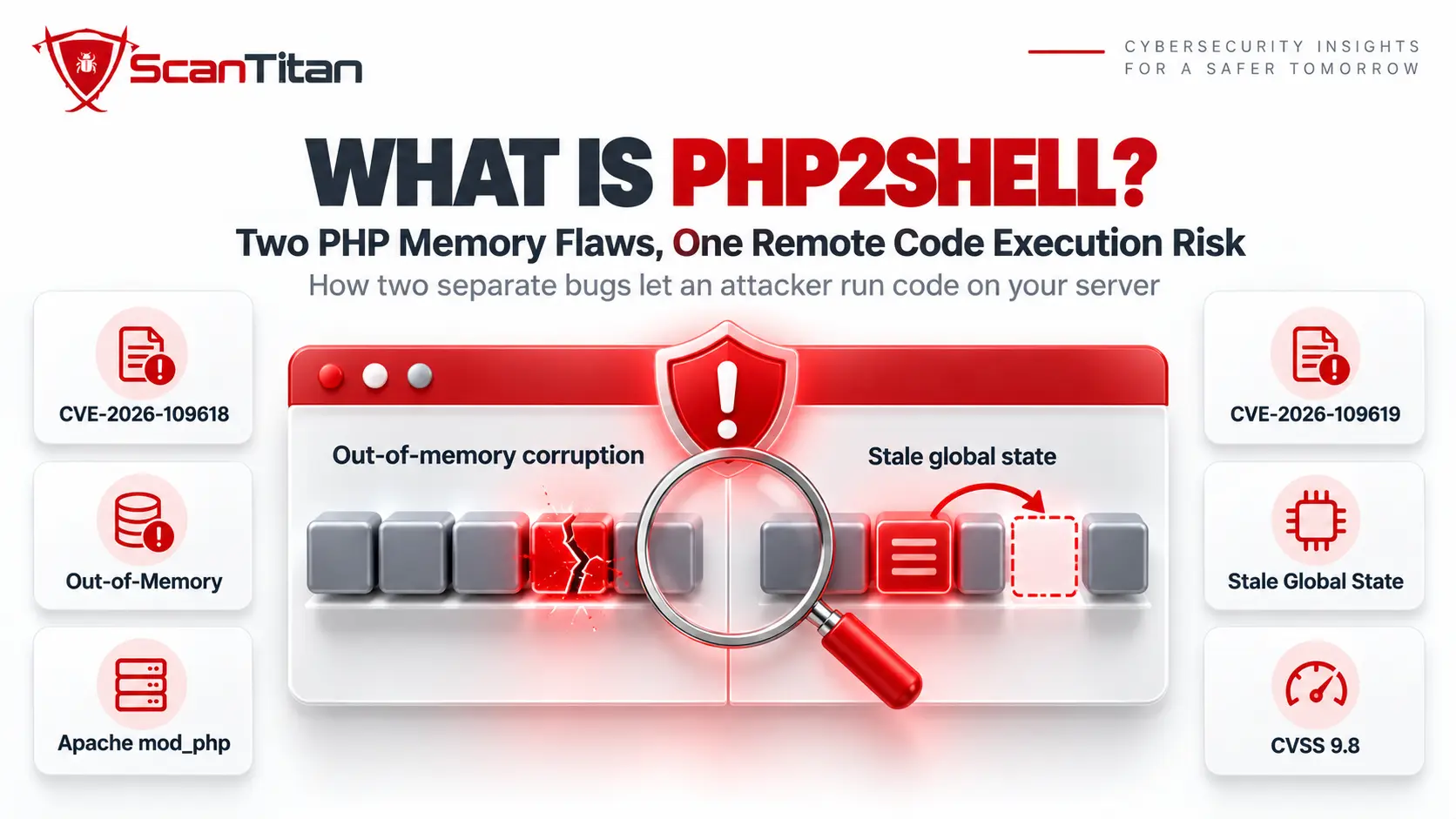
PHP2Shell is the name researchers gave to two critical PHP core flaws, CVE-2026-109618 and CVE-2026-109619, that let an unauthenticated attacker run code on a server through ordinary web requests. The
To find a backdoor in a website, run three passes: compare every file against a clean copy, search for code that behaves like a backdoor, and trace unusual requests in
How did my website get hacked? Almost always through one of nine entry points: a vulnerable plugin or theme, stolen credentials, a nulled theme, a compromised hosting account, vulnerable custom
Run a free website vulnerability scan in under a minute and see the findings that matter first. Enter your domain and get your most critical findings in minutes, with no credit card and nothing to install. The free scan runs real tests, not a teaser list.
OWASP Top 10 basics: Common injection, XSS, and access-control checks.
Exposed sensitive files: Readable .env, backups, and config in the web root.
SSL and TLS misconfigurations: Weak ciphers, expired certificates, protocol gaps.
Software and version detection: CMS, plugin, and library versions mapped to known CVEs.
Enter your domain: for the first result.
See prioritised findings: Each scored by CVSS with HTTP evidence attached.
Get the fix: A step-by-step remediation for every issue.
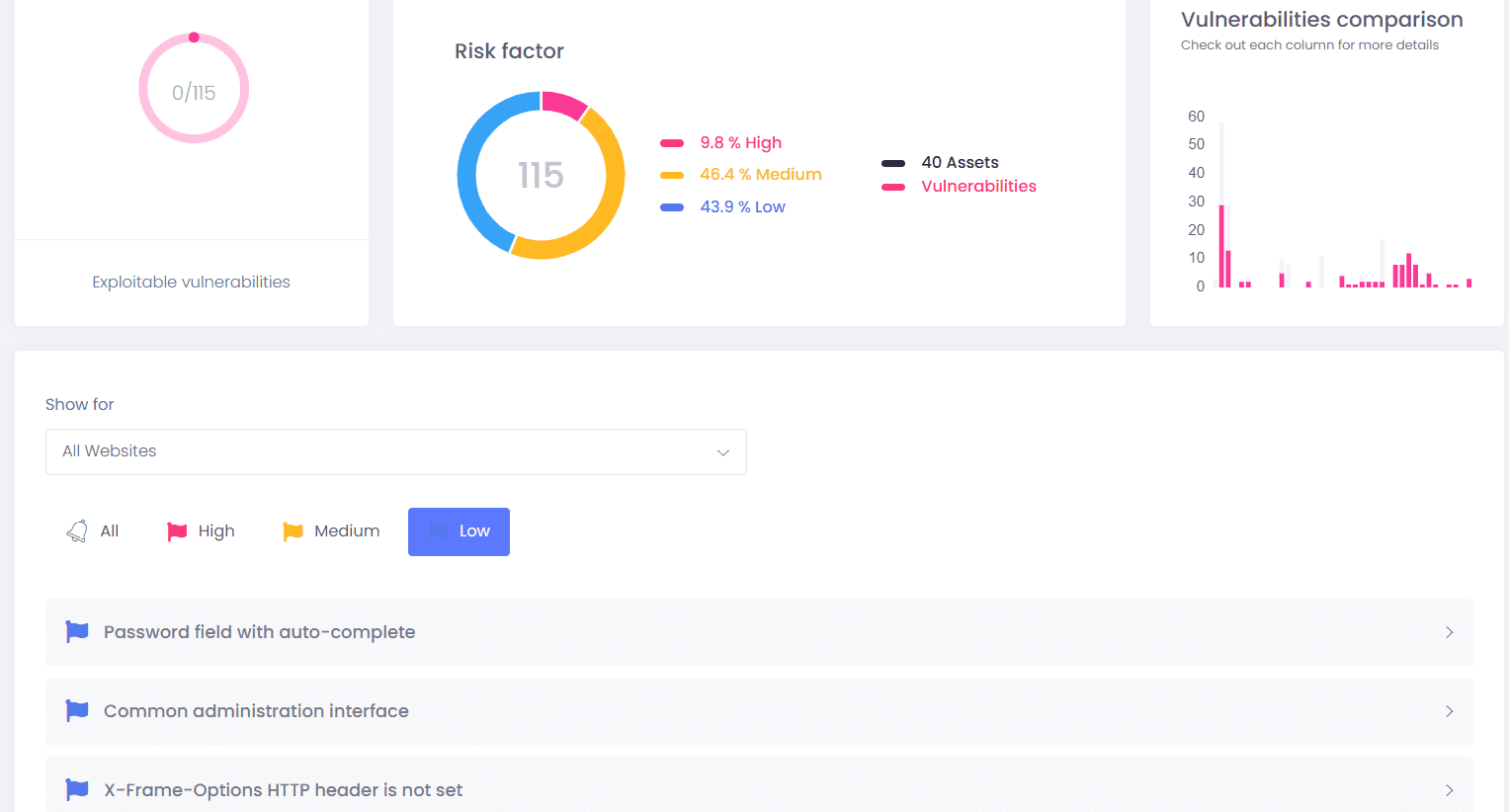
Your website is being probed right now. Not metaphorically — automated scanners run 24 hours a day targeting known CVEs, exposed admin panels, and misconfigured cloud assets. A free ScanTitan scan takes three minutes to set up and tells you exactly what’s exposed before an attacker finds it first. No credit card. No commitment. Just an honest report of what we find.
No credit card. No commitment. GDPR-compliant. Results in under 10 minutes.
CISSP · GXPN · GCIH · GWAPT · CISA · CEH · EnCE · ISO 27001 Lead Auditor · COBIT 5 · 12+ years in information security Author profile →