
For developers
DAST tests a running application from the outside, the way an attacker meets it. ScanTitan scans deployed websites and APIs so developers can find problems that source code analysis does not show, such as exposed endpoints, broken access control and risky configuration in a live environment. It does not read your source code, so it complements code scanners rather than replacing them.
Start with a free account: one website and one included website scan. API scanning and automation are on Business at $155 per asset place per year.
Create free accountSee what it testsStatic analysis (SAST) and dependency scanning read your source code. Dynamic application security testing (DAST) tests the deployed application. The two answer different questions, and a team usually needs both.
Reads source code and dependencies before deployment. ScanTitan does not do this.
Tests the running website or API from outside: what is reachable, what it returns, and whether access control and configuration hold up.
That makes DAST the right check after a deploy, on staging or production, when problems come from configuration, authentication and the way components work together rather than from a single line of code.
Active website assessments with testing depths and controls. Extended profiles are on Business and Consultant. See the website vulnerability scanner.
An isolated browser explores supported JavaScript navigation and dynamic requests. See the SPA security scanner.
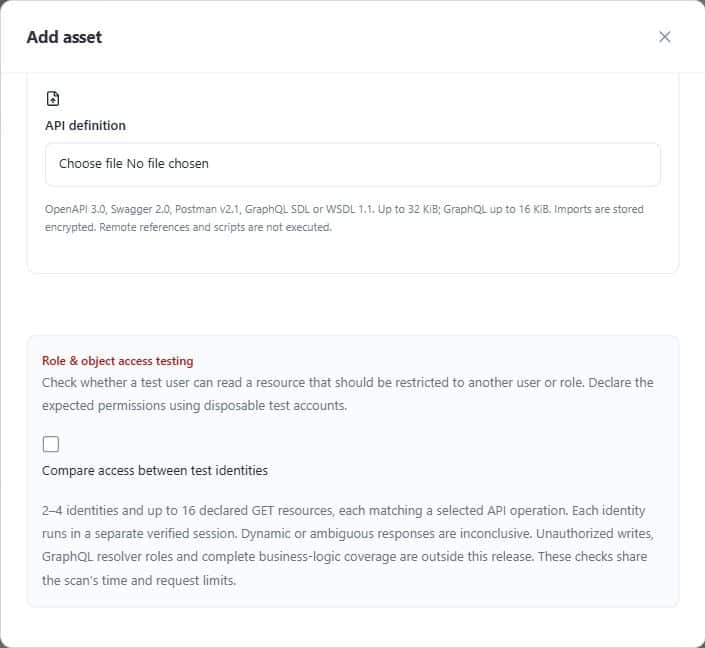
Import OpenAPI 3.0 or Swagger 2, resolved Postman v2.1, GraphQL query SDL or a self-contained WSDL 1.1 SOAP file, with Bearer, X API Key or HTTP Basic access. See the API vulnerability scanner.
Correlated callbacks help detect selected blind cases in eligible active website scans. See out of band testing.
There are no native GitHub, GitLab or Azure DevOps plugins. A CI step that calls the API is a custom integration you build.
Start with Free: one website and one included website scan. Business at $155 per asset place per year covers websites, public servers and Web APIs, with authenticated API tests, extended profiles, optional AI guided checks and the customer API. All paid plans are billed annually. See pricing.
A dynamic application security testing tool tests a running application from the outside. ScanTitan does this for websites and APIs.
No. It does not read source code. Use it alongside a code scanner.
OpenAPI 3.0 and Swagger 2, resolved Postman v2.1, GraphQL query SDL and self-contained WSDL 1.1 SOAP.
With Bearer, X API Key or HTTP Basic access.
There are no native pipeline plugins. The Business customer API and signed completion webhooks let you build your own integration.
No. gRPC, GraphQL mutations and subscriptions are not supported.
Extended testing can generate more traffic. Use scan budgets and scan only systems you own or are authorized to test.
Create a free account and run the included website scan, or choose Business to scan APIs and automate with the customer API.
Create free accountCompare plans