
What Is the Difference Between Agentless and Agent-Based Scanning?
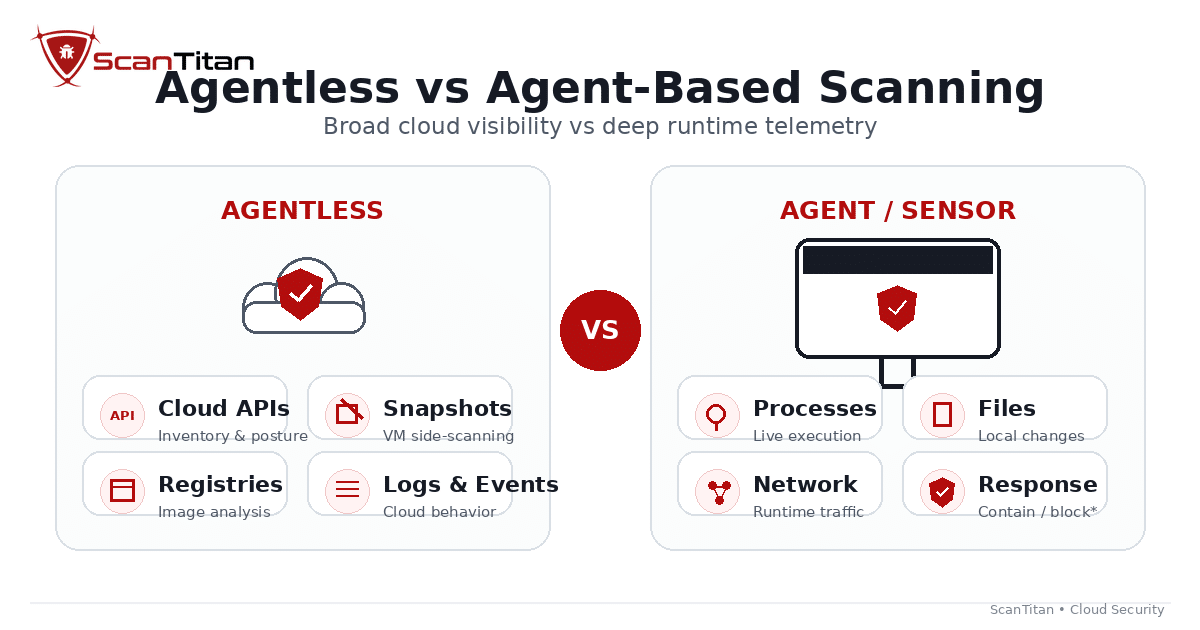
The difference is a deployment model, not a single feature. Agentless scanning assesses cloud resources without installing a persistent security sensor inside each workload. Depending on the technique, it may use cloud-provider APIs, disk or volume snapshots, registry access, configuration data, cloud logs, event streams, identity telemetry, or other cloud-native integrations. Agent- or sensor-based scanning, by contrast, deploys a resident or node-level component on the systems where deeper runtime visibility is required, so it can watch activity from the inside. The common property that makes something agentless is simple: no persistent security agent has to be installed inside every workload being assessed. That single distinction shapes coverage, depth, permissions, and cost, but it does not reduce to agentless-equals-shallow and agents-equal-deep. Both are families of techniques, and this comparison sits alongside the broader cloud security scan overview.
Agentless vs Agent Based Scanning: Side-by-Side Comparison
The table sums up how the two families differ across the criteria that matter when you choose. Treat any timing or coverage note as illustrative, since exact behavior depends on the platform and architecture.
| Criterion | Agentless scanning | Agent/sensor-based scanning |
|---|---|---|
| Deployment model | No persistent sensor required inside every workload | Sensor deployed on host, node, or supported workload |
| Common data sources | APIs, snapshots, registries, logs, events, metadata | Processes, files, local network, runtime/kernel telemetry depending on sensor |
| Onboarding | Usually centralized and faster for supported cloud scopes | Requires fleet or node deployment and lifecycle management |
| Coverage | Strong across cloud services and resources the integrations support | Limited to systems or nodes where the sensor is installed and healthy |
| Runtime visibility | Can use cloud, API, log, and event behavior but usually lacks deep in-guest visibility | Deep live in-workload telemetry |
| Detection cadence | Snapshot scans may be point-in-time; API, log, and event monitoring can be frequent or continuous | Can provide continuous local telemetry |
| Response | Assessment may be read-only; some platforms add separate cloud-native response actions | Some sensors can kill, quarantine, isolate, or block |
| In-guest overhead | Usually avoids persistent workload overhead; cloud, API, and snapshot operations still consume resources and cost | CPU, memory, storage, and network overhead on monitored systems |
| Ephemeral coverage | Depends on discovery cadence, onboarding, supported services, and integrations | Depends on sensor availability on the node or workload and bootstrap speed |
| Main blind spot | Deep kernel, process, memory, and file runtime detail without a sensor | Resources or services without a healthy sensor |
| Best suited for | Broad inventory, posture, managed services, vulnerability and configuration visibility | Deep runtime detection, investigation, and host response |
Which Resource Types Work Best with Each Approach?
Different resources favor different methods, and matching the method to the resource is more useful than picking a side. Neither column below is complete on its own.
| Resource type | Agentless / cloud-native | Agent / sensor-based |
|---|---|---|
| Virtual machine | Strong for inventory, snapshots, vulnerabilities, configuration | Strong for live process, file, network, runtime visibility |
| Container image | Excellent before runtime via registry scanning | Not applicable until the workload runs |
| Kubernetes node | Strong for cloud posture and configuration | Strong for deep node and runtime telemetry |
| Running container | Cloud and API context plus image data | Strong runtime visibility via node or container sensor |
| Serverless function | Strong for config, package, and API assessment | Traditional persistent host agent usually unavailable |
| Managed database | Strong for posture, IAM, network, configuration | Host agent usually unavailable to the customer |
| Object storage | Strong API, policy, and configuration assessment | Agent not applicable |
| IAM identities | Strong API and control-plane analysis | Host agent not applicable |
| SaaS or managed service | Strong where an API integration exists | Traditional host agent generally unavailable |
Does “Agentless” Always Mean the Same Thing?
No, and this is the most common misunderstanding. Agentless is an umbrella term that can describe several very different techniques: cloud API and posture scanning, snapshot or side-scanning, registry and image scanning, cloud log and event-based monitoring, control-plane threat detection, and in some contexts remote or credentialed scanning. Each collects different data and offers different depth. Cloud API scanning reads configuration; snapshot scanning inspects disk contents; log analysis watches cloud behavior. Two products can both call themselves agentless while collecting very different data and providing very different visibility. So when you compare tools, the useful question is not whether a product is agentless, but which agentless techniques it uses, what data each one reads, and how deep that data goes. Treating agentless as one fixed capability is how buyers end up surprised by a coverage gap they assumed was handled.
How Does Agentless Scanning Work?
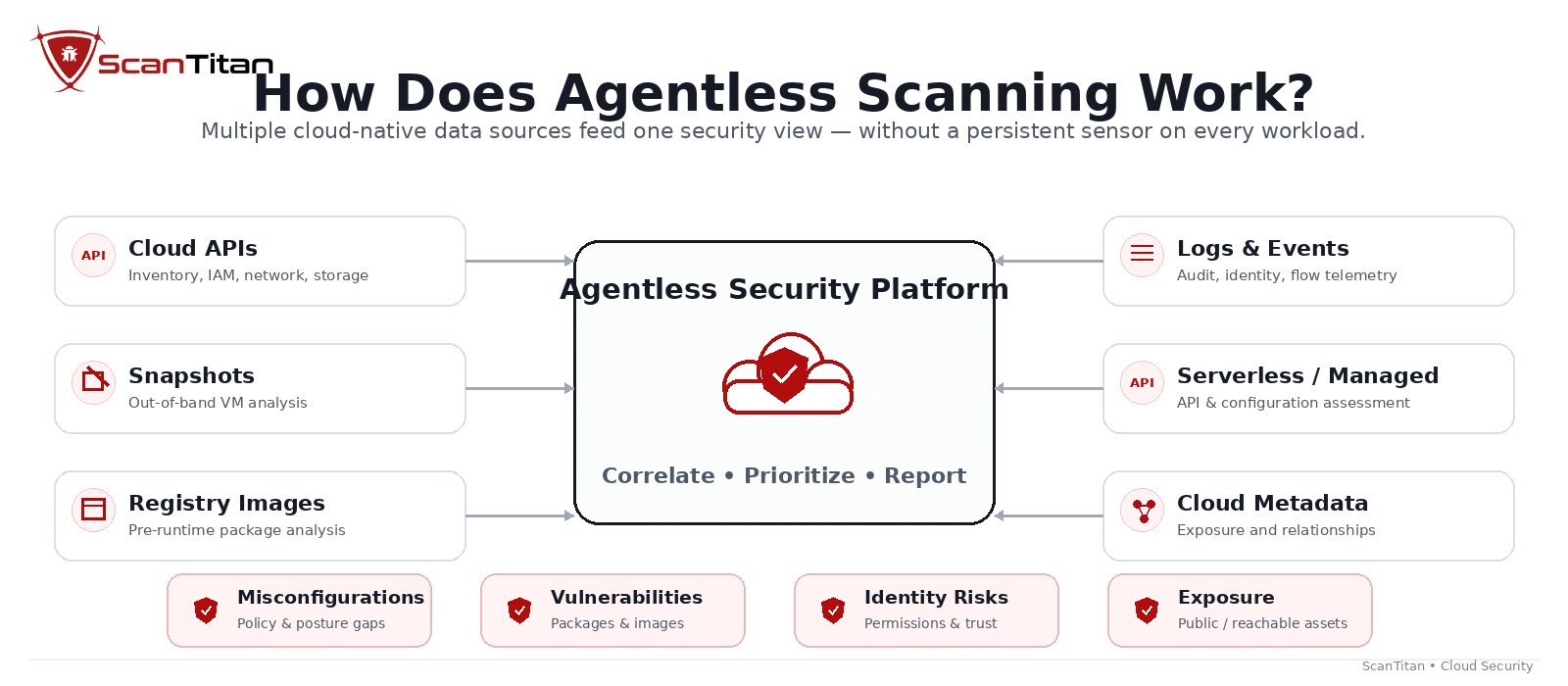
Agentless is not one mechanism but several, often combined in one platform. These are the main techniques.
Cloud API and Configuration Assessment
The most familiar agentless technique reads directly from the cloud control plane. Using provider APIs, the tool pulls asset inventory, identity and access management (IAM) policies, network rules, storage policies, managed-service settings, and resource metadata, then compares them against secure baselines and known-issue data. This is the backbone of cloud posture and configuration checking, and it is how a scanner finds a public storage bucket, an over-permissive role, or an open security group without touching a workload. Provider-native services such as Amazon Inspector also offer agentless assessment paths for supported resources. Because it reads what the provider already records, this technique covers many accounts and regions from one integration and extends naturally to managed services with no host to install anything on.
Snapshot or Side-Scanning
A second technique inspects the contents of a workload without logging into it. The platform creates or accesses a snapshot of a virtual machine disk or volume, then analyzes that copy out-of-band for installed packages, vulnerabilities, files, secrets, and configuration artifacts. Because the analysis runs on a copy rather than the live system, it avoids installing anything on the workload and avoids competing for its resources. This technique needs more than simple read permissions: creating and reading snapshots requires narrowly scoped rights, and analyzing encrypted disks may require access to the relevant key-management keys, depending on the architecture. Snapshot analysis is powerful for depth of inspection, though any single snapshot is a point-in-time view of that disk.
Registry and Image Scanning
Containers are best assessed before they ever run, and registry scanning does exactly that. Agentless tools analyze container images directly in registries such as Amazon Elastic Container Registry (ECR), Azure Container Registry, and Google Artifact Registry, inspecting layers and packages for known vulnerabilities and, in many cases, embedded secrets and misconfigurations. Catching a vulnerable base image in the registry means it can be fixed before deployment rather than found in production, which is why this pairs naturally with continuous-integration pipelines. It is a build-time and pre-deployment control. What it does not do, on its own, is tell you what a container does once it is running, which is a separate question that runtime techniques address.
Cloud Log and Event Analysis
Agentless security is not limited to static configuration. It can also consume control-plane audit logs, identity events, network flow logs such as VPC Flow Logs, and provider-native threat or event findings, then analyze them for suspicious activity. This is the technique that pushes back on the idea that agentless is always point-in-time, because log and event streams can be monitored frequently or continuously. It supports detection of unusual API behavior, risky control-plane changes, suspicious identity activity, and network anomalies. What this analysis sees is cloud-level behavior rather than the inside of a workload. It is a genuinely behavioral signal, but it operates at the control-plane and network layer, not at the process or memory level.
Serverless and Managed Services
Some resources cannot host a traditional agent at all, and this is where cloud-native techniques are not just convenient but necessary. Managed databases, object storage, serverless functions, and other provider-managed services do not give customers a host to install software on, so agentless assessment through APIs, configuration analysis, and package inspection is often the only practical option. For a serverless function, that means checking its code package for vulnerable dependencies, its IAM permissions for least privilege, and its triggers for unsafe exposure. The breadth of managed services in a modern cloud estate is a large part of why agentless coverage matters: it reaches parts of the environment an agent-based model structurally cannot.
Taken together, these techniques show that “agentless” describes the deployment model, not one single scanning mechanism.
What Permissions Does Agentless Scanning Require?
How much access agentless scanning needs depends on the technique, which is why read-only describes one mode rather than defining agentless as a whole.
- Grant read and list access for configuration and posture assessment. Inventory APIs, security-posture APIs, and get or list permissions are usually enough to evaluate configuration, identity, and network settings.
- Scope snapshot permissions narrowly for side-scanning. Creating, copying, reading, and deleting snapshots requires specific rights, and analyzing encrypted volumes may require access to the relevant key-management keys, often within a dedicated security account or project.
- Provide registry access for image scanning. This typically means access to image metadata, manifests, and layer or package contents in the registry.
- Allow read or subscribe access for log and event analysis. Consuming audit logs, event streams, flow logs, and identity telemetry requires read or subscription rights to those sources.
- Separate any response permissions explicitly. If a platform can take remediation or containment actions, those permissions should be distinct from assessment, narrowly scoped, and auditable, never bundled into a broad role.
Granting the least privilege each technique needs, and no more, keeps an agentless integration from becoming its own risk.
How Does Agent-Based Scanning Work?
Agent- or sensor-based scanning places a component on the systems where deeper runtime visibility is required, and the form it takes varies. On a virtual machine, it may be a traditional endpoint or host agent installed in the operating system. In Kubernetes, it is often a node-level sensor deployed through a DaemonSet, which places one sensor per node rather than an agent inside every application container. Once running, a sensor can observe processes, file changes, and network connections, and in some implementations kernel or system-call events, streaming that telemetry to a central platform. Capabilities differ: a lightweight eBPF sensor and a full traditional agent are not the same thing, and only some sensors can take enforcement actions such as blocking or isolating a workload. The defining trait is a resident component collecting in-guest telemetry the cloud control plane cannot see.
What Are the Main Types of Cloud Scanning Methods?
Agentless and agent-based are two families, and each contains distinct methods worth naming. Most platforms blend several.
- Query cloud APIs (API-based scanning). The scanner reads configuration, inventory, and metadata from the control plane, which is the backbone of agentless posture and vulnerability assessment.
- Snapshot the disk (snapshot-based or side-scanning). The tool copies a VM disk or volume and analyzes it out-of-band for packages, vulnerabilities, and secrets, without logging into the machine.
- Analyze images in registries. Agentless tools inspect container images in ECR, Azure Container Registry, or Google Artifact Registry before they run, catching vulnerable layers early.
- Read cloud logs and events (log and event analysis). Tools examine control-plane logs, identity events, and flow-log metadata to detect cloud-level behavioral anomalies.
- Install a traditional host agent (agent-based). A resident agent monitors processes, files, and network activity and, in some cases, can enforce actions on the host.
- Deploy a node or eBPF sensor. A node-level or eBPF sensor gives runtime visibility into workloads, often with lower overhead than a full traditional agent, though the impact varies by implementation.
- Watch running behavior (runtime scanning). Through a sensor, runtime scanning can detect live activity such as unexpected processes, privilege escalation, or crypto-mining on the workload itself.
What Does Each Approach See and Miss?
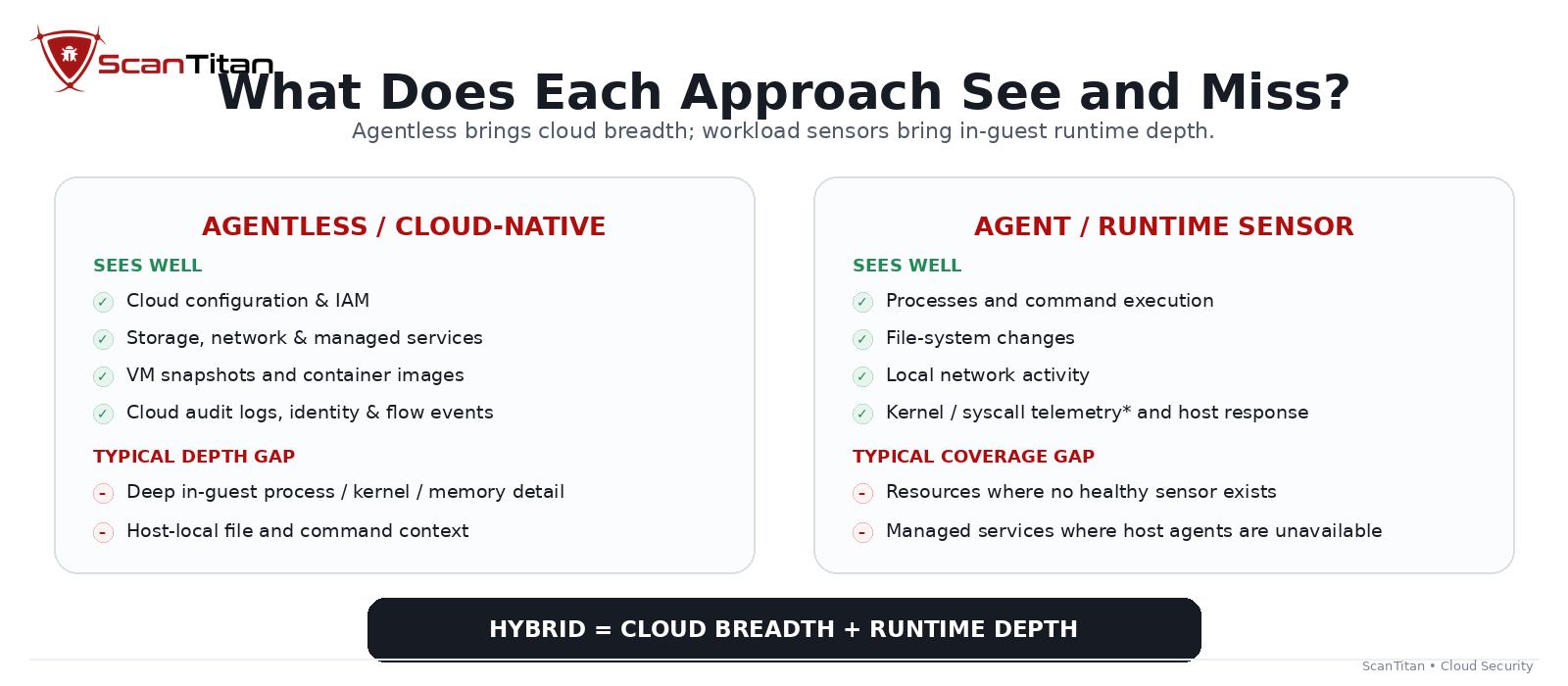
Neither approach is complete on its own, and the honest way to compare them is by their blind spots, not just their strengths.
Neither approach tests the application from the attacker’s position. That remains the job of a website security scanner operating from outside the environment.
What Agentless Scanning Sees and Misses?
Agentless scanning is strongest at breadth. Depending on the techniques enabled, it can see configuration, inventory, identities, vulnerabilities from snapshots and registries, network settings, and cloud-level behavior from logs and events, which makes it effective at finding common cloud misconfigurations, exposed resources, and risky IAM across many accounts. What it generally does not provide, without a workload sensor, is deep in-guest visibility into live processes, memory, and system calls. Snapshot analysis is also point-in-time, so a short-lived event between snapshots can pass unseen, though log and event analysis can narrow that gap at the cloud layer. The tradeoff is broad reach and low workload friction in exchange for deep in-guest runtime detail.
What Agent-Based Scanning Sees and Misses?
Agent- or sensor-based scanning is strongest at depth on the systems that carry a healthy sensor. It can watch process trees, file changes, and network connections as they happen, and depending on the sensor, kernel or system-call events, which is what surfaces malware behavior, privilege escalation, lateral movement, and crypto-mining at the workload level. Some sensors can also act, blocking a process or isolating a host. Its blind spot is anything without a working sensor: hosts where deployment failed, systems outside the build pipeline, managed services that cannot host one, and short-lived resources that vanish before a sensor is in place. A sensor may continue buffering local telemetry if central connectivity drops, though reporting, correlation, policy updates, and some response actions can require connectivity to the management platform.
If you are choosing between the two, see our vulnerability scanners compared by asset type, from large fleets to small web teams.
Can Agentless Scanning Detect Runtime Threats?
Partly, and this is where the simple agentless-equals-no-detection story breaks down. Agentless and cloud-native techniques can analyze runtime-relevant signals from the cloud itself: control-plane and API activity, cloud identity events, network flow telemetry, managed-service logs, cloud-resource events, and provider-native threat findings. From these, they can detect suspicious identity activity, unusual API behavior, risky control-plane changes, network anomalies, and cloud-resource abuse such as sudden cryptomining-style usage, often on a frequent or continuous basis. What these signals do not provide, without a workload sensor, is the same depth of in-guest visibility: live process trees, file-system activity, system calls, and memory inspection on the host. So the accurate framing is not agentless versus runtime detection, but two layers of runtime insight: cloud-level behavioral signals that agentless methods can see, and in-guest workload behavior that generally requires a sensor. Serious programs use both.
How Do They Compare on Performance and Overhead?
Performance is where the two approaches differ most in daily operation, though the details are implementation-specific. Agentless assessment usually avoids persistent in-guest CPU and memory overhead, because analysis runs against APIs, snapshots, and logs rather than inside the workload. It is not free, though: API calls, snapshot creation and storage, registry access, data transfer, and the analysis itself can carry cloud-side operational and cost implications, especially at scale. Agent or sensor overhead, by contrast, depends on the implementation, the volume of telemetry collected, the workload type, and the features enabled. An eBPF-based sensor can reduce overhead compared with some traditional user-space monitoring approaches, but the actual impact is implementation-specific and should be measured on representative workloads rather than assumed. The honest summary is that neither approach is truly overhead-free; they simply spend the cost in different places.
How Do They Handle Ephemeral and Containerized Workloads?
Cloud environments change fast: auto-scaling groups add instances, containers live briefly, and serverless functions run and disappear. Agentless discovery is generally well suited to this because centralized API, event, and registry integrations can discover supported resources without waiting for a host agent to install. Coverage is not instantaneous or universal, though: it depends on account onboarding, permissions, supported resource types, event integrations, and discovery cadence. For containers, registry scanning can assess images before deployment. For Kubernetes, node-level runtime sensors can add deeper telemetry to running workloads. For serverless, cloud-native, API, and package analysis is often the practical option because a traditional persistent host agent is generally unavailable inside managed serverless infrastructure. The realistic goal is broad agentless coverage of the fast-changing majority, with sensors added where running workloads justify deeper runtime inspection.
How Do You Verify Agentless and Agent Coverage?
Enabling a tool is not the same as being covered, and the gap between the two is where real exposure hides. Coverage should be measured, not assumed.
- Verify agentless coverage. Confirm that all required accounts, subscriptions, and projects are onboarded, that permissions are healthy, that expected regions are covered, and that supported resource types are actually being discovered; then check scan and event freshness, snapshot-job success, registry connection health, encryption and key-management access, and that log and event streams are flowing.
- Verify sensor coverage. Confirm the installation percentage and the healthy-sensor percentage, not just that a rollout happened; then check version and update status, last check-in times, failed or disabled sensors, Kubernetes node coverage, autoscaling bootstrap behavior, unsupported operating systems, and any intentionally excluded workloads.
- Keep the evidence. A coverage dashboard, a missing-resource report, a stale-sensor report, a list of failed scan jobs, and documented onboarding exceptions turn a vague belief that you are covered into something you can actually show.
A gap you have not measured is a gap you are trusting to luck.
Which Approach Produces Fewer False Positives?
False positives decide whether a team trusts its tools or drowns in noise, and the two approaches reduce them differently. Agentless methods reduce noise with context: exposure, identity, configuration, and attack-path relationships help prioritize static findings, so an internet-facing database with admin access stands out from an isolated dev box carrying the same vulnerability. That context helps ranking, but it does not by itself prove a finding is exploitable. Runtime sensors reduce noise from another angle: depending on the sensor and the telemetry it collects, they may provide evidence that a process executed, a library was loaded, or suspicious behavior actually occurred, which moves a finding from theoretical toward observed. Neither eliminates false positives. The strongest signal usually comes from combining agentless exposure context with runtime evidence, so each helps qualify what the other reports.
How Do the Costs Compare?
Cost is easy to overlook and easy to underestimate, and the two models spend money in different places. Agentless costs are mostly cloud-side: API calls, snapshot creation, temporary storage for those snapshots, data transfer, and the analysis the platform runs on its own infrastructure. These scale with the size of your estate but avoid per-host software and heavy operations. Agent-based scanning carries a different bill: agent licensing per host, the engineering time to deploy and maintain sensors across the fleet, and the data-ingestion cost of streaming detailed telemetry into a central console or SIEM, which can grow quickly at scale. Neither is automatically cheaper, and the answer depends on how many hosts you run, how much telemetry you retain, and how much engineering time you can spend on sensor operations. A hybrid keeps sensor costs contained by placing them only where their depth is worth paying for.
How Do They Support Compliance and Audit?
Compliance can pull you toward one approach or both. Agentless posture and vulnerability scanning can contribute valuable technical evidence for audits and assurance programs, particularly for configuration, inventory, vulnerability-management, and cloud-control checks. Whether that evidence satisfies a specific requirement depends on the framework, the assessment scope, the testing method, and the assessor’s expectations. PCI DSS has explicit internal and external vulnerability-scanning requirements for applicable environments, and external PCI DSS scans may need to be performed by a PCI SSC Approved Scanning Vendor (ASV) depending on the requirement and scope; a cloud scan report by itself does not establish PCI DSS compliance. Similarly, scan evidence can support technical controls, but a SOC 2 examination or an ISO 27001 audit evaluates a broader control environment than scanning alone. This is why scanning feeds a cloud security audit rather than replacing it.
Where Do Agentless and Agent-Based Fit: CSPM, CIEM, CWPP, and CNAPP?
These methods map onto the platform categories in the market, but the mapping is not a rigid equation. Cloud Security Posture Management (CSPM), which checks configuration and posture, and Cloud Infrastructure Entitlement Management (CIEM), which analyzes identity and entitlement risk, commonly rely heavily on cloud APIs and control-plane data. A Cloud Workload Protection Platform (CWPP) focuses on protecting workloads and may combine agentless vulnerability visibility with host, node, container, or eBPF runtime sensors. A Cloud-Native Application Protection Platform (CNAPP) is the broader integrated platform, and modern CNAPPs increasingly combine agentless and sensor-based approaches rather than sitting strictly on one side. The practical takeaway is that deployment method varies by vendor and capability, so it is more useful to ask what data a tool collects and how deep it goes than to assume a category implies agentless or agent-based.
When Should You Use Agentless, Agents, or Both?
There is no universal winner, only the right mix for your environment.
- Choose agentless or cloud-native methods when you need fast centralized inventory, broad multi-account visibility, posture, IAM, and configuration coverage, snapshot or registry vulnerability scanning, coverage of many managed services, or assessment of resources where an agent cannot be installed, including ephemeral fleets.
- Add sensors when you need in-guest process, kernel, or file runtime telemetry, endpoint or container forensics, host-level threat prevention, detailed investigation evidence, or endpoint and runtime controls required by policy, especially on highly sensitive workloads.
- Combine the two when both broad cloud coverage and deep runtime visibility are genuinely needed. Hybrid is often appropriate when the operational cost is justified by the workloads and risks, rather than as a default for its own sake.
Some platforms began agentless-first while others grew from endpoint and runtime sensors, but many now provide both cloud-native agentless visibility and optional runtime sensors, so evaluate current capabilities rather than assume a fixed category.
How Do You Migrate to a Hybrid Scanning Model?
If you are moving from an agent-heavy setup, or from limited visibility, do it in phases rather than all at once.
- Baseline current coverage so you know what you actually see today.
- Identify unmanaged accounts and resources that nothing is currently assessing.
- Measure existing sensor health, including failed, stale, and missing sensors.
- Connect agentless integrations to build an inventory of supported resources across all connected cloud scopes.
- Deploy sensors only to the workloads that require deep runtime visibility.
- Normalize severity and ownership so findings from both models are comparable and actionable.
- Test duplicate findings and correlation so the two approaches reinforce each other rather than double-count.
- Retire redundant agents only after replacement coverage is verified, never simply because agentless coverage now exists.
Agentless discovery often surfaces systems that were never protected, which is usually the fastest security win of the transition. The goal is not all agents or no agents, but the smallest, cleanest set of tools that covers your real risks.
How Do You Combine Them in a Hybrid Model?
A hybrid model follows the logic of defense-in-depth: layer techniques so one covers what another misses. A common pattern is to run agentless assessment across your cloud accounts for broad inventory, posture, and vulnerability coverage, then add runtime sensors on the narrower set of workloads, such as production databases, payment systems, or regulated data stores, that genuinely justify deeper inspection. For a small team, the goal is not the most tools but the fewest that cover the real risks. Between assessments, pair this with continuous vulnerability scanning so new exposure surfaces quickly. ScanTitan’s Cloud Vulnerability Scanner is designed to assess supported AWS, Azure, and Google Cloud resources through cloud-native integrations, surfacing supported vulnerabilities, misconfigurations, exposed resources, and identity risks with contextual evidence and remediation guidance where available.
Frequently Asked Questions
What is the main difference between agentless and agent-based scanning?
It is a deployment model. Agentless scanning assesses cloud resources without installing a persistent security sensor inside each workload, using techniques such as APIs, snapshots, registries, and logs. Agent-based scanning deploys a resident or node-level sensor on the systems that need deep in-guest runtime visibility. Agentless favors breadth; sensors add workload-level depth.
Is agentless scanning better than agent-based scanning?
Neither is universally better. Agentless is stronger for discovery, posture, configuration, managed services, and vulnerability visibility, while sensors are stronger for deep in-guest runtime detection, forensics, and host response. Most mature programs use agentless for breadth and sensors for depth on the workloads that need it.
Does agentless scanning miss runtime threats?
Agentless techniques can detect some runtime-relevant behavior from cloud logs, API events, identity telemetry, and network-flow data, but they generally do not provide the same in-guest process, kernel, file, syscall, or memory visibility as a workload sensor. The two work as layers rather than substitutes.
Can agentless scanning cover containers and serverless functions?
Agentless methods can scan container images in registries and assess serverless configuration, packages, permissions, and cloud-service exposure through supported integrations. Deep runtime visibility in running containers generally requires a node or workload runtime sensor, and traditional persistent host agents are usually not available inside managed serverless infrastructure.
Do you need both agentless and agent-based scanning?
It depends on the environment. Broad cloud posture and managed-service coverage may be handled agentlessly, while high-value workloads may justify runtime sensors. A hybrid is common where both breadth and deep runtime protection are required.
What is snapshot-based or side-scanning?
Snapshot or side-scanning is one agentless technique, not the definition of all agentless scanning. It copies a virtual machine disk or volume and analyzes that copy out-of-band for vulnerabilities, misconfigurations, and secrets, without installing an agent, at the cost of being point-in-time for that disk.
Does agentless mean read-only?
No. Many posture checks use read-oriented API permissions, but snapshot creation, encrypted-volume analysis, registry access, or automated response may require additional narrowly scoped permissions. Read-only describes one mode of agentless scanning, not the whole category.
Reviewed by Obaida Al-Sulaiman, Information Security Manager, ScanTitan. CISSP, GXPN, GCIH, GWAPT, CISA, CEH, ISO 27001 Lead Auditor. Obaida leads offensive and defensive security assessments across ScanTitan’s vulnerability scanning, malware, and attack surface work.