
Can Vulnerability Scanning Ensure NIS2 Compliance? The Short Answer
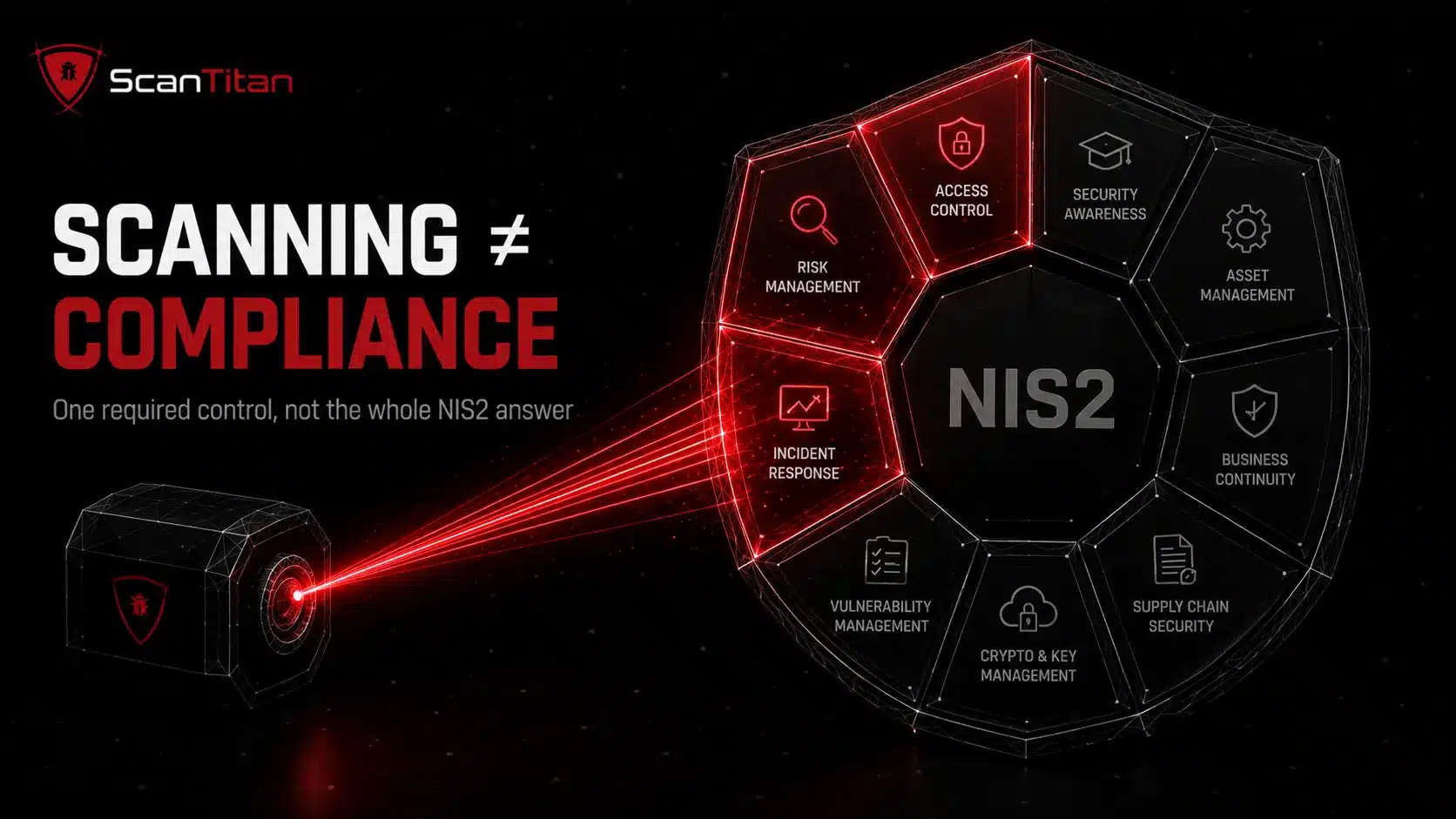
Let’s settle the headline question first. Vulnerability scanning cannot make you NIS2 compliant on its own, because NIS2 is a governance and risk-management law, not a scanning mandate. The directive names ten mandatory measures in Article 21(2), and an automated scanner directly serves just one of them, vulnerability handling, while feeding supporting evidence into two or three more. That leaves board accountability, incident reporting, supply-chain security, encryption, and staff training untouched by any tool. So treat your scanner the way an auditor does: necessary, expected, and nowhere near sufficient. A regulator who fines an essential entity up to €10 million will not care how clean last week’s scan report looked.
Scanning tells you which doors are unlocked. NIS2 asks who is responsible for locking them, how fast you report a break-in, and whether your board signed off on the policy. A tool answers the first question and none of the rest.
NIS2 Compliance at a Glance:
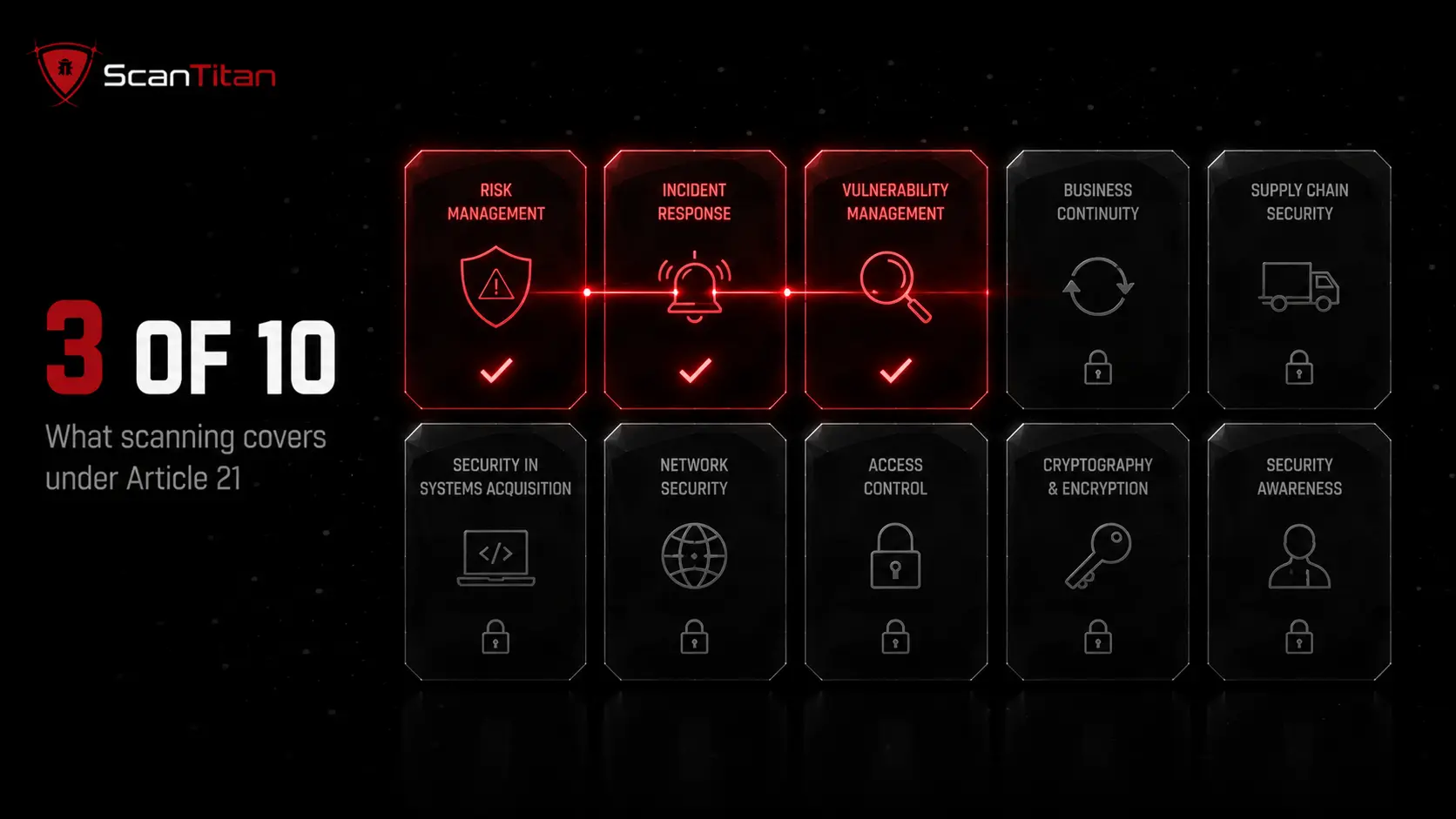
Here is the fast version before the detail. NIS2’s Article 21(2) sets ten baseline measures, and most of them are organizational rather than technical. Vulnerability scanning supplies direct evidence for only two or three; the rest are policy, process, and people. The table maps each measure to its type and shows, honestly, where a scanner actually contributes. Print it, assign an owner to every row, and you have the start of the documentation a national supervisory authority will ask to see when it reviews your management system.
| Article 21(2) measure | Type | Does scanning help? |
|---|---|---|
| (a) Risk analysis & security policies | Organizational | Indirect, feeds the risk register |
| (b) Incident handling | Organizational | No |
| (c) Business continuity & backup | Organizational | No |
| (d) Supply-chain security | Organizational | Partial, scan external vendor assets |
| (e) Secure development + vulnerability handling | Technical | Yes, direct evidence |
| (f) Effectiveness assessment | Organizational | Partial, scan trend metrics |
| (g) Cyber hygiene & training | Human | No |
| (h) Cryptography & encryption | Technical | Partial, flags weak TLS/SSL |
| (i) Access control & asset management | Organizational | Partial, asset discovery |
| (j) MFA & secure communications | Technical | No |
What Is the NIS2 Directive?
The NIS2 Directive (Directive (EU) 2022/2555) is the European Union’s updated cybersecurity law for critical and important sectors, replacing the original 2016 NIS Directive. It takes an all-hazards approach, meaning it treats physical, human, and technical risk as one problem, and it applies to far more organizations than its predecessor. In-scope entities must implement the ten risk-management measures in Article 21, report significant incidents under Article 23, and put their management bodies on the hook for oversight under Article 20. The national transposition deadline was 17 October 2024; most member states have now written NIS2 into local law, though a few are still finalizing. You can read the binding text on EUR-Lex.
Who Must Comply: Essential vs Important Entities
NIS2 sorts covered organizations into two tiers, essential and important entities, and the tier sets both your penalty ceiling and how closely regulators watch you. Size drives the split: broadly, large organizations (250+ staff or €50M+ turnover) in the Annex I sectors are essential, while medium organizations (50+ staff or €10M+ turnover) and the Annex II sectors are important. US companies are not automatically exempt; if you provide covered services inside the EU, such as a SaaS or cloud platform, you can be pulled into scope and may need to appoint an EU representative. The table maps the practical differences that change what you must budget for and document.
| Essential entities | Important entities | |
|---|---|---|
| Example sectors | Energy, transport, banking, health, water, digital infrastructure (Annex I) | Postal, waste, chemicals, food, manufacturing, digital providers (Annex II) |
| Typical size | Large: 250+ staff or €50M+ turnover | Medium: 50+ staff or €10M+ turnover |
| Supervision | Proactive, audits and inspections | Reactive, after evidence of an issue |
| Maximum fine | €10M or 2% of global turnover | €7M or 1.4% of global turnover |
| Director bans | Possible for material failure | Not specified |
Transposition still varies by countryNIS2’s national transposition deadline was 17 October 2024. Most member states have now transposed it, but a few are still finalizing, so confirm the exact obligations in each country where you operate via the European Commission or ENISA.
NIS2 Penalties and Director Liability:
NIS2 gives regulators real teeth, and the fines scale with your tier. Essential entities face penalties up to €10 million or 2% of total worldwide annual turnover, whichever is higher. Important entities face up to €7 million or 1.4% of worldwide turnover. Those ceilings sit in Article 34, and they apply to the whole management system, not to any single missed scan. Beyond the money, supervisory authorities can suspend certifications and, for essential entities, temporarily ban executives from holding management roles after a material failure. That personal exposure is exactly why NIS2 belongs on the board agenda, not buried in the IT backlog where a compliance obligation quietly goes stale.
What NIS2 Requires Beyond Vulnerability Scanning?
Three obligations carry most of NIS2’s weight, and not one of them is a scanner. Miss any of these and a clean vulnerability report will not save you.
Board Governance Under Article 20:
NIS2 puts your name on the line, not just your IT team’s. Article 20 requires management bodies to approve the cybersecurity risk-management measures, oversee their implementation, and complete regular training so directors can identify risks themselves. Executives can be held personally liable for failures, and supervisory authorities can temporarily ban members of management from holding managerial roles at an essential entity that materially fails to comply. This clause moves security from an IT budget line to a board responsibility. No scanner produces board minutes, an approval trail, or a director training log, and those are the first artifacts an auditor asks to see, usually before touching a single technical finding.
The 24-Hour and 72-Hour Incident Reporting Rule (Article 23):
When a significant incident lands, NIS2 starts a clock. Article 23 sets three deadlines: an early warning to your national CSIRT or competent authority within 24 hours, a fuller incident notification with an initial severity assessment and indicators of compromise within 72 hours, and a final report covering root cause and mitigation within one month. Miss the 24-hour early warning and you have a separate, reportable failure, independent of how well the breach itself was contained. Vulnerability scanning helps you avoid reaching this point by catching exploitable weaknesses early, but once an incident is significant, the obligation shifts to detection, decision-making, and paperwork under pressure that no scan can produce for you.
Where Vulnerability Scanning Fits Into NIS2 Compliance?
Scanning earns its place in two specific measures, and doing them well produces the audit evidence NIS2 assessors expect to receive.
Article 21 expects regular technical assessment. A documented, recurring website security scan is the most direct evidence of that for any internet-facing service.
Risk Assessment and Asset Inventory (Article 21(2)(a) and (i)):
You cannot protect an asset you never counted. NIS2’s risk-analysis measure (Article 21(2)(a)) and its asset-management requirement (i) both depend on an accurate inventory of internet-facing systems, and this is where scanning starts to pay off. A discovery scan enumerates your live domains, subdomains, IP ranges, open ports, and the software versions running on each, often surfacing forgotten staging servers and shadow-IT SaaS that never made it onto a spreadsheet. If you want the ground-level definitions first, our primer on what vulnerabilities in cyber security actually are sets the baseline. Feed that inventory into your risk register and you have turned a raw scan into governance evidence.
Technical Vulnerability Handling and Disclosure (Article 21(2)(e)):
Article 21(2)(e) is the measure a scanner maps to most directly: security in the acquisition, development, and maintenance of systems, “including vulnerability handling and disclosure.” In practice an assessor wants proof of a repeatable loop, detect, prioritize, patch, re-test, with severity-based SLAs behind it. That means running authenticated scans, not just surface checks; the gap between an authenticated scan vs unauthenticated scan is the gap between seeing a login page and seeing the vulnerable library behind it. It also means scanning the assets attackers actually probe, including your APIs, which our guide on how to scan an API for vulnerabilities walks through. Layer EPSS and the CISA KEV catalog over raw CVSS so you patch what is genuinely being exploited first.
What Vulnerability Scanning Alone Cannot Cover Under NIS2?
Here is the uncomfortable part for anyone hoping a subscription solves compliance. A scanner stays silent on most of what NIS2 grades you on.
- Prove governance, because board approval, oversight, and director training under Article 20 live in minutes and sign-off records, not scan output.
- Report incidents, since the 24-hour, 72-hour, and one-month notifications under Article 23 depend on human detection and decisions under pressure.
- Secure the supply chain, as assessing vendors and managed providers under Article 21(2)(d) needs contracts and audits your scanner never sees.
- Document business continuity, keeping backups, disaster recovery, and crisis-management plans under (c) that no scan creates or tests.
- Enforce access control, deploying multi-factor authentication and least privilege under (i) and (j) as configuration a scanner can flag but not implement.
A clean scan is not a compliance defenseIf your only evidence is a green scan report, you have documented one of ten Article 21 measures. Supervisory authorities assess the whole management system, and missing governance or reporting records is where fines actually originate.
Vulnerability Scanning vs Penetration Testing Under NIS2 and DORA:
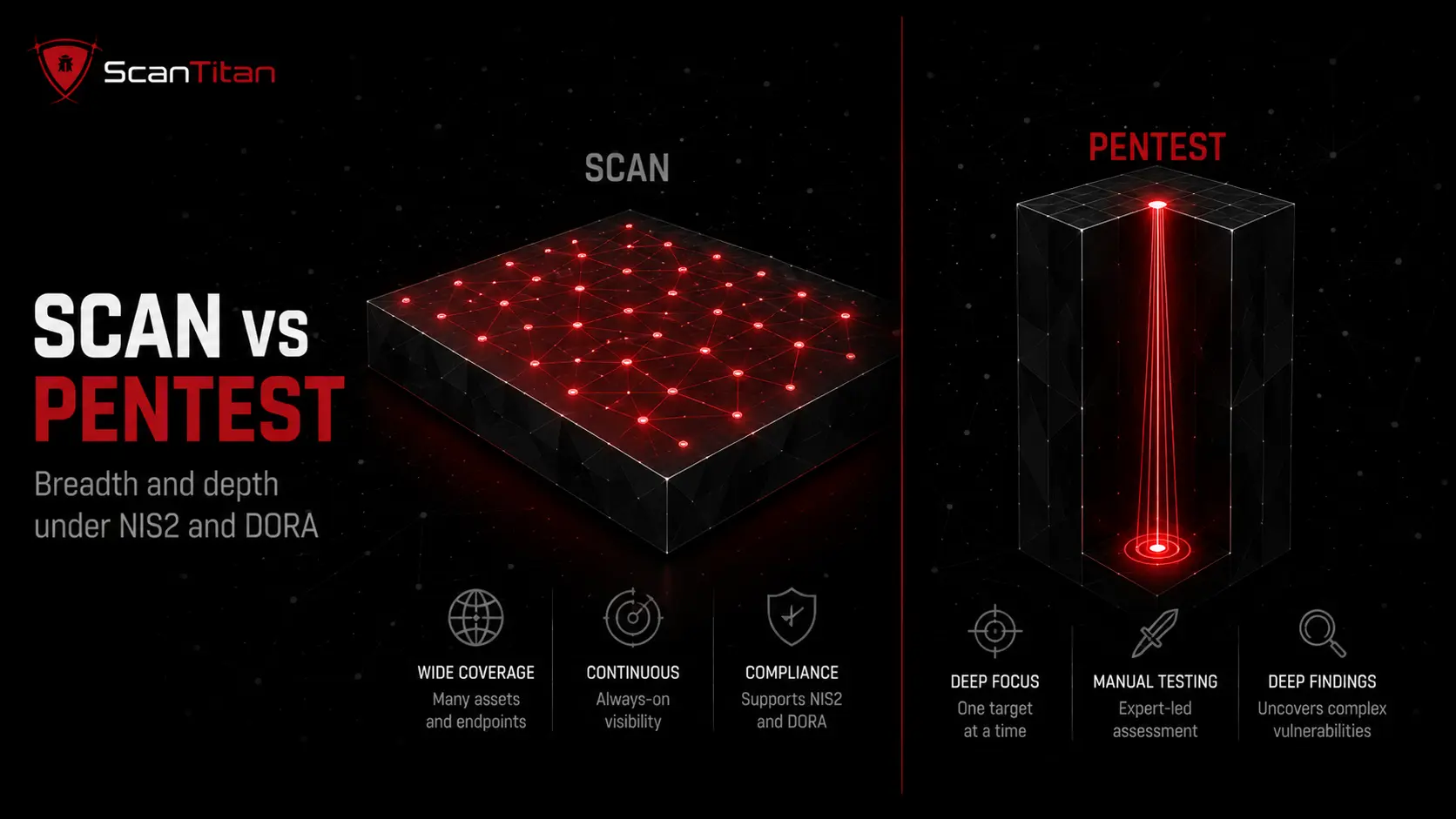
NIS2 does not treat security testing as one thing, and neither should you. Vulnerability scanning and penetration testing answer different questions, and Article 21(2)(f), which requires you to assess whether your measures actually work, expects both where they are proportionate to your risk. Scanning gives you breadth: automated, repeatable coverage of your whole surface. Penetration testing gives you depth: a human attacker chaining flaws a scanner cannot see. For financial-sector organizations, the separate DORA regulation makes this explicit, mandating threat-led penetration testing on a multi-year cycle. The table shows where each one earns its keep.
| Vulnerability scan | Penetration test | |
|---|---|---|
| Method | Automated | Manual, human-led |
| Breadth | Wide, the whole surface | Deep, targeted |
| Frequency | Continuous or weekly | Annual or biannual |
| Finds | Known CVEs, misconfigurations | Logic flaws, chained exploits |
| NIS2 / DORA role | Continuous risk assessment, Article 21(2)(a) and (e) | Resilience and effectiveness testing, 21(2)(f), DORA TLPT |
| Cost | Low, recurring | High, per engagement |
How Vulnerability Scanning Supports NIS2 Compliance?
Automated scanning is the engine behind several NIS2 obligations at once.
- Drive continuous risk assessment, detecting weaknesses across networks, applications, and systems before attackers reach them, which feeds Article 21(2)(a) directly.
- Prevent reportable incidents, closing exploitable flaws early so you reduce the chance of ever starting the Article 23 reporting clock.
- Extend scanning to the supply chain, running checks on external and third-party connections, not just your own perimeter, to support Article 21(2)(d).
- Tune depth and cadence, running scans weekly or monthly and after every change, and choosing the right method; our guide on active vs passive vulnerability scanning explains when each fits, including roaming endpoints and short-lived cloud assets.
How Penetration Testing Supports NIS2 and DORA?
Penetration testing goes where scanning stops, validating that your controls hold under a real attack.
- Demonstrate cyber resilience, uncovering attack vectors and chained exploits that automated scans miss and proving your defenses withstand pressure.
- Test incident response, using a simulated intrusion to show whether your team actually detects and reacts to a live attacker.
- Meet DORA testing mandates, since DORA requires regular resilience testing for banks and financial entities, including threat-led penetration testing against production systems.
- Re-test after remediation, running pentests at least annually or biannually across internal and external surfaces and confirming each fix closed the hole rather than moved it.
How ScanTitan Covers the Technical Side of NIS2 Compliance?
ScanTitan will not write your incident-response policy or sit in your board meeting, and we are not going to pretend it will. What the platform does is own the technical evidence for Article 21(2)(e) so that side of your audit is airtight. ScanTitan runs continuous, authenticated scanning across your websites, networks, and APIs, then prioritizes findings with EPSS and CISA KEV data layered over CVSS, so a two-person security team fixes the handful of genuinely exploitable issues first instead of triaging three hundred low-risk ones. Every finding ships with reproduction evidence and a remediation step, and a re-scan confirms closure. That is the detect, prioritize, patch, re-test loop an assessor wants documented. Pair it with the governance, reporting, and training work only your organization can do, and scanning becomes a real compliance asset.
Start with the evidence you can control todayGovernance takes months to mature. Technical vulnerability management does not. Stand up continuous, authenticated scanning now so Article 21(2)(e) is covered while you build out the organizational measures around it.
NIS2 and Vulnerability Scanning FAQ
Can vulnerability scanning alone make my company NIS2 compliant?
No. Scanning directly satisfies one of the ten risk-management measures in Article 21(2), vulnerability handling, and helps evidence a few others. Compliance also requires board-approved governance (Article 20), incident reporting (Article 23), supply-chain security, encryption, and staff training. Treat scanning as a required technical control inside a much larger management system, not as the whole answer.
Which NIS2 article does vulnerability scanning satisfy?
Vulnerability scanning maps most directly to Article 21(2)(e), which covers security in the acquisition, development, and maintenance of systems, including vulnerability handling and disclosure. It also supports the risk-analysis measure (a) and asset management (i) by producing an accurate inventory and risk data. It does not, by itself, satisfy the governance, reporting, or training measures.
How often should we scan to meet NIS2?
NIS2 does not name a fixed number; it demands a risk-based approach. In practice that means continuous or at least monthly scanning, plus a scan after every code deployment, dependency update, or infrastructure change, and whenever a named CVE affecting your stack is published. Document the cadence and the results so you can show a repeatable process to an assessor.
Does NIS2 require penetration testing as well as scanning?
NIS2 does not explicitly mandate penetration testing, but Article 21(2)(f) requires you to assess whether your measures work, which proportionate testing supports. Scanning covers breadth; a pentest adds depth by chaining exploits a scanner misses. In the financial sector, the separate DORA regulation goes further and mandates threat-led penetration testing on a regular cycle.
Does NIS2 apply to US companies?
It can. NIS2 covers organizations that provide in-scope services within the EU, even when headquartered elsewhere. A US SaaS, cloud, or managed service provider with EU customers or operations may fall into scope and could be required to appoint an EU representative. Confirm your status against the Annex I and II sectors and the size thresholds for each country you serve.
What are the penalties for failing NIS2?
Essential entities face fines up to €10 million or 2% of total worldwide annual turnover, whichever is higher. Important entities face up to €7 million or 1.4% of turnover. Under Article 20, executives can be held personally liable, and supervisory authorities can temporarily ban members of management at an essential entity that materially fails to comply.
Official NIS2 Resources and References
Work from primary sources rather than second-hand summaries when you scope your obligations. These are the authoritative references behind this guide.
- Directive (EU) 2022/2555 on EUR-Lex, the full binding NIS2 legal text, including Articles 20, 21, 23, and 34.
- European Commission: the NIS2 Directive, official policy overview, scope, and transposition updates.
- CISA Known Exploited Vulnerabilities (KEV) catalog, the list of CVEs under active exploitation to patch first.
- FIRST EPSS, the Exploit Prediction Scoring System for ranking findings by real-world exploit likelihood.
Cover the Technical Side of NIS2 with Confidence
Can vulnerability scanning ensure NIS2 compliance on its own? No, but it is the one technical control you can stand up today, and it produces the Article 21(2)(e) evidence an assessor will ask for. Run continuous, authenticated scanning as your detection layer, pair it with the governance, reporting, and training only your organization can own, and you close the gap competitors leave open. ScanTitan combines website, network, and API scanning with CVSS, EPSS, and CISA KEV prioritization in one dashboard, so a lean team keeps the technical side audit-ready without stitching tools together.