
What Is a Use After Free Vulnerability in One Sentence
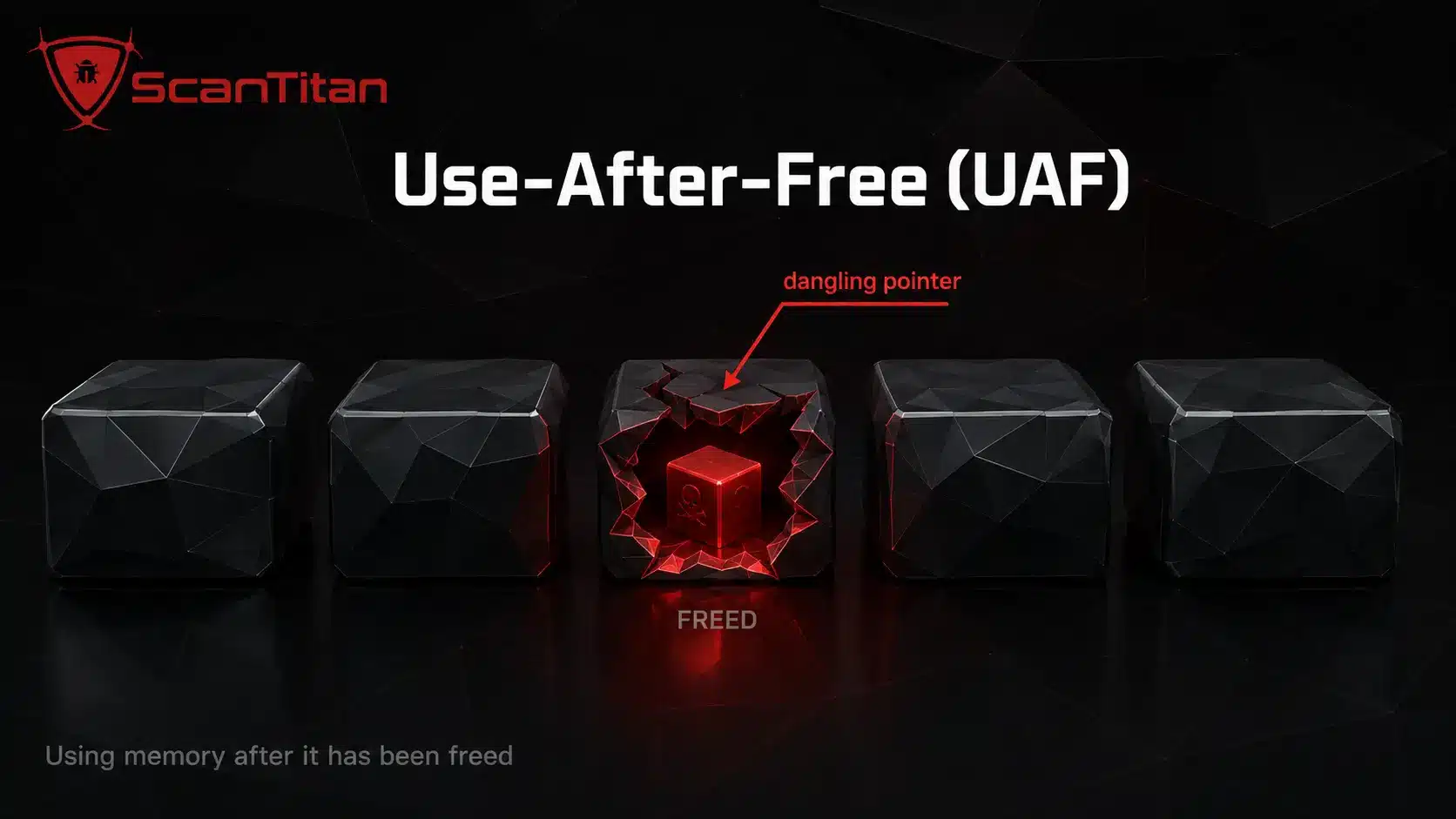
A use-after-free vulnerability is a bug where software reads or writes memory that it already freed. Programs borrow memory from a pool called the heap, use it, then free it so the system can reuse it. The flaw appears when the program frees the memory but keeps a pointer to it, then follows that pointer again. By the time it does, the freed slot may hold something else entirely. That gap between “freed” and “still referenced” is what attackers can weaponize. Not every use-after-free is exploitable, and many only crash the program, but under the right conditions the bug becomes a foothold for code execution or privilege escalation. MITRE catalogs it as CWE-416.
A Simple Analogy: The Re-Rented Apartment Key
Imagine you move out of an apartment and hand back the key, but you keep a copy. The landlord re-rents the unit to someone new. Your old key still opens the door, so you walk in and use the place as if it were yours, except now someone else’s furniture is inside. That is a use-after-free. The apartment is the block of memory, handing back the key is the free operation, and your kept copy is the dangling pointer. The danger is not that you left. It is that you can still get in after the space belongs to someone else. If an attacker is the “someone new,” they get to choose what sits in that room when your program walks back in.
How a Use-After-Free Vulnerability Happens
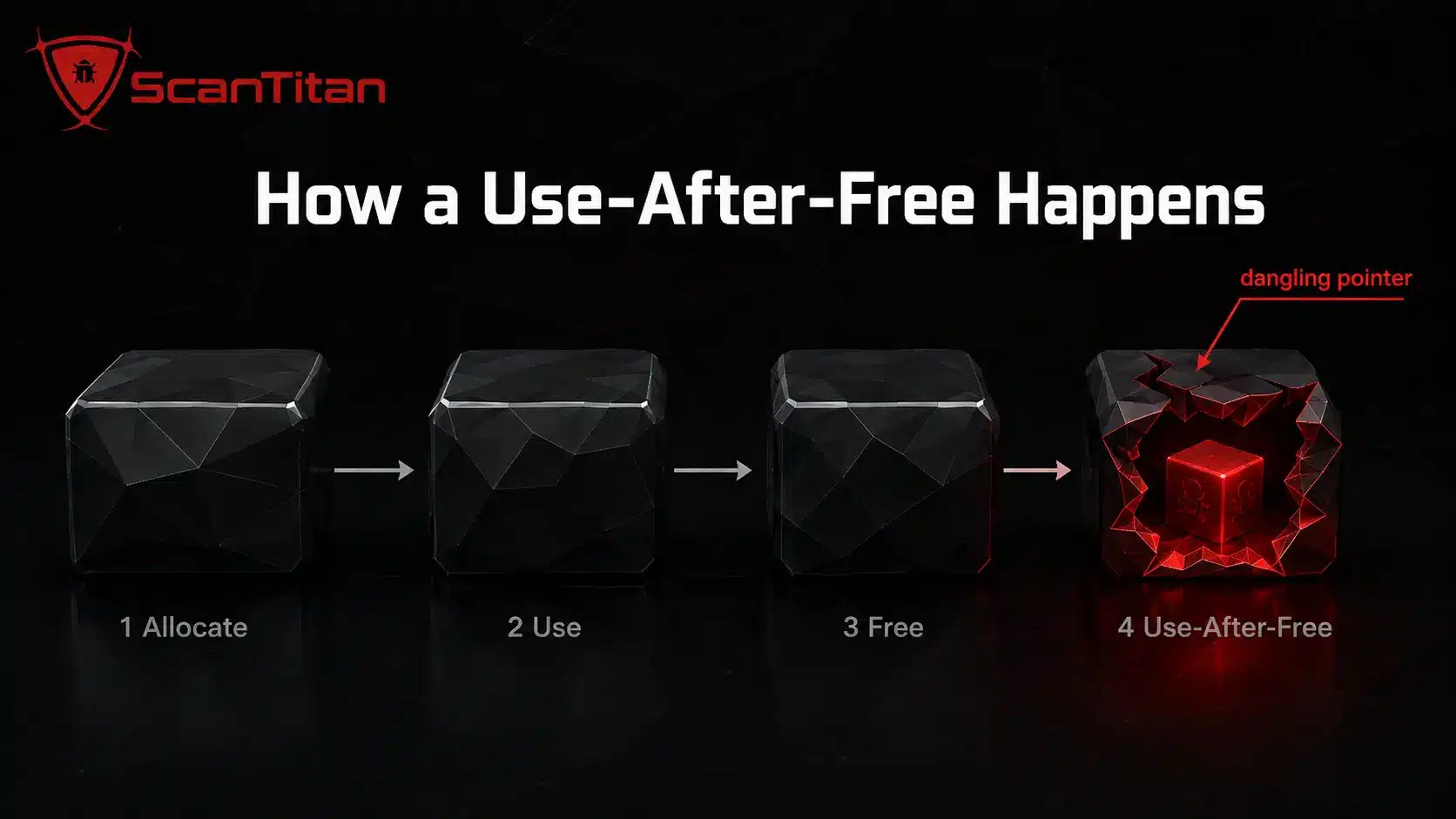
Heap Memory, free(), and Dangling Pointers
At a high level, most use-after-free vulnerabilities follow the same short lifecycle. The problem occurs when memory is released while a stale pointer or reference to it remains accessible. Here is the flow from allocation to the invalid access.
1. Allocate — malloc()
The program allocates a block of heap memory and receives a pointer to its address.
2. Use — Access the data
The program reads from or writes to the allocated memory through that pointer.
3. Free — free() or delete
The program releases the block using free() in C or delete in C++, allowing the allocator to reuse it. However, one or more stale references may still point to the old address.
4. Use After Free — Access *ptr again
The program accesses the released memory through a dangling pointer. This invalid access is the use-after-free vulnerability.
Because accessing freed memory causes undefined behavior, the program may read stale or unrelated data, corrupt another object, crash, or—under exploitable conditions—allow an attacker to influence program execution.
Memory Allocation and the free() Call
When software needs to store data whose size it only learns at runtime, it requests memory from the heap using functions like malloc() or the new operator, and it gets back a pointer holding the address. When the data is no longer needed, the program calls free() or delete to release the block so the allocator can reuse it. That reuse is the point. Modern allocators recycle freed blocks fast to stay efficient. The trouble starts if the code frees a block but does not also clear every pointer that referenced it. The memory is marked available, yet the program still holds a live address into it.
Dangling Pointers Explained
A dangling pointer is a reference that still holds the address of memory that has already been freed. It looks valid because the numeric address has not changed, but the meaning behind that address has. In a large codebase with many branches, callbacks, and threads, it is easy for one path to free an object while another still holds a pointer to it. When that second path follows the pointer, it reads or writes whatever now lives in the reclaimed block. If the allocator has handed the block to a new object, the program may treat one type of data as another. That condition is called type confusion, and it is often how a simple crash turns into code execution.
The Bug in Code: Vulnerable vs Safer
Here is the whole bug in four lines of C. The program allocates memory, uses it, frees it, then reads it again through the same pointer:
// Vulnerable
int *ptr = malloc(sizeof(int)); // 1. allocate a block on the heap
*ptr = 42;                       // 2. use it normally
free(ptr);                       // 3. free the block
printf("%d", *ptr);              // 4. use-after-free: ptr still points at freed memory
Line four is the vulnerability. In C and C++, reading or writing memory after it is freed is undefined behavior: the language standard makes no promise about what happens next. The program might return the old value, return garbage, crash, or, in an exploit, hand back whatever the attacker placed there. One common safeguard is to check the allocation and clear the pointer right after freeing:
// Safer
int *ptr = malloc(sizeof(int));
if (ptr == NULL) {
    return 1;                    // handle the allocation failure
}
*ptr = 42;
free(ptr);
ptr = NULL;                      // clear this pointer so it can no longer be followed
if (ptr) printf("%d", *ptr);     // the guard now skips the dangling access
Setting ptr to null prevents this specific pointer from being followed again. However, it is only a defense-in-depth measure. Other pointers may still reference the freed block, so the complete fix is to correct the object’s ownership and lifetime and ensure that no code accesses it after it is released.
Common Root Causes of Use-After-Free
Use-after-free is rarely one careless line. It usually grows out of a handful of recurring patterns in how software manages memory. Recognizing them helps you spot the risk in a codebase or a code review.
- Manage memory by hand, which is the base cause: C and C++ leave freeing to the programmer, so a missed cleanup becomes a dangling pointer.
- Alias the same block through several pointers, so freeing through one leaves the others pointing at reclaimed memory.
- Branch through complex control flow, where one path frees an object that another path still assumes is alive.
- Race across threads, where one thread frees an object while another is still using it, a timing bug that is hard to reproduce.
- Chain callbacks and event handlers, common in browsers, where an object is destroyed while a pending callback still holds a reference to it.
Read-After-Free vs Write-After-Free
Not all use-after-free bugs behave the same way, and the difference shapes the impact. A read-after-free happens when the program reads the freed block. If an attacker has placed sensitive or crafted data there, the read can leak secrets like tokens or pointers, which also helps defeat protections such as ASLR. A write-after-free happens when the program writes into the freed block. That is usually the more dangerous case, because writing lets an attacker corrupt a newly placed object, overwrite a function pointer, and steer execution. In practice, exploit chains often use a read-after-free to learn the memory layout, then a write-after-free to seize control.
How Attackers Exploit Use-After-Free for RCE and Privilege Escalation
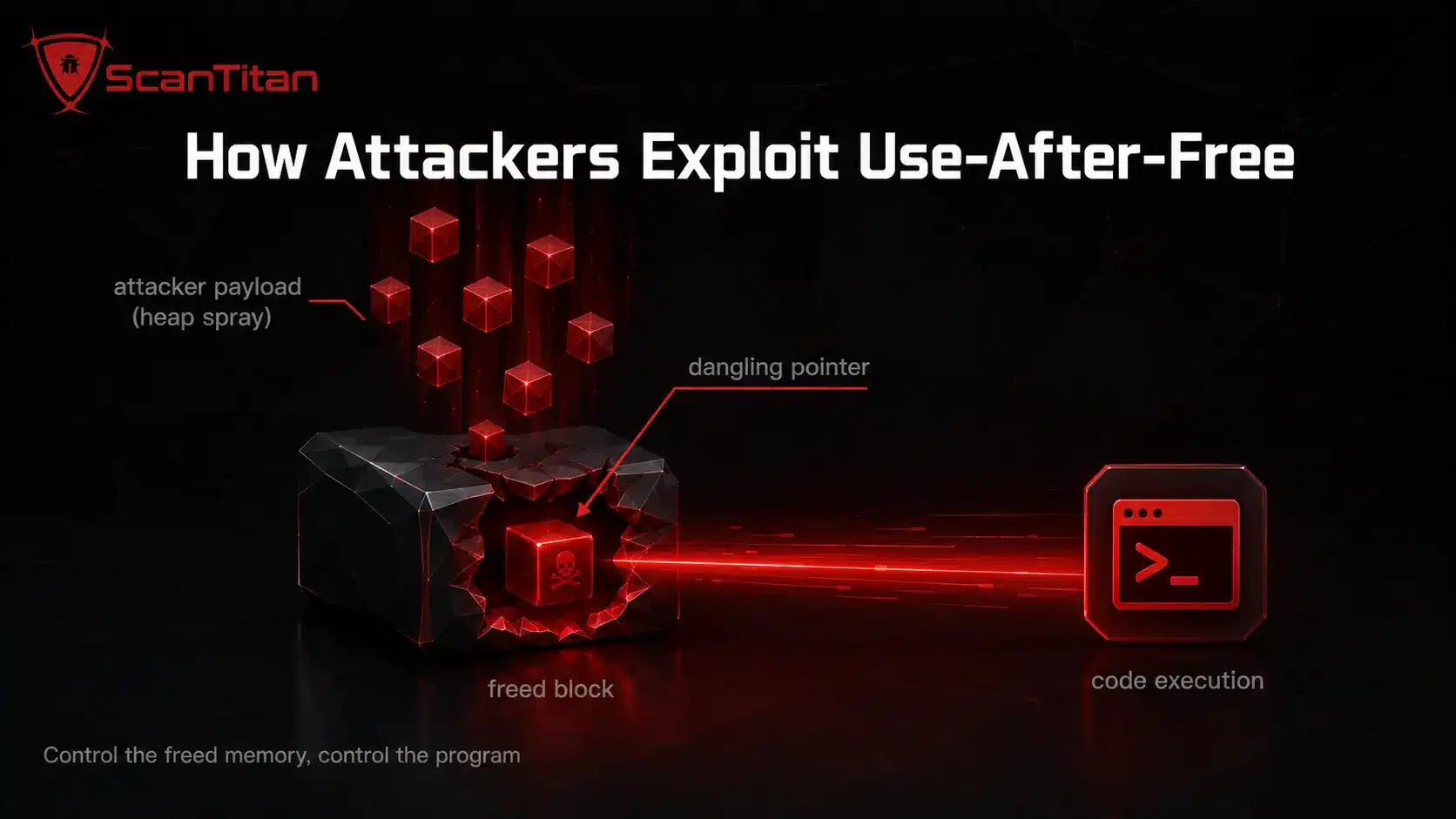
When conditions allow, attackers turn a use-after-free into control by deciding what fills the freed block. The standard move is heap spraying. After triggering the free, the attacker rapidly allocates many objects of the same size so one of their crafted objects lands in the freed slot. When the program follows its dangling pointer, it can read attacker-controlled data, often a fake object holding a poisoned function pointer or virtual table. From there, techniques like Return-Oriented Programming (ROP) chain existing code fragments to work around defenses such as Address Space Layout Randomization (ASLR) and Data Execution Prevention (DEP).
A use-after-free can look like a harmless crash. In the wrong place, with attacker-controlled memory in the freed slot, that same bug can become code execution.
The payoff depends on where the bug lives. In a browser, a use-after-free can execute code inside the rendering process and then chain with a second flaw to escape the browser sandbox. In an operating system kernel, it can escalate a normal user to full administrator or root. Reliable exploitation is difficult and not guaranteed, but the potential outcomes are the ones defenders care about most: remote code execution, privilege escalation, data disclosure, and denial of service.
Use-After-Free vs Other Memory Corruption Bugs
Use-after-free is one branch of a larger family called memory corruption. Knowing how it differs from its cousins helps you gauge impact and prioritize patches. The table lines up the four you will meet most often, with their CWE identifiers, root causes, and the fix that actually closes each one.
| Bug type | CWE ID | Root cause | Typical impact | Primary fix |
|---|---|---|---|---|
| Use-after-free | CWE-416 | Dangling pointer references freed memory | Code execution, privilege escalation | Correct object ownership and lifetime; use RAII, smart pointers, or memory-safe languages |
| Double free | CWE-415 | The same block is freed twice | Heap corruption, code execution | Enforce single ownership and release exactly once |
| Buffer overflow | CWE-120 | Data written past a buffer boundary | Code execution, data corruption | Validate lengths and enforce bounds-safe operations |
| Heap overflow | CWE-122 | Overflow targeting heap-allocated memory | Code execution, data manipulation | Validate allocation sizes and enforce heap bounds |
Real-World Use-After-Free Examples: Browser, Kernel, and Windows CVEs
Use-after-free is not a textbook curiosity. It ships in the software running on billions of devices, and attackers exploit it in the wild. Three officially classified CWE-416 cases show the range.
Chrome, CVE-2019-5786: a use-after-free in Chrome’s FileReader let a malicious web page free an object while a file operation was still pending, then run code in the browser’s renderer when the dangling reference fired. Google confirmed active exploitation, and attackers chained it with a Windows flaw to break out of the sandbox. Record: NVD CVE-2019-5786.
Linux kernel, CVE-2024-1086: a use-after-free in the kernel’s netfilter component (CVSS 7.8) let a local user escalate straight to root. CISA added it to the Known Exploited Vulnerabilities catalog in May 2024 and lists it as known to be used in ransomware campaigns. Record: NVD CVE-2024-1086.
Windows, CVE-2024-38193: a use-after-free in the Windows Ancillary Function Driver for WinSock (CVSS 7.8) gave a local attacker SYSTEM privileges. Gen Threat Labs attributed exploitation of the vulnerability to the Lazarus-linked Diamond Sleet actor, which used it to deploy the FudModule rootkit before Microsoft patched it in August 2024. Records: Microsoft MSRC and NVD.
Why Use-After-Free (CWE-416) Ranks Among MITRE’s Most Dangerous Weaknesses
MITRE tracks the software weaknesses behind the most real-world damage in its annual CWE Top 25. MITRE ranked Use After Free (CWE-416) seventh in its 2025 CWE Top 25, up one position from 2024. The ranking also identified 14 CWE-416 vulnerabilities in CISA’s Known Exploited Vulnerabilities catalog. Its staying power comes from a nasty combination. It is common in the C and C++ code that underpins browsers, kernels, and infrastructure. It is hard to spot in review because the buggy code still runs fine in testing. And when it is exploitable, it hands attackers code execution rather than a mere crash. The exploitation window is also shrinking. Mandiant found that the average time-to-exploit across its 2023 dataset was five days, down from 32 days across 2021 and 2022. That dataset included both zero-day and n-day vulnerabilities, so the figure should not be interpreted as a guaranteed exploitation timeline for every newly disclosed use-after-free.
Languages Most Affected: C and C++ vs Memory-Safe Rust
Use-after-free is a symptom of how a language handles memory. Languages that make the programmer manage memory by hand put the whole burden of freeing at the right time on humans, who make mistakes. Languages that manage memory for you, through garbage collection or compile-time ownership rules, remove most of the risk by design. The table shows where the exposure concentrates.
| Language family | Examples | Memory management | Use-after-free risk |
|---|---|---|---|
| Manual | C, C++ raw pointers | Programmer manages object lifetime | High |
| Managed runtimes | Java, C#, Python | Garbage collection in managed code | Low in managed code; native runtimes and extensions may still contain UAF |
| Ownership-based | Safe Rust | Compiler checks ownership, borrowing, and lifetimes | Very low in safe code |
| Unsafe or native boundaries | Rust unsafe, FFI, native extensions | Manual or externally managed memory | Depends on implementation |
Rust’s ownership and borrow-checking rules prevent most use-after-free bugs in safe Rust code. Unsafe blocks, FFI boundaries, and native dependencies can still reintroduce memory-lifetime errors. Rewriting a mature C++ browser or kernel in Rust is a years-long effort, so C and C++ will keep producing use-after-free flaws for a long time, even as new memory-safe components steadily shrink the attack surface.
How to Detect a Use-After-Free Vulnerability
Detection is the hard part, because a use-after-free behaves differently depending on what the allocator drops into the freed block, which changes at runtime. Unlike a web-layer flaw such as SQL injection that you can test directly against an endpoint, a use-after-free hides inside compiled software. Developers and defenders reach for different tools.
- Run AddressSanitizer (ASan), a runtime detector built into GCC and Clang that instruments memory operations and flags a use-after-free the moment it happens, pointing at both the free and the bad access.
- Fuzz the code with tools like AFL or libFuzzer, which feed random inputs to trigger the odd timing that surfaces a use-after-free, especially when paired with ASan.
- Scan source with static analysis tools such as Clang Static Analyzer or Coverity, which flag dangling-pointer patterns during development before the code ships.
- Track your software versions with a vulnerability scanner that checks installed products against the NVD, the practical option when you run software you did not write.
- Monitor the CISA KEV catalog for use-after-free entries, since a listing means confirmed exploitation and a patch that belongs at the front of your queue.
How to Prevent and Mitigate Use-After-Free Vulnerabilities
Prevention splits by role. Developers fix the code. Everyone who runs software fixes it by patching. Both matter, because the world’s infrastructure runs on C and C++ that no single team can rewrite.
For developers
- Adopt memory-safe languages like Rust for new components, so the compiler blocks use-after-free before the code runs.
- Use smart pointers in C++ (unique and shared pointers) that manage object lifetime automatically. They remove most dangling references, though misuse like handing out raw pointers can still reintroduce the bug.
- Null the pointer right after freeing it. This helps, but it only protects the pointer you nulled; if other pointers still alias the same block, the risk remains, so pair it with clear ownership.
- Enable compiler and platform mitigations such as Control Flow Integrity, ASLR, and hardened allocators. Depending on their configuration, hardened allocators may quarantine freed chunks, delay reuse, validate heap metadata, or place guard pages around selected allocations. These controls make exploitation less reliable but do not replace fixing the lifetime bug.
For IT and security teams
- Patch fast, because vendors ship fixes as soon as a use-after-free is confirmed and attackers move within days of disclosure.
- Prioritize by exploitation: a CVE on CISA’s KEV list or with a public proof-of-concept jumps the queue over a higher raw CVSS score that no one is exploiting.
- Scan continuously so you learn the day a product you run has a published use-after-free, with the version and fix attached.
- Inventory your software so a new advisory can be matched to the exact assets that need the patch.
Prioritize by exploitation, not just severityA use-after-free on CISA’s KEV list or with a public proof-of-concept deserves a patch today. One buried in software you do not expose can wait for your normal cycle. Confirmed exploitation beats the raw CVSS number every time.
Your First 24 Hours After a Use-After-Free CVE Drops
When a use-after-free advisory lands for software you run, the clock starts. These steps, in order, get you from alert to contained fast.
- Confirm whether you run the affected product and version, using your software inventory or a scan.
- Check the CISA KEV catalog and the advisory for confirmed exploitation or a public proof-of-concept, which sets your urgency.
- Apply the vendor patch to exposed and high-value systems first, then roll it out across the fleet.
- Mitigate temporarily where you cannot patch yet, by disabling the affected feature or restricting access to the vulnerable service.
- Verify the fix with a re-scan, and watch logs for exploitation attempts against the systems that were exposed.
How ScanTitan Helps You Catch Memory-Safety Exposure
You will almost never audit C++ memory management yourself, and you do not need to. What you can do is know exactly which software you run and patch the memory-safety flaws in it before attackers reach them. ScanTitan fingerprints the software and versions across your assets, matches them against a live vulnerability feed, and flags a known use-after-free the day its CVE publishes, with the CVSS score and fix attached. It catches the same way every other named flaw is caught, from the POODLE vulnerability in obsolete protocols to broader SSL vulnerabilities, by version and configuration. That moves you from chasing individual bugs to managing exposure over time, which is the difference between vulnerability and exposure management.
ScanTitan fingerprints the server and runtime versions behind your site, which is how a memory-safety CVE in an upstream component becomes visible to you.
Frequently Asked Questions
What is a use-after-free vulnerability in simple terms?
A use-after-free vulnerability happens when a program uses a piece of memory after it has already been released. It is like handing back an apartment key but keeping a copy and walking in after someone else moves in. The program follows a stale pointer into memory that now belongs to something else, and an attacker who controls what lands there may run their own code or steal data.
Is use-after-free a remote code execution vulnerability?
It can lead to one, but not automatically. A use-after-free is a memory-safety bug, and many only cause a crash. When the flaw sits in software that processes untrusted input, like a web browser, and the freed memory is reachable and controllable, attackers can turn it into remote code execution. It may also cause privilege escalation, data disclosure, or a denial-of-service crash.
What causes use-after-free vulnerabilities?
The root cause is manual memory management gone wrong: a program frees a block of memory but keeps a pointer to it, then uses that dangling pointer again. Complex control flow, multiple pointers to the same block, race conditions across threads, and callback-heavy code all make it easy to free an object that another path still references. It is most common in C and C++.
Can a vulnerability scanner detect use-after-free?
A vulnerability scanner detects known use-after-free CVEs by matching the software and version you run against a vulnerability database, which is exactly what you need for software you did not write. It does not find novel use-after-free bugs in your own source code; that requires developer tools like AddressSanitizer, fuzzing, and static analysis. For most teams, scanning plus fast patching is the practical defense.
Which software is most affected by use-after-free bugs?
Web browsers (Chrome, Firefox, Safari, Edge), operating system kernels (Windows, Linux), and any application written in C or C++ are the most affected. Browsers are especially prone because they create and destroy huge numbers of objects while running untrusted code from every site you visit, which gives attackers many chances to trigger a dangling reference.
How do you prevent use-after-free vulnerabilities?
Developers prevent them by correcting object ownership and lifetime, using memory-safe languages like Rust, adopting smart pointers in C++, and enabling mitigations like ASLR, Control Flow Integrity, and hardened allocators. Nulling a pointer after freeing is a useful defense-in-depth step but not a complete fix. Teams that run the software prevent exploitation by patching fast, prioritizing CVEs on CISA’s KEV list, and scanning continuously so affected software is flagged the day a fix exists.
Catch Memory-Safety Flaws Before Attackers Exploit Them
You now know what a use-after-free vulnerability is, why it can end in code execution, and how to detect and prevent it. For most teams the practical defense is speed: knowing the day a product you run has a published use-after-free, with the fix in hand. ScanTitan tracks your software against a live vulnerability feed and tells you exactly that. Start a scan and see what memory-safety exposure is sitting on your assets right now.