
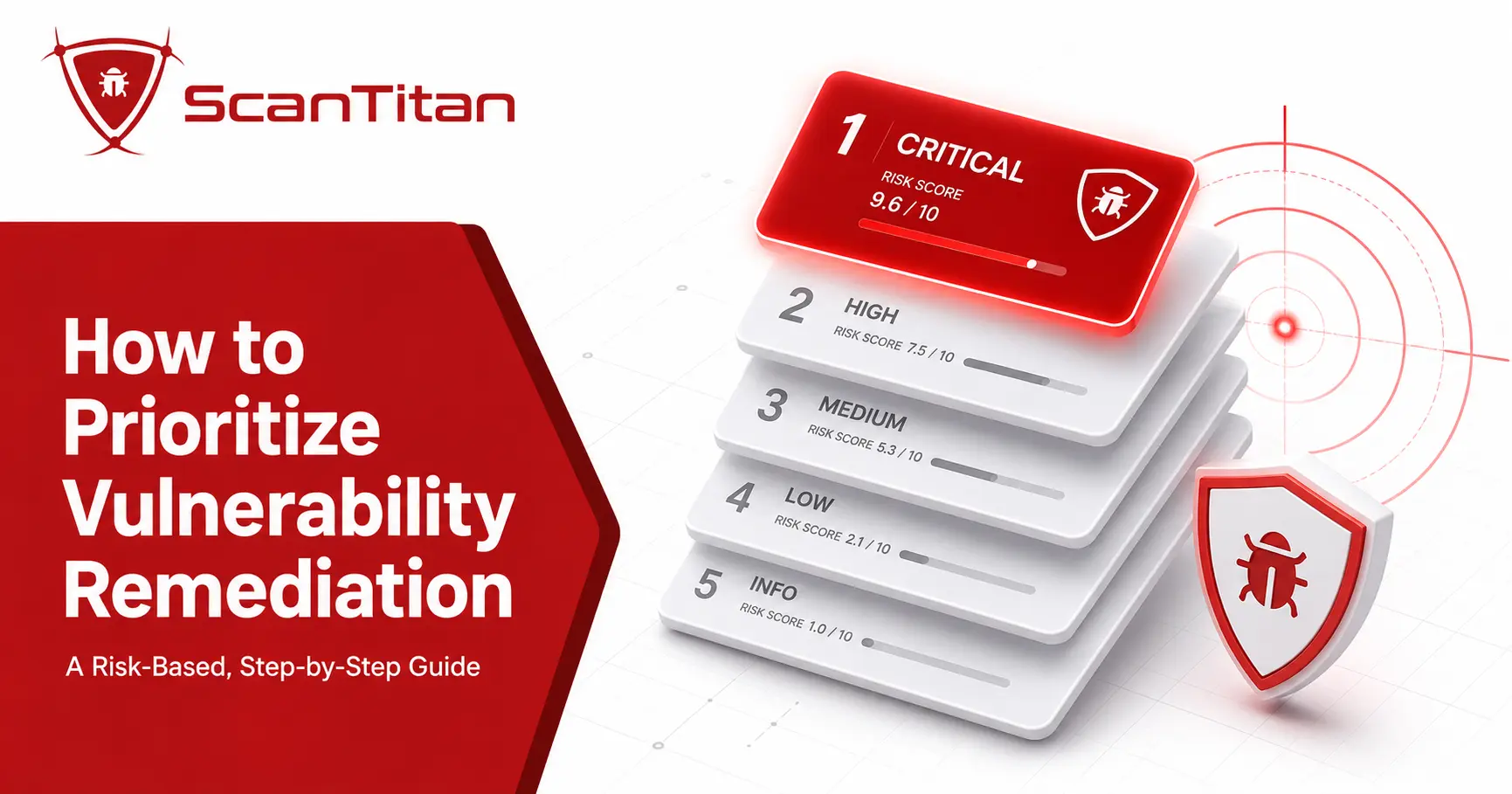
Learning How to Prioritize Vulnerability Remediation means deciding which security flaws to fix first based on the real risk they pose, not just their severity score. With scanners flagging thousands of findings and no team able to patch them all, prioritization is the decision layer that separates the handful of vulnerabilities attackers can actually exploit from the noise. This guide walks through a repeatable, risk-based method: the factors that determine priority, a nine-step workflow you can run every cycle, the methods that feed it, and how to set remediation SLAs, assign owners, and measure whether the program is working.
What Is Vulnerability Remediation Prioritization?
Vulnerability remediation prioritization is the process of ranking discovered vulnerabilities by the actual risk they pose to your organization, so your team fixes the issues most likely to lead to a breach first. It sits in the middle of the vulnerability management lifecycle: scanning finds the issues, prioritization decides what matters, and remediation fixes them. Without it, you are left with two bad options, trying to patch everything, which is impossible at scale, or patching by severity score alone, which sends your team chasing high numbers on systems no attacker can reach. Prioritization turns a flat, overwhelming list into a ranked queue tied to real exposure and business impact. Done well, it is what makes a vulnerability management program actually reduce risk instead of generating busywork.
How to Prioritize Vulnerability Remediation? Step by Step
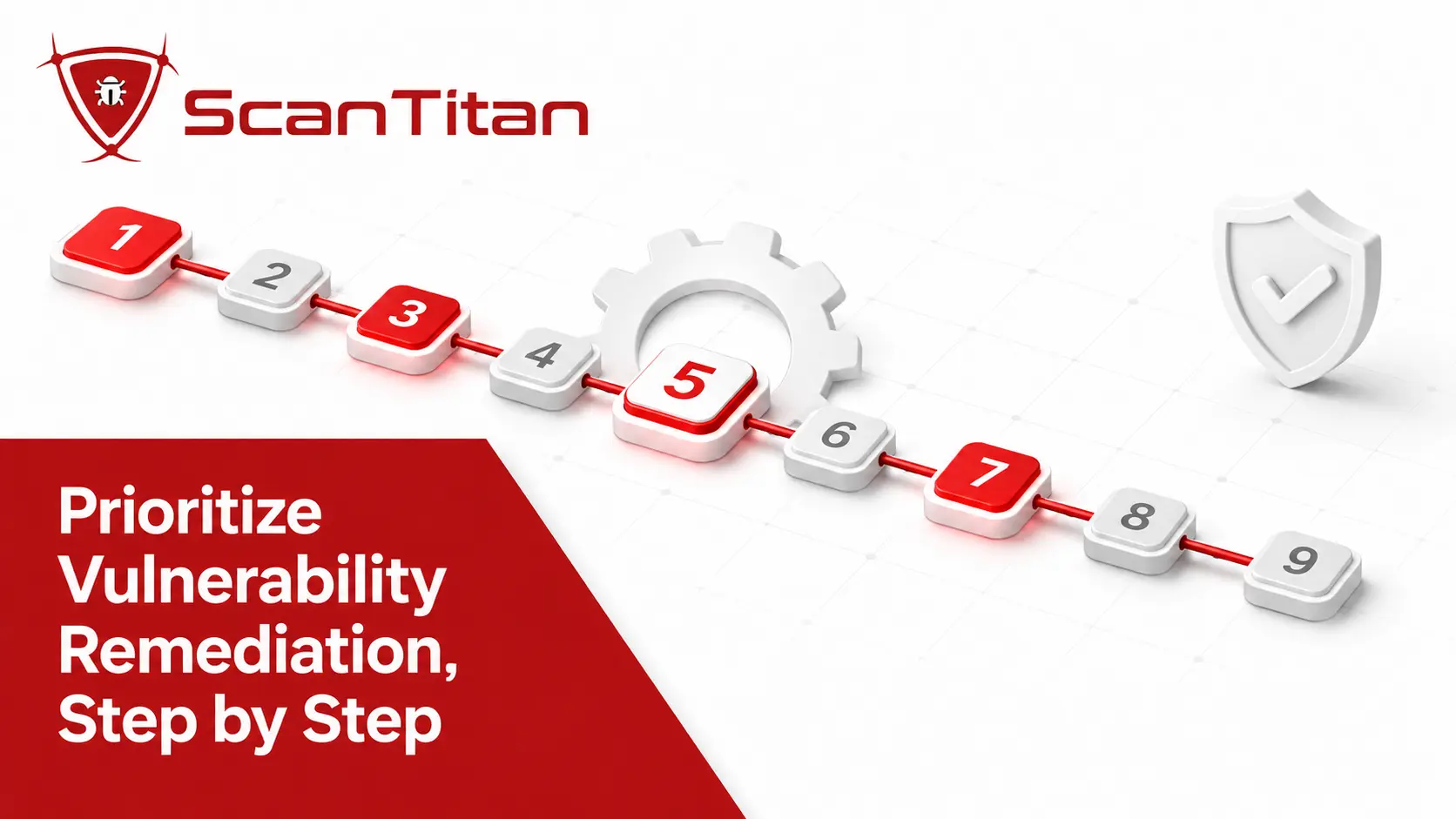
Here is a repeatable, risk-based workflow you can run every cycle. Each step adds a layer of signal that raw severity scores cannot give you.
- Build a continuous asset inventory. You cannot prioritize what you cannot see. Maintain an always-current list of every server, container, serverless function, application, and managed service, and tag each with an owner, business function, data sensitivity, and whether it is internet-facing. New assets appear between scans, so discovery has to run continuously rather than once a quarter.
- Consolidate findings into one queue. Pull results from your vulnerability scanner, cloud posture tools, and any penetration-test or bug-bounty findings into a single, deduplicated list. Chasing the same CVE across five dashboards wastes the time you are trying to save, and one unified queue is what makes ranking possible.
- Add severity and exploit intelligence. Start with the CVSS base score as a severity baseline, then layer exploit likelihood from EPSS and observed real-world exploitation from the CISA KEV catalog. The practical hierarchy most teams use is straightforward: confirmed-exploited findings that apply to your environment get expedited first, high-EPSS items jump the queue next, and CVSS orders the long tail after that.
- Enrich each finding with environmental context. This is where severity becomes real risk. For every finding ask: is the asset reachable from the internet, what identity and permissions does it carry, what sensitive data can it reach, and is the vulnerable component actually running rather than just installed. A medium CVE on an internet-facing host with admin rights to a customer database outranks a critical on an isolated dev machine.
- Score attack paths, not just single findings. Attackers chain weaknesses. Two low-severity findings plus a misconfiguration can form a path to your crown jewels, as the 2019 Capital One breach showed, where a firewall misconfiguration and an over-permissive role mattered more than any single high-rated CVE. Look for these combinations and rank the whole path, not each part in isolation. Our guide to common cloud misconfigurations covers the settings that most often complete these chains.
- Rank into risk tiers and map them. Sort the queue into tiers, critical, high, medium, and low, based on the combined signal above, then plot them on a likelihood-by-impact matrix so the order is defensible and easy to explain to non-technical stakeholders.
- Assign owners, SLAs, and route to ticketing. Every finding needs a finding owner who tracks it, an asset or application owner who controls the fix, and a remediation team who does the work. Route findings straight into the tools engineers already use, such as Jira or ServiceNow, with the context and a fix recommendation attached. Define when the SLA clock starts, the exception or escalation path when a deadline cannot be met, and who owns retesting and closure, so nothing stalls in a handoff.
- Remediate, mitigate, or accept the risk. Patch what you can. Where a patch is unavailable or not yet safe to deploy, apply a compensating control such as a firewall rule, a WAF signature, or a configuration change to reduce exposure. Where the risk is genuinely low and fixing it is disproportionate, formally accept it: document the decision, have the right owner approve it, set an expiry date, and schedule a review.
- Verify, rescan, and measure MTTR. Confirm each fix actually closed the gap with a rescan, then track mean time to remediate by tier so you can see whether the program is getting faster and where it stalls. Feed what you learn back into the next cycle.
Why Prioritize Vulnerability Remediation?
The case is simple: there are far more vulnerabilities than any team can fix. The National Vulnerability Database publishes tens of thousands of new CVEs (Common Vulnerabilities and Exposures) every year, and only a small share of them are ever exploited in the wild. Sorting by severity and working top-down means spending scarce engineering time on flaws that pose little real risk while the genuinely dangerous ones wait. That gap has consequences: teams that chase high CVSS scores routinely miss the medium-rated flaw on an exposed system that becomes the actual entry point. Prioritization also fights alert fatigue, the slow burnout that sets in when a small team faces an endless queue with no way to tell signal from noise. And it supports compliance: risk-based vulnerability prioritization supports compliance and assurance programs. PCI DSS has explicit vulnerability risk-ranking and security-update expectations, while other frameworks and assurance programs such as SOC 2, HIPAA, and FedRAMP may require vulnerability management or risk treatment with different prioritization rules and timelines.
What Makes Vulnerability Prioritization Difficult?
If prioritization were easy, no one would need a method for it. It gets hard for reasons that have little to do with severity scores. Scanners generate more findings than any team can realistically fix, so the queue grows faster than it clears. Asset inventory or ownership is often incomplete, which means some findings have no clear owner and some assets are missed entirely. The same finding frequently appears across several tools, inflating the count and wasting triage time on duplicates. Exposure and infrastructure change over time, so a low-risk finding last month can become urgent after a network change this month. Severity, exploit intelligence, and environmental context do not always point the same way, leaving genuine judgment calls. And some systems cannot be patched immediately because of uptime requirements, compatibility constraints, or the risk of the change itself. The through-line is this: vulnerability prioritization is difficult because risk changes with context, not because teams need another severity score.
What Factors Determine Vulnerability Priority?
Severity is only one input. Real prioritization weighs several signals together, because the same CVE can be urgent on one asset and irrelevant on another. The table below shows the factors that shift priority and why.
| Factor | Question it answers | Effect on priority |
|---|---|---|
| Severity (CVSS) | How bad is it if exploited? | A baseline, not the decider |
| Exploit likelihood (EPSS) | How likely is exploitation soon? | Raises high-probability CVEs |
| Active exploitation (KEV) | Has exploitation in the wild been observed? | High-confidence signal, expedite review |
| Exploit availability | Is reliable public exploit code or a working PoC available? | Raises urgency when exposure and applicability are confirmed |
| Network exposure | Is the asset internet-facing? | Internet-facing findings jump the queue |
| Identity and blast radius | What can an attacker reach next? | Admin-level access raises impact |
| Data sensitivity | Is PII, financial, or secret data near? | Proximity to sensitive data raises risk |
| Runtime status | Is the vulnerable code actually running? | Running components may warrant higher priority |
| Business and asset criticality | Does it support a critical function? | Revenue and compliance systems first |
| Compensating controls | Is exposure already reduced? | Existing controls can lower urgency |
| Remediation feasibility | Is a safe fix available, and what change does it require? | Influences whether you patch now, mitigate, schedule, or use an exception |
The core idea running through all of these: severity tells you how bad a vulnerability could be, but exposure, exploitability, and business context tell you whether it matters here. Note that remediation feasibility shapes the response decision and timing, not the underlying risk itself.
How Does Environmental Context Change Vulnerability Priority?
The fastest way to see why context matters is to compare two findings. Consider Finding A: a CVSS 9.8 vulnerability on an isolated development system with no internet exposure and no sensitive data. Now consider Finding B: a CVSS 7.5 vulnerability on an internet-facing production workload that runs with a privileged identity, can reach sensitive customer data, and has a high exploit likelihood or known exploitation. On paper, Finding A looks more urgent because its score is higher. In practice, Finding B is the one to fix first: it is reachable, it is exploitable, and a compromise there leads straight to customer data, while Finding A sits behind layers of isolation that an attacker would struggle to cross. The signals that drive that judgment are network exposure, asset criticality, identity permissions, sensitive-data access, runtime evidence where available, surrounding misconfigurations, and compensating controls. Environmental context is what adds organization-specific risk on top of the generic technical severity, and it is often what flips the order.
Internet-facing assets outrank internal ones at the same CVSS score, and a website scanner is what establishes which of your assets are genuinely internet-facing.
Why Do Attack Paths Matter in Vulnerability Prioritization?
Real-world risk rarely comes from a single finding. It comes from a combination, such as a vulnerability plus public exposure plus an over-permissive identity plus access to sensitive data. Any one of those on its own might be a manageable, moderate issue. Lined up together on the same resource, they form a path an attacker can walk from the internet all the way to your most valuable data, which is why this pattern is sometimes called a toxic combination. The lesson for prioritization is that scoring each finding in isolation misses the danger: three medium-rated issues that chain into a route to customer records are, collectively, a critical problem. When you rank findings, look for these paths and treat the whole chain as one high-priority item, rather than leaving its pieces scattered across the queue as unremarkable mediums.
What Is the Difference Between Prioritization and Exposure Validation?
These two are related but not the same. Prioritization ranks findings using the signals and context you already have, severity, exploit intelligence, exposure, identity, and business impact, to decide what to fix first. Exposure validation goes a step further and checks whether a weakness or attack path can actually be exercised under authorized, controlled conditions, confirming that a theoretical risk is a real one. Validation can raise your confidence for high-value or disputed exposures, turning “this looks dangerous” into “this is proven reachable.” It is not required for every CVE, and most prioritization decisions are made without it, but for the findings where the stakes or the uncertainty are highest, validation is what removes the doubt.
Which Vulnerability Prioritization Methods Should You Use?
No single method decides priority, but several each add a useful dimension, and combining them is far stronger than relying on any one.
| Method | What it measures | Role in prioritization |
|---|---|---|
| CVSS | Technical severity from 0 to 10 | Baseline severity signal |
| EPSS | Probability of exploitation in the next 30 days | Exploit-likelihood input |
| CISA KEV | Observed exploitation in the wild | High-confidence urgency signal |
| SSVC | A decision outcome such as Act, Attend, or Track | Triage decision framework |
| Environmental and runtime context | Real exposure and impact in your environment | The layer that makes the rest specific to you |
The Common Vulnerability Scoring System rates how much damage a flaw could do, but it does not know your environment, and its own maintainers say the base score should not be used alone for prioritization. CVSS v4 also includes Threat and Environmental metrics that can refine the generic base score using current exploit conditions and organization-specific impact when those inputs are available. The Exploit Prediction Scoring System adds the likelihood that a vulnerability will be exploited soon: the EPSS probability estimates exploitation likelihood over the model’s 30-day horizon, while the EPSS percentile only shows where a CVE ranks relative to other vulnerabilities. The CISA KEV catalog records vulnerabilities with reliable evidence of exploitation in the wild; when the affected product and version are actually present, a KEV entry should trigger expedited applicability review and remediation. SSVC is a decision tree that turns those inputs plus your context into an action.
The one thing all of the global systems have in common is what they cannot see. CVSS, EPSS, KEV, and SSVC do not know your actual exposure, your identity blast radius, your asset criticality, your sensitive-data proximity, your runtime evidence, or your compensating controls. That environmental and runtime context is what turns a generic score into a decision that fits your organization, which is why it belongs in every prioritization method, not as an afterthought.
What Is a Vulnerability Prioritization Matrix?
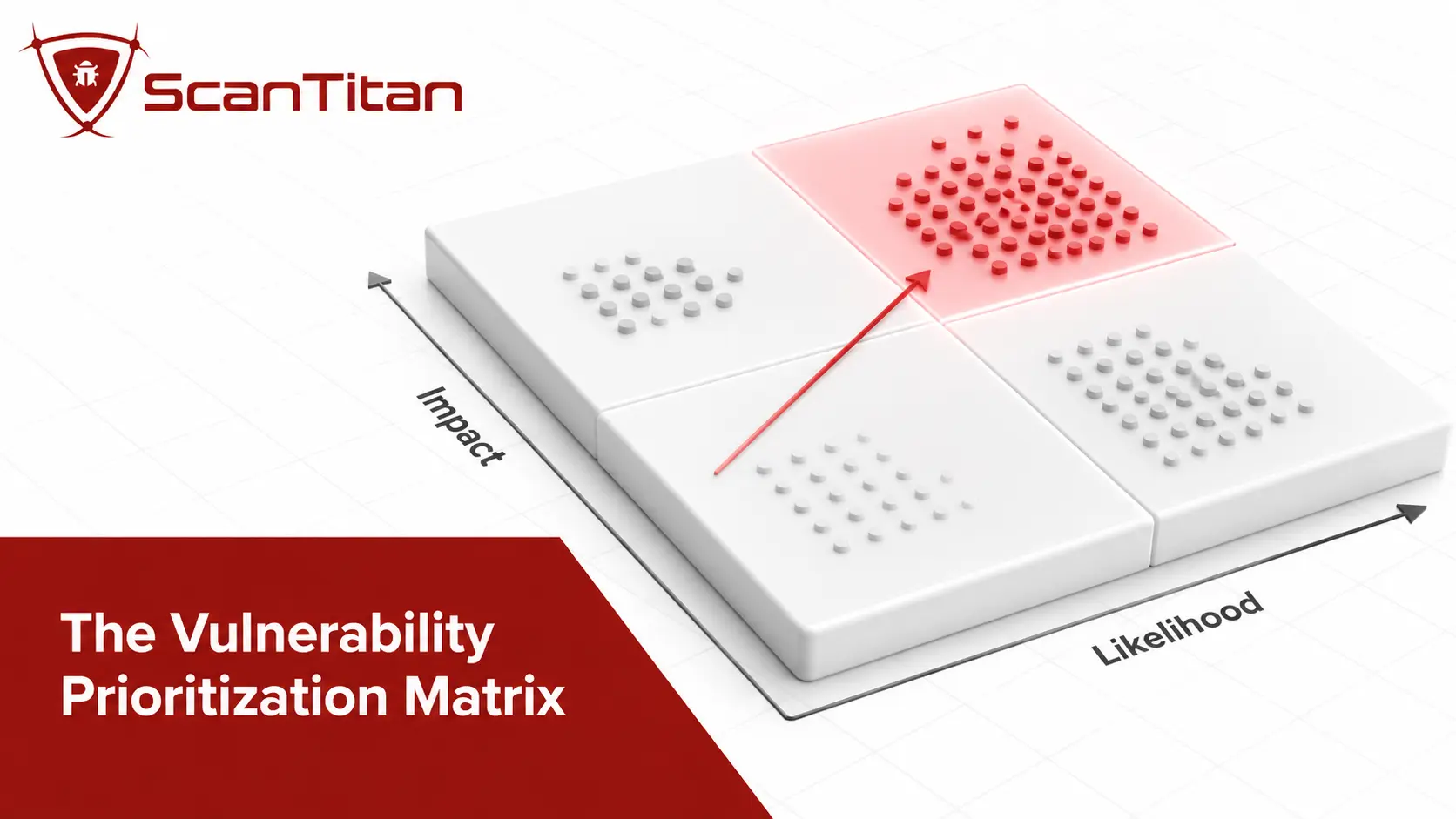
A vulnerability prioritization matrix is a simple grid that plots each finding by two axes, the likelihood of exploitation and the business impact if it happens, so priority becomes visible at a glance. High-likelihood, high-impact issues land in the top corner and get fixed first; low-likelihood, low-impact issues sit at the bottom and can be scheduled or monitored. The value of the matrix is not mathematical precision. It is communication: it turns a spreadsheet of CVEs into a picture a non-technical stakeholder can read, which is what you need when you are justifying why a “critical” was deprioritized or asking for time to fix a “medium.” Build it from the combined signals above, review the placement with asset owners, and use it to anchor your risk tiers and SLAs.
How Do You Set Remediation SLAs and Measure MTTR?
Priority without a deadline drifts, so pair every risk tier with a remediation service-level agreement (SLA). As an example internal SLA model, many teams use a tiered approach: actively exploited or internet-facing critical issues in days, high-risk issues within roughly 30 days, medium within 60 to 90, and low on a scheduled basis or by exception. Tighten the top tier for anything with observed exploitation. Treat these as a starting template rather than a universal standard, and note that regulatory, contractual, vendor, or emergency-response requirements can override your internal SLA targets. To know whether the SLAs are working, measure mean time to remediate (MTTR), the average time from when a vulnerability is detected to when it is verified fixed. Track MTTR by tier rather than as a single number, because a healthy critical-tier MTTR can hide a low-tier backlog, and a rising MTTR is an early warning that your team is falling behind the inflow. Report it alongside SLA compliance so leadership can see both speed and coverage.
When Should You Patch, Mitigate, or Accept the Risk?
Not every vulnerability gets patched, and pretending otherwise is how backlogs grow. There are three legitimate responses, and choosing well is part of prioritization. Patch when a fix exists and can be deployed safely; it is the cleanest outcome and the default for anything high-risk or exploited. Mitigate when you cannot patch yet, using a compensating control, a firewall or network rule, a WAF signature, disabling a feature, or a configuration change, to shrink the exposure while a proper fix is scheduled. Accept the risk only when the likelihood and impact are genuinely low and remediation would cost more than the risk warrants, and only through a documented process: write down the rationale, have the accountable risk owner approve it, set an expiry date, and put a review on the calendar. An accepted risk with no expiry is not a decision, it is a forgotten problem waiting to resurface.
Your organization’s risk appetite shapes these decisions directly. It influences which risks can be accepted at all, who must sign off on an acceptance, how long an exception is allowed to stay open, and how strict the remediation SLAs are for important systems. A business with a low risk appetite for customer-data systems will demand faster fixes and higher approval authority for any exception on them, while a higher tolerance elsewhere may allow longer timelines. Whatever the appetite, risk acceptance should still be documented, owned, approved, reviewed, and time-limited, so tolerance never quietly turns into neglect.
How Does Threat Intelligence Improve Prioritization?
Threat intelligence is what turns a static severity list into a live risk picture. By telling you which vulnerabilities attackers are exploiting right now, through the KEV catalog, exploit-likelihood data, and threat feeds, it lets you move active threats to the front of the queue even when their severity score has not changed. A medium-rated CVE that suddenly appears in a ransomware campaign is no longer a medium priority. This is the core of vulnerability and threat intelligence: enriching each finding with real-world exploitation context so prioritization reflects what is actually happening in the wild, not just what a scanner calculated in isolation. The caveat is that intelligence only helps when paired with your environment: a CVE trending globally still needs to be reachable and reach something valuable in your estate before it earns the top of your list.
Read More: Threat Intelligence vs Vulnerability Management: What Is the Difference?
What Are Common Vulnerability Prioritization Mistakes?
Most prioritization failures come from a handful of repeatable habits. Avoid these.
- Sorting by CVSS alone. A high base score on an unreachable asset is not more urgent than a medium on an internet-facing one; severity without context is misleading.
- Ignoring exposure and reachability. A vulnerability an attacker cannot reach is a very different risk from one sitting on the public internet.
- Overlooking chained low findings. Attackers combine minor issues into a real path, so scoring each finding in isolation misses the most dangerous combinations.
- Skipping owners and SLAs. A ranked queue with no deadlines and no accountable owner tends to stay a queue.
- Trying to patch everything. Chasing every alert burns out the team and still leaves the important issues unaddressed; precision beats volume.
- Forgetting accepted risks. Risk acceptance without an expiry date and a review quietly turns into permanent, unmanaged exposure.
Which Tools Help You Prioritize Vulnerability Remediation?
Tools do not replace judgment, but they make prioritization repeatable at scale. A vulnerability assessment or scanner finds the issues and, increasingly, enriches them with exposure and exploit context. Risk-based prioritization platforms consolidate findings from multiple scanners, add environmental context, and produce a single ranked queue with ownership and remediation guidance. Threat intelligence feeds, including the CISA KEV catalog, keep the ranking aligned with active exploitation. Ticketing systems such as Jira and ServiceNow route findings to the engineers who fix them, and continuous vulnerability scanning keeps the inventory and the queue current between cycles. ScanTitan’s Vulnerability and Threat Intelligence is designed to enrich detected vulnerabilities with exploitation context and prioritization signals so smaller teams can focus on what genuinely matters, with contextual evidence and remediation guidance where available.
Can Vulnerability Prioritization Be Automated?
Much of the work can be automated, and automating the repetitive parts is what frees a small team to spend its judgment where it counts. Automation handles enrichment well: pulling in CVSS, EPSS, KEV status, and exploit availability for every finding; deduplicating the same issue across tools; attaching asset ownership and exposure context; assigning a risk tier; routing findings into Jira or ServiceNow; tracking SLAs; re-prioritizing automatically when threat or exposure data changes; and driving retesting workflows. What automation should not decide on its own is the judgment-heavy part: business impact, the risk of a given change, whether a compensating control is adequate, exception approval, and formal risk acceptance. Those need an accountable human. The right model is automation for the enrichment, scoring, and routing, with people owning the decisions that carry business consequences.
Frequently Asked Questions
How do you decide which vulnerabilities to fix first?
Rank by real risk, not severity alone. Fix anything with observed exploitation that applies to your environment (on the CISA KEV list) first, then high exploit-likelihood issues on exposed, high-value assets, then work down by combined severity, exposure, and business impact. A vulnerability that is reachable, exploitable, and near sensitive data outranks a higher-scored one that is isolated.
How do you prioritize two vulnerabilities with the same CVSS score?
Equal severity does not mean equal organizational risk, so compare the context around each: exploitation evidence, EPSS, exploit availability, network exposure, runtime evidence where available, identity permissions, sensitive-data access, asset criticality, compensating controls, and remediation urgency. The finding that is reachable, exploitable, and close to sensitive data on a critical asset wins the higher priority.
What is a good remediation SLA?
There is no universal number, but a common example model is days for actively exploited or internet-facing critical issues, around 30 days for high-risk, 60 to 90 days for medium, and scheduled handling for low. What matters most is that each tier has a written, owned, and enforced deadline tied to risk, and that regulatory, contractual, or emergency requirements can override it.
What is MTTR in vulnerability management?
MTTR, or mean time to remediate, is the average time from when a vulnerability is detected to when the fix is verified. Tracking it by risk tier shows whether your program is keeping pace with new findings and where remediation is stalling.
Should you always patch critical CVSS vulnerabilities first?
No. A critical CVSS score on an unreachable or low-value asset can be a lower real-world priority than a medium-rated flaw on an internet-facing system with access to sensitive data. Use CVSS as a baseline, then apply exploitability and environmental context.
Can vulnerability prioritization be automated?
Much of the enrichment, scoring, routing, and SLA tracking can be automated, which handles the repetitive work at scale. Business impact, change risk, compensating controls, exception approval, and formal risk acceptance still need accountable human decisions, so the best approach automates the mechanics and keeps people on the judgment calls.
Does a KEV vulnerability always come first?
A KEV entry is a strong exploitation signal, but it still has to apply to a product and version actually present in your environment. When it does, treat it as high-priority and expedite applicability review and remediation; when the affected product is not present, it may not be relevant to you at all.
What is risk-based vulnerability management?
It is an approach that prioritizes remediation by the actual risk a vulnerability poses, combining severity with exploit intelligence, asset exposure, and business context, rather than treating every finding of the same severity as equal. Prioritization is its central activity.
How often should you re-prioritize?
Continuously where possible. Exposure, exploitation activity, and your own environment change daily, so a point-in-time ranking goes stale quickly. At minimum, re-prioritize when new critical or actively exploited vulnerabilities appear, after major deployments, and when assets change exposure.
Reviewed by Obaida Al-Sulaiman, Information Security Manager, ScanTitan. CISSP, GXPN, GCIH, GWAPT, CISA, CEH, ISO 27001 Lead Auditor. Obaida leads offensive and defensive security assessments across ScanTitan’s vulnerability scanning, malware, and attack surface work.