
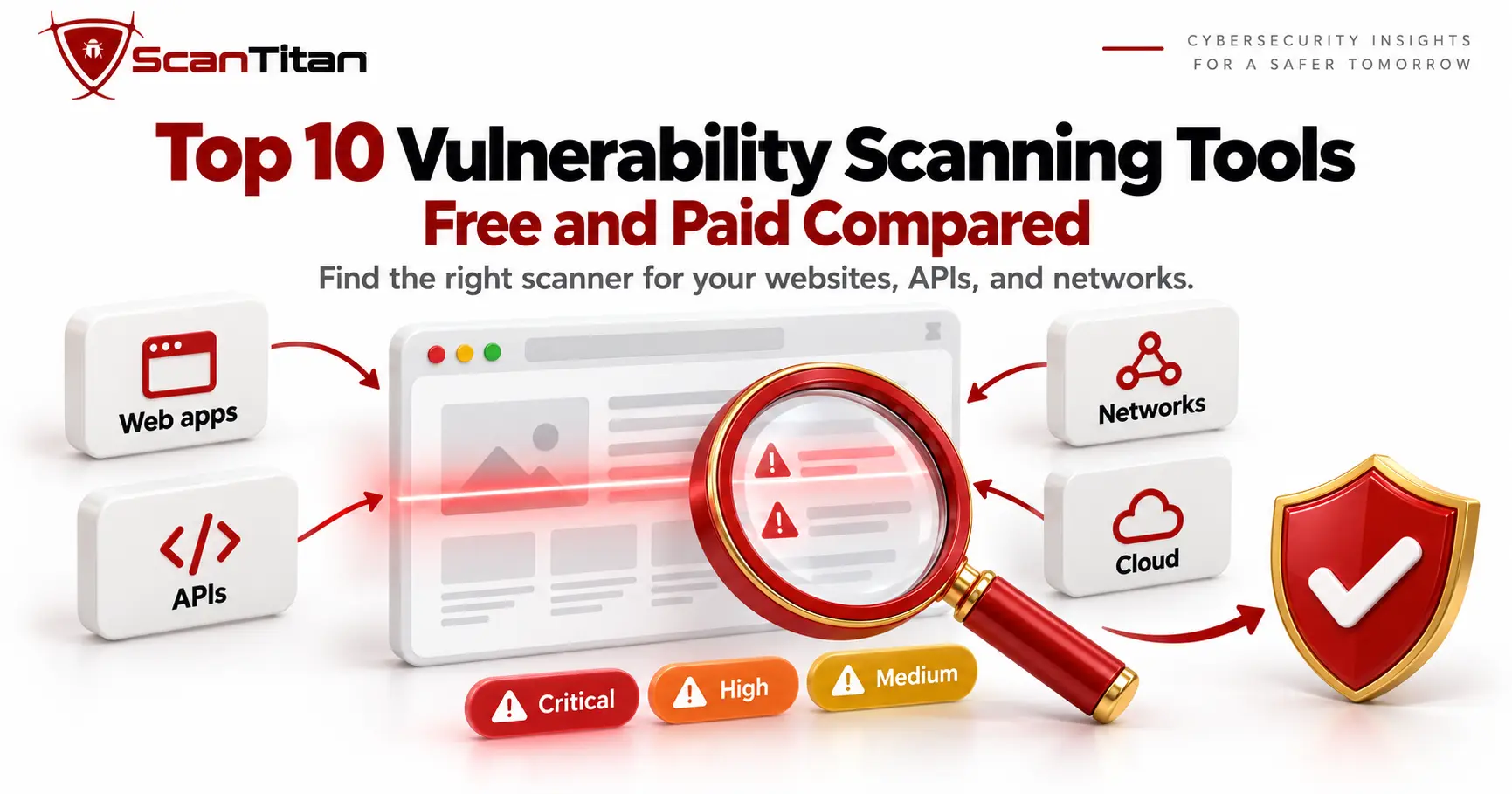
The best vulnerability scanning tools in 2026 depend on what you need to scan. ScanTitan, Intruder, and HostedScan serve small teams that want cloud scanning without a security department, Tenable Nessus, Qualys VMDR, and Rapid7 InsightVM cover servers and networks, and Invicti, Burp Suite DAST, and Detectify test running web applications. This guide compares ten scanners by scan type, free options, and fit, then shows how to choose one, how often to run it, and what to do with the results.
Disclosure
ScanTitan is our product and sits first in the list. We did not run a benchmark, and we state its limits like every other tool.
Vulnerability scanning tools comparison table
The table below summarizes the ten scanners by best use, scan focus, Gartner Peer Insights rating, and free option. It is not a ranking, and ScanTitan sits first only because it is our product. A rating of n/a means we did not confirm a Gartner rating for that product in our October 2026 check, and a free option marked not confirmed means we could not verify one from the vendor or OWASP. Gartner states that its Peer Insights content consists of individual opinions, so read the star counts as a sentiment signal. Use the table to build a shortlist of two or three tools, then run each against the same target before you pay for anything.
| Tool | Best for | Scan focus | Gartner Peer Insights | Free option |
|---|---|---|---|---|
| ScanTitan | SMBs needing web, API, network | Authenticated DAST, API, CMS, network | n/a | Free scan, no credit card |
| Tenable Nessus | Servers and networks | Network and host, credentialed and non-credentialed | 4.6 (684 ratings) | Free Essentials tier with a small IP cap |
| Qualys VMDR | Large asset fleets | Assets, network, host, cloud | 4.4 (531 ratings) | Not confirmed |
| Rapid7 InsightVM | Ticket-driven remediation | Network and host with risk scoring | 4.3 (744 ratings) | Free trial listed by OWASP |
| Invicti | Large web application portfolios | Web application and API DAST | n/a | Limited free version of Acunetix |
| Burp Suite DAST | Engineer-tuned web scans | Scheduled and CI/CD web scanning | n/a | Community Edition, manual tools only |
| Detectify | External web assets | Web vulnerabilities and surface monitoring | n/a | Not confirmed |
| Pentest-Tools.com | Pentest-style web checks | Website Scanner with OWASP Top 10 tests | n/a | Free tier listed by OWASP |
| Intruder | Small teams, continuous scans | External network, cloud, web | 4.7 (102 ratings) | Not confirmed |
| HostedScan | Low-budget recurring scans | Network, server, web via open-source engines | n/a | Free-forever tier listed by OWASP |
Quick answer: which vulnerability scanning tool should you pick?
Pick the scanner that matches your asset mix, not the vendor with the biggest logo. Choose an infrastructure scanner such as Nessus or Qualys VMDR if most of your risk sits in servers, network devices, and endpoints. Choose a web application scanner such as Invicti or Burp Suite DAST if your risk sits in custom code. Choose a cloud scanner such as ScanTitan, Intruder, or HostedScan if you run a small team with a public website, an API, and a few cloud accounts. The UK National Cyber Security Centre (NCSC) recommends a layered approach: start with general scanning, then add specialised scanners where your estate needs them. If you remember one rule, scan before you buy. A free scan against your own domain shows which category you need.
What are vulnerability scanning tools and how do they work?
Vulnerability scanning tools are automated programs that probe systems for known weaknesses and report each one with a severity score. A scanner first discovers assets: live hosts, open ports, web pages, and API endpoints. It then fingerprints the software it finds and matches version numbers against CVE (Common Vulnerabilities and Exposures) records, and it sends test requests to confirm flaws such as SQL injection or cross-site scripting (XSS). Each finding receives a CVSS (Common Vulnerability Scoring System) score from 0 to 10. After attackers began exploiting Log4Shell (CVE-2021-44228, CVSS 10.0) in December 2021, a scanner with a Log4Shell check could list every exposed Java server running a vulnerable version. Tools that test running web applications from the outside are called DAST (Dynamic Application Security Testing) scanners.
Types of vulnerability scanning tools
NCSC splits the market into infrastructure scanners and application scanners, and Safe Security names three families: network, web application, and host-based. In practice a buyer meets six types.
Use infrastructure scanners
Use them to find live hosts, open ports, and outdated services. They suit estates built from off-the-shelf software, and teams run them from outside and from inside, as the guide to internal and external vulnerability scanning explains. A network scanner such as the ScanTitan network vulnerability scanner belongs here.
Run web application scanners (DAST)
Use them to crawl a site, submit crafted input, and read the responses for SQL injection, XSS, server-side request forgery (SSRF), and weak configuration. They find flaws in custom code that infrastructure scanners cannot see.
Apply API scanners
Use them when your product exposes REST or GraphQL endpoints. A dedicated API vulnerability scanner imports an OpenAPI or Swagger file and tests authorization and injection on every endpoint. Our OWASP API Top 10 guide explains the ten risks that such a scanner should cover.
Deploy host-based scanners
Use them when you need to log in to operating systems and check patch levels, local configuration, and installed packages.
Add cloud scanners
Use them to inspect cloud accounts for open storage buckets, weak identity policies, and exposed metadata endpoints.
Keep code and container scanners (SAST and SCA)
Run them in your build pipeline. They read source code and dependencies, which is a different job, so this guide excludes them.
How we chose the top 10 vulnerability scanning tools
NCSC publishes the questions a buyer should ask every vendor, and we adapted them into seven checks. We did not run a head-to-head benchmark. Our sources are vendor documentation, the OWASP DAST tool directory, Gartner Peer Insights ratings, and independent roundups we read in October 2026. ScanTitan is our product and sits first in the list, so we apply the same checks to it and state its limits.
- Confirm coverage. Ask whether the scanner tests the asset types you own, and whether a web scanner detects every category in the OWASP Top 10.
- Check authentication support. Ask whether the scanner can log in, because an unauthenticated scan never reaches member areas or admin panels. The guide to authenticated and unauthenticated scans shows what each one finds.
- Measure accuracy. Count false positives (reported flaws that do not exist) and false negatives (real flaws the scanner misses) on a target you already know.
- Test responsiveness. Ask how quickly a newly disclosed CVE reaches detection. NCSC expects a few days at most for critical issues.
- Review reporting. Open a sample report and check that it shows the affected URL, severity, evidence, and a fix.
- Verify integrations. Confirm that findings reach Jira, Slack, or your CI/CD pipeline without manual export.
- Compare cost models. Note whether the vendor charges per scanner, per asset, or per subscription tier.
Top 10 vulnerability scanning tools in 2026
ScanTitan is listed first because this is our guide, and we say so up front: the order is not the result of a benchmark. The other nine are grouped by what they scan, from infrastructure to web applications to small-team tools, because the best infrastructure scanner and the best web scanner solve different problems. Gartner Peer Insights lists 134 products in its vulnerability assessment market, and its ratings reflect the opinions of individual end users rather than a lab benchmark, so we treat them as one signal only. Ratings were checked in October 2026. Where a vendor does not publish a price, we say so. Each entry names who the tool suits and who should skip it.
ScanTitan: Best for SMBs that want web, API, and network scanning in one platform
Our product

ScanTitan is a website vulnerability scanner that provides authenticated DAST for web applications, APIs, JavaScript single-page apps, and internal networks, and it matches detected software versions against CVE data that it refreshes daily. Each confirmed finding ships with the HTTP request, the server response, and a screenshot, so a developer can reproduce the flaw before fixing it. ScanTitan offers a free scan with no credit card, and paid plans start at $119 a year, billed yearly. It covers WordPress, Drupal, and Joomla through dedicated scanners: the WordPress vulnerability scanner, the Drupal vulnerability scanner, and the Joomla vulnerability scanner. It is listed in the OWASP vulnerability scanning tools directory as a commercial SaaS DAST tool with limited free capability. It does not perform SAST or software composition analysis, and it does not replace a manual penetration test.
Choose it if
You want web application, API, CMS, and network scanning in one dashboard, with evidence for every finding and a free scan to test it first.
Skip it if
You need manual penetration testing with human-written attack narratives, or SAST and software composition analysis of your source code.
Tenable Nessus: Best for network and host scanning
Tenable Nessus is a vulnerability scanner that detects software flaws, misconfigurations, missing patches, and malware across operating systems, devices, and applications, according to its Gartner Peer Insights listing. It supports credentialed and non-credentialed scans, so an analyst can compare what an outside attacker sees with what a logged-in user sees. Gartner shows Nessus at 4.6 stars from 684 ratings. Tenable licenses Nessus per scanner and sells web application scanning as a separate product. When we checked, review sites quoted Nessus Professional anywhere from about $2,600 to $4,790 per year, so confirm the price in Tenable’s store.
Choose it if
You need broad coverage across servers, network devices, and endpoints.
Skip it if
Custom web applications are your main exposure.
Qualys VMDR: Best for large asset fleets
Qualys VMDR is a cloud-based platform that combines asset discovery, vulnerability scanning, prioritization, and remediation workflows. Gartner Peer Insights lists it at 4.4 stars from 531 ratings. It scans with agents and without them, which suits fleets where laptops rarely touch the office network. Qualys sells by asset count on a quote basis, so the cost grows with your estate and you cannot price it from a public table.
Choose it if
You manage hundreds of servers and endpoints and need audit-ready reports for PCI DSS or ISO 27001.
Skip it if
You run a dozen web servers and one WordPress site, where the licensing and setup effort outweigh the benefit.
Rapid7 InsightVM: Best for ticket-driven remediation
Rapid7 InsightVM is a vulnerability management platform that ranks findings with an Active Risk Score built from threat intelligence, then sends remediation tasks to Jira and ServiceNow, per its Gartner Peer Insights description. It rates 4.3 stars from 744 ratings, the highest rating count in that market. Rapid7 also connects InsightVM to Metasploit, which lets a team test whether a flaw is exploitable, and OWASP’s directory lists a free trial.
Choose it if
Your team already works from tickets and wants risk-ranked queues.
Skip it if
You need deep web application testing, which Rapid7 sells separately as AppSpider.
Invicti: Best for large web application portfolios
Invicti, which also owns Acunetix, is a DAST scanner built for web applications and APIs. Safe Security’s review says Acunetix detects SQL injection and XSS and adds network scanning, and OWASP lists both products as commercial, with a limited free version of Acunetix. Geekflare’s 2026 roundup of web scanners names Invicti its pick for enterprise use. Check Invicti’s site for current pricing, because we could not confirm a public price list.
Choose it if
You test many custom web applications and want repeatable DAST in your pipeline.
Skip it if
Your site is a WordPress install with a few plugins, where a CMS-aware scanner finds the same plugin CVEs with less setup.
Burp Suite DAST: Best for security engineers who tune scans
Burp Suite DAST from PortSwigger, formerly Burp Suite Enterprise, runs scheduled and CI/CD scans across many sites, according to AIMultiple’s comparison of scanning tools. PortSwigger’s other editions differ: Community Edition is free but has no automated scanner, and Burp Suite Professional is licensed per user for penetration testers who test by hand. Many teams run Professional for manual work and the DAST edition for scheduled coverage.
Choose it if
A security engineer will tune scan scope and read the results every week.
Skip it if
Nobody has that time, because a scanner nobody tunes produces noise that developers learn to ignore.
Detectify: Best for external web asset scanning
Detectify is a SaaS scanner for websites and web applications that reports vulnerabilities, misconfigurations, and malware indicators in one dashboard, per Cybersecurity News’ 2026 roundup of web scanners. OWASP lists it as a commercial SaaS product, and Geekflare names it the best fit for small and medium businesses. Detectify also sells surface monitoring, which tracks subdomains and other exposed assets.
Choose it if
You want an attacker-view scan of public web assets with little setup.
Skip it if
You need to scan private network ranges, because Detectify focuses on what the internet can reach.
Pentest-Tools.com: Best for pentest-style web checks
Pentest-Tools.com is a cloud toolkit whose Website Scanner finds XSS using real browsers, server-side template injection, code injection with out-of-band detection, and other OWASP Top 10 flaws, according to OWASP’s tool directory, which also notes newer classes such as client-side prototype pollution. OWASP lists it as commercial or free. Its toolkit puts many separate tools behind one login, and Geekflare names it best for web penetration testing.
Choose it if
You run client assessments or pentest-style checks and want many tools behind one login.
Before you buy
Confirm the scheduling and ticketing limits of the plan you buy if you want a standing, scheduled program.
Intruder: Best for small teams that want continuous scans
Intruder is a cloud-based scanner that runs continuous scans across external networks, cloud assets, and web-facing systems, according to a 2026 comparison on Cyberpress. Gartner Peer Insights lists it at 4.7 stars from 102 ratings, and Geekflare names it the best pick for continuous scanning and for small to medium businesses. Intruder describes its platform as one place for vulnerability management, attack surface monitoring, and AI penetration testing.
Choose it if
You want an established scanner with a polished interface for a small team.
Before you buy
Confirm which plan includes web application scanning before you commit, because tiers differ.
HostedScan: Best for low-budget recurring scans
HostedScan bundles open-source scanning engines behind a hosted dashboard that covers networks, servers, and web applications, per Geekflare. OWASP’s directory notes a free-forever tier, which makes it one of the cheapest ways to get scheduled scans and a readable report for a customer or auditor. Because it builds on open-source engines, its detection quality follows the quality of those engines, and the dashboard adds scheduling, alerts, and reporting rather than a proprietary test library.
Choose it if
Budget is your main constraint and you need recurring scans.
Before you buy
Compare the free tier’s limits with your asset count before you rely on it.
Free and open source vulnerability scanning tools
Free scanners cost nothing to license, and they cost analyst hours instead. A two-person IT team that installs, updates, and tunes four open-source tools often spends more than it would on a hosted plan. These five are the ones teams meet most often.
- Run OpenVAS from Greenbone when you want a full network vulnerability scanner you control on your own Linux hardware. OWASP lists it as open source, and Safe Security notes its detection feed updates regularly.
- Use OWASP ZAP as an intercepting proxy and automated web scanner. It runs headless inside CI pipelines, carries an Apache-2.0 license, and is now sponsored by Checkmarx.
- Write Nuclei templates when your team is comfortable at the command line. ProjectDiscovery’s scanner runs fast checks defined in simple YAML files, which suits custom detections after a new CVE drops.
- Point Nikto at a web server to find dangerous files and outdated server software, as Geekflare describes. It is a quick first check, not a full web scanner.
- Script Nmap for host and service discovery. Its scripting engine adds vulnerability checks, according to Safe Security.
How to choose a vulnerability scanning tool
NCSC frames the decision as a sequence, and the order matters because each answer narrows the next. Follow these steps with your own asset list in hand.
- Identify every asset you own: servers, web applications, APIs, cloud accounts. Many vendors charge per asset, so an accurate count is the first number you need.
- Match a scanner type to your highest-risk assets. Custom web applications need a DAST scanner, while fleets of servers need an infrastructure scanner.
- Decide between software-as-a-service (SaaS) and on-premises. NCSC notes that a SaaS scanner cannot reach private networks unless you install an agent or open firewall rules, while an on-premises scanner needs your own patching and capacity.
- Test two shortlisted tools against the same staging target and compare false positives and missed flaws.
- Confirm the fix workflow: rescans after patching, ticket creation, and exportable evidence for auditors.
How often should you run vulnerability scans?
Run infrastructure scans at least once a month and immediately after you patch a critical issue, as NCSC advises, and scan web applications after every release. PCI DSS Requirement 11.3 sets a floor of quarterly internal scans and quarterly external scans by an Approved Scanning Vendor (ASV), and we treat that floor as a minimum, not a goal. Jerry Gamblin’s 2025 CVE Data Review counted 48,185 CVEs published in 2025, up 20.6% on 2024, which is roughly 132 new CVEs every day. A quarterly scan leaves roughly 90 days of blind exposure to everything disclosed in between. The guide to continuous vulnerability scanning shows how to schedule scans so new CVEs match your stack automatically.
Vulnerability scanning tools vs penetration testing
A scanner is automated and broad. A penetration tester is a person who chains weaknesses together to reach a goal such as database access. NCSC states that automated scanning cannot match manual testing for breadth and depth of coverage, and it adds that regular scanning clears the easy findings so penetration testers can focus on complicated issues. We agree with that split. Run a scanner every week to catch known flaws, then book a penetration test once a year or after a major architecture change. The comparison of vulnerability scanning vs penetration testing walks through scope, cost, and when each one is the right call. Skipping the scanner and buying only a pen test wastes the tester’s hours on issues a tool finds in minutes.
What to do with vulnerability scan results
A scan that nobody acts on is a report, not security. Gamblin’s review found that 18,987 of the 48,185 CVEs published in 2025, or 39.4%, were rated Critical or High, so a raw severity filter still leaves thousands of items. CVSS alone is a poor prioritization signal. A CVSS 7.0 flaw on your public checkout page deserves attention before a CVSS 9.0 flaw on an internal test server with no known exploit. Rank findings by exposure, by whether attackers are exploiting the CVE (CISA’s Known Exploited Vulnerabilities catalog shows this), and by the value of the asset. The walkthrough on how to prioritize vulnerability remediation gives a matrix a two-person team can apply in an afternoon. Rescan after every fix to confirm it worked.
Common mistakes when buying a vulnerability scanner
Most failed scanner purchases share the same few causes. One of them is treating a remote scan as complete coverage, because of what a remote scanner cannot see: server files, the database and scheduled tasks.
- Avoid buying for the logo. A team of five with one WordPress site and an API does not need an enterprise platform quoted per asset.
- Stop scanning only before audits. Researchers published roughly 132 new CVEs a day in 2025, and a yearly scan documents last year’s risk.
- Reject unverified findings. Ask vendors for the evidence behind each finding, such as the request and response, and drop tools that hand your developers a list of unproven alerts.
- Include authenticated scans. Scanning only the public login page misses the application behind it.
- Plan the fix workflow. Choose a tool that rescans and reports closure, otherwise every finding becomes a manual spreadsheet row.
Frequently asked questions
Are there free vulnerability scanning tools?
Yes. OpenVAS, OWASP ZAP, Nuclei, Nikto, and Nmap are open source and free to run, and several hosted products offer free tiers: OWASP’s directory lists HostedScan as free forever and notes limited free versions of Burp Suite and Acunetix. ScanTitan also offers a free scan with no credit card. The catch is time. Open-source tools need installation, updates, and tuning, and free tiers cap assets or features, so check the limits against your asset count before you build a process around one. For a quick first look at a public site, a hosted free scan finishes in minutes, while a self-built open-source stack can take days to configure.
Which vulnerability scanning tools scale best?
Platforms priced and built per asset scale best across large estates. Qualys VMDR and Tenable Vulnerability Management run as cloud services that add assets without new hardware, and Rapid7 InsightVM adds remediation projects that integrate with ticketing tools. NCSC notes the same pattern: SaaS scanners expand to meet demand without the cost of idle capacity, while on-premises scanners need extra hardware for peaks. For a small team, scale matters less than a clear per-asset price and a scanner that handles the first fifty assets without a consultant. Ask each vendor what happens to cost and scan time when your asset count doubles.
What tools are used for vulnerability scanning?
Teams combine tools by layer. Infrastructure scanning commonly uses Nessus, Qualys VMDR, InsightVM, or OpenVAS. Web application testing uses Invicti, Acunetix, Burp Suite, or OWASP ZAP. Smaller teams reach for cloud scanners such as Intruder, HostedScan, Detectify, or ScanTitan, and Nmap often sits underneath for host discovery. NCSC recommends a general scanner first and specialised scanners later, so most mature programs run two or three tools rather than one. Which layer you start with depends on where your risk sits: servers, custom code, APIs, or cloud accounts. Map your assets before you shop, because that map decides the tool type.
Do vulnerability scanning tools replace asset inventory tools?
No. A scanner finds weaknesses on the assets it can see, while an asset inventory records what you own. Some platforms, including Qualys VMDR and Rapid7 InsightVM, include discovery and tagging, and NCSC advises keeping an asset register so you pick the right scanner type and estimate per-asset cost. If your inventory is incomplete, your scans are incomplete, because a scanner never reports on a server it was not told about. A forgotten staging subdomain with an old CMS version is the classic example: nobody scans it, and an attacker finds it first. Pair scanning with regular asset discovery, even a simple spreadsheet reviewed monthly.
What are the best tools for cloud vulnerability scanning?
Look for scanners that read cloud accounts directly. Cloud scanners check for open storage buckets, public databases, exposed metadata endpoints, and weak identity policies across AWS, Azure, and GCP. ScanTitan includes a cloud vulnerability scanner for these checks, and open-source Prowler, listed by OWASP, scans AWS, Azure, GCP, and Kubernetes. Pair a cloud scanner with an external web scanner, because misconfigured cloud assets and vulnerable web applications fail in different ways. A public S3 bucket never appears in a web crawl, and a SQL injection flaw never appears in a cloud configuration audit, so each layer needs its own check.
How much do vulnerability scanning tools cost?
Pricing falls into four models: free and open source, a per-scanner license, a per-asset quote, and a subscription tier. Tenable licenses Nessus per scanner, and Qualys quotes by asset count. Published figures disagree across review sites, so we do not repeat them. We found Nessus Professional listed from about $2,600 to $4,790 per year, a gap that shows why you should verify any price with the vendor. Ask what the price includes: support, plugin or signature updates, web application scanning, authenticated scans, and compliance reports. A cheap license that excludes the module you need costs more than a fair price that includes it.
Where ScanTitan fits, and where it does not
ScanTitan fits SMBs and mid-market teams that want web application, API, CMS, and network scanning in one dashboard, with evidence for every finding and a free scan to test it first. It also fits teams that need CVSS-ranked results and audit-ready exports mapped to PCI DSS Requirement 11.3, ISO 27001, SOC 2, and GDPR. It does not fit teams that need manual penetration testing with human-written attack narratives, because a scanner cannot chain flaws the way a tester does. It also does not fit teams that need SAST or software composition analysis of source code, since ScanTitan tests running applications. If that describes you, pair ScanTitan with a code scanner and an annual pen test.
Run a free scan before you buy
Every comparison in this guide points to one conclusion: the right vulnerability scanning tool depends on your assets, and the fastest way to learn your assets is to scan them. Run a free scan against your own domain and compare the findings with what any shortlisted tool reports. Create a free ScanTitan account to see prioritized findings with the request and response behind each one, then review ScanTitan pricing if you want continuous scanning, authenticated scans, or compliance exports. Share the report with your developers and your auditor so everyone starts from the same evidence. A scan that takes minutes tells you more than a month of vendor demos.
Sources. NCSC, “Vulnerability scanning tools and services” (2021); OWASP, Vulnerability Scanning Tools directory; Gartner Peer Insights, Vulnerability Assessment market (checked October 2026); Jerry Gamblin, “2025 CVE Data Review” (January 2026); PCI Security Standards Council, PCI DSS Requirement 11.3.