
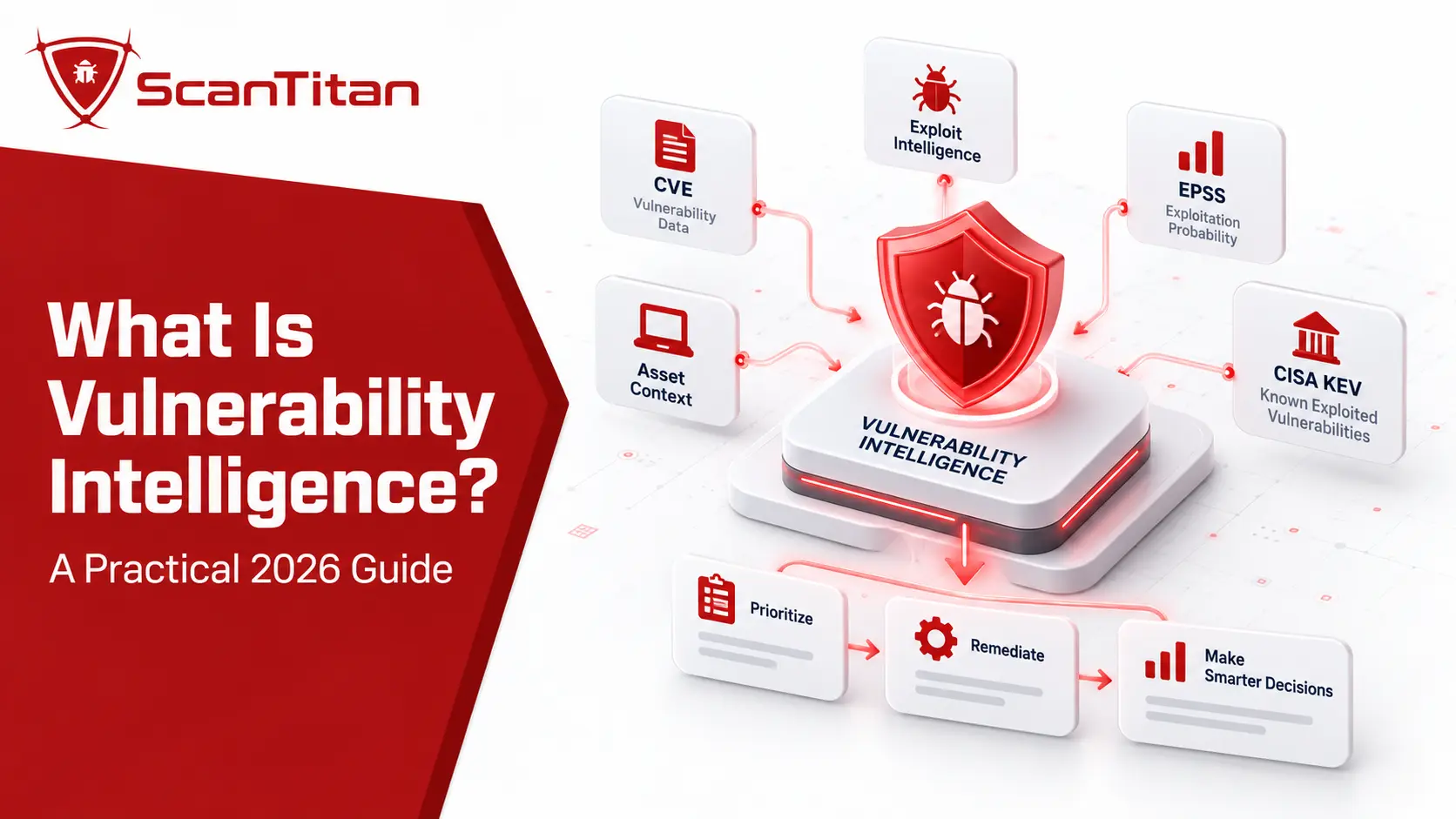
Vulnerability intelligence is the process of turning raw vulnerability data into decisions about what to fix first. It combines CVE records with exploit activity, technical severity, affected products, patch status, threat context, and your own asset exposure. That matters more in 2026 because Verizon reports vulnerability exploitation as the initial access path in 31% of breaches, while NIST has changed NVD enrichment to prioritize higher-risk CVEs. This guide explains the full intelligence lifecycle, the signals that matter, and how to apply them without treating every CVE as equally urgent.
Quick answer
Vulnerability intelligence is the continuous collection, validation, enrichment, contextualization, and prioritization of information about known and emerging vulnerabilities. It goes beyond a CVE ID or severity score by asking whether exploitation is occurring, whether exploit code exists, what products and versions are affected, whether a fix or mitigation is available, and whether the vulnerable asset matters in your environment. Its purpose is not to create a bigger vulnerability list. Its purpose is to create a better remediation decision.
What Is Vulnerability Intelligence?
Vulnerability intelligence is a specialized form of security intelligence focused on understanding which software and hardware weaknesses are relevant, exploitable, and urgent. A raw CVE record tells security teams that a vulnerability has been publicly identified. Vulnerability intelligence adds the context needed to act: affected products and versions, technical impact, exploit availability, evidence of exploitation, threat actor interest, patch or mitigation status, exposure, and business importance.
The key distinction is that vulnerability intelligence is a decision layer. It does not replace vulnerability scanning, the CVE Program, the National Vulnerability Database, or vendor advisories. It consumes information from those sources and combines it with threat and asset context. A vulnerability can therefore move from known to urgent without its CVE identifier changing. A public exploit may appear, CISA may add the flaw to its Known Exploited Vulnerabilities catalog, a vulnerable product may suddenly become internet-facing, or a compensating control may reduce exposure.
ScanTitan already has a broader guide to vulnerability assessment. The role of vulnerability intelligence is narrower: it improves the quality of the decisions made after vulnerabilities are discovered.
Why Vulnerability Intelligence Matters in 2026?
The problem is no longer simply that organizations have too many vulnerabilities to patch. The harder problem is that the available data is uneven, exploitation changes quickly, and a severity score cannot tell you whether a flaw affects an exposed asset in your environment. Verizon’s 2026 Data Breach Investigations Report says vulnerability exploitation accounted for 31% of breaches in its reporting dataset, overtaking credential abuse as the leading initial access vector for the first time in the report’s 19-year history.
The public vulnerability-data ecosystem is also changing under the weight of disclosure volume. NIST reported in April 2026 that CVE submissions increased 263% between 2020 and 2025, and submissions during the first three months of 2026 were nearly one-third higher than the same period in 2025. NIST therefore moved the NVD to a risk-based enrichment model that prioritizes KEV-listed vulnerabilities, software used by the federal government, and critical software. In June 2026, NVD feeds and APIs also began carrying CISA SSVC data and CVE affected-product information.
The 2026 lesson
A CVE being published does not guarantee that every public database will immediately contain the same depth of enrichment. Security teams need to understand the source and freshness of each signal instead of assuming one database is a complete vulnerability-intelligence feed.
What Types of Vulnerability Intelligence Are There?
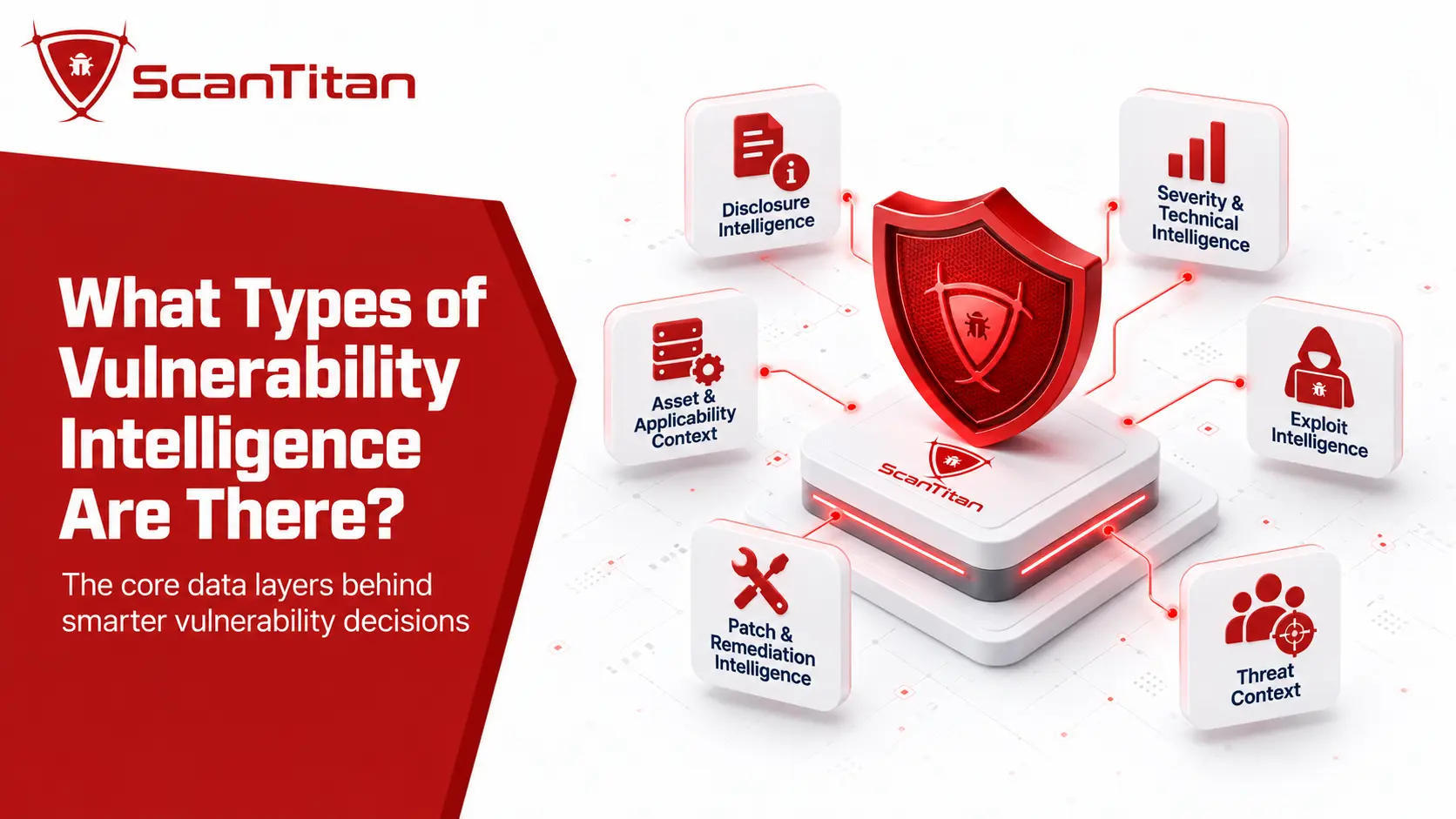
Vulnerability intelligence is often described as one feed, but in practice it contains several distinct layers. Separating them is useful because each layer answers a different part of the remediation question, and a provider that supplies only CVE descriptions is not delivering the same thing as one that tracks exploitation, patch reliability, and threat context.
| Type | What it adds | Example question |
|---|---|---|
| Raw vulnerability intelligence | CVE identity, affected products, references, weakness classification | What is the vulnerability and what versions are affected? |
| Exploit intelligence | PoC availability, exploit maturity, weaponization, observed exploitation | Can attackers exploit it now? |
| Threat-context intelligence | Actors, ransomware groups, campaigns, malware, targeting patterns | Who is using this vulnerability and against whom? |
| Patch and remediation intelligence | Fix versions, workarounds, mitigations, operational patch considerations | What is the safest available response? |
| Predictive intelligence | Signals estimating the probability of near-term exploitation | Which unexploited CVEs are more likely to be attacked soon? |
| Asset-context intelligence | Product presence, exposure, reachability, criticality, compensating controls | Does this vulnerability create meaningful risk for us? |
Bitsight and Group-IB both distinguish raw vulnerability feeds from exploit and threat-context intelligence, while Flashpoint emphasizes the difference between simply aggregating vulnerability records and researching, validating, and enriching them. The practical takeaway is vendor-neutral: useful vulnerability intelligence combines several layers rather than presenting every CVE as an equally meaningful alert.
What Data Should Vulnerability Intelligence Include?
A useful vulnerability record should answer identification, severity, exploitability, applicability, and response questions in one place. Not every field comes from the same authority. CVE supplies the canonical vulnerability record, NVD and other publishers may add enrichment, FIRST maintains CVSS and EPSS, CISA maintains KEV and its SSVC model, vendors publish affected versions and fixes, and intelligence providers may add exploit or threat-actor context.
| Signal | What it tells you | Important limitation |
|---|---|---|
| CVE | Canonical identifier and published vulnerability record | A CVE ID is not a severity, exploitability, or risk score |
| CWE | Weakness type or root-cause classification | Describes a class of weakness, not your exposure |
| CPE / affected-product data | Products and versions potentially affected | Matching quality depends on accurate product and version data |
| CVSS | Technical severity characteristics | Does not by itself know your asset importance or exposure |
| EPSS | Estimated probability of exploitation in the next 30 days | Not a severity or environment-specific risk score |
| CISA KEV | Evidence that a CVE is known to be exploited | It is a confirmed-exploitation subset, not a forecast of every future exploit |
| SSVC | Decision-oriented vulnerability response context | Requires stakeholder and environment context |
| Exploit availability | Whether PoC or working exploit material exists | Public code does not prove successful exploitation in your environment |
| Patch or mitigation status | Whether a fix, workaround, or compensating control exists | Availability does not prove the fix was deployed successfully |
| Threat context | Actors, campaigns, malware, targets, and observed usage | Coverage varies by intelligence source |
| Asset context | Reachability, ownership, business impact, runtime use, local controls | Must come from your environment, not a global feed |
The Vulnerability Intelligence Lifecycle
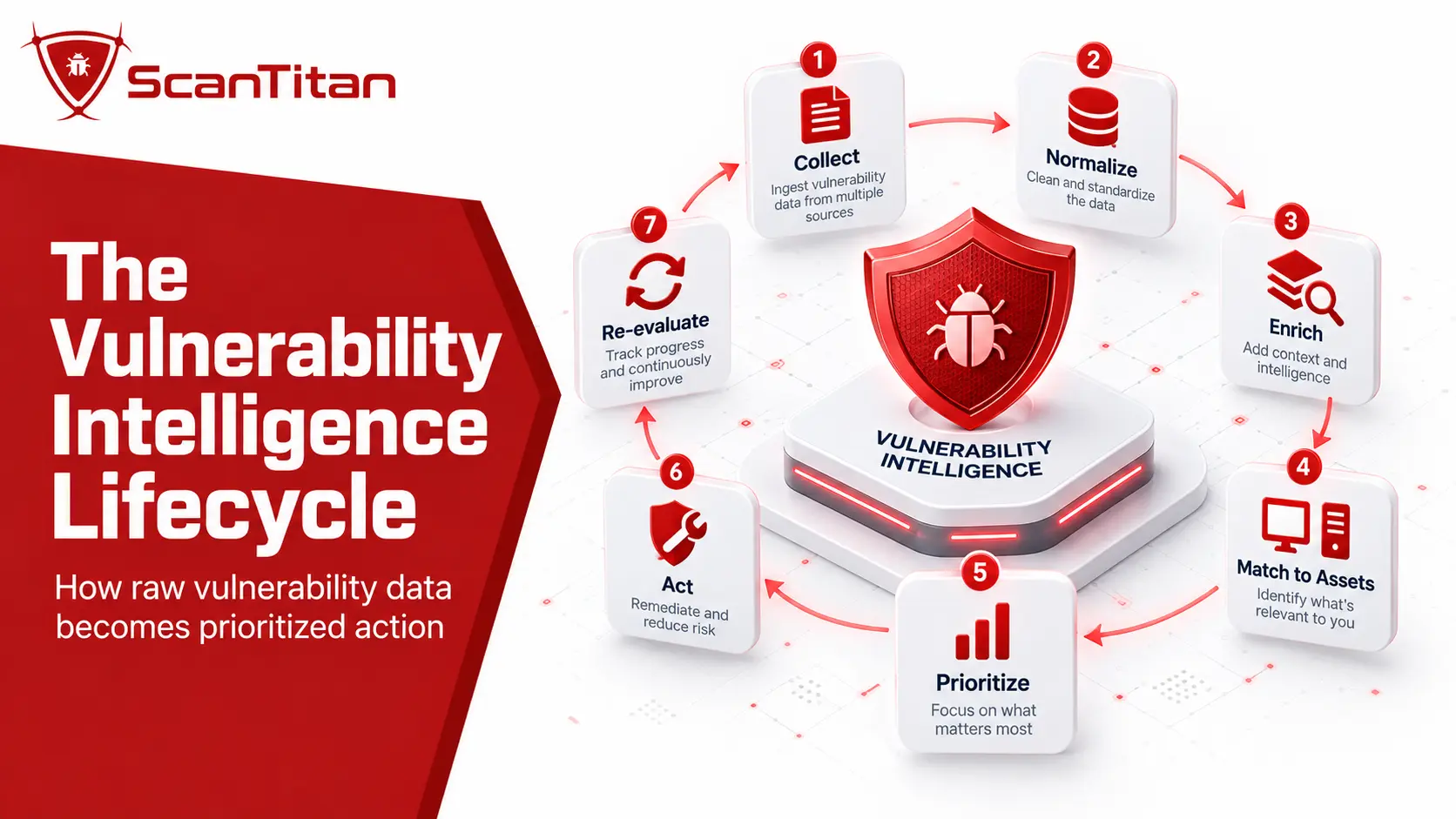
The strongest competitor pages describe vulnerability intelligence as a lifecycle rather than a database. Flashpoint emphasizes discovery, research, and analysis, while Group-IB adds contextualization, prioritization, remediation, and feedback. A practical operational model combines those ideas into six repeating stages.
1. Discover and collect vulnerability information
The first stage gathers disclosures from sources that do not all publish at the same speed or depth. That includes CVE records, NVD, vendor advisories, national CERTs, security researchers, code repositories, exploit repositories, mailing lists, bug trackers, and threat-intelligence sources. Discovery is broader than downloading the NVD feed because a vendor advisory or researcher disclosure may contain the most accurate affected-version or remediation details before third-party enrichment catches up. The objective is coverage with traceable provenance: every important claim should still point back to the source that published it rather than becoming an untraceable field copied across several aggregators.
2. Validate, normalize, and map the records
Collected vulnerability data has to be normalized before different feeds can be compared. Product names, version ranges, CVE references, duplicate disclosures, rejected records, and vulnerability states may be represented differently across sources. Good intelligence preserves the canonical CVE identifier while mapping the vulnerability to accurate affected-product information and resolving whether a record actually applies to a given product version. This stage also catches a common operational problem: a scanner or feed can identify a vulnerability correctly but map it to the wrong local asset because inventory data is stale, the product was renamed, or the installed version cannot be determined reliably.
3. Enrich the vulnerability with exploit and threat context
Enrichment turns the technical record into an intelligence record. Analysts and automation add CVSS metrics, EPSS probability, KEV status, exploit availability, exploitation evidence, threat-actor or malware associations, targeting patterns, patch status, and mitigations. The source of each signal matters. A public proof of concept means something different from CISA-confirmed exploitation, and underground discussion means something different from telemetry showing a campaign in progress. The goal is not to collapse all signals into one mysterious number. It is to preserve enough detail that a defender can understand why the priority changed and which evidence supports the change.
4. Contextualize against your assets and exposure
Global intelligence becomes organization-specific only when it is matched to the assets that actually exist in your environment. This stage asks whether the vulnerable product and version are present, whether the vulnerable function is enabled or reachable, whether the system is internet-facing, what privileges exploitation would provide, what data or business process sits behind it, and whether existing controls reduce the attack path. Two companies can receive exactly the same CVE intelligence and make different remediation decisions because one runs the vulnerable product on a public production gateway while the other has it on an isolated test system scheduled for retirement.
5. Prioritize and act
Prioritization combines technical severity, evidence or probability of exploitation, exposure, business impact, and remediation feasibility. The result should be an action rather than another score: patch immediately, apply a vendor mitigation, isolate the asset, disable a vulnerable feature, increase monitoring, schedule the change, or formally accept the residual risk for a defined period. Confirmed exploitation is a strong urgency signal when the affected product is actually present. High exploit probability can move a vulnerability forward before it appears in KEV. CVSS still contributes severity context, but it should not be the only field determining where engineering time goes.
6. Monitor, re-prioritize, and verify closure
Vulnerability intelligence is perishable because the state of a vulnerability changes. New exploit code can appear, a flaw can enter KEV, a patch can be revised, an asset can become externally exposed, or a compensating control can be removed. Intelligence therefore needs continuous monitoring and re-prioritization rather than quarterly refreshes. Remediation also has to be verified. A ticket marked complete is not proof that every affected instance was updated. Re-scan the relevant assets, confirm the vulnerable version or condition is gone, and retain the evidence needed to show why the issue was closed or why an exception remains valid.
How CVSS, EPSS, KEV, and SSVC Work Together
These four signals are often shown beside each other, but they were built for different purposes. CVSS v4.0 is an open framework for communicating vulnerability characteristics and severity. Its Base metrics describe intrinsic qualities, while Threat and Environmental metrics can reflect changing exploit conditions and the consumer’s environment. EPSS estimates the probability that a published CVE will be exploited in the wild within the next 30 days and is updated daily. CISA KEV identifies vulnerabilities with evidence of active exploitation. SSVC helps translate vulnerability characteristics into response decisions for a particular stakeholder.
| Signal | Question | Best use |
|---|---|---|
| CVSS | How severe are the vulnerability’s technical characteristics? | Severity baseline and technical comparison |
| EPSS | How likely is exploitation in the next 30 days? | Forecast-based ranking of disclosed CVEs |
| CISA KEV | Has exploitation been observed? | High-confidence trigger for expedited applicability review |
| SSVC | What response decision fits the stakeholder context? | Action-oriented prioritization |
FIRST explicitly warns that EPSS is not a complete risk score because it cannot know whether the vulnerable product exists in your environment, whether a compensating control is present, or what the business impact would be. The same principle applies more broadly: intelligence works by combining signals while preserving what each signal actually means. For a detailed operational workflow, see ScanTitan’s guide to prioritizing vulnerability remediation.
A Worked Example: When a Medium Vulnerability Comes Before a Critical One
Imagine two findings are discovered on the same day. Finding A has a CVSS Base score of 9.1 and affects an internal reporting library on a segmented test network. No relevant exploit activity is known, the vulnerable function is not exposed externally, and the system contains no sensitive production data. Finding B has a CVSS Base score of 6.4 and affects software on an internet-facing customer portal. It has been added to CISA KEV, has a high EPSS probability, and reliable public exploit material exists.
Sorting by CVSS alone puts Finding A first. Vulnerability intelligence changes the decision because it adds exploit evidence and environment context. Finding B now has confirmed exploitation, direct exposure, and a meaningful business path, so it receives expedited remediation. Finding A still needs a fix, but it can move into the normal patch cycle if the local controls and asset importance justify that timing. The lesson is not that medium vulnerabilities are more dangerous than critical ones. It is that severity and priority are different questions.
What Are the Main Sources of Vulnerability Intelligence?
No single source contains every field a mature program needs. The CVE Program supplies canonical identifiers and records; NVD provides enrichment and machine-readable services; vendors are often the best authority for affected versions, patches, and mitigations; CISA contributes KEV and SSVC; FIRST maintains CVSS and EPSS; researchers and exploit repositories reveal technical details and proof-of-concept material; and threat-intelligence sources can connect vulnerabilities to campaigns, malware, actors, or underground discussion.
| Source | Best use | What to verify |
|---|---|---|
| CVE Program | Canonical vulnerability identity and record | Record state, affected products, references |
| NVD | Structured enrichment, CVSS, CWE, affected data, SSVC feeds | Whether the record has been enriched and when |
| Vendor advisories | Affected versions, fixes, mitigations, product-specific guidance | Revision date and exact product applicability |
| CISA KEV | Known exploitation evidence | Applicability to your product and version |
| FIRST EPSS | Near-term exploitation probability | Current daily score and environment context |
| Researchers and exploit repositories | PoCs, exploit details, reproduction, technical analysis | Reliability, weaponization, and whether the code actually applies |
| Threat-intelligence sources | Actor, campaign, malware, targeting, underground signals | Source confidence and observation scope |
Flashpoint’s practitioner guide makes an important point here: vulnerability disclosures appear across many channels, so an intelligence feed built only from CVE and NVD may miss useful detail or receive it later. The answer is not to distrust authoritative databases. It is to treat them as foundational sources and supplement them with vendor and research data while maintaining provenance.
What Is Network Vulnerability Intelligence?
Network vulnerability intelligence applies the same intelligence process specifically to routers, switches, firewalls, VPN appliances, load balancers, wireless infrastructure, and other network or security devices. BackBox’s competitor page is centered on this narrower use case: inventory the exact vendor, device, and operating-system version; correlate that inventory with known CVEs; assess risk; and identify a remediation or mitigation that the network team can actually deploy.
The network context matters because patching infrastructure is not always as simple as updating a library. A firmware or operating-system update may require a maintenance window, compatibility validation, configuration backup, failover planning, and rollback. In some cases a vendor mitigation, such as disabling an exposed service or changing a configuration, can reduce risk before the permanent update is practical. Network vulnerability intelligence therefore needs both exploit context and operational remediation guidance.
Where Vulnerability Intelligence Fits in Vulnerability Management and CTEM
Vulnerability intelligence is an input to vulnerability management, not a replacement for it. Vulnerability management owns the full operational loop: asset inventory, scanning, validation, prioritization, remediation, exceptions, retesting, and metrics. Intelligence improves the prioritization and decision stages by supplying exploitability, threat, patch, and external-risk context. A company can buy excellent vulnerability intelligence and still have poor vulnerability management if nobody owns the findings or verifies fixes.
The same relationship applies to exposure management and Continuous Threat Exposure Management. Exposure management expands beyond CVEs to include misconfigurations, weak identities, exposed services, shadow assets, and other conditions attackers can use. Vulnerability intelligence helps decide which vulnerability-related exposures are most urgent, while exposure management adds the wider attack-path and business context. ScanTitan covers those boundaries in vulnerability management vs exposure management.
How Do You Evaluate the Quality of Vulnerability Intelligence?
The strongest competitor gap is not another definition. It is a practical way to judge whether an intelligence source is actually useful. A large vulnerability count can look impressive while providing little operational value if the data is late, duplicated, difficult to map to products, or missing the evidence behind its prioritization.
- Coverage: Does the source monitor the vendors, products, ecosystems, and disclosure channels you actually depend on?
- Timeliness: How quickly are new disclosures, exploit changes, KEV additions, and vendor updates reflected?
- Provenance: Can analysts trace important fields back to a vendor advisory, CVE record, government source, researcher, or observed telemetry?
- Product mapping: Can the feed accurately distinguish affected and unaffected versions and connect records to real inventory?
- Exploit context: Does it separate PoC availability, public exploit code, observed exploitation, and threat-actor discussion rather than treating them as one signal?
- Remediation context: Are fixes, mitigations, workarounds, and vendor guidance available and kept current?
- Transparency: Can the team understand why a vulnerability was prioritized rather than receiving an opaque score?
- Integration: Can the data flow into scanners, SIEM, SOAR, ticketing, asset inventory, or exposure-management workflows without manual re-entry?
Group-IB emphasizes SIEM and SOAR integration, Bitsight emphasizes automated CVE-to-product mapping and exploit prediction, Flashpoint emphasizes comprehensive discovery and metadata, and BackBox emphasizes exact device inventory and remediation. Those are different product approaches, but together they show what buyers should test: not how many feeds a vendor claims to ingest, but whether the intelligence improves an actual decision.
How Do You Put Vulnerability Intelligence Into Practice?
You do not need to build a threat-intelligence company inside your security team. A smaller organization can get most of the operational value by defining a few reliable sources, linking them to accurate asset data, and agreeing in advance how different signals change remediation urgency.
Intelligence only becomes action once you know whether you are affected, so scan your own website and match findings against the KEV and EPSS data above.
- Maintain an accurate asset and software inventory. Vulnerability intelligence cannot tell you what matters locally if you cannot tell which products and versions are running.
- Collect from authoritative sources first. Use CVE, vendor advisories, NVD, CISA KEV, FIRST EPSS, and relevant CERT or product-security sources as the baseline.
- Add exploit and threat context. Track exploit availability, exploitation evidence, actor or campaign associations, and credible research where they materially change urgency.
- Define prioritization rules. Combine severity, KEV, EPSS, internet exposure, runtime use, asset criticality, and compensating controls without pretending one field is a universal risk score.
- Map intelligence to action. Define when the response is patch, mitigation, isolation, increased monitoring, scheduled remediation, or time-limited risk acceptance.
- Automate enrichment and routing. Push context into the same queue engineers already use instead of creating another dashboard that analysts must manually reconcile.
- Re-prioritize continuously. Update priorities when KEV status, EPSS, exploit availability, exposure, or asset ownership changes.
- Verify remediation. Re-scan and confirm that the vulnerable condition is actually gone before closing the work item.
A continuous process works best when discovery is also continuous. ScanTitan’s guide to continuous vulnerability scanning explains how to keep the detection side current while intelligence and ownership drive the response.
Common Vulnerability Intelligence Mistakes
The biggest failures usually come from confusing more data with better intelligence. A feed can contain hundreds of thousands of records and still produce poor decisions if the team cannot tell what applies, what is exploited, what is exposed, or what action should follow.
- Treating CVSS Base as a priority queue: severity is important, but it does not know your exposure or business context.
- Treating EPSS as a complete risk score: FIRST explicitly says EPSS does not include your environment or impact.
- Treating every public PoC as active exploitation: exploit availability and observed exploitation are separate evidence levels.
- Assuming KEV means the product exists in your estate: confirmed exploitation still requires local applicability review.
- Using stale inventory: high-quality external intelligence cannot correct bad local product and version data automatically.
- Ignoring patch intelligence: knowing a vulnerability is urgent is incomplete if the team does not know the fixed version or viable mitigation.
- Failing to preserve provenance: analysts should be able to trace critical claims to their source rather than trust a copied field with no evidence.
- Collecting intelligence without ownership: intelligence reduces risk only when someone is responsible for acting on the decision.
Frequently Asked Questions
What is vulnerability intelligence in simple terms?
Vulnerability intelligence is information that helps a security team decide which vulnerabilities matter most. It takes raw vulnerability records and adds context such as exploit activity, affected versions, patch status, EPSS probability, CISA KEV status, threat activity, asset exposure, and business importance so the team can decide whether to patch, mitigate, monitor, or accept the risk.
What is VULINT?
VULINT is an abbreviation sometimes used for vulnerability intelligence. It refers to the same discipline: collecting, validating, enriching, and analyzing vulnerability information so it becomes useful for risk prioritization and remediation. The abbreviation is less standardized than terms such as CVE, CVSS, EPSS, or CTI, so it is better to define it the first time it appears.
What is the difference between vulnerability intelligence and threat intelligence?
Threat intelligence is broader and focuses on adversaries, campaigns, malware, infrastructure, indicators, and tactics. Vulnerability intelligence focuses on software and hardware weaknesses and the evidence that changes their priority, such as exploit availability, active exploitation, affected products, and local asset exposure. Vulnerability intelligence can use threat intelligence as one of its contextual inputs.
What is the difference between vulnerability intelligence and exploit intelligence?
Exploit intelligence focuses specifically on whether and how vulnerabilities can be exploited, including proof-of-concept code, exploit maturity, weaponization, exploit kits, and observed use. Vulnerability intelligence is broader. It also includes affected products, severity, patch status, predictive signals, threat context, and asset relevance. Exploit intelligence is therefore one component of a complete vulnerability-intelligence record.
What are the main sources of vulnerability intelligence?
Common sources include the CVE Program, NIST NVD, vendor security advisories, CISA KEV, FIRST EPSS, national CERTs, security researchers, exploit repositories, code repositories, and threat-intelligence sources. No single source contains every field, so mature programs correlate several while preserving the original source and update time for important claims.
Is CVSS enough to prioritize vulnerabilities?
No. CVSS communicates technical vulnerability characteristics and severity, and CVSS v4 can also incorporate Threat and Environmental metrics. But public Base scores alone do not know whether the affected asset exists in your environment, whether it is internet-facing, whether exploitation has been observed, or what the business impact would be. Use CVSS alongside exploit and asset context.
What is the difference between EPSS and CISA KEV?
EPSS estimates the probability that a published CVE will be exploited in the wild within the next 30 days and is updated daily. CISA KEV is a catalog of vulnerabilities with evidence of active exploitation. EPSS is predictive, while KEV is evidence-based confirmation. Neither replaces applicability and business context from your own environment.
How does vulnerability intelligence improve vulnerability management?
It improves the prioritization step. Scanners can discover many findings, but intelligence adds information about exploitability, active exploitation, affected products, patches, mitigations, and threat activity. When that information is matched to local exposure and asset value, vulnerability management can route engineering effort toward the findings most likely to create meaningful risk.
What is network vulnerability intelligence?
Network vulnerability intelligence applies vulnerability-intelligence methods to network and security devices such as routers, switches, firewalls, VPN appliances, and load balancers. It combines exact device and operating-system inventory with CVE applicability, exploit context, severity, and remediation or mitigation guidance so network teams can decide which device changes need priority.
How often should vulnerability intelligence be updated?
Continuously where possible. CVEs, exploit availability, EPSS scores, KEV status, patches, and asset exposure can change independently, so a quarterly intelligence snapshot becomes stale quickly. At minimum, re-evaluate priorities whenever a new relevant vulnerability appears, exploitation status changes, a vendor publishes a fix, or an asset becomes externally reachable.
Sources and Review Method
This guide prioritizes primary vulnerability-data and scoring authorities for factual definitions and current 2026 changes: the CVE Program for CVE records, NIST for NVD operations and enrichment, FIRST for CVSS and EPSS, CISA for KEV and SSVC, and Verizon for the 2026 breach-entry statistic. Competitor pages from BackBox, Group-IB, Flashpoint, and Bitsight were used to identify search intent, terminology, lifecycle models, product-specific viewpoints, and content gaps rather than as the sole authority for standards or government data.