Path traversal statistics depend on what is counted, because “path traversal” is a weakness type and not a field you can filter in CISA or CVE data: in ScanTitan’s count of CISA’s Known Exploited Vulnerabilities catalog, 6.2% of entries (110 of 1,769) are path traversal flaws by weakness tag or wording, and the share of entries added each year fell to 2.7% in 2023 before climbing back to 7.8% in 2025 and 7.0% in 2026 so far. These flaws let an attacker read or write files outside the folder an application is meant to use, and 39.1% of the entries say so in their description, against 4.4% of other entries. CISA flags 34.5% of them as used in ransomware, against 19.5% of other entries, and since 2023 they took a median 52 days to reach the catalog after the CVE was published, against 15 days for other entries. Most pages on this topic repeat one or two vendor figures from 2024. This research counts the exploited catalog, labels vendor figures, and says where a popular number does not hold up. Data last checked: 19 November 2026.
Key Path Traversal Statistics for 2026
Executive Benchmark: Path Traversal Statistics for 2026
| Metric | Latest figure | Period | Trend / context | Source |
|---|---|---|---|---|
| CISA catalog entries that are path traversal flaws | 6.2% (110 of 1,769) | Added 2021 to 6 Nov 2026 | 5.9% (104) carry a path traversal weakness tag | CISA KEV feed, counted by ScanTitan |
| Path traversal entries added per year | 20 | 2026 to 6 Nov | 5 in 2023, 10 in 2024, 19 in 2025 | CISA KEV feed, counted by ScanTitan |
| Directory traversal entries in CISA’s catalog | 55 | 2 May 2024 | ScanTitan’s tag count for the same date is 56 | CISA and FBI |
| Path traversal rank in MITRE’s CWE Top 25 | 6th (10 CVEs in KEV) | 2025 list | 5th last year | MITRE |
| Share of all CVEs that carry the path traversal weakness CWE-22 | 1.5% (6,552 of 428,385) | NVD, queried 19 Nov 2026 | 4.6% of CISA catalog entries carry CWE-22 | NVD CVE API, counted by ScanTitan |
| Path traversal share of vulnerabilities in open source projects | 2.7% | 2024 to Nov | 3.5% in closed source projects, up from 1.9% in 2023 | Aikido, vendor-only |
| Path traversal attacks blocked in one month | 4,213 | September 2024 | About 55.8 thousand attacks blocked in total | Contrast Security, vendor-only |
| Vulnerable open source projects found in a GitHub study | 1,756 | Study posted May 2025 | 14% of reported cases were fixed after disclosure | arXiv 2505.20186 |
| Median days from CVE publication to CISA listing | 52 | Added 2023 to 6 Nov 2026 | 15 days for other entries | CISA KEV feed and CVE Services API, counted by ScanTitan |
Methodology: Four Ways to Count Path Traversal
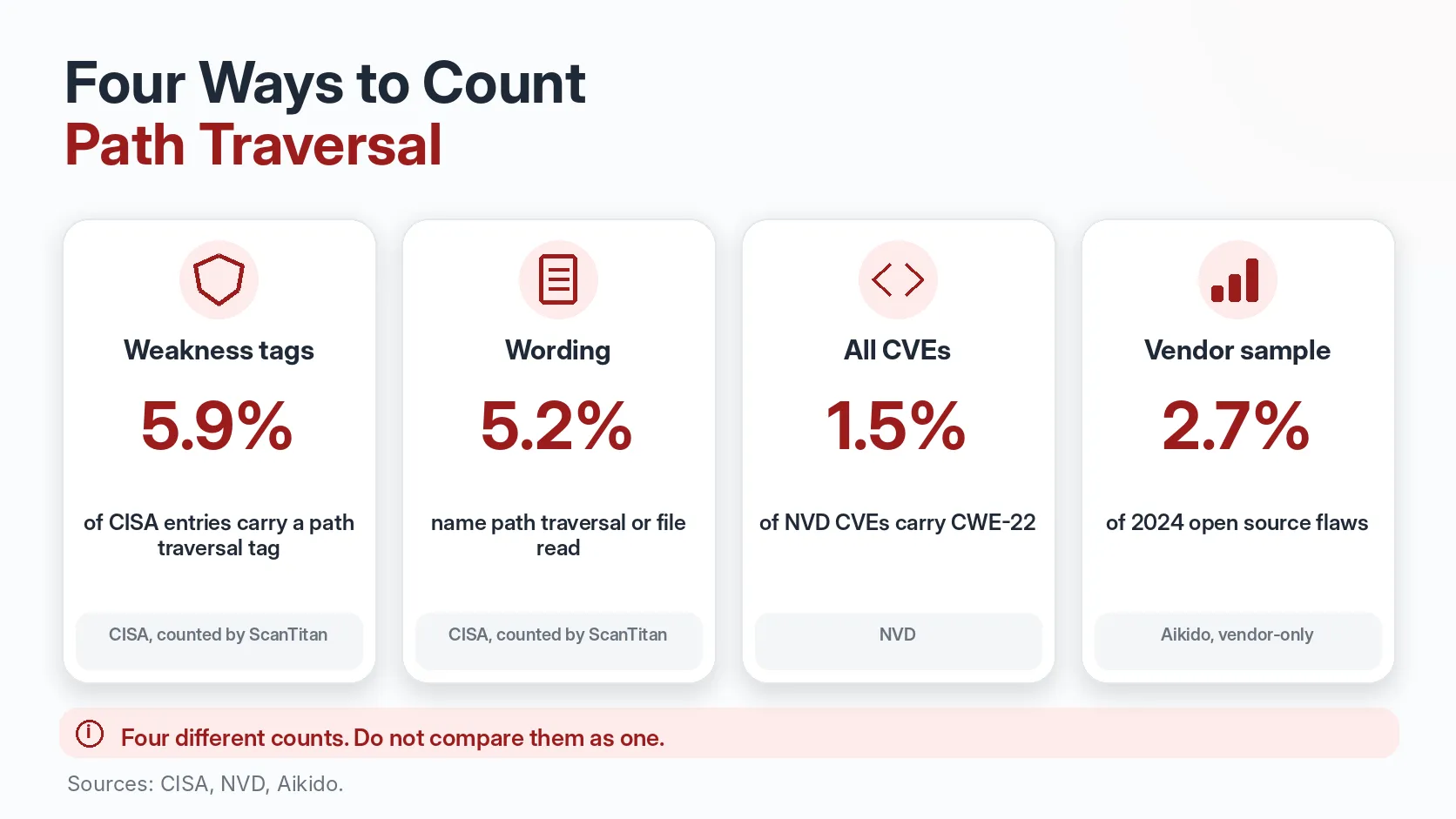
“Path traversal statistics” is used for four different counts. Each answers a different question and can be wrong in a different way.
| Count | What it matches | Example 2026 figure | Source type | What it cannot tell you |
|---|---|---|---|---|
| Weakness tag | A pathname traversal weakness type (CWE-22 to CWE-40) on a catalog entry | 5.9% of the CISA catalog | Catalog weakness tags | Flaws tagged only with a broader weakness |
| Description wording | An entry whose name or description says path traversal, directory traversal or arbitrary file read | 5.2% of the CISA catalog | ScanTitan text match | Entries described only by outcome, such as “code execution” |
| Share of all CVEs | CVEs that carry CWE-22 in the National Vulnerability Database | 1.5% (6,552 of 428,385) | NVD | Which flaws are exploited, since most CVEs never are |
| Share of a vendor’s sample | A vendor’s own share of the flaws it found in the code or projects it scanned | 2.7% of open source flaws in 2024 | Aikido, vendor-only | Other samples, or exploited versus unexploited flaws |
How ScanTitan counted. We downloaded the CISA Known Exploited Vulnerabilities feed, version 2026.11.06 with 1,769 entries. A path traversal tag means any of the pathname traversal weakness types CWE-22 to CWE-40. In the feed, CWE-22 (path traversal) appears on 82 entries, CWE-23 (relative path traversal) on 10, CWE-36 (absolute path traversal) on 5, and CWE-35, 25, 27, 39 and 40 on 7 tag matches combined. The wording count searches each entry’s name and short description for “path traversal”, “directory traversal”, “../”, “arbitrary file read”, “arbitrary file download” and “traversal”. CISA lists weakness tags on 1,594 of the 1,769 entries, so the tag share of tagged entries is 6.5%. These are text and tag matches, not CISA classifications. CVE publication dates come from the CVE Services API, and the NVD figures come from the NVD CVE API, queried on 19 November 2026.
What the vendors count. Aikido counts path traversal as a share of the vulnerabilities it found in open source and closed source projects each year. Contrast counts attacks its runtime product blocked in one month. A GitHub study counts open source projects that contain one vulnerable code pattern. Each denominator is different, so none of them equals a share of exploited flaws.
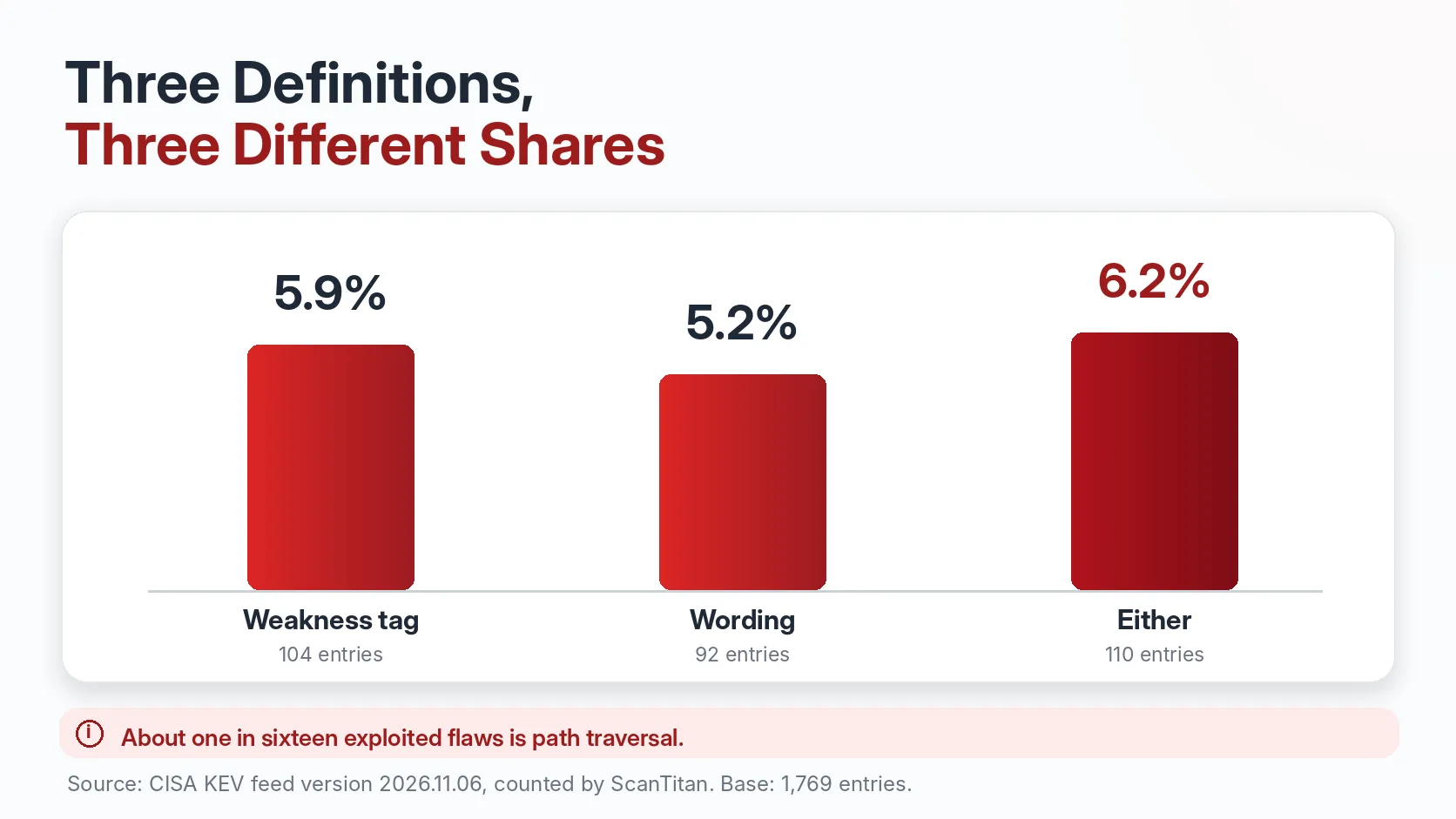
How Many Exploited Flaws Are Path Traversal?
| Definition (ScanTitan count) | Entries | Share of 1,769 |
|---|---|---|
| Carries a pathname traversal weakness tag (CWE-22 to CWE-40) | 104 | 5.9% |
| Carries the path traversal tag CWE-22 itself | 82 | 4.6% |
| Name or description says traversal or arbitrary file read | 92 | 5.2% |
| Name says traversal or arbitrary file read | 87 | 4.9% |
| Either a tag or the wording | 110 | 6.2% |
Source: CISA KEV feed version 2026.11.06, counted by ScanTitan. The counts overlap: 86 entries match both a tag and the wording, 18 carry only a tag and 6 match only the wording.
About one in sixteen exploited flaws in the catalog is a path traversal flaw. The two methods find slightly different entries. The 18 tag-only entries are mostly described by their outcome, such as a Zimbra file upload, a vCenter file upload, a Citrix ADC code execution flaw and an F5 BIG-IP management interface flaw, while their weakness tag shows the traversal behind it. The 6 wording-only entries, such as the Cisco ASA and FTD read-only path traversal flaw, carry a broader weakness tag such as improper input validation.
Path traversal is over-represented in the exploited list. CWE-22 is on 1.5% of all CVEs in the National Vulnerability Database but on 4.6% of the CISA catalog, about three times the rate. That is expected: a path traversal flaw in an internet-facing product is easy to test for and gives direct file access, so attackers use it more often than the number of such CVEs suggests.
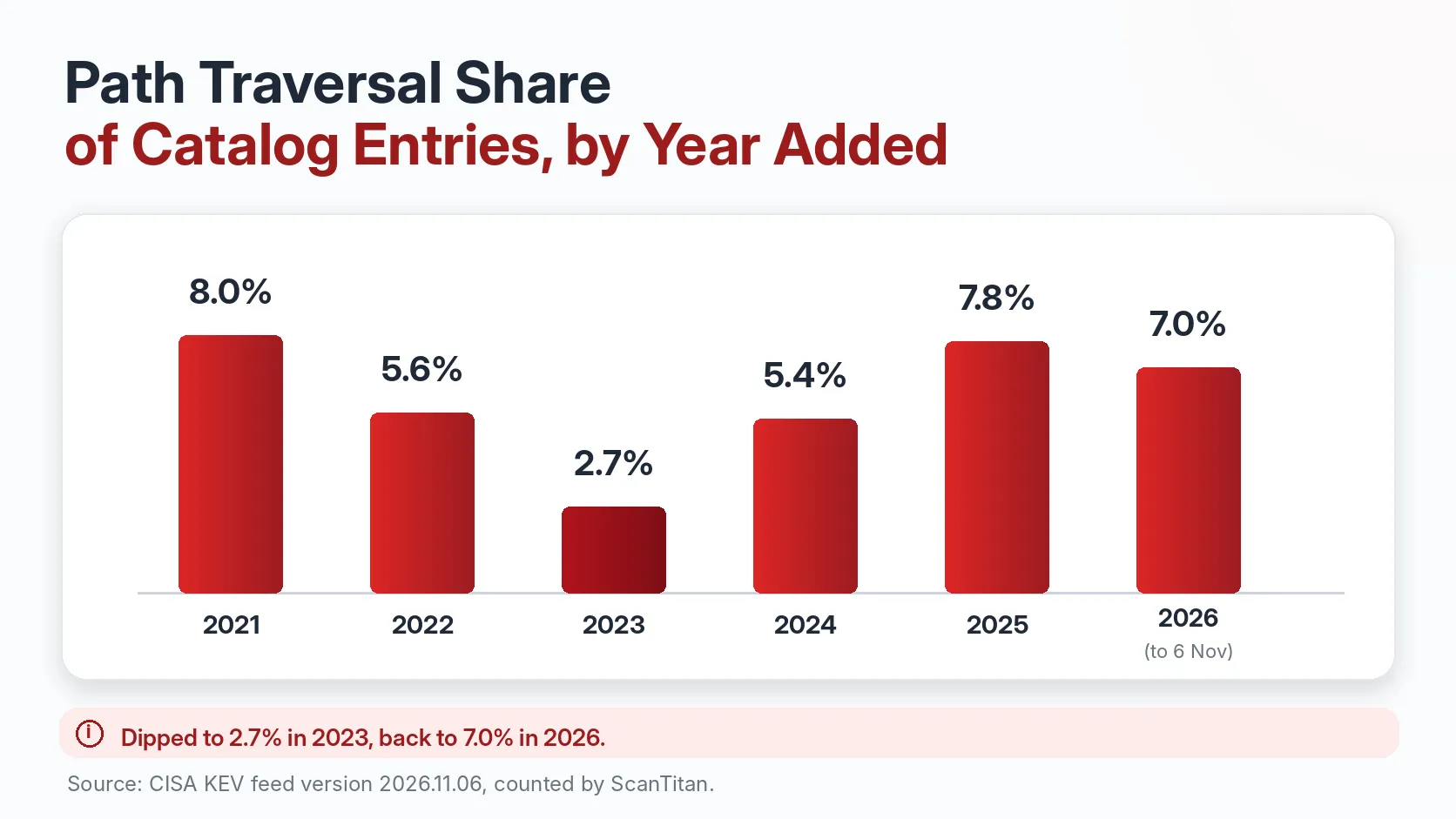
Is Path Traversal Rising or Falling?
| Year added | Path traversal entries | All entries added | Share |
|---|---|---|---|
| 2021 | 25 | 311 | 8.0% |
| 2022 | 31 | 555 | 5.6% |
| 2023 | 5 | 187 | 2.7% |
| 2024 | 10 | 186 | 5.4% |
| 2025 | 19 | 245 | 7.8% |
| 2026 to 6 Nov | 20 | 285 | 7.0% |
Source: CISA KEV feed version 2026.11.06, counted by ScanTitan. A path traversal entry here carries a tag or the wording.
The share fell to 2.7% in 2023 and has recovered to 7.8% in 2025 and 7.0% in 2026 so far, which is close to the 8.0% of 2021. The count tells the same story: 5 entries in 2023, 10 in 2024, 19 in 2025 and 20 already in 2026. Entries added in 2021 and 2022 include the catalog’s launch in November 2021 and its first large batches of older flaws, so the early years are not a clean baseline. Taken together, since 2023 the share is 6.0% (54 of 903) against 6.5% (56 of 866) for 2021 and 2022, which is a dip and a recovery and not a steady climb.
The count fell in 2023 as well, to 5 entries, in a year when CISA added fewer entries overall: 187 against 555 in 2022. The share is the better measure because it adjusts for that.
What Path Traversal Flaws Let Attackers Do
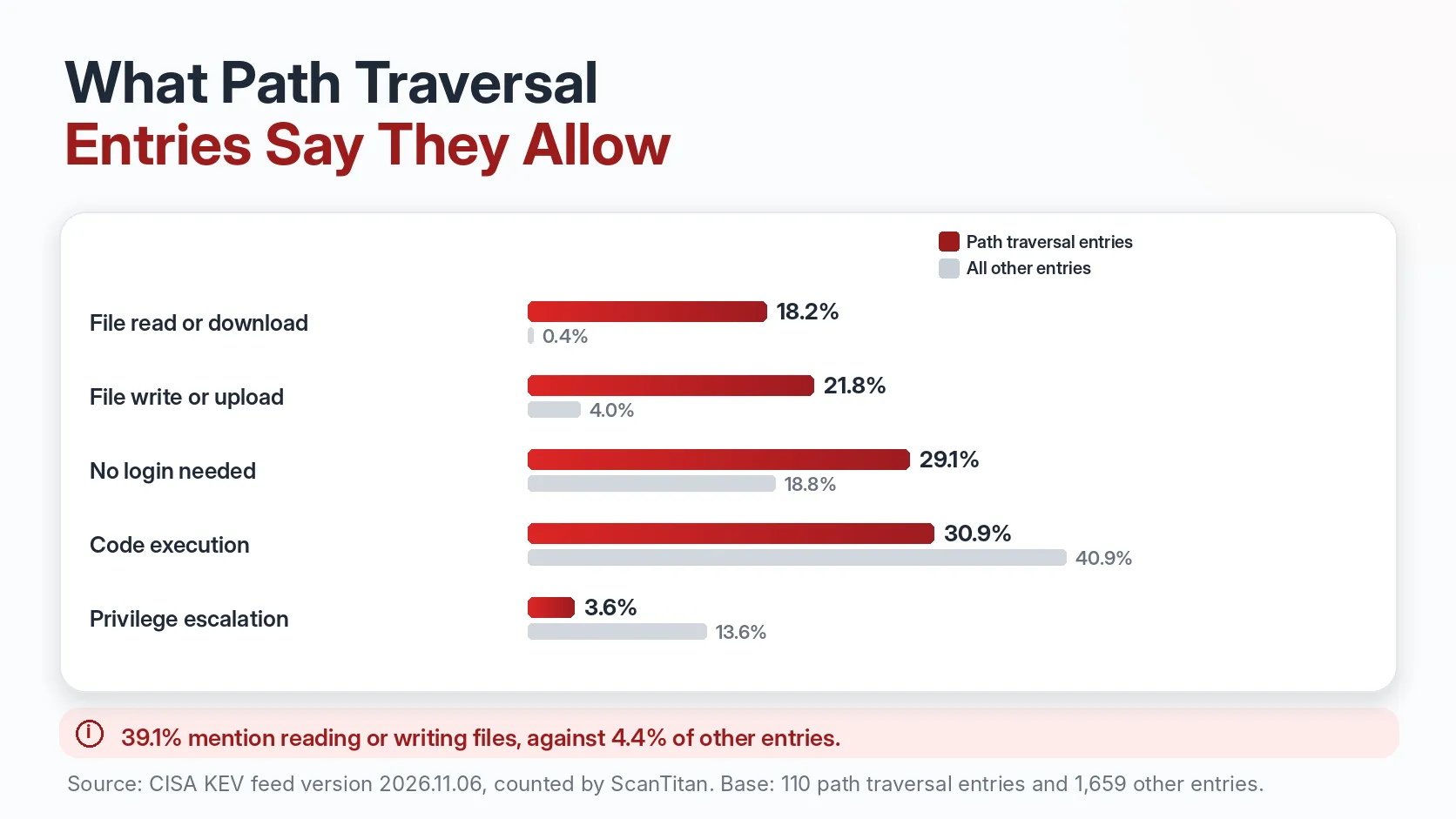
Path traversal is a file access flaw, and the descriptions in the catalog show it. We searched each entry’s name and short description for what the flaw allows.
| Wording in the entry | Path traversal entries | Share of 110 | All other entries |
|---|---|---|---|
| File read or download | 20 | 18.2% | 0.4% |
| File write, overwrite or upload | 24 | 21.8% | 4.0% |
| Authentication bypass or no login needed | 32 | 29.1% | 18.8% |
| Remote code execution | 34 | 30.9% | 40.9% |
| Privilege escalation | 4 | 3.6% | 13.6% |
Source: CISA KEV feed, counted by ScanTitan. The wording matches overlap, because one entry can describe several outcomes.
Together, 43 of the 110 path traversal entries (39.1%) describe reading or writing files, against 4.4% of all other entries. About three in ten mention code execution, which is less than the 40.9% of other entries, and only 3.6% mention privilege escalation. The picture is of a flaw that first gives file access, such as to configuration files, credentials or web shells, and then leads to code execution through that access. Our remote code execution statistics show how often exploited flaws end in code execution, and our privilege escalation statistics show that path traversal is rarely described as an escalation flaw.
The weakness tags show the variants. CWE-22 is the base type on 82 entries, relative path traversal (CWE-23) on 10 and absolute path traversal (CWE-36) on 5. Other tags on the same entries include unrestricted file upload (CWE-434) on 2 and improper input validation (CWE-20) on 2.
Which Vendors and Products Show Up
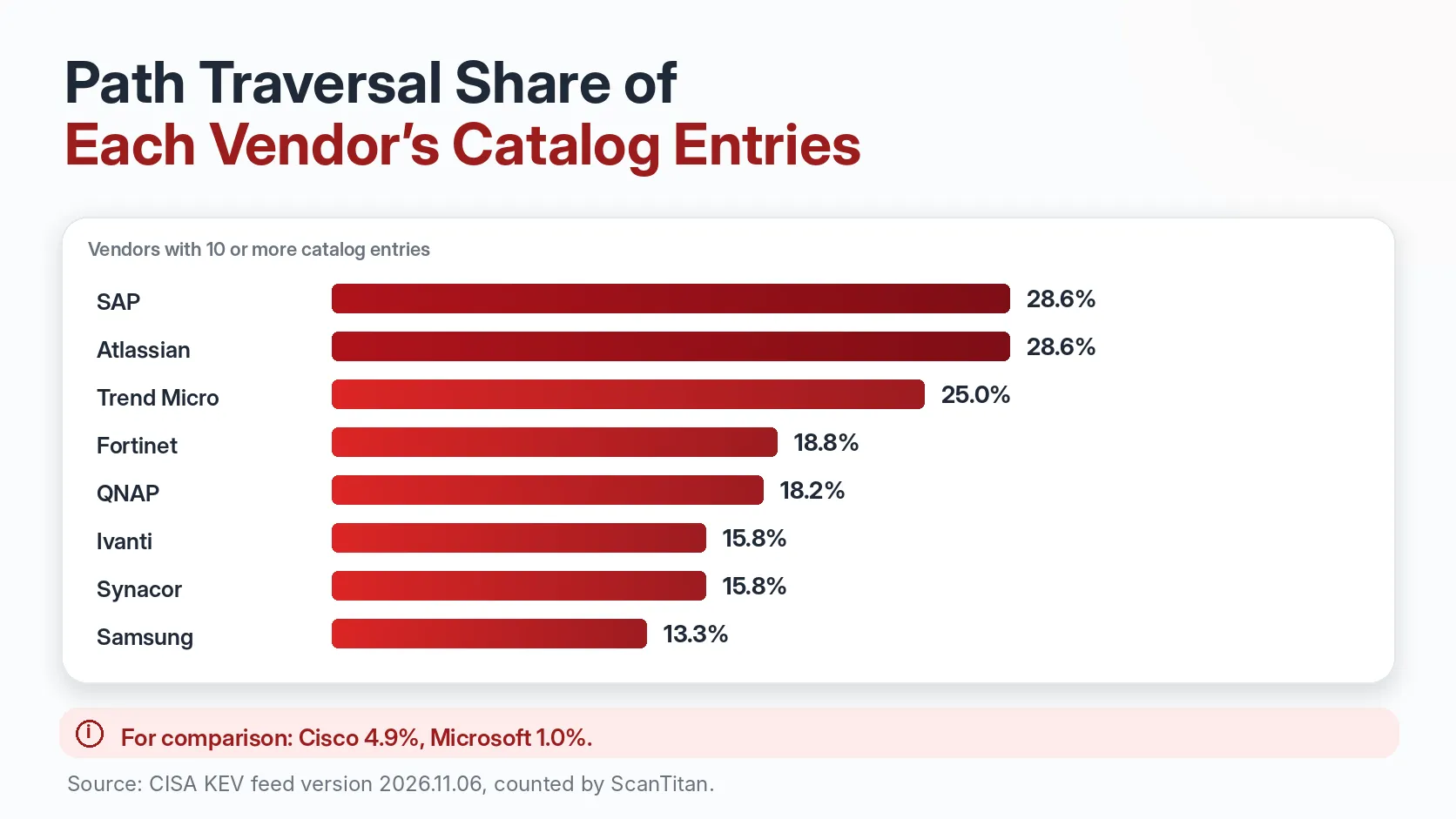
Path traversal is spread across 64 vendors, and 43 of them have only one entry. Seven vendors have four or more entries, together 33 entries or 30.0% of the 110.
| Vendor | Path traversal entries | Vendor’s catalog entries | Share of its own entries |
|---|---|---|---|
| Fortinet | 6 | 32 | 18.8% |
| Ivanti | 6 | 38 | 15.8% |
| Cisco | 5 | 102 | 4.9% |
| RARLAB (WinRAR, UnRAR) | 4 | 5 | 80.0% |
| SAP | 4 | 14 | 28.6% |
| Atlassian | 4 | 14 | 28.6% |
| Microsoft | 4 | 390 | 1.0% |
| Trend Micro | 3 | 12 | 25.0% |
| Synacor (Zimbra) | 3 | 19 | 15.8% |
| Apache | 3 | 41 | 7.3% |
Source: CISA KEV feed, counted by ScanTitan.
Among vendors with at least 10 catalog entries, SAP and Atlassian have the highest share, 28.6% of their entries each, followed by Trend Micro at 25.0% and Fortinet at 18.8%. Microsoft has the same number of entries as SAP but only 1.0% of its catalog, because most of its 390 entries are other kinds of flaws, such as the privilege escalation and memory flaws covered in our other reports. RARLAB’s four entries in a catalog of five are all in WinRAR and UnRAR, and three of the four are flagged for ransomware.
Several of the best-known entries are in the table: the Fortinet FortiOS SSL VPN flaw CVE-2018-13379, the Ivanti Pulse Connect Secure arbitrary file read CVE-2019-11510, the ConnectWise ScreenConnect flaw CVE-2024-1708 that CISA and the FBI named in their 2024 alert, and the WinRAR flaw CVE-2025-8088. All four are flagged by CISA as used in ransomware.
Edge Devices, Backup Tools and Enterprise Software
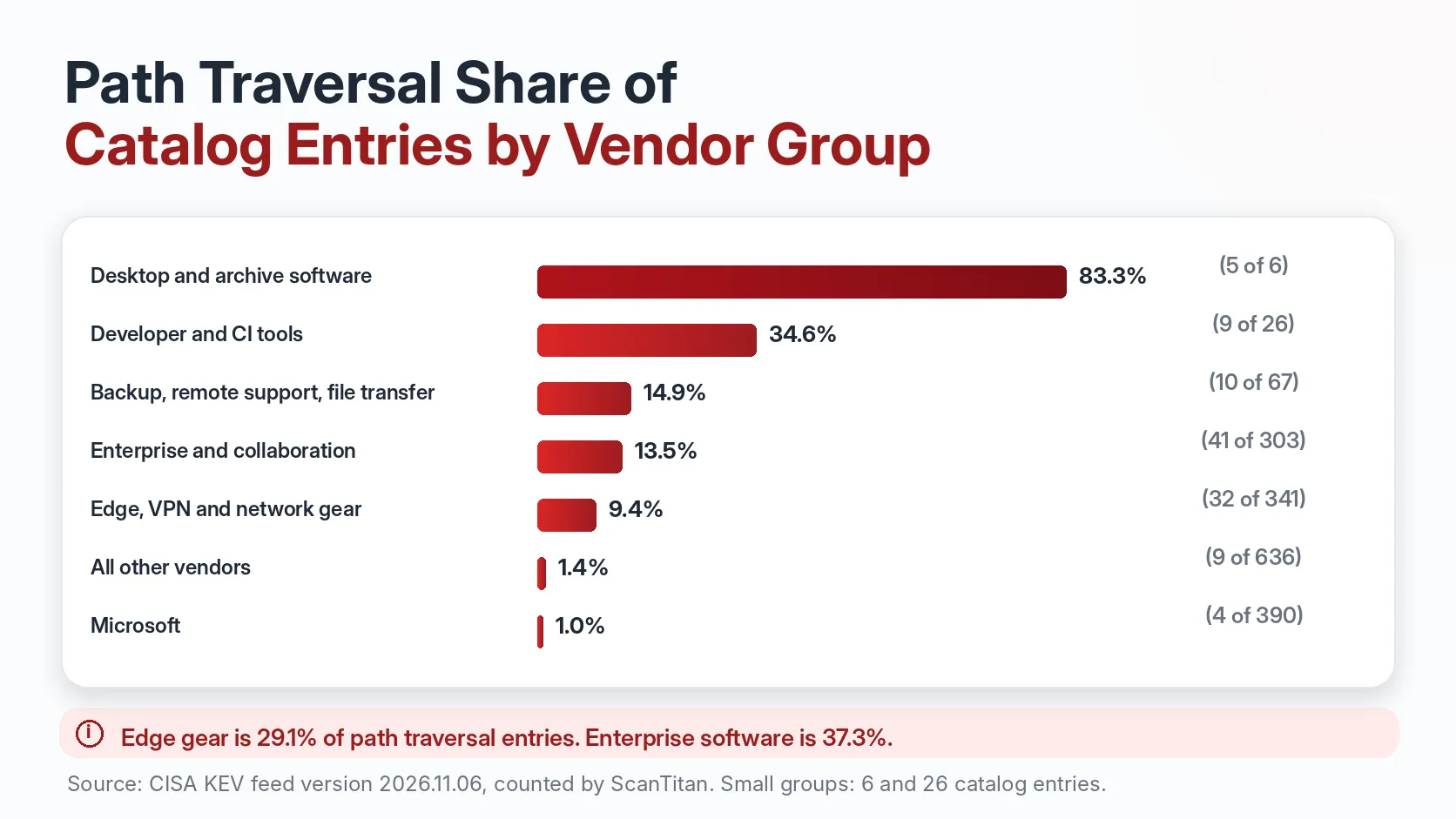
We grouped vendors by what they mainly sell. The groups are keyword and vendor based and listed in the compilation notes.
| Vendor group | Path traversal entries | All catalog entries | Share | Share of all path traversal entries |
|---|---|---|---|---|
| Edge, VPN and network gear | 32 | 341 | 9.4% | 29.1% |
| Backup, remote support and file transfer tools | 10 | 67 | 14.9% | 9.1% |
| Enterprise and collaboration software (not Microsoft) | 41 | 303 | 13.5% | 37.3% |
| Developer and CI tools | 9 | 26 | 34.6% | 8.2% |
| Desktop and archive software | 5 | 6 | 83.3% | 4.5% |
| Microsoft | 4 | 390 | 1.0% | 3.6% |
| All other vendors | 9 | 636 | 1.4% | 8.2% |
Source: CISA KEV feed, counted by ScanTitan.
Path traversal is not mainly an edge device problem. Edge, VPN and network gear vendors have a higher rate than the rest of the catalog, 9.4% of their entries against 5.5% for all other vendors, but they account for 29.1% of path traversal entries. Enterprise and collaboration software holds the largest part, 37.3%, at a rate of 13.5%, and backup, remote support and file transfer tools have a rate of 14.9%. Developer and CI tools and desktop archive software have very high rates, but on only 26 and 6 catalog entries, so treat those two as small samples.
The practical reading is that file-handling code in management consoles, collaboration servers and administration tools is where exploited path traversal sits, not only in firewalls.
How Fast Are Path Traversal Flaws Listed?
We measured the gap in days between the CVE’s publication date and the date CISA added the entry.
| Entries added since 2023 | Path traversal | All other entries |
|---|---|---|
| Entries measured | 54 | 849 |
| Median days from CVE publication to CISA listing | 52 | 15 |
| Listed on or before the CVE publication day | 16.7% (9) | 21.0% (178) |
| Listed within 30 days | 42.6% (23) | 55.2% (469) |
| Listed more than a year after the CVE | 29.6% (16) | 21.4% (182) |
Source: CISA KEV feed and CVE Services API, counted by ScanTitan.
Path traversal flaws reach the catalog more slowly than other flaws: a median of 52 days against 15, and 29.6% were listed more than a year after the CVE against 21.4%. The yearly medians for path traversal entries are improving, from about 150 days in 2024 (10 entries) to 55 days in 2025 (19 entries) and 32.5 days in 2026 (20 entries), though 2023’s median was only 7 days on 5 entries. Over all years, the medians are the same, 241.5 days against 231, because the catalog’s first batches in 2021 and 2022 added many old flaws at once.
For a team, the 52-day median means a path traversal flaw can be exploited for weeks before it is listed. Do not wait for the catalog to rank a patch. Our patch management statistics show how long patches take once flaws are known.
Path Traversal and Ransomware
CISA marks a catalog entry as used in ransomware campaigns when it has evidence. That flag covers 34.5% of path traversal entries (38 of 110), against 19.5% of all other entries (323 of 1,659).
| Period added | Path traversal entries flagged | All other entries flagged |
|---|---|---|
| Since 2023 | 22.2% (12 of 54) | 15.7% (133 of 849) |
| Before 2023 | 46.4% (26 of 56) | 23.5% (190 of 810) |
Source: CISA KEV feed, counted by ScanTitan.
Older entries have had longer to collect a ransomware flag, which is why the “before 2023” row is higher. In both periods path traversal entries are flagged more often than other entries. The flag is most common outside edge devices: 41.0% of path traversal entries from vendors outside the edge group are flagged (32 of 78), against 18.8% of the edge ones (6 of 32). RARLAB, Synacor and Microsoft have three flagged entries each, and SimpleHelp, Mitel, QNAP, Atlassian and Apache have two each.
What Outside Data Says About Path Traversal
| Source | Figure | Period | What it means |
|---|---|---|---|
| MITRE CWE Top 25 | CWE-22 ranks 6th, with 10 CVEs in KEV | 2025 list | Down from 5th, but still above out-of-bounds read and below out-of-bounds write |
| CISA and FBI | 55 directory traversal entries in the catalog | 2 May 2024 | ScanTitan’s tag count for the same date is 56, so the counts agree |
| NVD | 6,552 of 428,385 CVEs carry CWE-22 (1.5%) | Queried 19 Nov 2026 | Path traversal is 4.6% of the CISA catalog, about three times its share of all CVEs |
| Aikido, vendor-only | 2.7% of vulnerabilities in open source projects, 3.5% in closed source | 2024 | Closed source rose from 1.9% in 2023, a rise of 85% in the vendor’s sample |
| Contrast Security, vendor-only | 4,213 path traversal attacks blocked, about 7.6% of roughly 55.8 thousand | September 2024 | One month of one vendor’s customers, not the internet |
| arXiv study | 1,756 vulnerable open source projects found, 14% fixed after disclosure | May 2025 | One repeated code pattern found at GitHub scale |
The sources agree on the direction. Path traversal is old and well understood, yet it keeps appearing in new code and in exploited products. CISA and the FBI issued a Secure by Design alert on it in 2024 for that reason, and MITRE still ranks it sixth.
The vendor figures cannot be added to ours. Aikido’s 2.7% is a share of flaws in the projects it scanned, Contrast’s count is attacks blocked in one month, and our 6.2% is a share of exploited flaws. The 7.6% for Contrast is our division of its two published figures and is approximate.
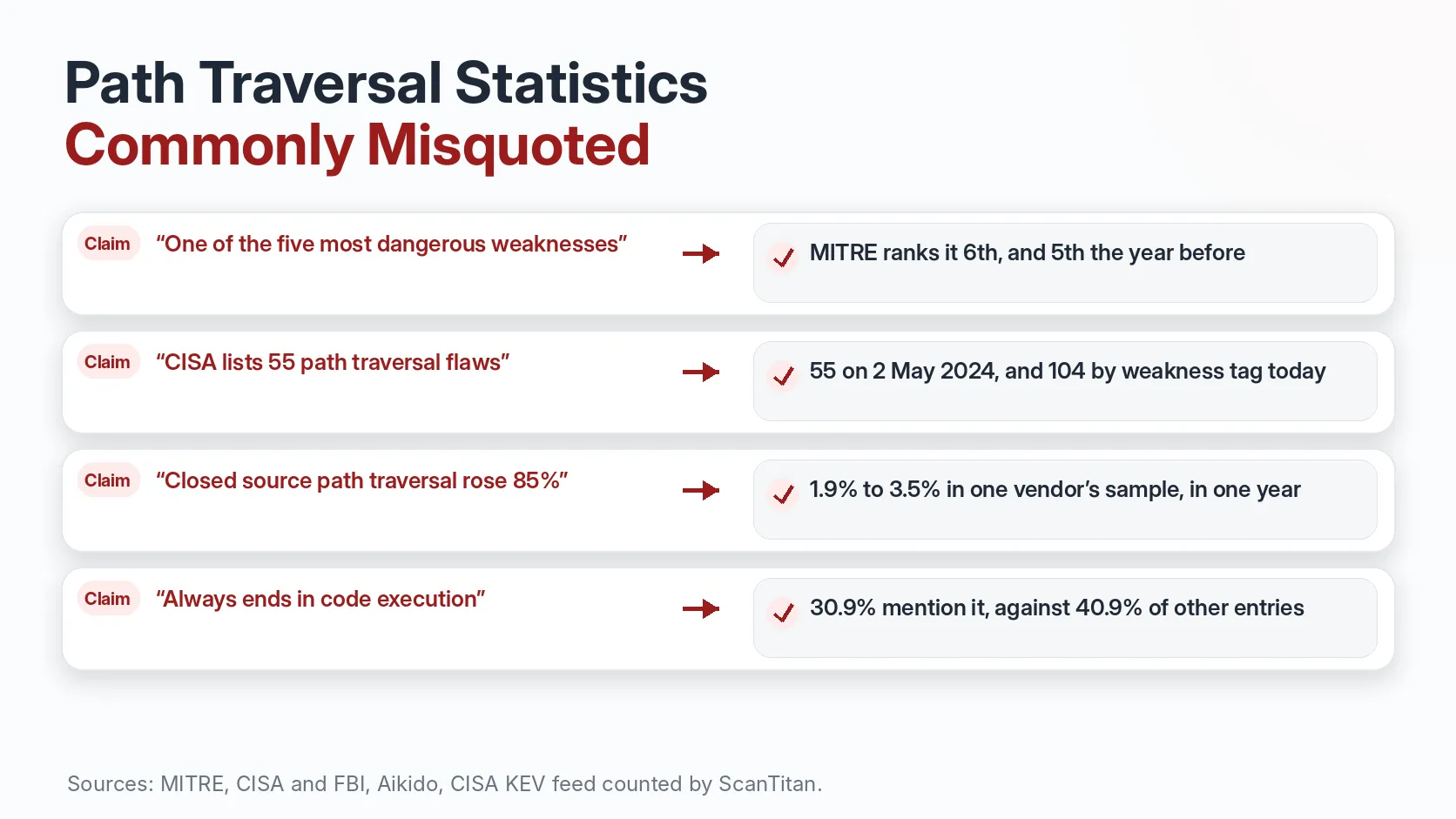
Path Traversal Statistics Commonly Misquoted
| Claim | What the data shows |
|---|---|
| “Path traversal is one of the five most dangerous weaknesses” | MITRE’s 2025 list ranks it 6th, and 5th the year before |
| “Path traversal is rare in real attacks” | It is 6.2% of CISA’s exploited catalog, and CWE-22 is about three times as common there as among all CVEs |
| “CISA lists 55 path traversal flaws” | That was the count on 2 May 2024. By 6 November 2026 the tag count was 104 and the tag-or-wording count 110 |
| “Closed source path traversal rose 85%” | One vendor’s sample, from 1.9% to 3.5% of its flaws, in one year. It is not a rate of attacks |
| “Path traversal always ends in remote code execution” | 30.9% of path traversal entries mention code execution, less than the 40.9% of other entries. File read or write is the common description |
| “Path traversal is an edge device problem” | Edge gear is 29.1% of path traversal entries. Enterprise and collaboration software is 37.3% |
Path Traversal Entries Added in 2026
These are the 20 path traversal entries CISA added to the catalog from 1 January to 6 November 2026.
| Date added | Vendor | Product | CVE |
|---|---|---|---|
| 12 Jan | Gogs | Gogs | CVE-2025-8110 |
| 25 Feb | Cisco | SD-WAN | CVE-2022-20775 |
| 20 Apr | Kentico | Kentico Xperience | CVE-2025-2749 |
| 20 Apr | JetBrains | TeamCity | CVE-2024-27199 |
| 24 Apr | Samsung | MagicINFO 9 Server | CVE-2024-7399 |
| 24 Apr | SimpleHelp | SimpleHelp | CVE-2024-57728 |
| 28 Apr | ConnectWise | ScreenConnect | CVE-2024-1708 |
| 21 May | Trend Micro | Apex One | CVE-2026-34926 |
| 15 Jun | Cisco | Catalyst SD-WAN Manager | CVE-2026-20262 |
| 23 Jun | Ubiquiti | UniFi OS | CVE-2026-34909 |
| 7 Jul | Adobe | ColdFusion | CVE-2026-48282 |
| 18 Aug | Broadcom | VMware vCenter | CVE-2026-59310 |
| 27 Aug | JFrog | Artifactory | CVE-2026-66384 |
| 11 Sep | GitLab | Community and Enterprise Edition | CVE-2026-85706 |
| 22 Sep | Check Point | Multiple Products | CVE-2026-93616 |
| 24 Sep | WSO2 | Multiple Products | CVE-2026-5430 |
| 1 Oct | Fortinet | FortiMail | CVE-2026-104286 |
| 8 Oct | ONLYOFFICE | Docs | CVE-2021-3199 |
| 14 Oct | Cisco | Secure Email Gateway | CVE-2026-76519 |
| 16 Oct | Fortinet | Multiple Products | CVE-2025-61624 |
Source: CISA KEV feed, version 2026.11.06.
Three points stand out. Twelve of the 20 CVEs were published in 2026 itself, so new path traversal flaws reach the catalog quickly. Five were published in 2024 or earlier, including a 2021 ONLYOFFICE flaw and a 2022 Cisco SD-WAN flaw, so attackers keep using older bugs. And 7 of the 20 are from edge, VPN and network gear vendors (Cisco 3, Fortinet 2, Check Point 1 and Ubiquiti 1), while the other 13 are management, developer, collaboration and remote support tools.
What the Numbers Mean for a Lean Team
Path traversal gives attackers file access first, so the work is quick patching of the tools that handle files and keeping secrets out of reach.
- Do not wait for the catalog. Path traversal entries took a median of 52 days to be listed since 2023, so patch on the vendor’s advisory. The CVE priority checker shows whether a flaw is listed.
- Patch backup and remote support tools first. Backup, remote support and file transfer tools have a rate of 14.9%, and ConnectWise ScreenConnect and SimpleHelp both appear in the 2026 entries. Do not expose their admin consoles to the internet.
- Update collaboration and developer servers. Atlassian, SAP, GitLab, TeamCity and Artifactory entries sit in this list. Inventory them and subscribe to their advisories.
- Treat a file read as a credential leak. 39.1% of path traversal entries involve reading or writing files, so after patching, rotate passwords, keys and tokens that were stored on the server. See our credential theft statistics for why stolen secrets matter.
- Update archive tools on desktops. WinRAR and UnRAR have four entries, and three are flagged for ransomware.
- If you write software, never pass user input straight to a file path. Resolve the final path, check that it stays inside the intended folder, allow only named files where you can, and run the service with the least file access it needs.
- Test for exposed files. A scan for open directories and exposed files finds the cheap wins; see our guide on the directory listing vulnerability.
How We Compiled and Verified These Statistics
- Used: the CISA Known Exploited Vulnerabilities feed (version 2026.11.06), CVE publication dates from the CVE Services API, NVD CVE API totals (queried 19 November 2026), MITRE’s 2025 CWE Top 25, the CISA and FBI Secure by Design alert of 2 May 2024, Aikido’s 2024 article, Contrast Security’s October 2024 article and the arXiv study 2505.20186. Vendor figures are labeled vendor-only.
- Method: each entry’s weakness tags and its name and short description were searched for pathname traversal weaknesses and terms. Counts were split by year added, outcome wording, vendor, vendor group, listing gap and ransomware flag. Every external figure was read on its own page, and the arXiv figures come from the paper’s abstract.
- Vendor groups: edge, VPN and network gear covers Fortinet, Ivanti, Cisco, SonicWall, Check Point, Zyxel, Juniper, Citrix, F5, Palo Alto Networks, Barracuda Networks, Array Networks, WatchGuard, Sophos, Pulse Secure, DrayTek, MikroTik, Ubiquiti, D-Link, TP-Link, Arcadyan, NETGEAR and Aviatrix. Backup, remote support and file transfer tools covers Veeam, Commvault, NAKIVO, Arcserve, SimpleHelp, ConnectWise, SysAid, SolarWinds, Progress, Fortra, Accellion, Cleo, Kiteworks, CrushFTP, Gladinet, Quest, Zoho and ManageEngine. Enterprise and collaboration software covers SAP, Atlassian, Synacor, Mitel, Oracle, Adobe, Qlik, TIBCO, WSO2, VMware, Broadcom, Samsung, Apache, ONLYOFFICE, Srimax, Ignite Realtime, Kentico, dotCMS, Grafana Labs and Trend Micro. Developer and CI tools covers GitLab, JetBrains, Jenkins, JFrog, Gogs, Rails and PEAR. Desktop and archive software covers RARLAB and Kingsoft.
- Limits: the counts are tag and text matches, not a CISA classification. The vendor groups are our choice and some vendors fit two groups. Several yearly and group samples are small. Vendor shares use different denominators and cannot be compared with the catalog share. The catalog lists only flaws CISA has evidence of exploitation for.
- Excluded: a figure of “over 5,200” NVD path traversal vulnerabilities in Contrast’s article, because we queried NVD ourselves; counts of path traversal vulnerabilities in Aikido’s article, because the page describes them inconsistently; and any figure without a primary source.
- Refresh: reviewed every 90 days. Catalog counts change daily.
How to cite this research. ScanTitan, “Path Traversal Statistics 2026: Flaws, Vendors & Trends,” 19 November 2026. For single figures, cite the primary source beside each number.
Primary Sources
- CISA Known Exploited Vulnerabilities catalog data feed
- CVE Program
- NVD CVE API
- CISA and FBI, Secure by Design Alert: Eliminating Directory Traversal Vulnerabilities in Software
- MITRE, 2025 CWE Top 25 Most Dangerous Software Weaknesses
- Aikido, Path Traversal in 2024: The year unpacked, vendor-only
- Contrast Security, September attack data: Spotlight on path traversal, vendor-only
- arXiv, Eradicating the Unseen: Detecting, Exploiting, and Remediating a Path Traversal Vulnerability across GitHub
Frequently Asked Questions
What is path traversal?
Path traversal, also called directory traversal, is a flaw where an application builds a file path from user input and does not stop the path leaving the intended folder. An attacker adds sequences such as “../” to reach files elsewhere on the server, such as configuration files and credentials.
How common is path traversal?
It is 6.2% of CISA’s Known Exploited Vulnerabilities catalog by ScanTitan’s count, 110 of 1,769 entries, and the CWE-22 weakness is on 1.5% of all CVEs in the National Vulnerability Database, so it is about three times as common among exploited flaws as among all flaws.
Is path traversal increasing?
It is recovering. The share of entries added each year fell to 2.7% in 2023 and rose to 7.8% in 2025 and 7.0% in 2026 to 6 November, and the count rose from 5 entries in 2023 to 19 in 2025 and 20 in 2026 so far.
What can attackers do with path traversal?
They mostly read or write files. 39.1% of path traversal entries in the catalog describe reading or writing files, against 4.4% of other entries, and 30.9% mention code execution, which usually follows from the file access.
Which vendors have the most exploited path traversal flaws?
Fortinet and Ivanti have 6 entries each, Cisco 5, and RARLAB, SAP, Atlassian and Microsoft 4 each. By share of its own entries, among vendors with at least 10 entries, SAP and Atlassian lead at 28.6%.
Is path traversal only an edge device problem?
No. Edge, VPN and network gear vendors have a higher rate than other vendors, 9.4% of their entries against 5.5%, but they are 29.1% of path traversal entries. Enterprise and collaboration software is 37.3%.
How fast are path traversal flaws added to CISA’s catalog?
For entries added since 2023, path traversal flaws were listed a median of 52 days after the CVE was published, against 15 days for other entries. The median is improving, from about 150 days for 2024 entries to 32.5 days for 2026 entries.
Is path traversal used in ransomware?
More than other flaws. CISA flags 34.5% of path traversal entries as used in ransomware against 19.5% of other entries, and the gap holds for entries added before and since 2023.
What is the difference between path traversal and directory traversal?
There is none in practice. They are two names for the same weakness, which MITRE lists as CWE-22. “Directory traversal” is the older name, and CISA and the FBI use it in their 2024 alert.
How do I prevent path traversal?
Do not pass user input straight to a file path, resolve the final path and check that it stays inside the intended folder, allow only known file names where you can, and run the service with the least file access it needs. For software you buy, patch quickly and keep management consoles off the public internet.
Where does this data come from?
From CISA’s Known Exploited Vulnerabilities feed (version 2026.11.06), the CVE Services API, the NVD CVE API and primary sources from MITRE, CISA and the FBI, Aikido, Contrast Security and an arXiv study, as named beside each figure.