SSRF statistics depend on what is counted, because server-side request forgery (SSRF) is a weakness type and not a field you can filter in CISA or CVE data: in ScanTitan’s count of CISA’s Known Exploited Vulnerabilities catalog, 1.5% of entries (26 of 1,769) are SSRF flaws by weakness tag or wording, but 11 of those 26 were added in 2026 alone, which is 3.9% of the year’s entries against 0.7% for 2022 to 2025 combined. SSRF lets an attacker make a server send requests on the attacker’s behalf, and 30.8% of the entries say no login is needed, against 19.5% of other entries. CISA flags 38.5% of them as used in ransomware, but 7 of those 10 flags sit on flaws added in 2021 and 2022, and 6 entries added in 2025 and 2026 were published 4 to 6 years earlier. Most pages on this topic repeat a few figures from 2019 and 2021. This research counts the exploited catalog, labels vendor figures, and says where a popular number does not hold up. Data last checked: 23 November 2026.
Key SSRF Statistics for 2026
Executive Benchmark: SSRF Statistics for 2026
| Metric | Latest figure | Period | Trend / context | Source |
|---|---|---|---|---|
| CISA catalog entries that are SSRF flaws | 1.5% (26 of 1,769) | Added 2021 to 6 Nov 2026 | 1.4% (24) carry the SSRF weakness tag CWE-918 | CISA KEV feed, counted by ScanTitan |
| SSRF entries added per year | 11 | 2026 to 6 Nov | 3 in 2025, 1 in 2024, 1 in 2023, 3 in 2022, 7 in 2021 | CISA KEV feed, counted by ScanTitan |
| SSRF rank in MITRE’s CWE Top 25 | 22nd, with 0 CVEs in KEV | 2025 list | 19th last year | MITRE |
| Share of all CVEs that carry the SSRF weakness CWE-918 | 0.37% (1,601 of 430,605) | NVD, queried 23 Nov 2026 | 1.4% of CISA catalog entries carry CWE-918, about 3.6 times the rate | NVD CVE API, counted by ScanTitan |
| SSRF in the OWASP Top 10 | 9,503 occurrences and 385 CVEs in A10 | 2021 edition | In 2025 SSRF is named inside A01 Broken Access Control | OWASP 2021 A10, OWASP 2025 A01 |
| SSRF entries flagged as used in ransomware | 38.5% (10 of 26) | Added 2021 to 6 Nov 2026 | 70.0% (7 of 10) before 2023 and 18.8% (3 of 16) since | CISA KEV feed, counted by ScanTitan |
| Median days from CVE publication to CISA listing | 27 | Added 2023 to 6 Nov 2026 | 15 days for other entries | CISA KEV feed and CVE Services API, counted by ScanTitan |
| EC2 instances enforcing IMDSv2, the AWS setting that blunts SSRF attacks on cloud credentials | One in two | 2025 study | Older instances lag behind | Datadog, vendor-only |
Methodology: Four Ways to Count SSRF
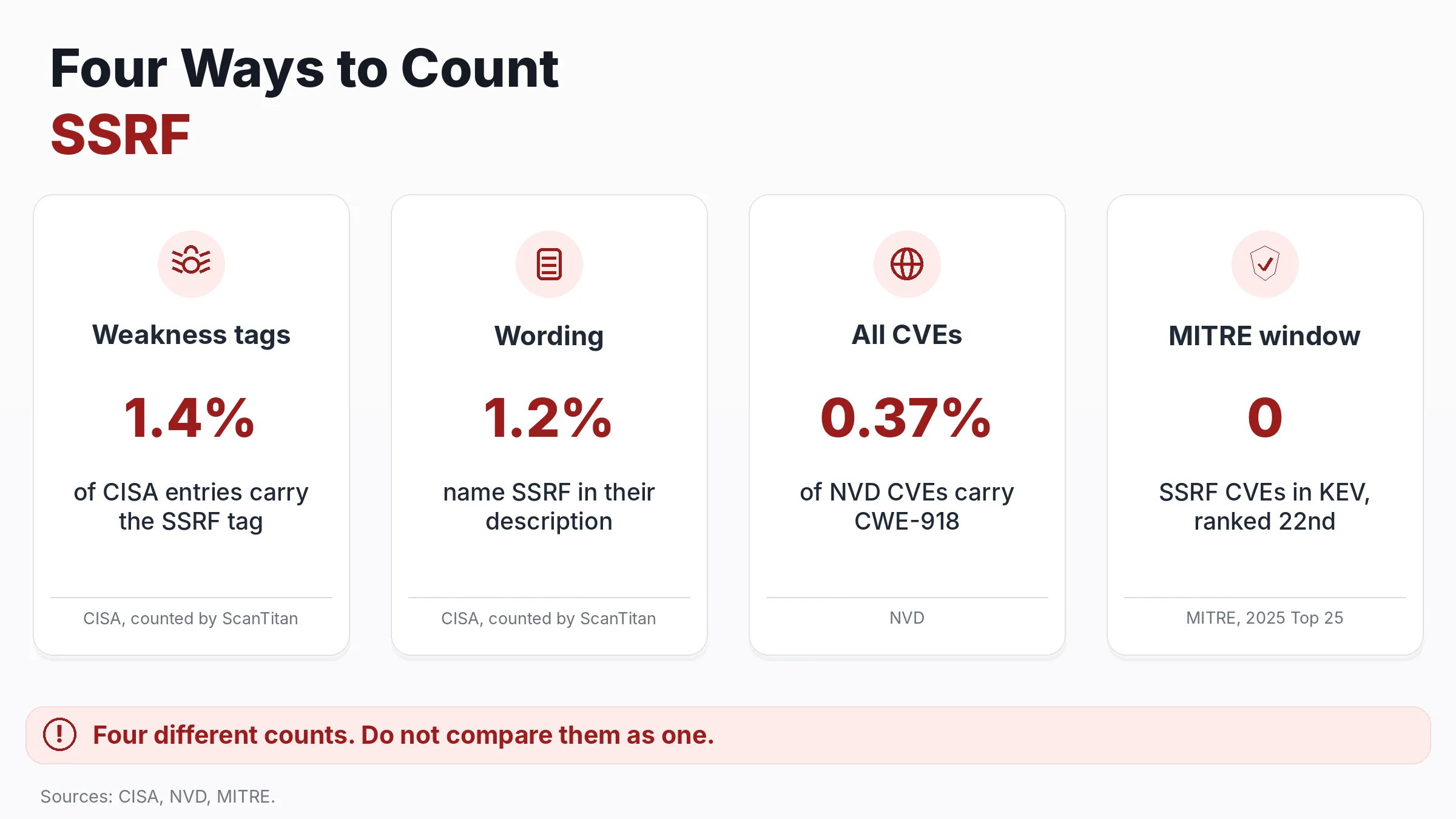
“SSRF statistics” is used for four different counts. Each answers a different question and can be wrong in a different way.
| Count | What it matches | Example 2026 figure | Source type | What it cannot tell you |
|---|---|---|---|---|
| Weakness tag | The SSRF weakness type CWE-918 on a catalog entry | 1.4% of the CISA catalog | Catalog weakness tags | Flaws tagged only with a broader weakness |
| Description wording | An entry whose name or description says SSRF or server-side request forgery | 1.2% of the CISA catalog | ScanTitan text match | Entries described only by outcome, such as “remote code execution” |
| Share of all CVEs | CVEs that carry CWE-918 in the National Vulnerability Database | 0.37% (1,601 of 430,605) | NVD | Which flaws are exploited, since most CVEs never are |
| MITRE’s data window | CVEs with the weakness that are in the catalog within MITRE’s scoring period | 0 CVEs in KEV, rank 22 | MITRE CWE Top 25 | Entries added outside MITRE’s window or tagged another way |
How ScanTitan counted. We downloaded the CISA Known Exploited Vulnerabilities feed, version 2026.11.06 with 1,769 entries. An SSRF tag means CWE-918 in the entry’s weakness list, which appears on 24 entries. The wording count searches each entry’s name and short description for “server-side request forgery”, “server side request forgery” and “SSRF”, and finds 21. Together the two methods find 26 entries: 19 match both, 5 carry only the tag and 2 match only the wording. CISA lists weakness tags on 1,594 of the 1,769 entries, so the tag share of tagged entries is 1.5%. These are text and tag matches, not CISA classifications. CVE publication dates come from the CVE Services API, and the NVD figure comes from the NVD CVE API, queried on 23 November 2026.
What the other sources count. MITRE scores weaknesses from CVE records in a fixed window and shows how many of those CVEs are in the catalog. OWASP counts occurrences in the application data contributed to it. Datadog counts cloud accounts it observes. Each denominator is different, so none of them equals a share of exploited flaws.
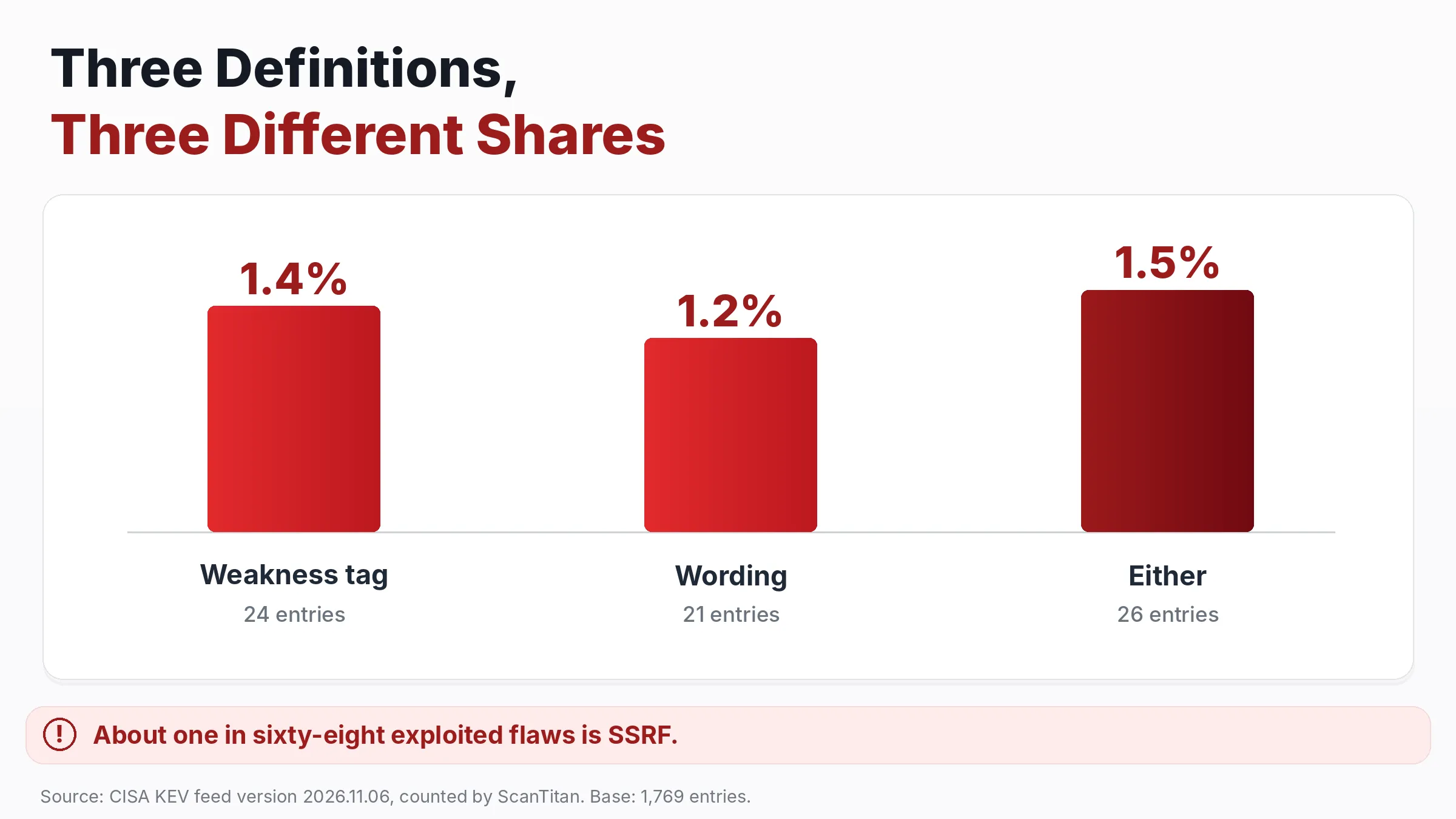
How Many Exploited Flaws Are SSRF?
| Definition (ScanTitan count) | Entries | Share of 1,769 |
|---|---|---|
| Carries the SSRF weakness tag CWE-918 | 24 | 1.4% |
| Name or description says SSRF or server-side request forgery | 21 | 1.2% |
| Either a tag or the wording | 26 | 1.5% |
Source: CISA KEV feed version 2026.11.06, counted by ScanTitan. The counts overlap: 19 entries match both a tag and the wording, 5 carry only a tag and 2 match only the wording.
About one in sixty-eight exploited flaws in the catalog is an SSRF flaw, a small share. The two methods find different entries, and the difference matters. The 5 tag-only entries are described by what happens next, not by the SSRF step: two Microsoft Exchange flaws, one of them the ProxyLogon flaw CVE-2021-26855, and a VMware vCenter flaw all say “remote code execution”, a Skype for Business flaw says “privilege escalation”, and a Kestra flaw says “OS command injection”. A search for the word SSRF alone would miss all five. The 2 wording-only entries, an ImageMagick flaw and a Yealink flaw, carry other weakness tags, improper input validation and OS command injection.
SSRF is over-represented in the exploited list compared with all CVEs. CWE-918 is on 0.37% of all CVEs in the National Vulnerability Database but on 1.4% of the CISA catalog, about 3.6 times the rate. A likely reason is that an SSRF flaw in an internet-facing server lets an attacker use the server’s own position inside the network, which is worth more than the flaw’s score alone suggests.
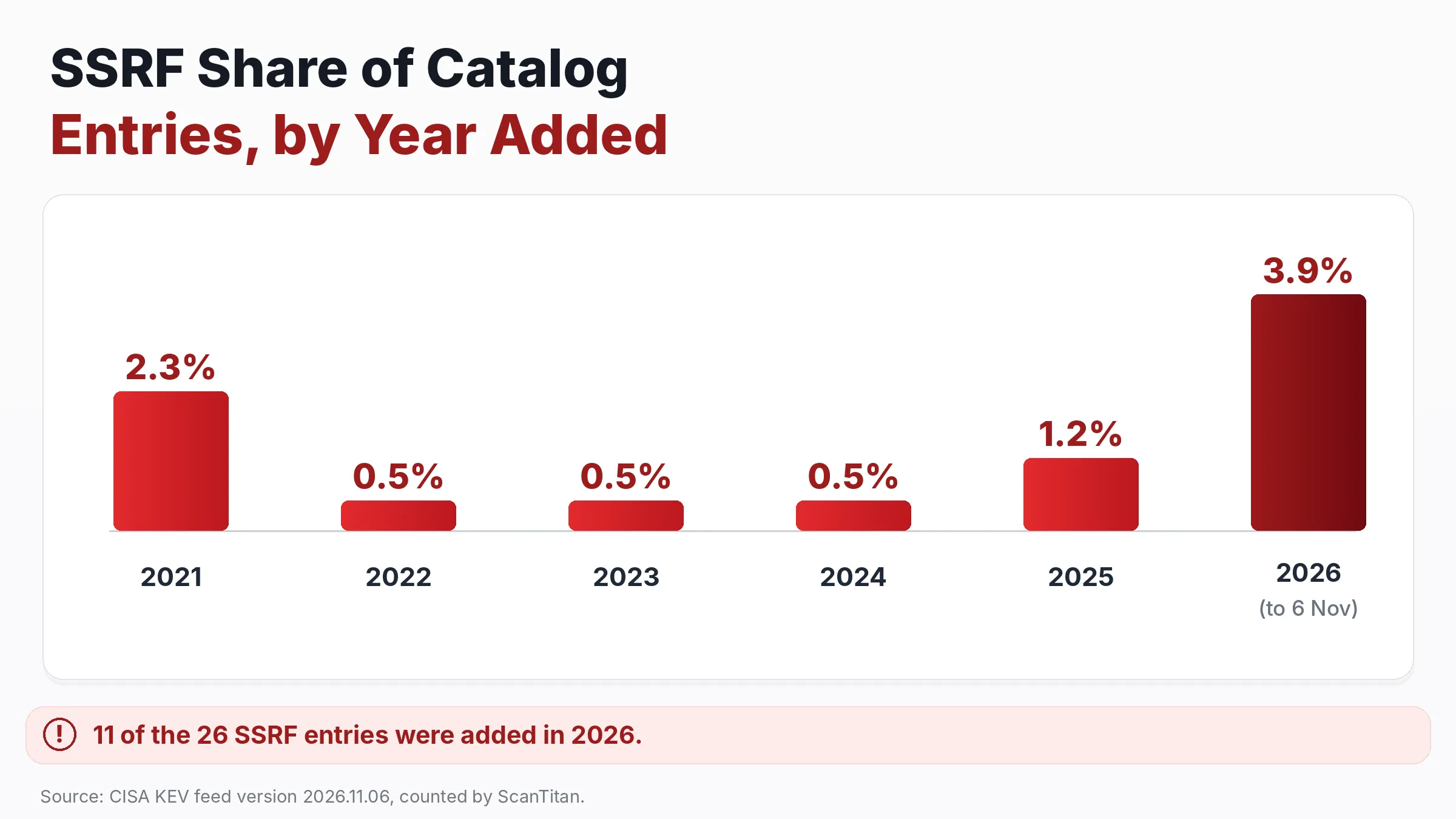
Is SSRF Rising or Falling?
| Year added | SSRF entries | All entries added | Share |
|---|---|---|---|
| 2021 | 7 | 311 | 2.3% |
| 2022 | 3 | 555 | 0.5% |
| 2023 | 1 | 187 | 0.5% |
| 2024 | 1 | 186 | 0.5% |
| 2025 | 3 | 245 | 1.2% |
| 2026 to 6 Nov | 11 | 285 | 3.9% |
Source: CISA KEV feed version 2026.11.06, counted by ScanTitan. An SSRF entry here carries a tag or the wording.
SSRF was a small and flat part of the catalog from 2022 to 2024, then moved up. The share was 0.5% in each of those three years, 1.2% in 2025 and 3.9% in 2026 so far. Across 2022 to 2025 combined it is 0.7% (8 of 1,173), so 2026 is more than five times that rate, and 11 entries in under eleven months is 42.3% of every SSRF entry the catalog holds. The 2021 figure is not a clean baseline: 6 of its 7 entries were added on 3 November 2021, the day the catalog launched with 287 entries.
The count is small, so the 2026 jump needs a careful reading. Some of the 11 come in pairs: Plex has two entries that chain together, SonicWall two, and GitLab two. They come from 8 vendors, and 4 of the 11 are old flaws added late, covered below. Since 2023 the share is 1.8% (16 of 903) against 1.2% (10 of 866) for 2021 and 2022, so the longer-run change is modest and the 2026 spike is the part that stands out.
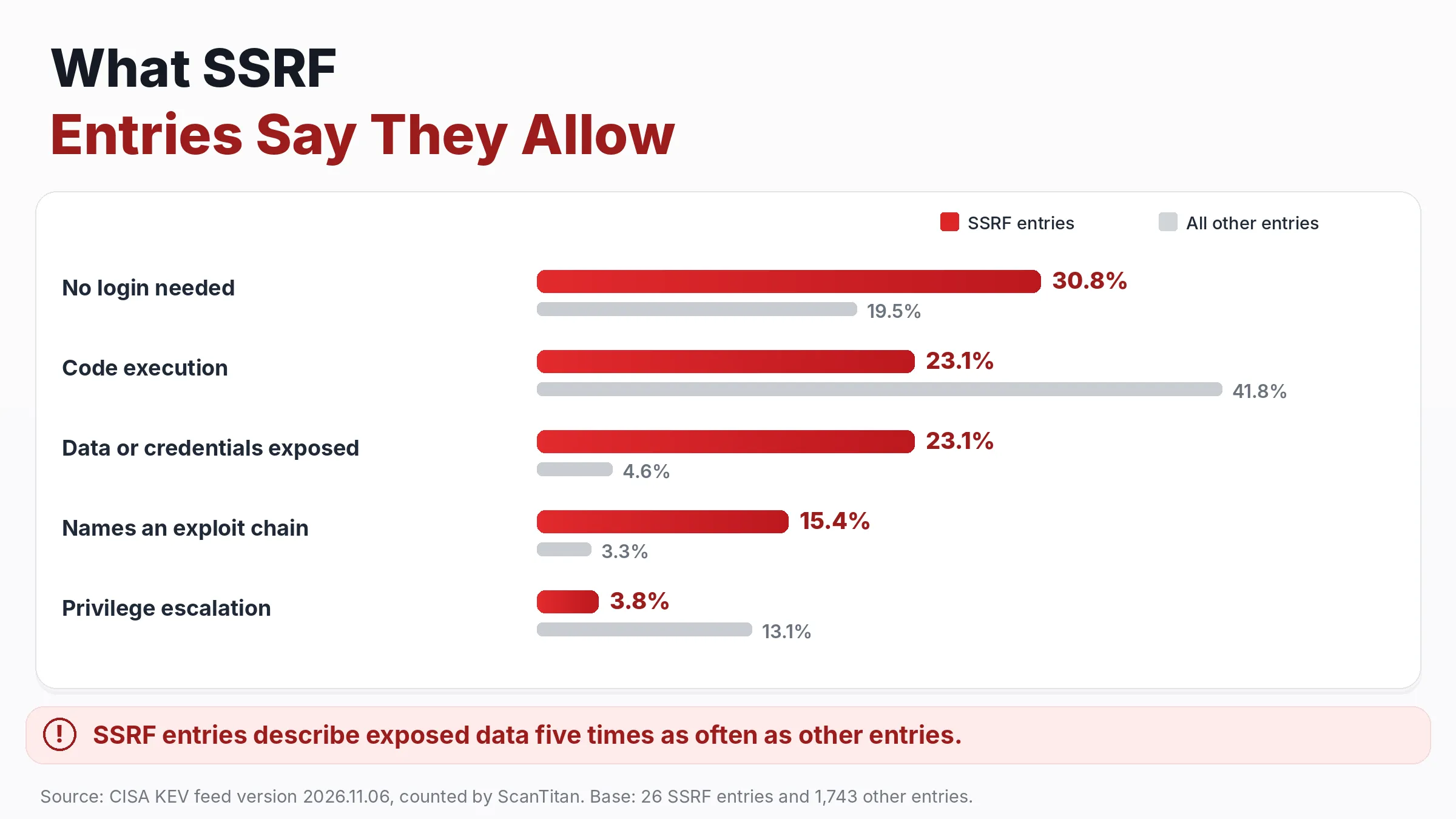
What SSRF Flaws Let Attackers Do
SSRF is a stepping stone flaw, and the catalog descriptions show it. We searched each entry’s name and short description for what the flaw allows.
| Wording in the entry | SSRF entries | Share of 26 | All other entries |
|---|---|---|---|
| No login needed (unauthenticated, without authentication or credentials) | 8 | 30.8% | 19.5% |
| Code or command execution | 6 | 23.1% | 41.8% |
| Information disclosure, sensitive data, stolen credentials, restricted resources or metadata | 6 | 23.1% | 4.6% |
| Names or links to an exploit chain | 4 | 15.4% | 3.3% |
| Mentions internal network resources or cloud metadata | 3 | 11.5% | 0.1% |
| Privilege escalation | 1 | 3.8% | 13.1% |
Source: CISA KEV feed, counted by ScanTitan. The wording matches overlap, because one entry can describe several outcomes. The 1,743 other entries are those that do not match the SSRF count.
Compared with other entries, SSRF descriptions say no login is needed more often (30.8% against 19.5%), describe exposed data far more often (23.1% against 4.6%), and name a chain four times as often (15.4% against 3.3%). They mention code execution less often (23.1% against 41.8%) and privilege escalation rarely. The four chain entries are the ProxyLogon flaw CVE-2021-26855, the ProxyNotShell flaw CVE-2022-41040 and the two Plex flaws from October 2026, each described as part of a chain or as chainable with other flaws. That is the pattern of an enabling step: SSRF reaches a service the attacker could not reach, and a second flaw does the damage. Our authentication bypass statistics show how often exploited flaws need no login at all.
Only three entries mention internal networks or cloud metadata. The MLflow flaw CVE-2026-64849, added in August 2026, says an attacker can reach internal or cloud metadata services and read the response. The Plex flaw CVE-2026-96655 and the GitLab flaw CVE-2021-22175 mention internal addresses or webhooks to the internal network. The catalog does not say how often cloud metadata is the actual target, so a claim that most SSRF attacks steal cloud credentials has no support here.
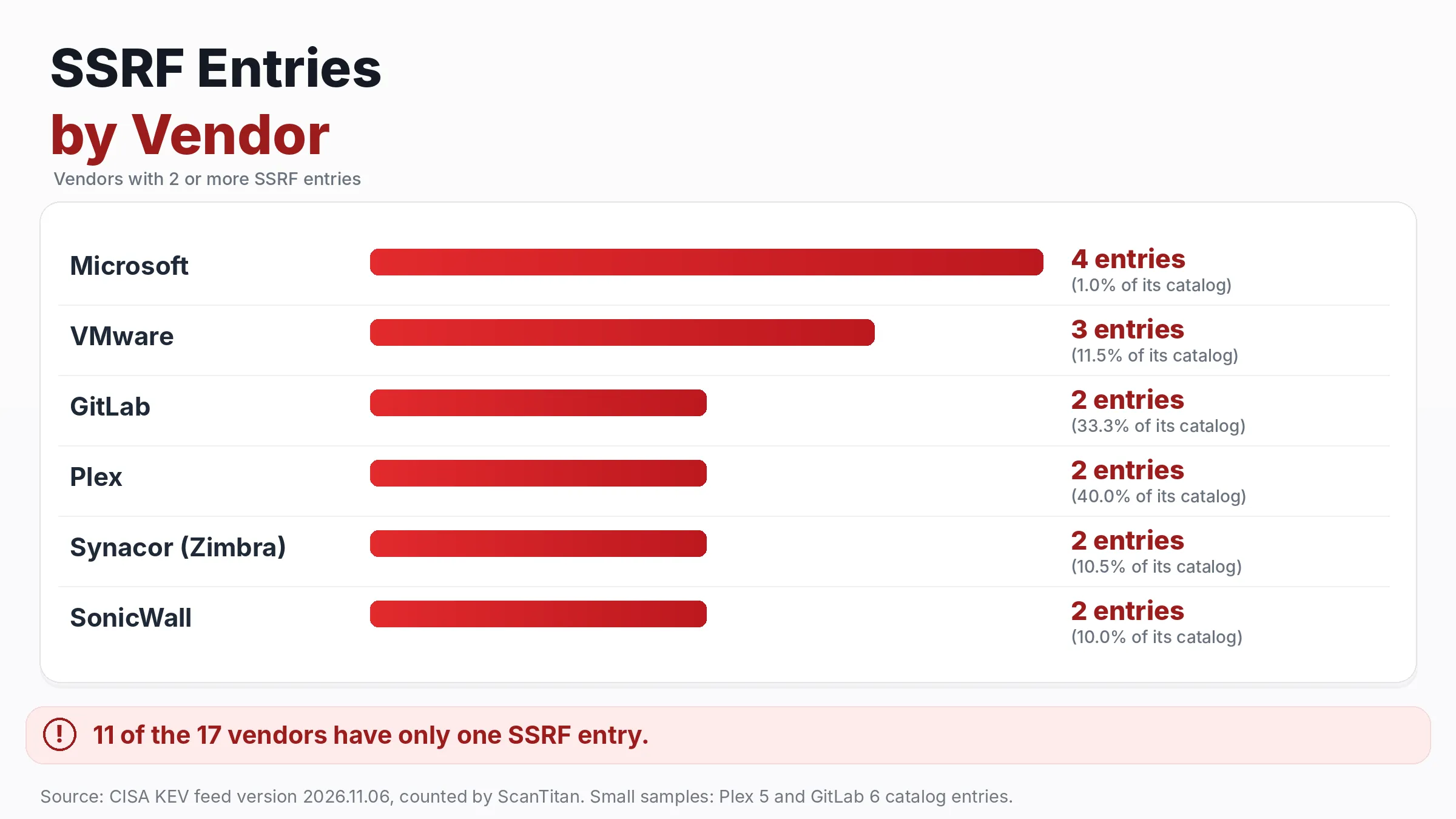
Which Vendors and Products Show Up
SSRF is spread across 17 vendors, and 11 of them have only one entry. Six vendors have two or more entries, together 15 entries or 57.7% of the 26.
| Vendor | SSRF entries | Vendor’s catalog entries | Share of its own entries |
|---|---|---|---|
| Microsoft | 4 | 390 | 1.0% |
| VMware | 3 | 26 | 11.5% |
| Plex | 2 | 5 | 40.0% |
| GitLab | 2 | 6 | 33.3% |
| Synacor (Zimbra) | 2 | 19 | 10.5% |
| SonicWall | 2 | 20 | 10.0% |
Source: CISA KEV feed, counted by ScanTitan. Vendors with a single SSRF entry: Accellion, Adminer, Apache, Cisco, ImageMagick, Ivanti, Kestra, MLflow, Omnissa, Oracle and Yealink. Omnissa Workspace ONE UEM was formerly named VMware Workspace ONE UEM and is counted under Omnissa here, as CISA lists it.
Microsoft has the most entries, 4, but only 1.0% of its 390 catalog entries, because most of its entries are other kinds of flaws. Three of the four Microsoft entries are Exchange flaws, and Exchange is the best-known SSRF target in the list: ProxyLogon (CVE-2021-26855) and CVE-2021-34473 in 2021 and ProxyNotShell (CVE-2022-41040) in 2022. Plex and GitLab have the highest shares of their own entries, 40.0% and 33.3%, but on only 5 and 6 catalog entries, so treat those two as small samples. VMware’s three are vCenter and vRealize flaws added between November 2021 and March 2022.
The most recent entries are not from the same places. Plex, MLflow and Kestra are a media server, a machine learning platform and a workflow engine, none of which sit in the classic edge device list.
Email Servers, Developer Tools and Management Software
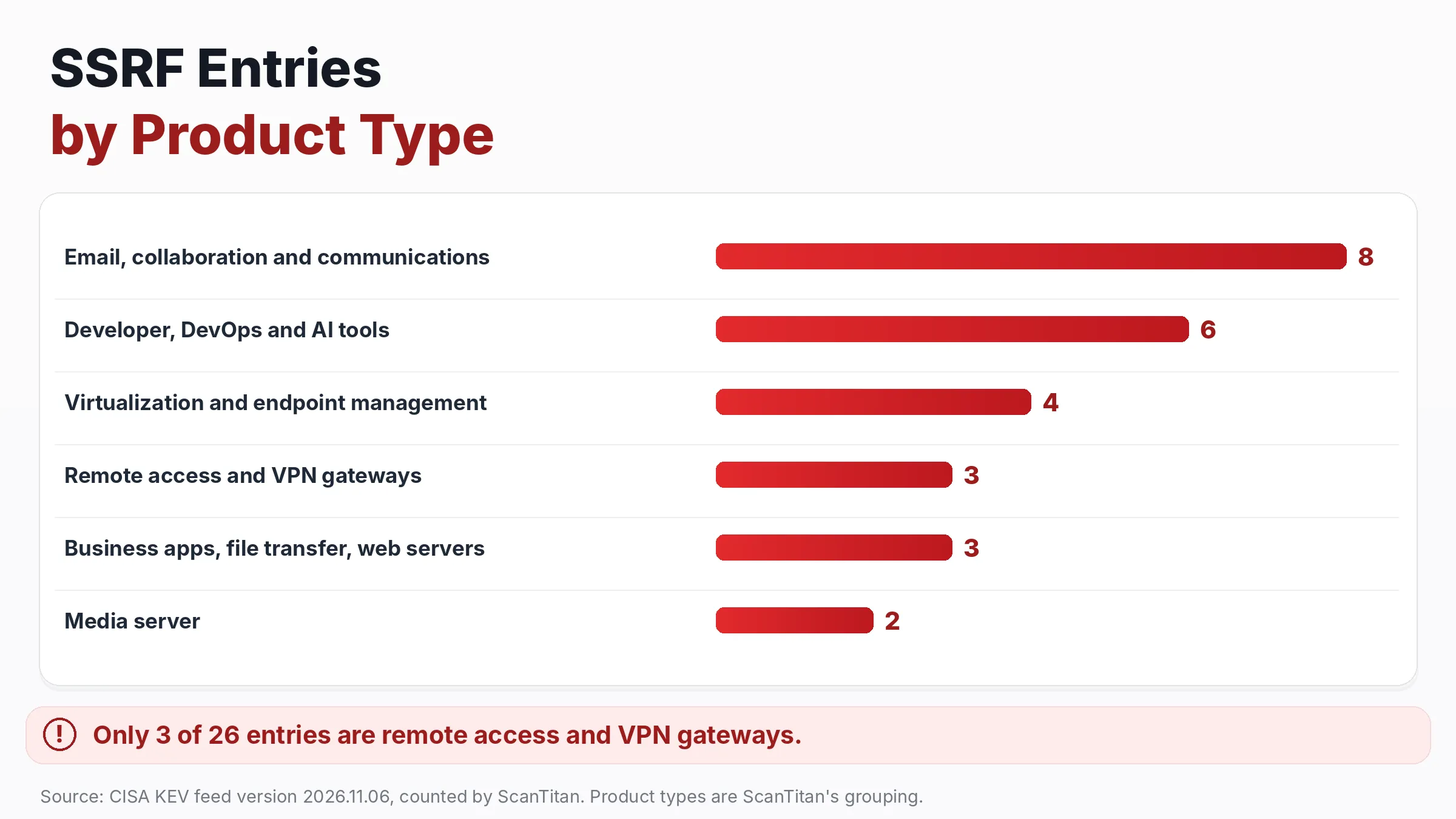
We grouped the 26 entries by what the affected product does. The groups are our choice, so we show counts and not shares. Catalog totals for such groups are not comparable across vendors.
| Product type | SSRF entries | Examples |
|---|---|---|
| Email, collaboration and communications servers | 8 | Exchange (3), Zimbra (2), Skype for Business, Yealink Device Management, Cisco Unified Communications Manager |
| Developer, DevOps and AI tools | 6 | GitLab (2), MLflow, Kestra, Adminer, ImageMagick |
| Virtualization and endpoint management | 4 | vCenter (2), vRealize Operations, Omnissa Workspace ONE UEM |
| Remote access and VPN gateways | 3 | SonicWall SMA1000 (2), Ivanti Connect Secure |
| Business applications, file transfer and web servers | 3 | Oracle E-Business Suite, Accellion FTA, Apache HTTP Server |
| Media server | 2 | Plex Media Server (2) |
Source: CISA KEV feed, counted by ScanTitan.
SSRF sits mostly in software that fetches or proxies content as part of its job: mail servers that relay requests, source code platforms that call webhooks, and management tools that talk to other services. Edge gear is a minority here, only the three remote access and VPN entries (Ivanti and two SonicWall flaws), which is unlike our path traversal statistics, where edge, VPN and network gear holds more than a quarter of entries. For a lean team the practical reading is that SSRF risk lives in internal servers that were never meant to face the internet, and in any feature that fetches a web address.
How Fast Are SSRF Flaws Listed?
We measured the gap in days between the CVE’s publication date and the date CISA added the entry.
| Entries added since 2023 | SSRF | All other entries |
|---|---|---|
| Entries measured | 16 | 887 |
| Median days from CVE publication to CISA listing | 27 | 15 |
| Listed on or before the CVE publication day | 18.8% (3) | 20.7% (184) |
| Listed within 30 days | 56.3% (9) | 54.5% (483) |
| Listed more than a year after the CVE | 37.5% (6) | 21.6% (192) |
Source: CISA KEV feed and CVE Services API, counted by ScanTitan.
SSRF flaws look about as fast as other flaws on the ordinary measures. Within 30 days, 56.3% were listed against 54.5%, and 18.8% were listed on or before the CVE day against 20.7%. The median is slower, 27 days against 15, because of a long tail: 6 of the 16 were listed more than a year after the CVE. Ten of the 16 are flaws that reached the catalog within 68 days of publication, with a median of 5 days, and the other six came 1,513 to 2,260 days (about 4 to 6 years) later. Over all years the median is 94 days for SSRF entries (26 measured) against 234 for other entries (1,743 measured), because the catalog’s first batches in 2021 and 2022 added many old flaws of every kind at once.
For a team, the lesson is that a flaw does not age out. Our patch management statistics show how long patches take once flaws are known, and the six old entries below show what that delay costs.
Old SSRF Flaws, Exploited Again
These are the 11 SSRF entries CISA added from 1 January to 6 November 2026.
| Date added | Vendor | Product | CVE | CVE published |
|---|---|---|---|---|
| 3 Feb | GitLab | Community and Enterprise Editions | CVE-2021-39935 | 2021 |
| 17 Feb | Synacor | Zimbra Collaboration Suite | CVE-2020-7796 | 2020 |
| 18 Feb | GitLab | GitLab | CVE-2021-22175 | 2021 |
| 9 Mar | Omnissa | Workspace ONE UEM | CVE-2021-22054 | 2021 |
| 25 Jun | Cisco | Unified Communications Manager | CVE-2026-20230 | 2026 |
| 14 Jul | SonicWall | SMA1000 Appliances | CVE-2026-15409 | 2026 |
| 19 Aug | MLflow | MLflow | CVE-2026-64849 | 2026 |
| 2 Sep | Kestra | Kestra OSS | CVE-2026-49869 | 2026 |
| 2 Sep | SonicWall | SMA1000 Appliances | CVE-2026-83548 | 2026 |
| 20 Oct | Plex | Media Server | CVE-2026-96655 | 2026 |
| 20 Oct | Plex | Media Server | CVE-2026-96652 | 2026 |
Source: CISA KEV feed, version 2026.11.06, and CVE Services API.
Seven of the 11 are flaws published in 2026 itself, and they reached the catalog quickly: gaps of 0, 1, 2, 22, 27, 27 and 68 days, a median of 22 days. Four are old flaws, two GitLab, one Zimbra and one Omnissa flaw published in 2020 and 2021, added after 1,513 to 2,191 days, a median of 1,628 days or about 4.5 years. Two more old flaws were added in 2025: the Zimbra flaw CVE-2019-9621 after 2,260 days and the Adminer flaw CVE-2021-21311 after 1,691 days. A flaw patched years ago is still worth an attacker’s time, because self-hosted tools such as GitLab, Zimbra and Adminer are often left on old versions.
Of the 11, only one is flagged for ransomware, the SonicWall flaw CVE-2026-15409.
SSRF and Ransomware
CISA marks a catalog entry as used in ransomware campaigns when it has evidence. That flag covers 38.5% of SSRF entries (10 of 26), against 20.1% of all other entries (351 of 1,743).
| Period added | SSRF entries | Flagged for ransomware |
|---|---|---|
| 2021 and 2022 | 10 | 70.0% (7) |
| Since 2023 | 16 | 18.8% (3) |
Source: CISA KEV feed, counted by ScanTitan.
The overall figure is high, but it comes from the early years. The 7 flagged entries from 2021 and 2022 are the Accellion FTA flaw, the three Exchange flaws, the VMware vCenter flaw CVE-2021-21985, the vRealize flaw CVE-2021-21975 and the Apache HTTP Server flaw CVE-2021-40438, so most are part of the Exchange and VMware exploitation of those years. Since 2023 only 3 of 16 are flagged: the Ivanti flaw CVE-2024-21893, the Oracle E-Business Suite flaw CVE-2025-61884 and the SonicWall flaw CVE-2026-15409. Older entries have had longer to collect a flag, which also lifts the early rate.
What Outside Data Says About SSRF
| Source | Figure | Period | What it means |
|---|---|---|---|
| MITRE CWE Top 25 | CWE-918 ranks 22nd with a score of 3.36, with 0 CVEs in KEV | 2025 list | Down from 19th, and the only weakness in this report with no CVEs in KEV in MITRE’s window |
| OWASP Top 10:2021 | A10 had 9,503 occurrences, 385 CVEs and a 2.72% average incidence rate | 2021 edition | A low incidence rate with above average exploit and impact scores. It entered from the community survey |
| OWASP Top 10:2025 | CWE-918 is named among the notable weaknesses in A01 Broken Access Control | 2025 edition | SSRF no longer has its own place in the list |
| NVD | 1,601 of 430,605 CVEs carry CWE-918 (0.37%) | Queried 23 Nov 2026 | SSRF is 1.4% of the CISA catalog, about 3.6 times its share of all CVEs |
| Datadog, vendor-only | One in two EC2 instances enforces IMDSv2 | 2025 study | The AWS setting that protects instance credentials against SSRF. Newly created instances often allow both versions |
The sources agree that SSRF is a narrow weakness with a large effect. It is low in volume, which is why MITRE ranks it 22nd and OWASP folded it into a larger category, and yet it keeps appearing in exploited products. MITRE’s 0 and ScanTitan’s 24 describe the same weakness over different periods: MITRE counts the CVEs it scored in its window, while our count covers every entry added since the catalog launched in November 2021.
The Datadog figure is a vendor measurement of its own customers and cannot be added to ours. It is also the only cloud figure here that we read on its own page, and we left out other cloud percentages that we could not check at the source.
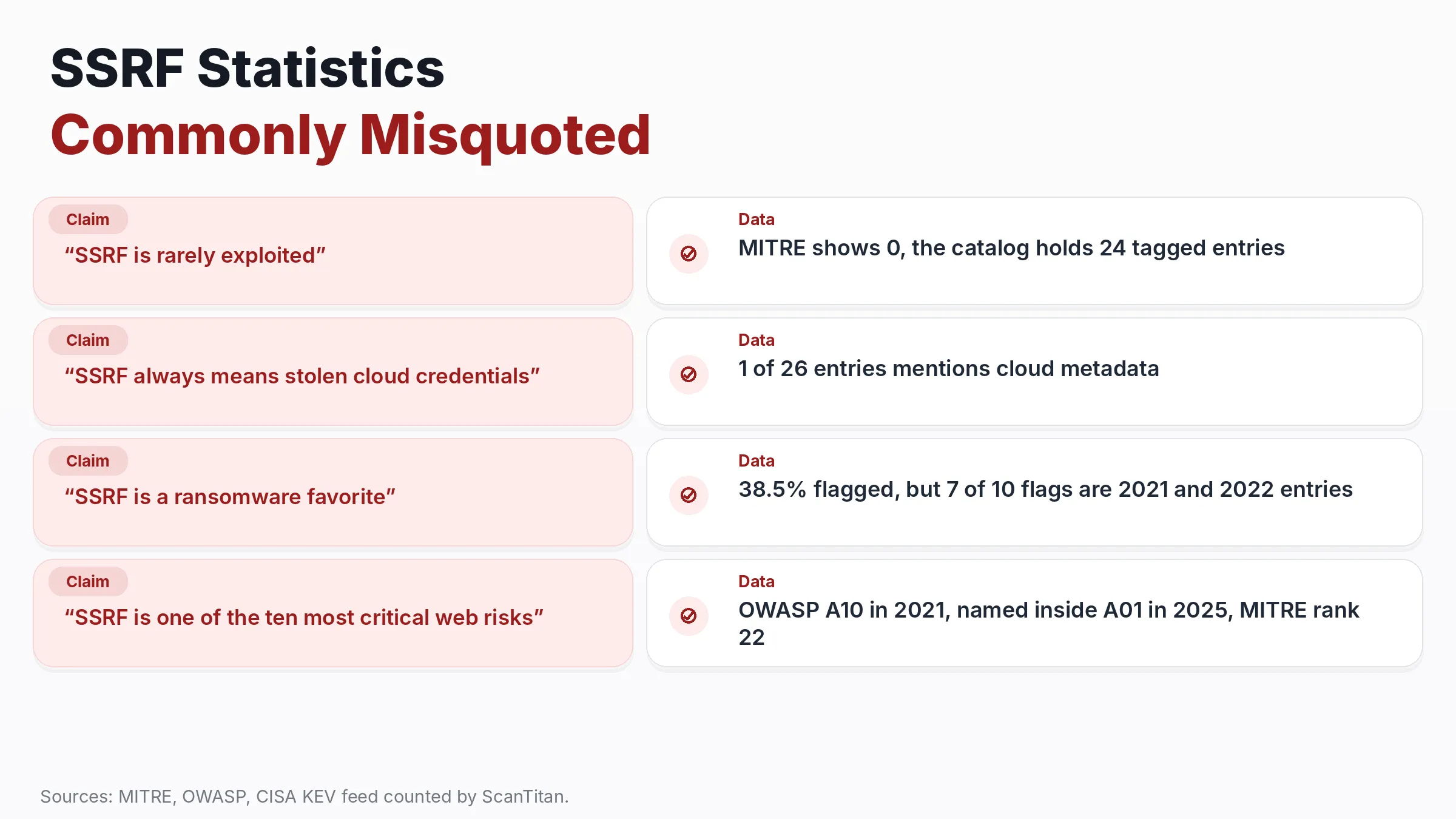
SSRF Statistics Commonly Misquoted
| Claim | What the data shows |
|---|---|
| “SSRF is one of the ten most critical web risks” | It was A10 in OWASP’s 2021 list. In 2025 OWASP names it inside A01 Broken Access Control, and MITRE ranks CWE-918 22nd |
| “SSRF is rarely exploited” | MITRE counts 0 CVEs in KEV for its window, but the whole catalog holds 24 SSRF-tagged entries, 11 of them added in 2026 |
| “SSRF always means stolen cloud credentials” | Only 1 of 26 entries mentions cloud metadata, and 6 mention code execution. The catalog does not say what the attacker reached in most cases |
| “SSRF is an old problem” | 15 of the 26 entries are for CVEs published in 2021 or earlier, but 7 of the 11 entries added in 2026 are for flaws published in 2026 |
| “SSRF is a ransomware favorite” | 38.5% are flagged, but 7 of the 10 flags are on 2021 and 2022 entries. Since 2023 it is 3 of 16 |
What the Numbers Mean for a Lean Team
SSRF is a quiet flaw until it is chained, so the work is to patch servers that fetch things and to limit what those servers can reach.
- Do not wait for the catalog. Six of the 16 SSRF entries since 2023 were listed more than a year after the CVE, and the other ten within 68 days. Patch on the vendor’s advisory, and use the CVE priority checker to see whether a flaw is listed.
- Patch old versions of self-hosted tools. GitLab, Zimbra, Adminer and Omnissa entries are for flaws 4 to 6 years old. Inventory the self-hosted tools you run and check their versions.
- Keep mail, collaboration and management servers off the internet where you can. Exchange, Zimbra, vCenter, vRealize and Cisco Unified Communications Manager account for 9 of the 26 entries. Put them behind a VPN or an access gateway.
- Limit what servers can reach. SSRF works because a server can reach internal systems. Block outbound requests from servers by default and allow only the destinations they need. The SSRF guide covers allowlists and egress filtering.
- Enforce IMDSv2 on AWS instances. Datadog recommends it to protect against SSRF, and found that one in two EC2 instances enforced it in 2025. Older instances lag behind. This is a vendor study, so treat the figure as indicative.
- Test every feature that fetches a web address. Webhooks, URL previews, image importers and PDF generators are the usual entry points, and SSRF is item API7 in our OWASP API Top 10 guide. A scan of your API endpoints finds the cheap cases, as in the API vulnerability scanner.
- Rotate secrets after an SSRF fix. Where SSRF touched an internal service, assume tokens and keys on that path were read. See our credential theft statistics for why stolen secrets matter.
How We Compiled and Verified These Statistics
- Used: the CISA Known Exploited Vulnerabilities feed (version 2026.11.06), CVE publication dates from the CVE Services API, NVD CVE API totals (queried 23 November 2026), MITRE’s 2025 CWE Top 25, the OWASP Top 10 pages for 2021 and 2025, and Datadog’s 2025 State of Cloud Security article. The Datadog figure is labeled vendor-only.
- Method: each entry’s weakness tags and its name and short description were searched for the SSRF weakness and terms. Counts were split by year added, outcome wording, vendor, product type, listing gap and ransomware flag. Every external figure was read on its own page.
- Product types: email, collaboration and communications servers covers Microsoft Exchange and Skype for Business, Synacor Zimbra, Yealink Device Management and Cisco Unified Communications Manager. Developer, DevOps and AI tools covers GitLab, MLflow, Kestra, Adminer and ImageMagick. Virtualization and endpoint management covers VMware vCenter and vRealize Operations Manager and Omnissa Workspace ONE UEM. Remote access and VPN gateways covers SonicWall SMA1000 and Ivanti Connect Secure. Business applications, file transfer and web servers covers Oracle E-Business Suite, Accellion FTA and Apache HTTP Server. Media server is Plex.
- Limits: the counts are tag and text matches, not a CISA classification. With 26 entries, one entry moves a share by almost four points, so percentages are shown beside counts and yearly shares show direction only. Product types are our choice and some products fit two groups. The catalog lists only flaws CISA has evidence of exploitation for.
- Excluded: a 2019 scan of Atlassian Jira servers and its metadata leak rates, because we could not open the source page; SSRF figures from a conference video and from search summaries, because we could not trace them to a primary page; cloud percentages from other vendors that we did not read at the source; and any figure without a primary source.
- Refresh: reviewed every 90 days. Catalog counts change daily.
How to cite this research. ScanTitan, “SSRF Statistics 2026: Exploited Flaws, Vendors & Trends,” 23 November 2026. For single figures, cite the primary source beside each number.
Primary Sources
- CISA Known Exploited Vulnerabilities catalog data feed
- CVE Program
- NVD CVE API
- MITRE, 2025 CWE Top 25 Most Dangerous Software Weaknesses
- OWASP, Top 10:2021, A10 Server Side Request Forgery
- OWASP, Top 10:2025, A01 Broken Access Control
- Datadog, Key learnings from the 2025 State of Cloud Security study, vendor-only
Frequently Asked Questions
What is SSRF?
Server-side request forgery (SSRF) is a flaw where an application fetches a web address chosen by the user and does not check where the request goes. An attacker uses it to make the server reach internal systems, cloud services or other servers that the attacker cannot reach directly.
How common is SSRF?
It is 1.5% of CISA’s Known Exploited Vulnerabilities catalog by ScanTitan’s count, 26 of 1,769 entries, and the CWE-918 weakness is on 0.37% of all CVEs in the National Vulnerability Database, so it is about 3.6 times as common among exploited flaws as among all flaws.
Is SSRF increasing?
In the exploited catalog, yes, in 2026. The share of entries added each year was 0.5% in 2022, 2023 and 2024, 1.2% in 2025 and 3.9% in 2026 to 6 November, with 11 of the 26 SSRF entries added this year. The sample is small, so treat it as direction and not precision.
What can attackers do with SSRF?
They use the server to reach places they cannot reach themselves. In the catalog, 30.8% of SSRF entries say no login is needed, 23.1% describe exposed data or credentials, and 23.1% mention code execution, usually through a second flaw chained with the SSRF step.
Why does MITRE show 0 SSRF flaws in the exploited catalog?
MITRE’s 2025 Top 25 counts CVEs in its own scoring window, and it ranks CWE-918 in 22nd place with 0 of them in the catalog. ScanTitan counts every entry added since 2021 and finds 24 with the CWE-918 tag. Both are correct for their periods.
Which vendors have the most exploited SSRF flaws?
Microsoft has 4 entries, VMware 3, and GitLab, Plex, Synacor (Zimbra) and SonicWall 2 each. By share of its own catalog entries, Plex leads at 40.0% and GitLab follows at 33.3%, but both are small samples.
Is SSRF used in ransomware?
CISA flags 38.5% of SSRF entries as used in ransomware, against 20.1% of other entries, but 7 of the 10 flagged entries were added in 2021 and 2022. Since 2023 it is 3 of 16.
How fast are SSRF flaws added to CISA’s catalog?
For entries added since 2023, SSRF flaws were listed a median of 27 days after the CVE was published, against 15 days for other entries. Ten of the 16 were listed within 68 days, and six were listed 4 to 6 years after the CVE.
What is the difference between SSRF and CSRF?
SSRF makes a server send a request, while cross-site request forgery makes a user’s browser send one. They sound alike but target different things; see our guide to CSRF.
Can SSRF lead to remote code execution?
Yes, when it is chained with another flaw. The Exchange flaws CVE-2021-26855 and CVE-2021-34473 and the VMware vCenter flaw CVE-2021-21985 are SSRF-tagged entries whose descriptions say remote code execution, and 23.1% of SSRF entries mention code execution. Flaws such as XML external entity injection can also be a route to SSRF, as in our guide to XXE.
Where does this data come from?
From CISA’s Known Exploited Vulnerabilities feed (version 2026.11.06), the CVE Services API, the NVD CVE API and primary pages from MITRE, OWASP and Datadog, as named beside each figure.