Privilege escalation statistics depend on the definition, because “privilege escalation” is not a field in CVE, NVD or CISA data: in ScanTitan’s count of CISA’s Known Exploited Vulnerabilities catalog, 9.8% of entries say “privilege” in their name, 16.9% describe escalating privileges, and 22.1% mention privileges in some role. Microsoft’s own security research puts local privilege escalation at 18% of exploited CVEs, up from 11% of all published ones, and its vulnerability counts put elevation of privilege at about 40% of its 2025 releases. Most privilege escalation statistics pages quote one of these figures, or a survey of insiders, without saying which definition they used. This research shows each count separately, explains how ScanTitan counted from public data, labels vendor figures, and says where a popular number does not hold up. Data last checked: 17 November 2026.
Key Privilege Escalation Statistics for 2026
Executive Benchmark: Privilege Escalation Statistics for 2026
| Metric | Latest figure | Period | Trend / context | Source |
|---|---|---|---|---|
| CISA catalog entries describing escalation of privileges | 16.9% (299 of 1,769) | Added 2021 to 6 Nov 2026 | 15.0% (135 of 903) since 2023 | CISA KEV feed, counted by ScanTitan |
| Entries with “privilege” in the name | 9.8% (173 of 1,769) | Added 2021 to 6 Nov 2026 | 2.6% (14 of 530) in 2025 and 2026 | CISA KEV feed, counted by ScanTitan |
| Entries mentioning privileges in any role | 22.1% (391 of 1,769) | Added 2021 to 6 Nov 2026 | Includes attackers who need privileges | CISA KEV feed, counted by ScanTitan |
| Local privilege escalation share of exploited CVEs | 18% of 2,056 | CVEs to Sept 2026 | 11% of all published CVEs | Microsoft Security Research |
| Remote code execution, privilege escalation and authentication bypass together | 78% of exploited CVEs | CVEs to Sept 2026 | Microsoft calls them takeover classes | Microsoft Security Research |
| Elevation of privilege share of Microsoft vulnerabilities | 40% (509 of 1,273) | 2025 | Total down 6% from 1,360 | BeyondTrust, vendor-only |
| Elevation of privilege share of Microsoft’s Patch Tuesday vulnerabilities | 38.3% | 2025 | 1,130 CVEs; remote code execution 30.8% | Tenable |
| Median days from CVE publication to CISA listing, escalation entries | 3 | Added 2023 to 6 Nov 2026 | 19 days for other entries | CISA KEV feed and CVE Services API, counted by ScanTitan |
| Escalation entries flagged as used in ransomware | 25.1% (75 of 299) | Added 2021 to 6 Nov 2026 | 19.5% of other entries | CISA KEV feed, counted by ScanTitan |
| Valid accounts used in privilege escalation, in CISA’s assessments | 45% of instances | Fiscal year 2023 | Assessment data, not exploited flaws | CISA |
| Privilege misuse share of breaches | 3% | 2026 report | Insider and abuse pattern, not software flaws | Verizon 2026 DBIR executive summary |
Methodology: Four Ways to Count Privilege Escalation
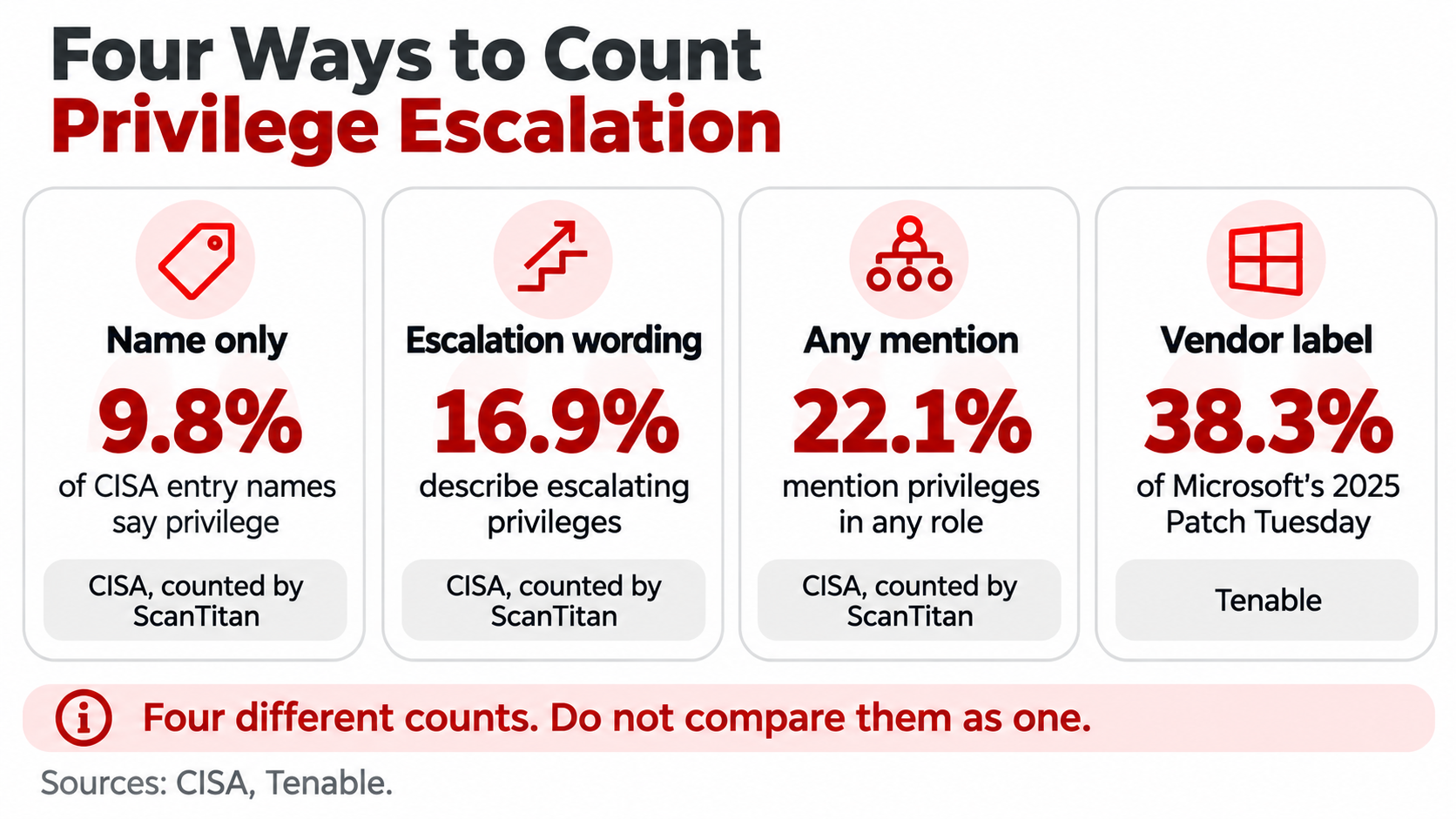
“Privilege escalation statistics” is used for four different counts. Each answers a different question and can be wrong in a different way.
| Count | What it matches | Example 2026 figure | Source type | What it cannot tell you |
|---|---|---|---|---|
| Name only | An entry whose name contains “privilege” | 9.8% of the CISA catalog | ScanTitan text match | Entries named after the bug type, such as “Use-After-Free” |
| Escalation wording | An entry whose name or description says it escalates, elevates or gains privileges | 16.9% of the CISA catalog | ScanTitan text match | Whether the attacker starts local or remote |
| Any mention | An entry that uses the word “privilege” anywhere | 22.1% of the CISA catalog | ScanTitan text match | Whether the flaw gives privileges or only needs them |
| Vendor label | A vendor’s own “elevation of privilege” rating | 38.3% of Microsoft’s 2025 Patch Tuesday | Vendor patch data (Tenable count) | Other vendors, or exploited versus unexploited flaws |
How ScanTitan counted. We downloaded the CISA Known Exploited Vulnerabilities feed, version 2026.11.06 with 1,769 entries, and searched each entry’s vulnerability name and short description. The name-only count matches “privilege” in the name. The escalation count matches “escalate”, “elevation of privilege”, “privilege elevation”, “improper privilege management” and wording such as “gain administrator privileges”. The any-mention count matches the word “privilege” anywhere. These are text matches, not CISA classifications, so the numbers describe how CISA writes its entries. The name-only count matches the 173 entries another publisher reported on the same catalog, so the method is reproducible. CVE publication dates come from the CVE Services API. Weakness tags are the CWE values CISA lists on 1,594 of the 1,769 entries.
What the sources count. Microsoft Security Research gave each of about 383,000 CVEs the single most consequential impact class and counts local privilege escalation as elevation to SYSTEM or root. BeyondTrust and Tenable count Microsoft’s own “elevation of privilege” label across its releases. CISA counts techniques used in its assessments. Verizon counts how breaches began.
How Many Exploited Flaws Are Privilege Escalation?
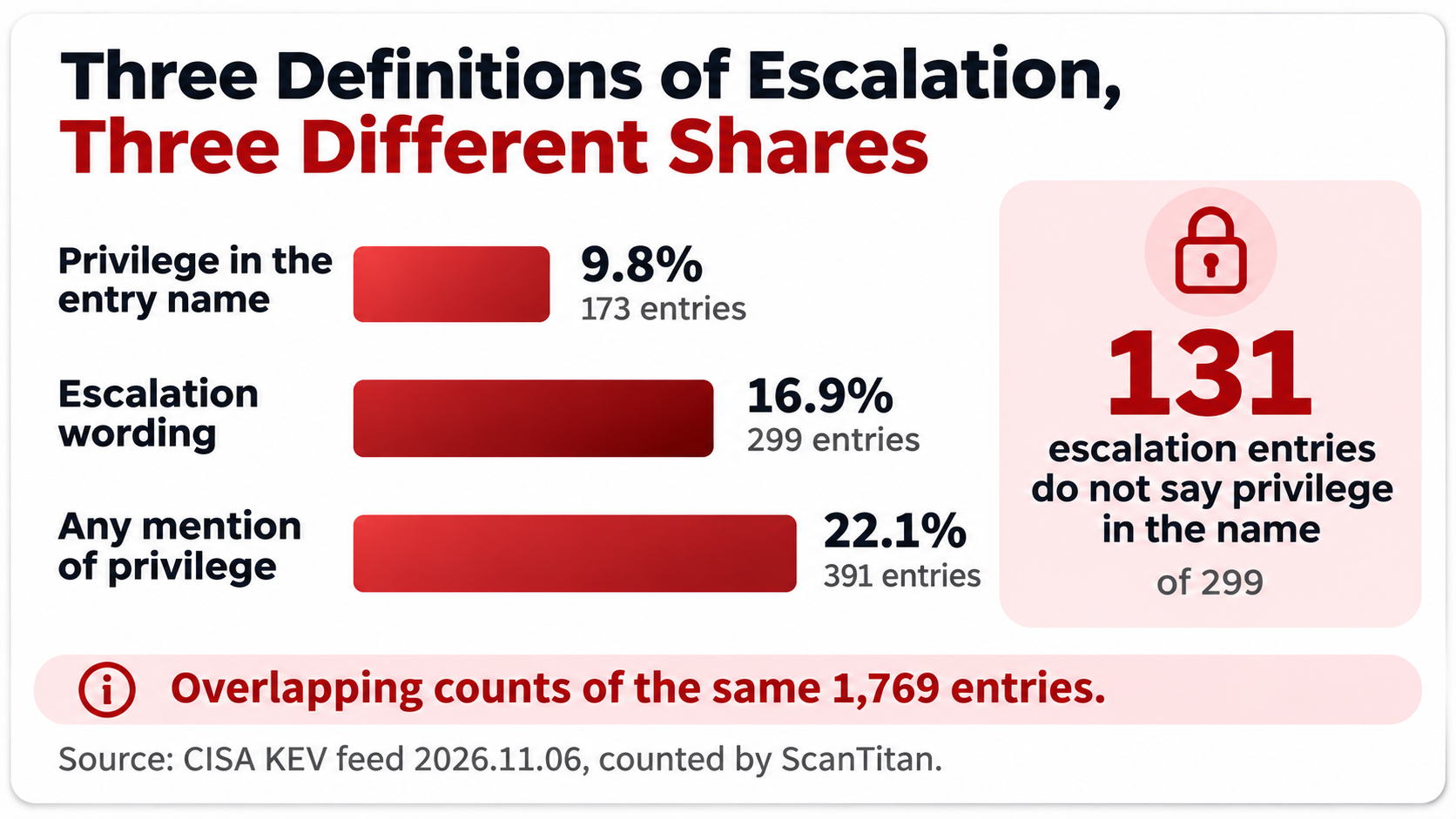
| Definition (ScanTitan text match) | Entries | Share of 1,769 |
|---|---|---|
| “Privilege” in the entry name | 173 | 9.8% |
| Escalation wording in the name or description | 299 | 16.9% |
| Any mention of “privilege” | 391 | 22.1% |
Source: CISA KEV feed version 2026.11.06, counted by ScanTitan. The three counts overlap: all 299 escalation entries mention privileges, and 131 of them do not say so in the name.
Roughly one in six exploited flaws in the catalog describes an attacker gaining higher privileges. The name-only count misses most of them: 131 of the 299 escalation entries are named after the bug, such as a use-after-free or a race condition, and say “escalate privileges” only in the description. The any-mention count goes the other way, because many entries use “privilege” to describe what the attacker already holds, as in a flaw that “allows a privileged attacker” to read files.
Of the 299 escalation entries, 88 say “local” in the entry, 38 say “remote”, “unauthenticated” or “network access”, 3 say both, and 176 say neither. The catalog wording rarely settles where the attacker starts. Several in the remote group are authentication flaws that hand over administrator rights, which our authentication bypass statistics count separately.
Is Privilege Escalation Rising or Falling?
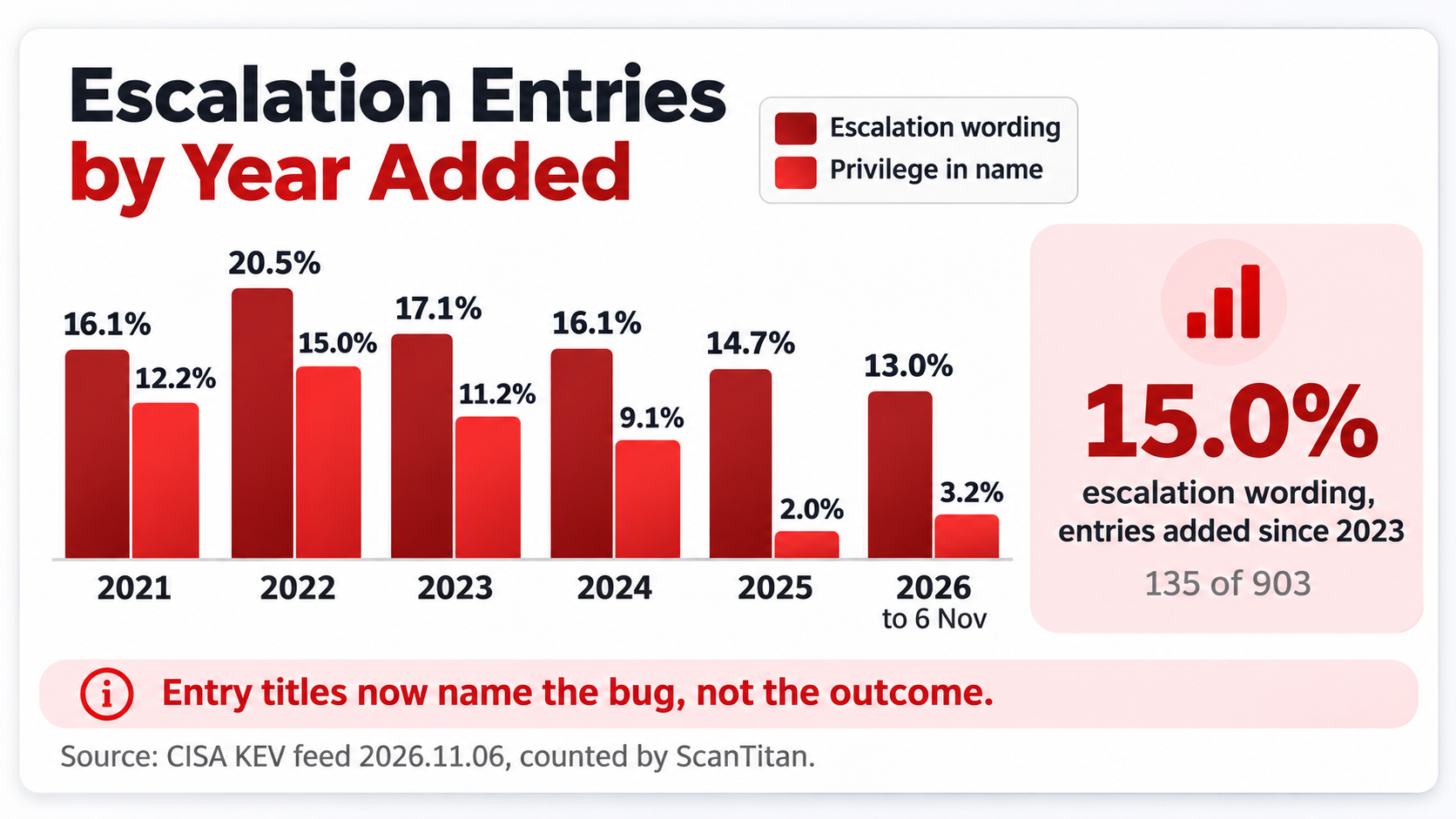
| Year added | Entries | Escalation wording | Share | “Privilege” in name | Share |
|---|---|---|---|---|---|
| 2021 | 311 | 50 | 16.1% | 38 | 12.2% |
| 2022 | 555 | 114 | 20.5% | 83 | 15.0% |
| 2023 | 187 | 32 | 17.1% | 21 | 11.2% |
| 2024 | 186 | 30 | 16.1% | 17 | 9.1% |
| 2025 | 245 | 36 | 14.7% | 5 | 2.0% |
| 2026 to 6 Nov | 285 | 37 | 13.0% | 9 | 3.2% |
Source: CISA KEV feed version 2026.11.06, counted by ScanTitan.
By this measure privilege escalation is not rising. The 2022 row is the launch backlog, when CISA listed old flaws in bulk, and it runs highest at 20.5%. Since 2023 the escalation share has drifted from 17.1% to 13.0%, with the count steady at 30 to 37 entries a year. The count of new entries is flat, so escalation flaws are a stable group in a catalog that grew.
The name-only count tells a different and misleading story. It falls from 15.0% in 2022 to 2.0% in 2025 and 3.2% in 2026. That is not a drop in escalation flaws but a change in how entries are titled: in 2025 and 2026 only 14 of 530 entries say “privilege” in the name, while 73 of 530 describe escalation in the description. A page that counts names would conclude escalation has nearly disappeared.
Microsoft’s research looks at a different population and finds a different level. Local privilege escalation is 11% of the roughly 383,000 CVEs published through September 2026 and 18% of the 2,056 exploited ones, so exploitation favors it, but its taxonomy gives each CVE only its single most consequential impact, so a flaw that also allows code execution is counted in another class. Source: Microsoft Security Research. Within Microsoft’s own releases, BeyondTrust counted elevation of privilege at 40% of 1,273 vulnerabilities in 2025, the dominant category for several years, and Tenable at 38.3% of 1,130 Patch Tuesday CVEs. Those figures cover every Microsoft vulnerability, not only exploited ones, so they should not be compared with the catalog percentages above.
What Causes Privilege Escalation: The Weaknesses Behind the Flaws
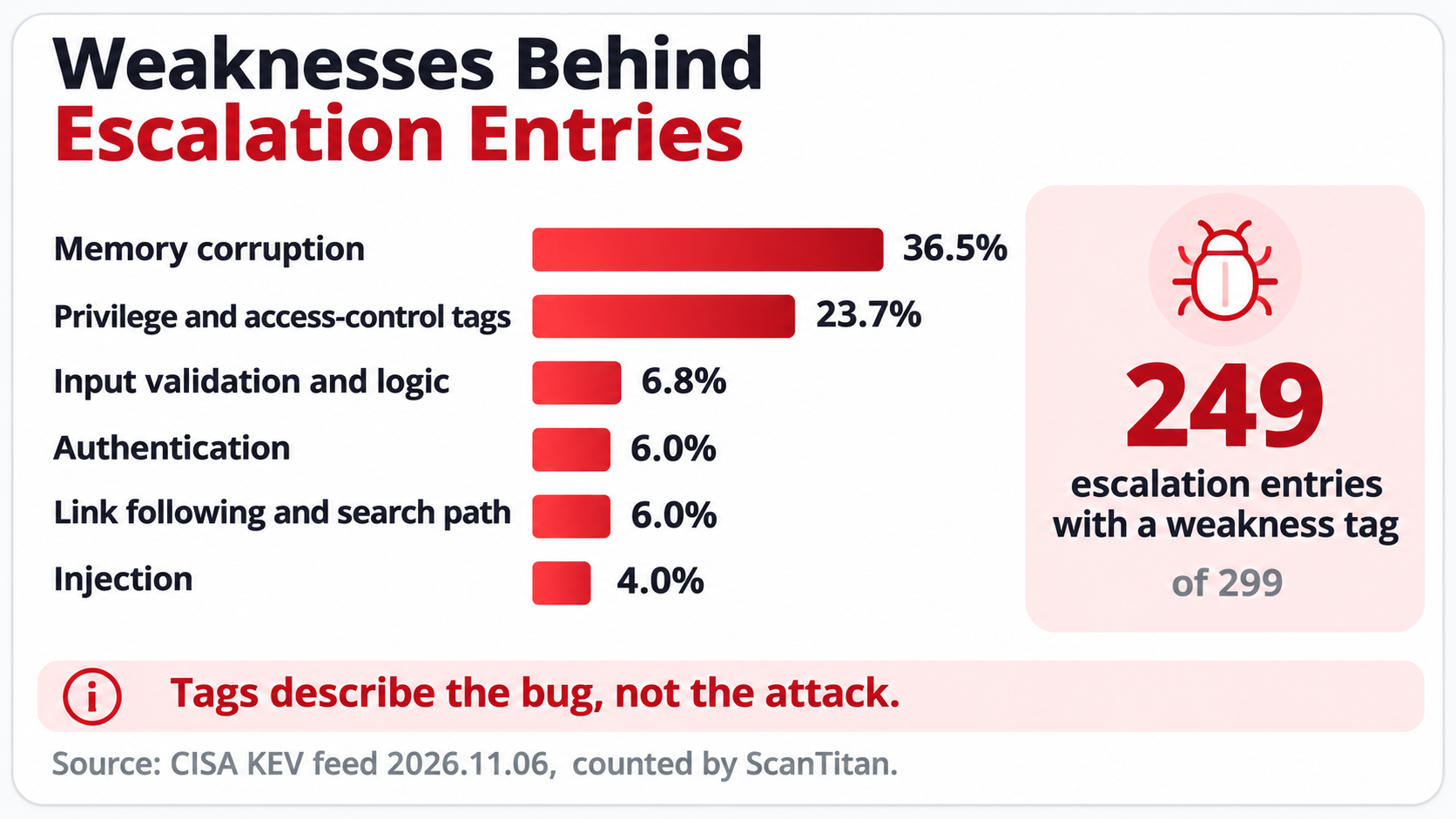
CISA lists weakness tags (CWE) on 1,594 of its 1,769 entries. Among the 299 escalation entries, 249 carry at least one tag.
| Weakness group | Escalation entries with the tag | Share of 249 |
|---|---|---|
| Memory corruption (use after free, out-of-bounds write, buffer overflow, integer overflow) | 91 | 36.5% |
| Privilege and access-control tags (CWE-264, 269, 250, 284, 862, 863) | 59 | 23.7% |
| Input validation and logic (CWE-20, 22, 345, 346) | 17 | 6.8% |
| Authentication (CWE-287, 306, 288, 290, 798, 294) | 15 | 6.0% |
| Link following and search path (CWE-59, 427, 426) | 15 | 6.0% |
| Injection (CWE-78, 77, 94, 89, 79) | 10 | 4.0% |
| Race conditions (CWE-362, 367) | 7 | 2.8% |
Source: CISA KEV feed version 2026.11.06, counted by ScanTitan. An entry can carry more than one tag, so the rows are not exclusive.
Memory corruption is the largest cause: more than a third of escalation entries with a tag, led by use after free (CWE-416, 29 entries) and out-of-bounds write (CWE-787, 20). These are bugs in kernels and drivers, where one memory error turns a low-rights process into SYSTEM or root. The next group is the privilege and access-control tags, which describe flaws in how rights are granted or checked: 20 entries carry the legacy permissions tag CWE-264 and 17 carry improper privilege management, CWE-269. Link following (CWE-59), where a privileged process follows a link an attacker planted, adds 14 more.
MITRE’s 2025 CWE Top 25 ranks two of the leading memory weaknesses high and reports how many of each type are in the catalog:
| Weakness | MITRE 2025 rank | Rank last year | CVEs in KEV (MITRE count) |
|---|---|---|---|
| Out-of-bounds write (CWE-787) | 5 | 2 | 12 |
| Use after free (CWE-416) | 7 | 8 | 14 |
| Incorrect authorization (CWE-863) | 17 | 18 | 4 |
| Improper access control (CWE-284) | 19 | Not ranked | 1 |
Source: MITRE 2025 CWE Top 25. MITRE’s counts come from its own data window and differ from ScanTitan’s whole-catalog counts. Improper privilege management (CWE-269) is not in the 2025 Top 25. Our use after free guide explains the leading cause.
Which Vendors and Products Show Up
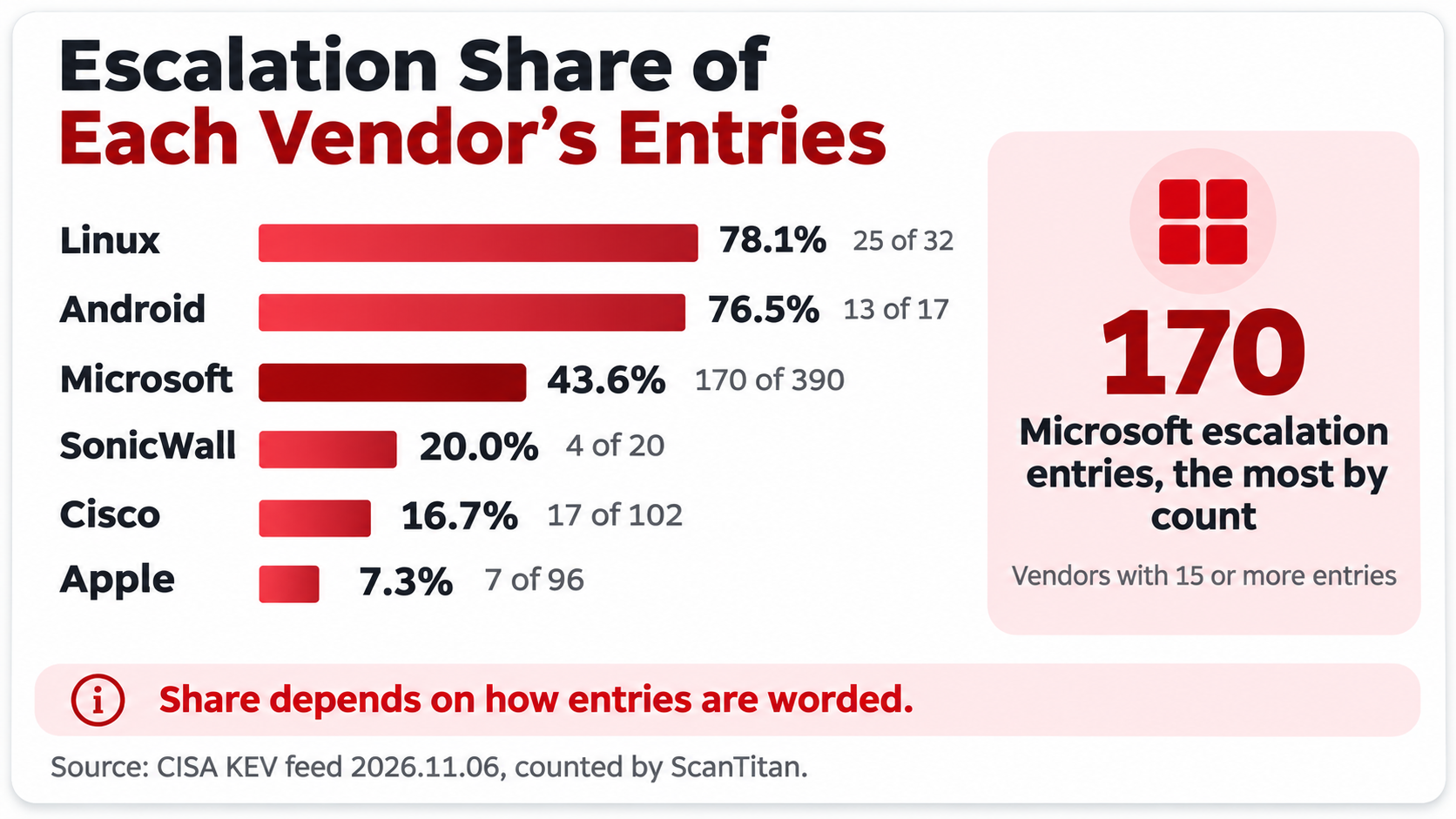
| Vendor | Escalation entries | Vendor’s catalog entries | Share of its entries |
|---|---|---|---|
| Linux | 25 | 32 | 78.1% |
| Android | 13 | 17 | 76.5% |
| Microsoft | 170 | 390 | 43.6% |
| SonicWall | 4 | 20 | 20.0% |
| Cisco | 17 | 102 | 16.7% |
| VMware | 3 | 26 | 11.5% |
| Apple | 7 | 96 | 7.3% |
| Apache | 3 | 41 | 7.3% |
| 2 | 76 | 2.6% |
Source: CISA KEV feed version 2026.11.06, counted by ScanTitan. Vendors with at least 15 catalog entries, sorted by share; the vendor field is the catalog’s own. Linux and Android are listed as vendors in the catalog.
Microsoft has more than six times the escalation entries of any other vendor, 170, because it has the most entries overall and because its Windows kernel components are a standard target: 101 of the 170 are Windows itself and 25 are the Win32k driver. By share, the Linux kernel and Android lead: 78.1% of the Linux entries and 76.5% of the Android entries describe escalation. These are platforms where the usual attack path is a malicious app or user already on the device. Only 51 of the 291 vendors in the catalog have an escalation entry.
Microsoft’s entries are also the recent ones: 32 of the 73 escalation entries added in 2025 and 2026 are Microsoft’s. This matches Microsoft’s own finding that operating-system flaws are 23% of published CVEs but 41% of exploited ones.
Operating Systems vs Edge Devices
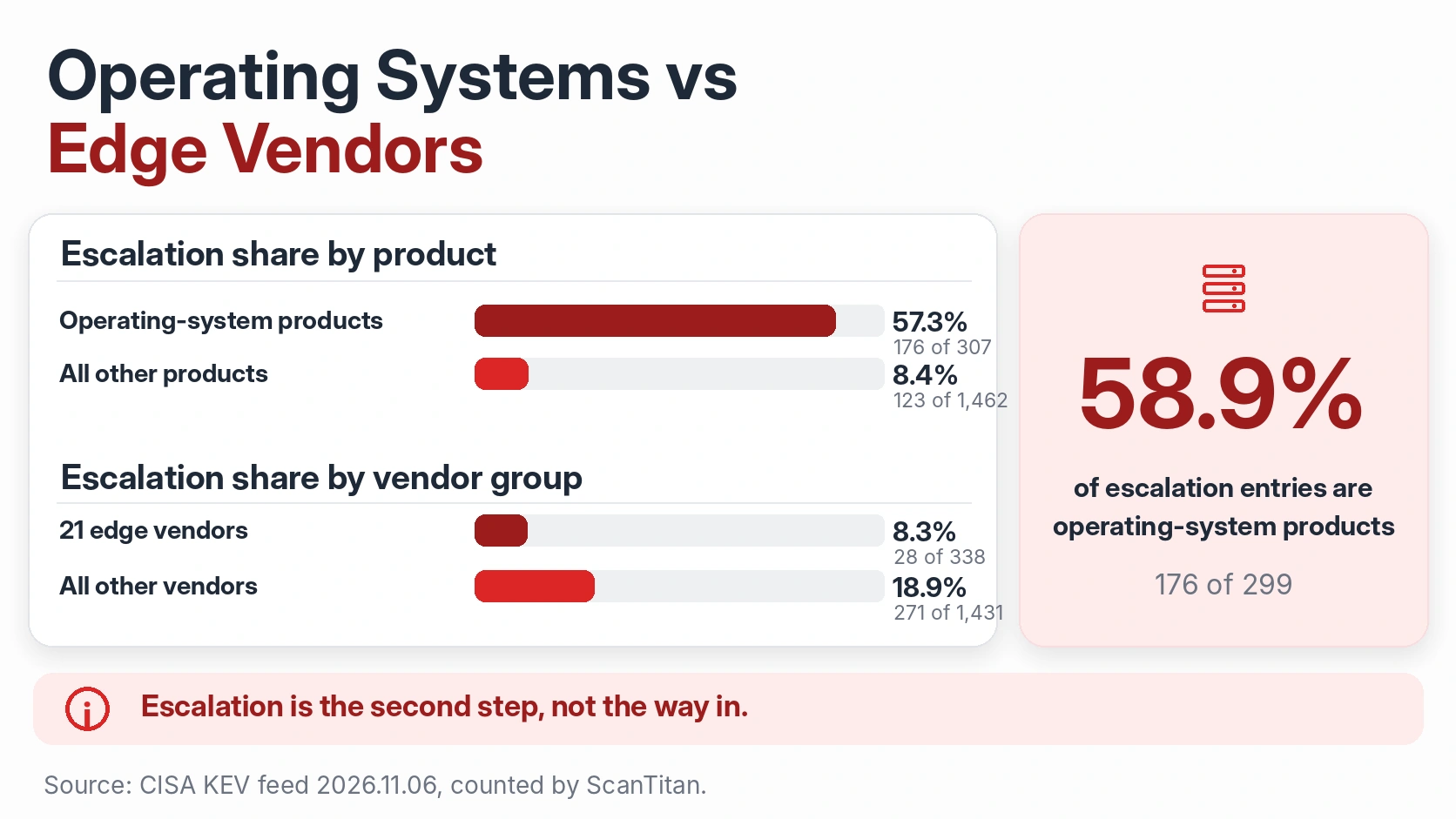
Escalation flaws live in operating systems, not on the network edge. ScanTitan grouped catalog entries by product: 307 entries are operating-system products (Windows, the Win32k driver, the Linux and Android kernels, iOS, iPadOS and macOS), and 338 come from the 21 firewall, VPN, router and gateway vendors (Cisco, Fortinet, Palo Alto Networks, Ivanti, Citrix, SonicWall, F5, Juniper, Check Point, Zyxel, D-Link, TP-Link, MikroTik, NETGEAR, Ubiquiti, WatchGuard, Barracuda, Sophos, Pulse Secure, Array Networks and DrayTek).
| Group | Entries | Escalation wording | Share |
|---|---|---|---|
| Operating-system products | 307 | 176 | 57.3% |
| All other products | 1,462 | 123 | 8.4% |
| 21 edge vendors | 338 | 28 | 8.3% |
| All other vendors | 1,431 | 271 | 18.9% |
Source: CISA KEV feed version 2026.11.06, counted by ScanTitan. The operating-system group excludes Cisco, because its router operating system is edge equipment. The groups overlap.
Escalation entries are 57.3% of the operating-system group against 8.4% of everything else, and 176 of the 299 escalation entries, 58.9%, are in operating-system products. Edge vendors show the opposite pattern: 8.3% of their entries describe escalation against 18.9% for other vendors, while 52.4% of their entries describe a login failure. Edge flaws get the attacker in, and operating-system flaws get them higher after they are in. The takeover classes Microsoft names fit the same split, and our authentication bypass statistics and remote code execution statistics cover the entry points.
How Fast Are Privilege Escalation Flaws Listed?
ScanTitan compared each entry’s CVE publication date with the date CISA added it, for entries added since 2023.
| Group | Entries | Median days to listing | Listed on or before CVE day | Listed within 30 days | Older than one year when listed |
|---|---|---|---|---|---|
| Escalation wording, all vendors | 135 | 3 | 42.2% | 57.8% | 20.0% |
| Escalation wording, Microsoft | 65 | 0 | 66.2% | 73.8% | 10.8% |
| Escalation wording, other vendors | 70 | 48 | 20.0% | 42.9% | 28.6% |
| All other entries | 768 | 19 | 16.9% | 53.9% | 22.3% |
Source: CISA KEV feed version 2026.11.06 and the CVE Services API, counted by ScanTitan, entries added 2023 to 6 November 2026.
Escalation flaws reach the catalog fast, but only because of Microsoft. For Microsoft escalation entries the median is 0 days, and 66.2% were listed on or before the day the CVE was published, which fits flaws exploited as zero-days and fixed on Patch Tuesday. For other vendors the median is 48 days, longer than the 19 days for non-escalation entries, and 28.6% were over a year old when listed. The overall figure of 3 days hides two different populations.
Microsoft’s research reports the same direction for all exploited flaws: CISA data in its analysis show the mean time from CVE publication to catalog listing falling from 89 days for 2024 CVEs to 57 days for 2025 CVEs and 20 days for 2026 CVEs to September, with a median of 3 days. The patching side is slower. Microsoft’s own data show the median vulnerability is patched in about two weeks on Windows workstations, more than a month on Windows Servers, ten or more weeks on Linux servers and macOS applications, and beyond a year on network appliances. Our zero-day statistics research covers how quickly the catalog lists new flaws, and our patch management statistics cover time to fix.
Privilege Escalation and Ransomware
CISA flags a catalog entry when it learns a flaw was used in a ransomware campaign.
| Group | Entries | Flagged as used in ransomware | Share |
|---|---|---|---|
| Escalation wording, all vendors | 299 | 75 | 25.1% |
| All other entries | 1,470 | 286 | 19.5% |
| Escalation wording, Microsoft | 170 | 61 | 35.9% |
| Escalation wording, other vendors | 129 | 14 | 10.9% |
Source: CISA KEV feed version 2026.11.06, counted by ScanTitan.
Escalation flaws are flagged for ransomware more often than other flaws, 25.1% against 19.5%, and the whole gap comes from Microsoft. Microsoft’s escalation entries are flagged at 35.9%, while escalation entries from other vendors are flagged at 10.9%, below the catalog average. That fits ransomware operators reusing Windows escalation flaws after getting in through another route. Our ransomware statistics research covers the flagged flaws by vendor and the entry-point data.
Valid accounts also play a large role in escalation. In CISA’s fiscal year 2023 risk and vulnerability assessments, the assessors escalated privileges using valid accounts in 45% of instances, which shows that stolen or reused credentials, not only flaws, move an attacker up. Source: CISA. That data comes from assessments of critical infrastructure organizations, not from real attacks. Our credential theft statistics research covers stolen logins.
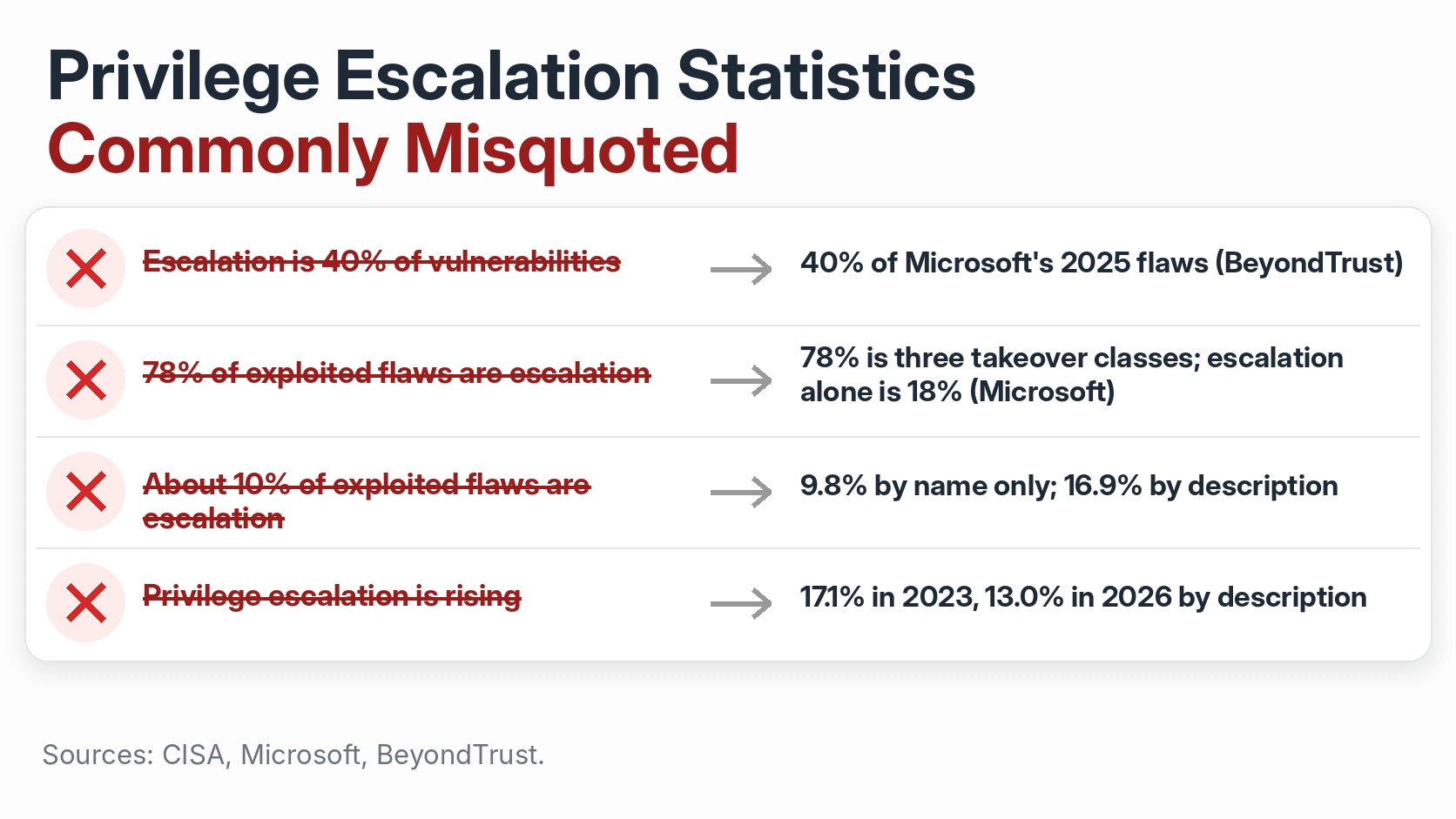
Privilege Escalation Statistics Commonly Misquoted
| Common claim | Correct context |
|---|---|
| “Privilege escalation is 40% of vulnerabilities.” | 40% is BeyondTrust’s share of Microsoft’s 2025 vulnerabilities (509 of 1,273), and Tenable’s figure is 38.3% of Microsoft’s Patch Tuesday CVEs. Both cover one vendor and every flaw, not only exploited ones. |
| “78% of exploited flaws are privilege escalation.” | Microsoft’s 78% covers three takeover classes together: remote code execution, authentication bypass and local privilege escalation. Local privilege escalation alone is 18% of exploited CVEs. |
| “About 10% of exploited flaws are privilege escalation.” | 9.8% of CISA’s catalog entries say “privilege” in the name. Counting the description gives 16.9%, because 131 escalation entries are named after the bug. |
| “Privilege escalation is rising.” | By description the share has drifted from 17.1% in 2023 to 13.0% in 2026 so far. The name-only share fell from 15.0% in 2022 to 3.2% only because entries are titled differently. |
| “55% of insider attacks use privilege escalation.” | CrowdStrike reported that 55% of the insider threats it logged from January 2021 to April 2023 relied on privilege escalation exploits. It is one vendor’s insider data from 2023. |
| “Privilege misuse is privilege escalation.” | Verizon’s 2026 DBIR counts privilege misuse, abuse of legitimate access, at 3% of breaches. It is not a software flaw count. |
What the Numbers Mean for a Lean Team
Escalation flaws are a second step, concentrated in operating systems and fixed on a published schedule, so the work is fast operating-system patching and removing the rights that make escalation worthwhile.
- Patch the operating system on every machine first. More than half of the escalation entries are in operating-system products, and 170 of the 299 are Microsoft’s. Windows Servers take more than a month to patch at the median, per Microsoft’s data, so start there. The CVE priority checker shows whether a flaw is listed.
- Treat Microsoft escalation flaws as ransomware preparation. 35.9% of Microsoft’s escalation entries are flagged for ransomware, so a Windows escalation flaw on a server that an attacker can reach is urgent even when it needs local access.
- Remove standing administrator rights. A flaw that escalates is worth most when the attacker lands on an account that can reach a vulnerable service. Use separate administrator accounts, and keep service accounts to the rights they need.
- Protect against the first step too. An escalation flaw needs a foothold. Fix entry-point flaws on edge devices and tighten credentials, because valid accounts raised privileges in 45% of CISA’s assessment instances.
- Watch the weak spots in your own code. Memory corruption leads the causes at 36.5%. If you ship software, use memory-safe languages for new components and test setuid binaries, services and file-handling code that run with high rights.
- Do not rely on the entry title. A catalog entry may say “use-after-free” and mean escalation. Read the description before you rank a ticket.
- Know what you expose. A website vulnerability scanner finds known flaws on the assets you list.
How We Compiled and Verified These Statistics
- Used: the CISA Known Exploited Vulnerabilities feed (version 2026.11.06), CVE publication dates from the CVE Services API, Microsoft Security Research’s analysis of 2 November 2026, BeyondTrust’s 2026 Microsoft Vulnerabilities Report, Tenable’s Microsoft Patch Tuesday 2025 review, MITRE’s 2025 CWE Top 25, CISA’s fiscal year 2023 risk and vulnerability assessment analysis, CrowdStrike’s insider threat data as reported by BleepingComputer, and Verizon’s 2026 DBIR executive summary. Vendor figures are labeled vendor-only.
- Method: each entry’s vulnerability name and short description were searched for escalation wording, and counts were split by year added, vendor, product group, edge group, weakness tag, listing gap and ransomware flag. Every other figure was read on its own page.
- Limits: the counts are a text match on CISA’s wording, not a CISA classification. They do not show whether an attacker starts local or remote. The CISA assessment and Verizon executive summary PDFs would not render in our browser, so their figures were confirmed from the document text as returned by search. The product groups are keyword based.
- Excluded: glossary-page claims, an 18% process-injection share that one page lists as privilege escalation but that the CISA text we could read ties to defense evasion, vendor survey claims about non-human identities and AI agents without a primary source, a credential-abuse share of 39% that conflicts with Verizon’s 13% initial access figure, and any figure without a primary source.
- Refresh: reviewed every 90 days. Catalog counts change daily.
How to cite this research. ScanTitan, “Privilege Escalation Statistics 2026: Flaws & Vendors,” 17 November 2026. For single figures, cite the primary source beside each number.
Primary Sources
- CISA Known Exploited Vulnerabilities catalog data feed
- CVE Program
- Microsoft Security Research, What exploited vulnerabilities have in common
- BeyondTrust, 2026 Microsoft Vulnerabilities Report summary, vendor-only
- Tenable, Microsoft Patch Tuesday 2025 Year in Review
- MITRE, 2025 CWE Top 25 Most Dangerous Software Weaknesses
- CISA, Fiscal Year 2023 Risk and Vulnerability Assessments
- Verizon, 2026 DBIR Executive Summary
- BleepingComputer, CrowdStrike insider threat report coverage, vendor-only
Frequently Asked Questions
What is privilege escalation?
Privilege escalation is a vulnerability or technique that lets an attacker with limited access gain higher rights, such as administrator, SYSTEM or root, on a system. It is usually a second step after an attacker gets a foothold.
How many exploited vulnerabilities are privilege escalation?
It depends on the definition. In ScanTitan’s count of CISA’s catalog, 9.8% of 1,769 entries say “privilege” in the name, 16.9% describe escalating privileges and 22.1% mention privileges in some role. Microsoft Security Research puts local privilege escalation at 18% of exploited CVEs.
Is privilege escalation increasing?
Not as a share of CISA’s catalog. By description it has drifted from 17.1% of entries added in 2023 to 13.0% in 2026 to 6 November, with 30 to 37 new entries a year. Counting by entry name shows a steep drop, which reflects how entries are titled.
What share of Microsoft vulnerabilities are elevation of privilege?
BeyondTrust counted 40% (509 of 1,273) in 2025, and Tenable found 38.3% of Microsoft’s 1,130 Patch Tuesday CVEs. In CISA’s catalog, 43.6% of Microsoft’s entries describe escalation.
What causes privilege escalation?
Memory corruption leads at 36.5% of escalation entries with a weakness tag, then privilege and access-control tags at 23.7%. Use after free and out-of-bounds write are the largest single causes.
Which vendors have the most privilege escalation flaws exploited?
Microsoft has the most by count, 170 catalog entries, followed by Linux (25), Cisco (17) and Android (13). By share of its own entries, Linux leads at 78.1%.
Are firewalls and VPNs more prone to privilege escalation?
No. 8.3% of the 21 edge vendors’ catalog entries describe escalation, against 18.9% for other vendors. Edge devices are mostly hit by login flaws and code execution, and escalation flaws sit in operating systems.
How fast are privilege escalation flaws added to CISA’s catalog?
For entries added since 2023, escalation flaws were listed a median of 3 days after the CVE was published, against 19 days for other entries. Microsoft’s escalation entries have a median of 0 days and other vendors’ 48.
Is privilege escalation linked to ransomware?
CISA flags 25.1% of escalation entries as used in ransomware, against 19.5% of other entries. The gap comes from Microsoft, at 35.9%, while other vendors’ escalation entries are at 10.9%.
Is privilege misuse the same as privilege escalation?
No. Verizon’s 2026 DBIR counts privilege misuse, abuse of legitimate access, at 3% of breaches. Privilege escalation flaws are software bugs that raise an attacker’s rights.
How do I protect against privilege escalation?
Patch operating systems on a fast schedule, remove standing administrator rights, separate administrator accounts, fix entry-point flaws and credentials, and keep service accounts to the rights they need.
Where does this data come from?
From CISA’s Known Exploited Vulnerabilities feed (version 2026.11.06), the CVE Services API and primary reports from Microsoft, BeyondTrust, Tenable, MITRE, CISA and Verizon, as named beside each figure.