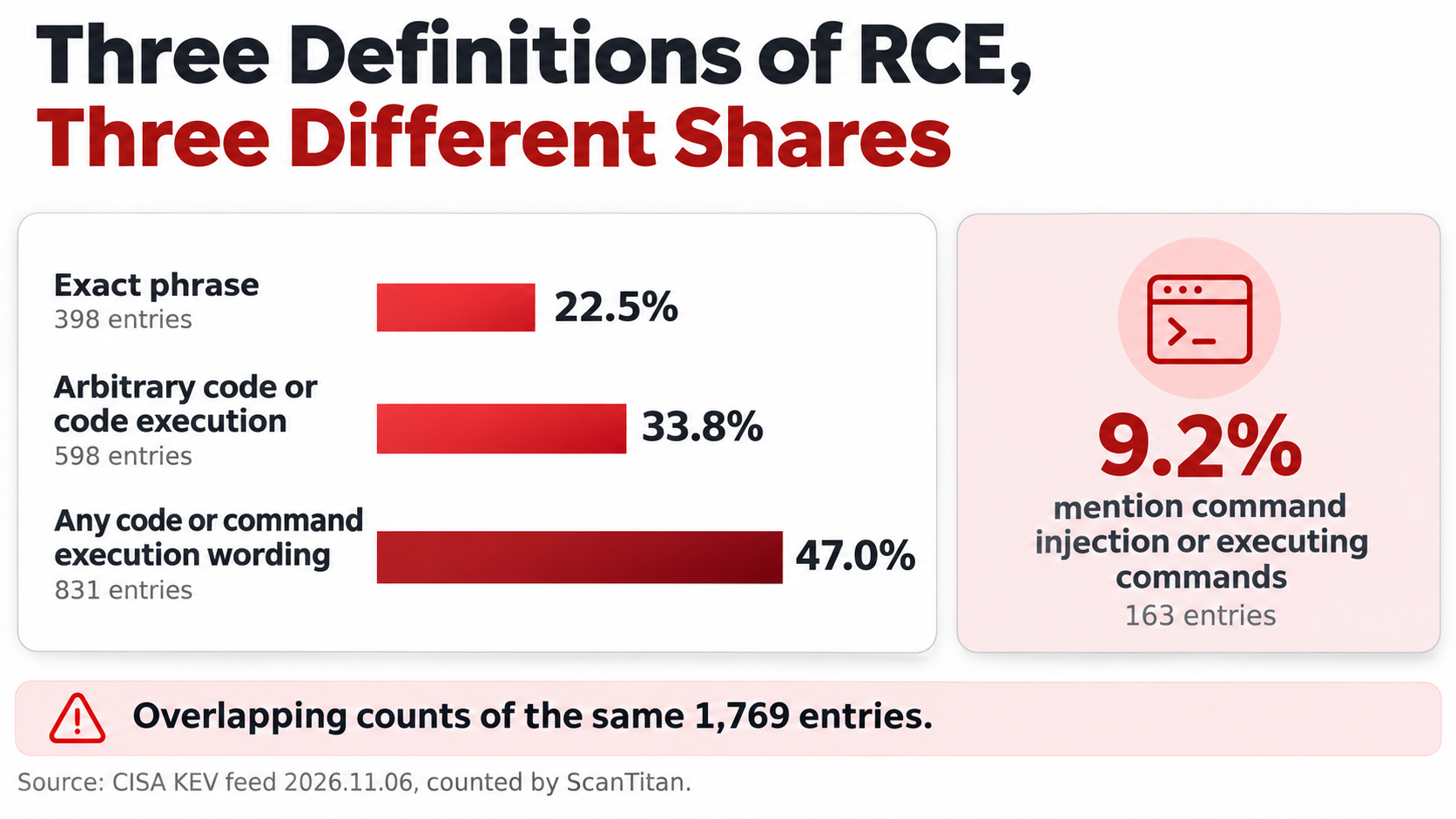
Remote code execution statistics depend on the definition, because “RCE” is not a field in CVE, NVD or CISA data: in ScanTitan’s count of CISA’s Known Exploited Vulnerabilities catalog, 22.5% of entries use the exact phrase “remote code execution”, 33.8% mention arbitrary code or code execution, and 47.0% describe code or command execution in some form. For entries added since 2023 the exact-phrase share is 14.5%, and the broader share has stayed between 38% and 44%. Microsoft’s own label puts remote code execution at 30.8% of its 2025 Patch Tuesday vulnerabilities, second to elevation of privilege at 38.3%. Most remote code execution statistics pages quote one of these shares without saying which definition they used. This research shows each count separately, explains how ScanTitan counted from public data, labels vendor figures, and says where a popular number does not hold up. Data last checked: 16 November 2026.
Key Remote Code Execution Statistics for 2026
Executive Benchmark: Remote Code Execution Statistics for 2026
| Metric | Latest figure | Period | Trend / context | Source |
|---|---|---|---|---|
| CISA catalog entries mentioning code or command execution | 47.0% (831 of 1,769) | Added 2021 to 6 Nov 2026 | 41.4% (374 of 903) since 2023 | CISA KEV feed, counted by ScanTitan |
| Entries using the phrase “remote code execution” | 22.5% (398 of 1,769) | Added 2021 to 6 Nov 2026 | 14.5% (131 of 903) since 2023 | CISA KEV feed, counted by ScanTitan |
| Entries mentioning “arbitrary code” or “code execution” | 33.8% (598 of 1,769) | Added 2021 to 6 Nov 2026 | Overlaps the other definitions | CISA KEV feed, counted by ScanTitan |
| Entries mentioning command injection or executing commands | 9.2% (163 of 1,769) | Added 2021 to 6 Nov 2026 | Overlaps the other definitions | CISA KEV feed, counted by ScanTitan |
| Remote code execution share of Microsoft Patch Tuesday vulnerabilities | 30.8% | 2025 | Elevation of privilege 38.3%; 1,130 CVEs | Tenable |
| Memory safety share of zero-days exploited in the wild | About 35% | 2025 | Enterprise appliances more often fell to injection, deserialization and authentication bypass | Google Threat Intelligence Group |
| OS command injection rank in MITRE’s CWE Top 25 | 9th (20 CVEs in KEV) | 2025 list | 7th last year | MITRE |
| Out-of-bounds write rank in MITRE’s CWE Top 25 | 5th (12 CVEs in KEV) | 2025 list | 2nd last year | MITRE |
| Median days from CVE publication to CISA listing, code-execution entries | 27 | Added 2023 to 6 Nov 2026 | 14 days for other entries | CISA KEV feed and CVE Services API, counted by ScanTitan |
| Code-execution entries flagged as used in ransomware | 21.2% (176 of 831) | Added 2021 to 6 Nov 2026 | 19.7% of other entries | CISA KEV feed, counted by ScanTitan |
| Exploitation of vulnerabilities as the top initial access vector | 31% of breaches | 2025 | Credential abuse 13% | Verizon 2026 DBIR, as reported by SecurityWeek |
Methodology: Four Ways to Count RCE
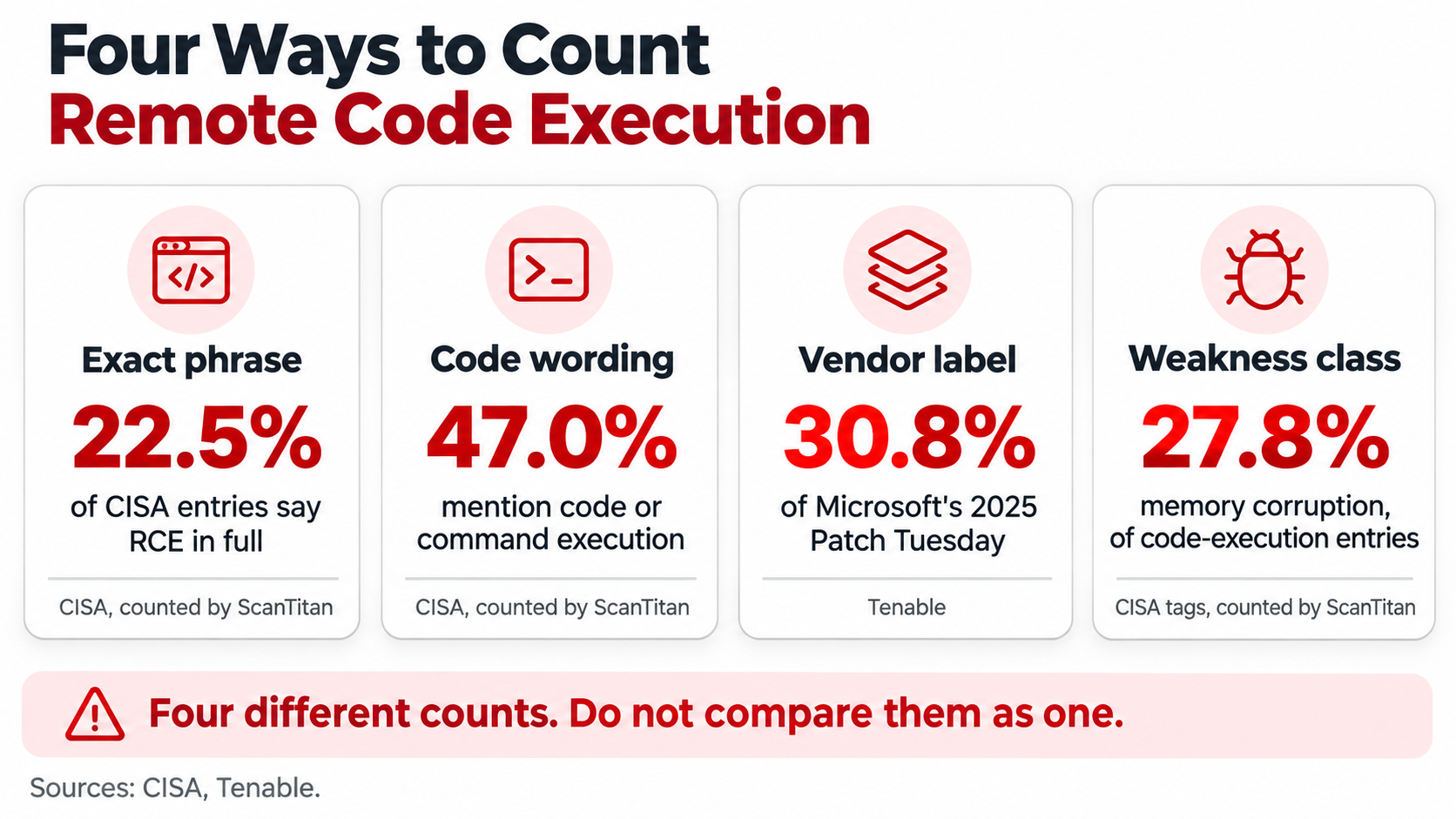
“Remote code execution statistics” is used for four different counts. Each answers a different question and can be wrong in a different way.
| Count | What it matches | Example 2026 figure | Source type | What it cannot tell you |
|---|---|---|---|---|
| Exact phrase | An entry whose name or description says “remote code execution” | 22.5% of the CISA catalog | ScanTitan text match | Flaws described as “arbitrary code” or “command injection” |
| Code or command execution wording | Any entry that mentions running code or commands | 47.0% of the CISA catalog | ScanTitan text match | Whether the attacker needs a login or network access |
| Vendor impact label | A vendor’s own “remote code execution” rating | 30.8% of Microsoft’s 2025 Patch Tuesday | Vendor patch data (Tenable count) | Other vendors, or exploited versus unexploited flaws |
| Weakness class | The weakness type (CWE) behind a flaw | Memory corruption 27.8% of code-execution entries | Catalog weakness tags | The attack path, or whether code runs |
How ScanTitan counted. We downloaded the CISA Known Exploited Vulnerabilities feed, version 2026.11.06 with 1,769 entries, and searched each entry’s vulnerability name and short description. The exact-phrase count matches “remote code execution”. The broader count adds “arbitrary code”, “code execution”, “execute commands”, “command injection” and similar wording. This is a text match, not a CISA classification, so the numbers describe how CISA writes its entries. CVE publication dates come from the CVE Services API. Weakness tags are the CWE values CISA lists on 1,594 of the 1,769 entries.
How Tenable counts. Tenable’s year-in-review analyzes Microsoft’s 2025 Patch Tuesday releases, 1,130 CVEs, and reports each impact type’s share. Its figures cover Microsoft products only.
How Many Exploited Flaws Allow Code Execution?
| Definition (ScanTitan text match) | Entries | Share of 1,769 |
|---|---|---|
| Exact phrase “remote code execution” | 398 | 22.5% |
| “Arbitrary code” or “code execution” | 598 | 33.8% |
| “Command injection” or “execute commands” | 163 | 9.2% |
| Any code or command execution wording | 831 | 47.0% |
Source: CISA KEV feed version 2026.11.06, counted by ScanTitan. The first three rows overlap, so they do not add to the last.
Code execution is the single most common outcome described in the catalog: nearly half of all exploited flaws. The share that uses the exact words “remote code execution” is less than half of that, because many entries say “arbitrary code execution”, “execute arbitrary commands” or describe command injection in a particular product. A page that quotes “RCE” as 22.5% or 47.0% of exploited vulnerabilities is using one of these definitions, and both can be true.
Is RCE Rising or Falling?
| Year added | Entries | Exact phrase | Share | Any code or command execution | Share |
|---|---|---|---|---|---|
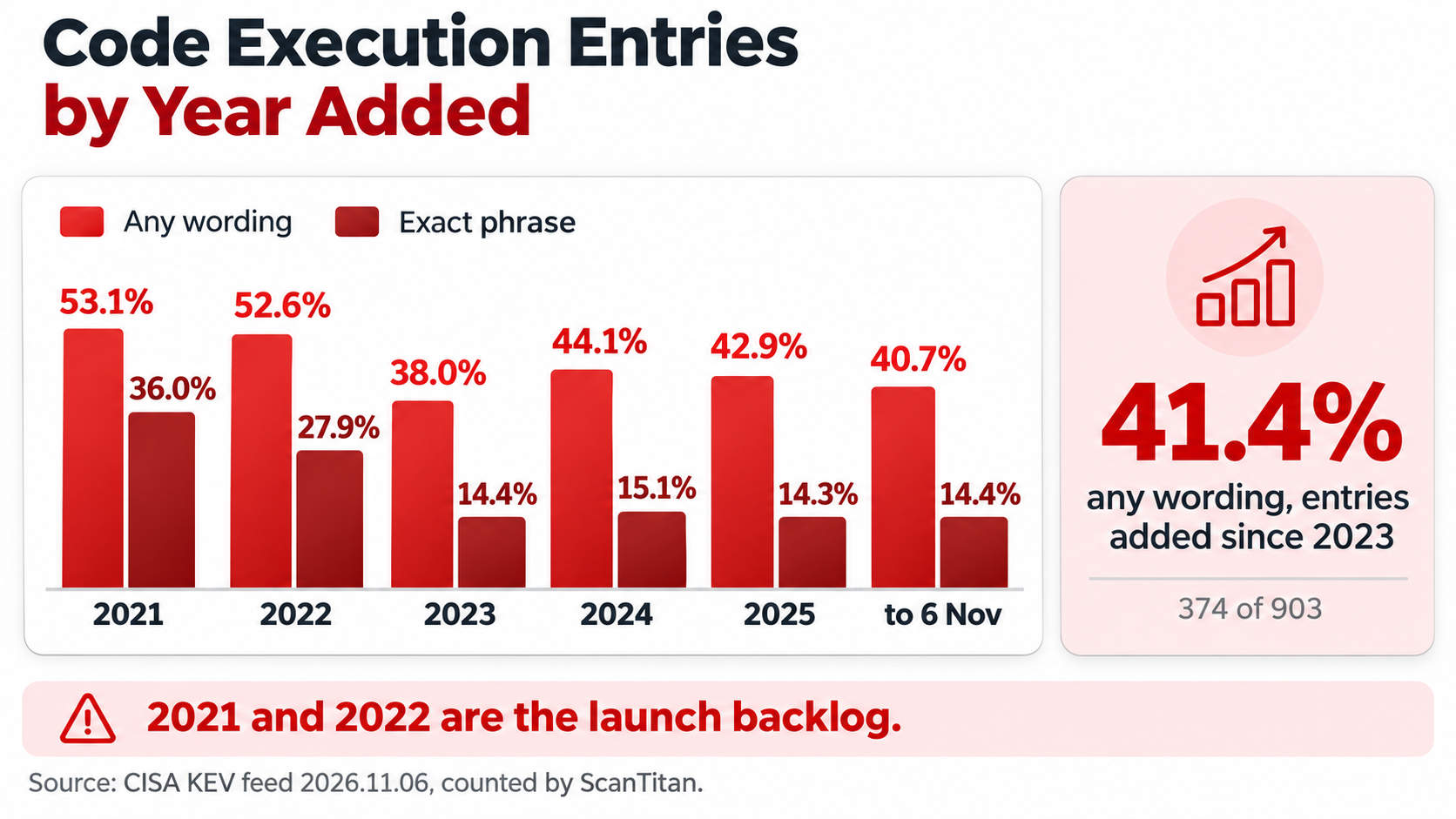
| 2021 | 311 | 112 | 36.0% | 165 | 53.1% |
| 2022 | 555 | 155 | 27.9% | 292 | 52.6% |
| 2023 | 187 | 27 | 14.4% | 71 | 38.0% |
| 2024 | 186 | 28 | 15.1% | 82 | 44.1% |
| 2025 | 245 | 35 | 14.3% | 105 | 42.9% |
| 2026 to 6 Nov | 285 | 41 | 14.4% | 116 | 40.7% |
Source: CISA KEV feed version 2026.11.06, counted by ScanTitan.
By this measure RCE is not rising. The 2021 and 2022 rows are the launch backlog, when CISA listed old flaws in bulk, and they run higher. From 2023 the exact-phrase share is stable at 14% to 15% a year, and the broader share moves between 38% and 44% with no clear direction. The count of code-execution entries per year did grow, from 71 in 2023 to 116 in 2026 so far, because CISA is adding more entries overall.
Microsoft’s own patch data points the same way for one vendor. Tenable counted 1,130 CVEs in Microsoft’s 2025 Patch Tuesday releases, 12% more than the 1,009 in 2024, and found remote code execution at 30.8% and elevation of privilege at 38.3%. That share covers every Microsoft patch, not only exploited flaws, so it should not be compared with the catalog percentages above. In the catalog, 43.6% of Microsoft’s own entries (170 of 390) mention code or command execution.
What Causes RCE: The Weaknesses Behind the Flaws
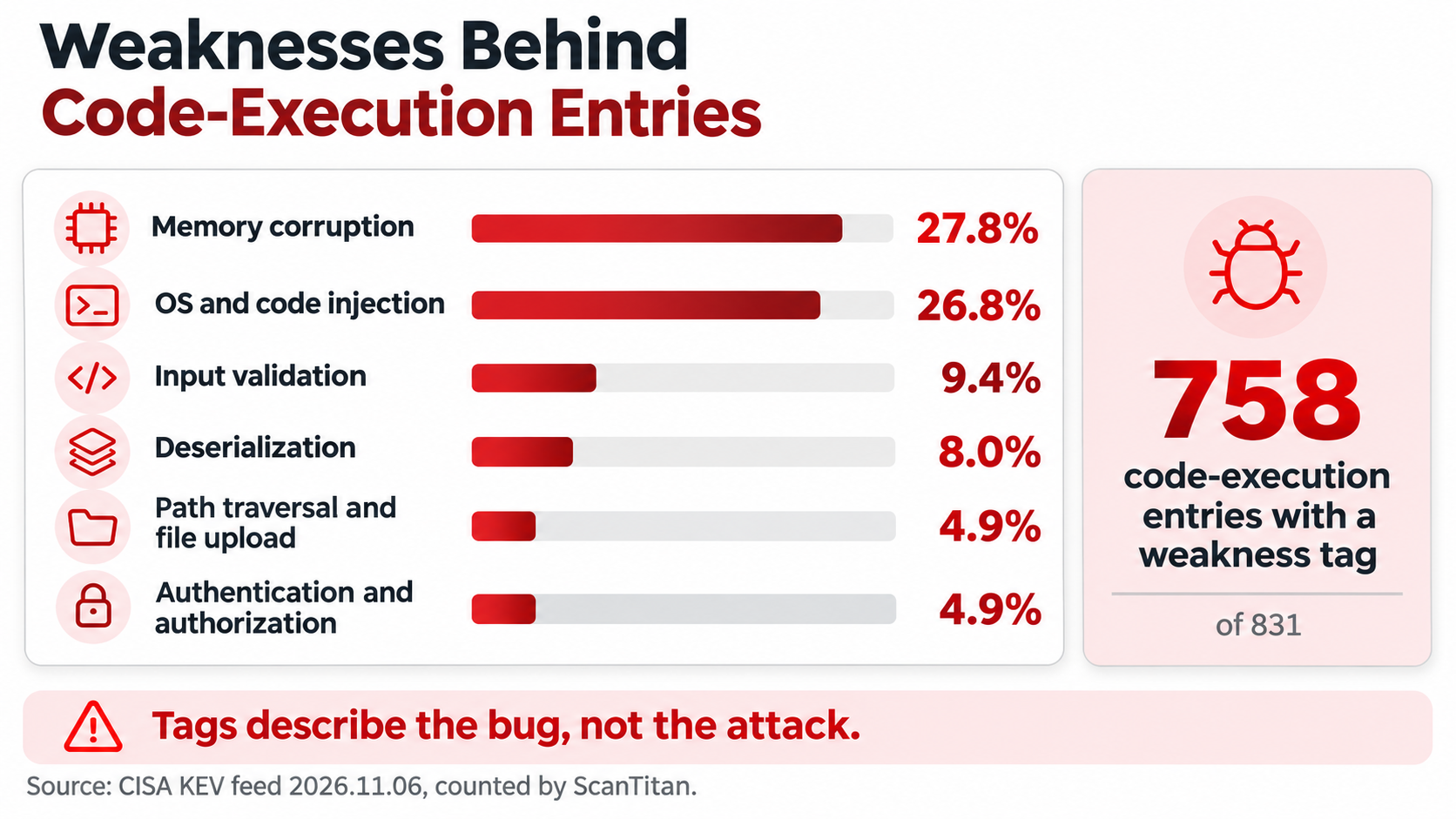
CISA lists weakness tags (CWE) on 1,594 of its 1,769 entries. Among the 831 code-execution entries, 758 carry at least one tag.
| Weakness group | Code-execution entries with the tag | Share of 758 |
|---|---|---|
| Memory corruption (out-of-bounds write and read, use after free, buffer overflows, type confusion) | 211 | 27.8% |
| OS and code injection (CWE-78, 77, 94, 95) | 203 | 26.8% |
| Improper input validation (CWE-20) | 71 | 9.4% |
| Deserialization of untrusted data (CWE-502) | 61 | 8.0% |
| Path traversal and file upload (CWE-22, 434) | 37 | 4.9% |
| Authentication and authorization failures (CWE-287, 306, 862, 863, 284) | 37 | 4.9% |
Source: CISA KEV feed version 2026.11.06, counted by ScanTitan. An entry can carry more than one tag, so the rows are not exclusive.
Two families account for over half: memory bugs and injection. They produce code execution differently. Memory corruption lets an attacker overwrite memory until their code runs, and is most common in operating systems, browsers and other software written in C and C++. Injection and deserialization let an attacker send input the application executes as a command or code, with no memory error needed. Google’s review of 2025 zero-days found about 35% were memory-safety flaws, and said enterprise appliances more often fell to injection, deserialization, authentication bypass and design flaws that allow code execution without memory corruption. Source: Google Threat Intelligence Group. Our command injection guide explains the injection route in detail.
MITRE’s 2025 CWE Top 25 ranks the same weaknesses by how often they appear in CVEs and how severe they are, and reports how many of each type are in the catalog:
| Weakness | MITRE 2025 rank | Rank last year | CVEs in KEV (MITRE count) |
|---|---|---|---|
| Out-of-bounds write (CWE-787) | 5 | 2 | 12 |
| Path traversal (CWE-22) | 6 | 5 | 10 |
| Use after free (CWE-416) | 7 | 8 | 14 |
| OS command injection (CWE-78) | 9 | 7 | 20 |
| Code injection (CWE-94) | 10 | 11 | 7 |
| Unrestricted file upload (CWE-434) | 12 | 10 | 4 |
| Deserialization of untrusted data (CWE-502) | 15 | 16 | 11 |
| Missing authentication for a critical function (CWE-306) | 21 | 25 | 11 |
Source: MITRE 2025 CWE Top 25. MITRE’s counts come from its own data window and differ from ScanTitan’s whole-catalog counts.
OS command injection has the most catalog entries of any weakness in this table, 20, even though it ranks ninth, behind out-of-bounds write and use after free. Injection flaws are over-represented in the catalog relative to their rank.
Which Vendors and Products Show Up
| Vendor | Code-execution entries | Vendor’s catalog entries | Share of its entries |
|---|---|---|---|
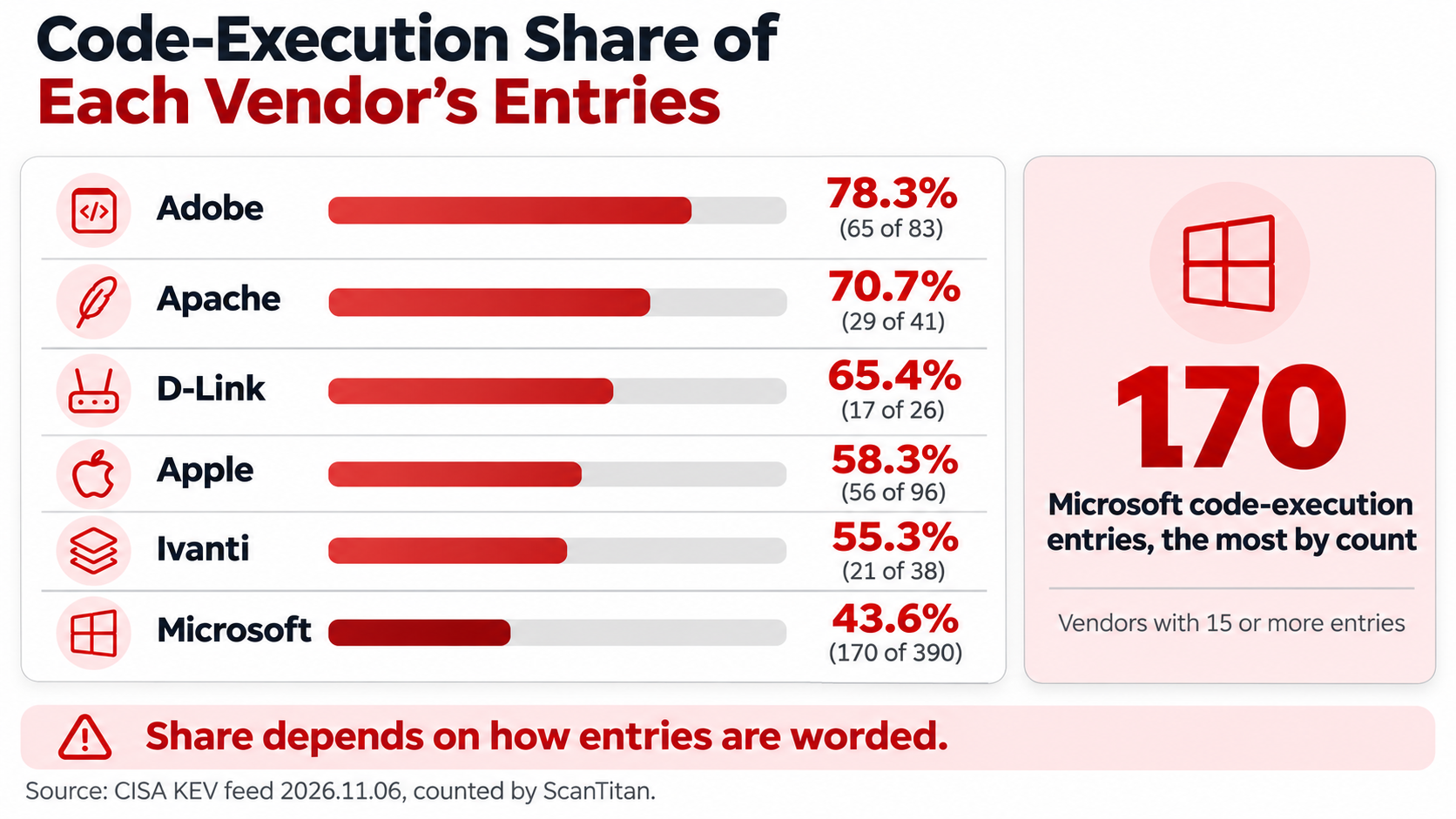
| Microsoft | 170 | 390 | 43.6% |
| Adobe | 65 | 83 | 78.3% |
| Apple | 56 | 96 | 58.3% |
| Cisco | 43 | 102 | 42.2% |
| Apache | 29 | 41 | 70.7% |
| Ivanti | 21 | 38 | 55.3% |
| D-Link | 17 | 26 | 65.4% |
| 16 | 76 | 21.1% | |
| Oracle | 15 | 46 | 32.6% |
| VMware | 12 | 26 | 46.2% |
Source: CISA KEV feed version 2026.11.06, counted by ScanTitan. Vendors with at least 15 catalog entries; the vendor field is the catalog’s own.
Microsoft has the most code-execution entries by count, 170, because it has the most entries overall. By share, Adobe leads: 78.3% of its catalog entries describe code execution, followed by Apache at 70.7% and D-Link at 65.4%. Google is the low outlier at 21.1%, which we did not investigate. The spread shows that the share depends on the product type: document readers, web servers and routers lead, while a vendor with many browser and operating system entries sits lower.
RCE on the Edge: Firewalls, VPNs and Routers
A group of 21 firewall, VPN, router and gateway vendors (Cisco, Fortinet, Palo Alto Networks, Ivanti, Citrix, SonicWall, F5, Juniper, Check Point, Zyxel, D-Link, TP-Link, MikroTik, NETGEAR, Ubiquiti, WatchGuard, Barracuda, Sophos, Pulse Secure, Array Networks and DrayTek) holds 335 catalog entries.
| Group | Entries | Code or command execution | Share |
|---|---|---|---|
| 21 edge vendors | 335 | 161 | 48.1% |
| All other vendors | 1,434 | 670 | 46.7% |
Source: CISA KEV feed version 2026.11.06, counted by ScanTitan. 65 of the 161 edge entries use the exact phrase “remote code execution”.
Edge products are not more likely than other software to have code-execution flaws in the catalog: 48.1% against 46.7%. What differs is the position of the product. An edge device sits on the network boundary, and Google notes most edge devices cannot run endpoint detection, so a code-execution flaw there gives an attacker a foothold inside. That matches the ransomware survey data: Sophos found 21% of attacks that began with an exploited flaw, credentials or brute force started at a firewall, and 59% of ransom demands after a firewall start were for $1 million or more, against 48% across all attacks. Source: Sophos, vendor-only.
How Fast Are Code-Execution Flaws Listed?
ScanTitan compared each entry’s CVE publication date with the date CISA added it, for entries added since 2023.
| Group | Entries | Median days to listing | Listed on or before CVE day | Listed within 30 days | Older than one year when listed |
|---|---|---|---|---|---|
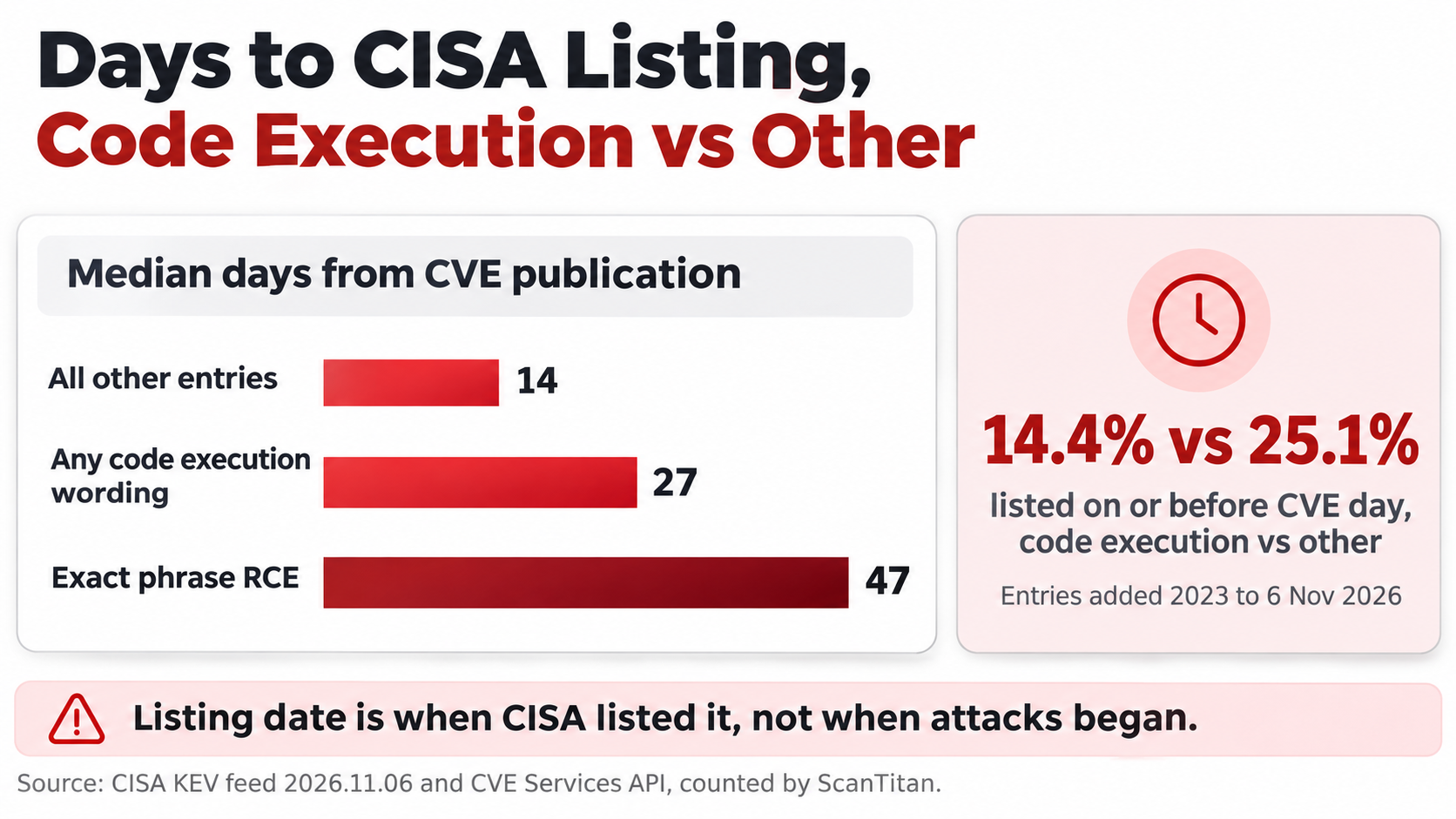
| Any code or command execution wording | 374 | 27 | 14.4% | 50.5% | 24.9% |
| Exact phrase “remote code execution” | 131 | 47 | 9.9% | 44.3% | 28.2% |
| All other entries | 529 | 14 | 25.1% | 57.3% | 19.8% |
Source: CISA KEV feed version 2026.11.06 and the CVE Services API, counted by ScanTitan, entries added 2023 to 6 November 2026.
Code-execution flaws reach the catalog later than other flaws: a median of 27 days against 14, and fewer are listed by the day the CVE is published (14.4% against 25.1%). The exact-phrase group is slower still, at 47 days. We did not test why. One reading is that many are exploited as n-days after a patch, not as zero-days. Our zero-day statistics research covers how quickly the catalog lists new flaws, and our patch management statistics show that the measured median to fully fix a catalog flaw is 43 days.
RCE and Ransomware
CISA flags a catalog entry when it learns a flaw was used in a ransomware campaign.
| Group | Entries | Flagged as used in ransomware | Share |
|---|---|---|---|
| Any code or command execution wording | 831 | 176 | 21.2% |
| All other entries | 938 | 185 | 19.7% |
Source: CISA KEV feed version 2026.11.06, counted by ScanTitan.
Code-execution flaws are flagged for ransomware at about the same rate as other flaws, 21.2% against 19.7%. That fits how ransomware groups work: they use whatever gets them access, including stolen credentials, phishing and privilege escalation after a first foothold. Our ransomware statistics research covers the flagged flaws by vendor and the entry-point data from Sophos and Verizon.
Remote Code Execution Statistics Commonly Misquoted
| Common claim | Correct context |
|---|---|
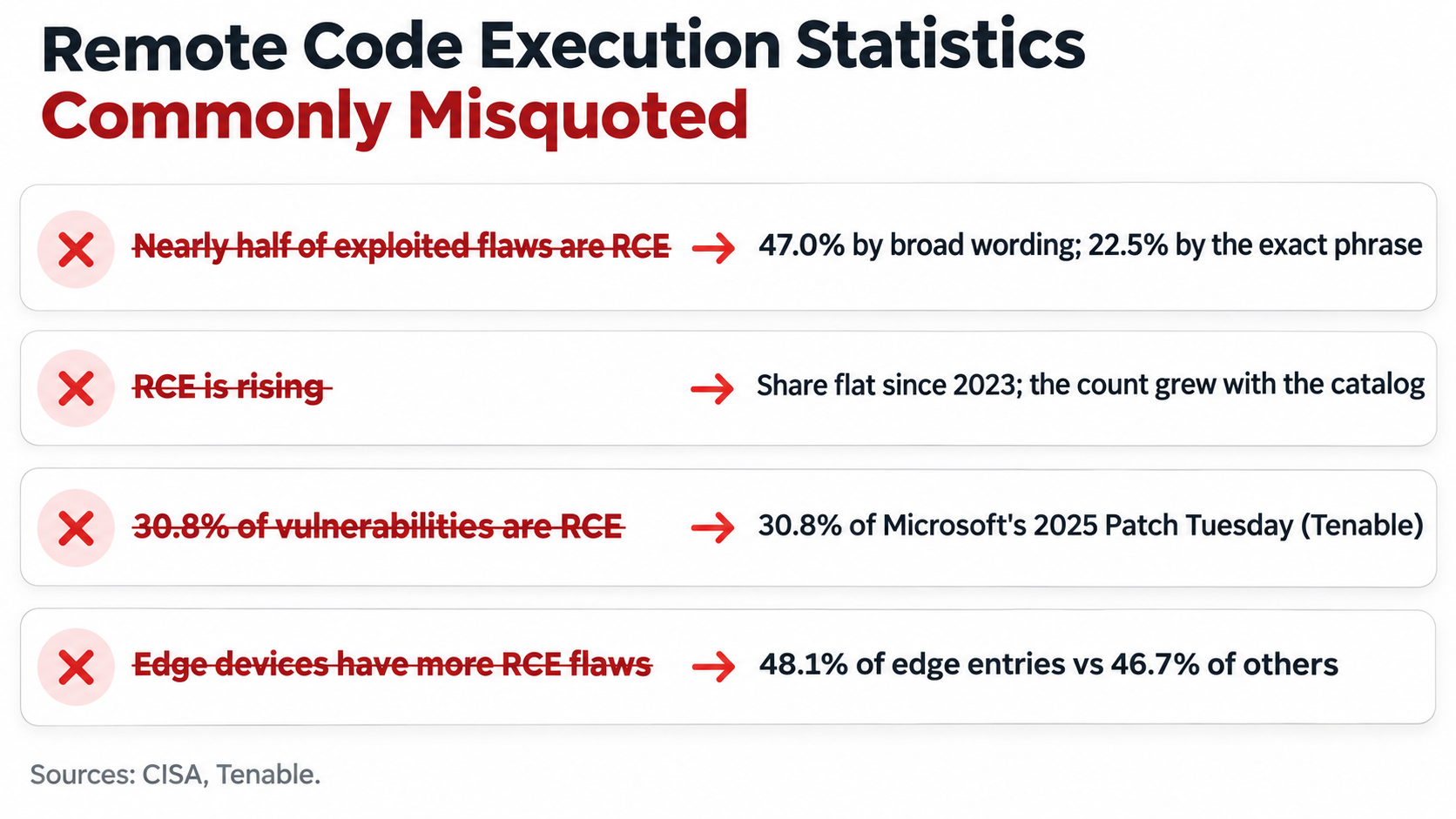
| “Nearly half of exploited vulnerabilities are RCE.” | 47.0% of CISA’s catalog entries mention code or command execution in some form. The exact phrase “remote code execution” is in 22.5%, and 14.5% of entries added since 2023. |
| “RCE is rising.” | The count of code-execution entries grew with the catalog, but the share has been flat since 2023: 38% to 44% for broad wording and 14% to 15% for the exact phrase. |
| “30.8% of vulnerabilities are RCE.” | 30.8% is the share of Microsoft’s 2025 Patch Tuesday vulnerabilities rated remote code execution (Tenable). It covers one vendor and every patch, not only exploited flaws. |
| “RCE always means an unauthenticated attack over the internet.” | The catalog wording does not say whether login or network access is needed. Authentication and authorization weaknesses are tagged on only 4.9% of code-execution entries with a weakness tag. |
| “Memory bugs cause most RCE.” | Memory corruption is the largest group among code-execution entries with a tag, at 27.8%, with injection close behind at 26.8%. Google’s 35% memory-safety figure covers a different set, 2025 zero-days. |
| “Edge devices have more RCE flaws.” | 48.1% of the 21 edge vendors’ catalog entries describe code execution, against 46.7% for other vendors. Their position on the network, not the share, is what matters. |
What the Numbers Mean for a Lean Team
Code execution is the outcome behind nearly half of the flaws attackers use, and the weaknesses behind it are well known, so the work is patching listed flaws fast and keeping vulnerable services off the public internet.
- Patch listed code-execution flaws first. A flaw in CISA’s catalog that allows code execution on software you run is the highest-priority ticket in public data. The CVE priority checker shows whether a flaw is listed.
- Treat edge and remote-access products as the front door. Firewalls, VPNs, routers and mail gateways give a foothold inside the network, and the survey data ties firewall starts to the largest ransom demands.
- Remove management interfaces from the public internet. Restrict them by IP, require multi-factor authentication and disable unused features. Mitigation is often the only option before a patch exists.
- Fix injection and deserialization in your own code. Validate and encode input, avoid building shell commands from user data, and do not deserialize untrusted input. Injection and deserialization tags together cover about a third of the code-execution entries with a tag (26.8% and 8.0%).
- Expect a lag between listing and your patch. Code-execution flaws are listed a median of 27 days after the CVE is published, so check vendor advisories for your products, not only the catalog.
- Know what you expose. A website vulnerability scanner finds known flaws on the assets you list.
How We Compiled and Verified These Statistics
- Used: the CISA Known Exploited Vulnerabilities feed (version 2026.11.06), CVE publication dates from the CVE Services API, MITRE’s 2025 CWE Top 25, Tenable’s Microsoft Patch Tuesday 2025 review, Google Threat Intelligence Group’s 2025 zero-day review, Sophos’s State of Ransomware 2026 summary and Verizon’s 2026 DBIR as reported by SecurityWeek. Vendor figures are labeled vendor-only.
- Method: each entry’s vulnerability name and short description were searched for code and command execution wording, and counts were split by year added, vendor, weakness tag, listing gap and ransomware flag. Every other figure was read on its own page.
- Limits: the counts are a text match on CISA’s wording, not a CISA classification. They do not show whether authentication is needed or whether exploitation is remote. MITRE’s catalog counts use its own data window.
- Excluded: glossary-page claims, device counts for older incidents such as Log4Shell and WannaCry from secondary sources, a vendor blog’s claim about the top 10 vulnerabilities of 2024 that we could not open on its page, and any severity share without a primary source.
- Refresh: reviewed every 90 days. Catalog counts change daily.
How to cite this research. ScanTitan, “Remote Code Execution Statistics 2026: Flaws & Causes,” 16 November 2026. For single figures, cite the primary source beside each number.
Primary Sources
- CISA Known Exploited Vulnerabilities catalog data feed
- CVE Program
- MITRE, 2025 CWE Top 25 Most Dangerous Software Weaknesses
- Tenable, Microsoft Patch Tuesday 2025 Year in Review
- Google Threat Intelligence Group, 2025 Zero-Days in Review
- Sophos, The State of Ransomware 2026, vendor-only
- SecurityWeek, Verizon DBIR 2026 coverage
Frequently Asked Questions
What is remote code execution?
Remote code execution (RCE) is a vulnerability that lets an attacker run their own code or commands on a target they do not control, usually over a network. It often leads to full control of the affected system.
How many exploited vulnerabilities are remote code execution?
It depends on the definition. In ScanTitan’s count of CISA’s catalog, 22.5% of 1,769 entries use the exact phrase “remote code execution”, 33.8% mention arbitrary code or code execution, and 47.0% describe code or command execution in some form.
Is remote code execution increasing?
Not as a share. The exact-phrase share of CISA’s catalog entries has been stable at 14% to 15% a year since 2023, and the broader share has moved between 38% and 44%. The number of entries grew because the catalog grew.
What share of Microsoft vulnerabilities are remote code execution?
Tenable found 30.8% of Microsoft’s 1,130 Patch Tuesday vulnerabilities in 2025 were remote code execution, behind elevation of privilege at 38.3%. In CISA’s catalog, 43.6% of Microsoft’s entries mention code or command execution.
What causes remote code execution?
Memory corruption (out-of-bounds write, use after free) and injection (OS command and code injection) are the two largest groups, at 27.8% and 26.8% of code-execution catalog entries with a weakness tag. Deserialization of untrusted data is 8.0%.
Which vendors have the most RCE flaws exploited?
Microsoft has the most by count, 170 catalog entries, followed by Adobe (65), Apple (56) and Cisco (43). By share of its own entries, Adobe leads at 78.3%.
Are firewalls and VPNs more prone to RCE?
Not by share: 48.1% of the 21 edge vendors’ catalog entries describe code execution against 46.7% for other vendors. Their position on the network boundary makes a flaw more damaging.
How fast are RCE flaws added to CISA’s catalog?
For entries added since 2023, code-execution flaws were listed a median of 27 days after the CVE was published, against 14 days for other entries. Those using the exact phrase took a median of 47 days.
Is RCE linked to ransomware?
CISA flags 21.2% of code-execution entries as used in ransomware, against 19.7% of other entries. Ransomware groups use many entry methods, including credentials and phishing.
Does RCE always mean no login is needed?
No. The catalog wording does not say whether authentication is required. Authentication and authorization weaknesses are tagged on only 4.9% of code-execution entries that carry a weakness tag.
How do I protect against remote code execution?
Patch listed flaws first, remove management interfaces from the public internet, fix injection and deserialization in your own code, and monitor vendor advisories for the software you run.
Where does this data come from?
From CISA’s Known Exploited Vulnerabilities feed (version 2026.11.06), the CVE Services API and primary reports from MITRE, Tenable, Google, Sophos and Verizon, as named beside each figure.