
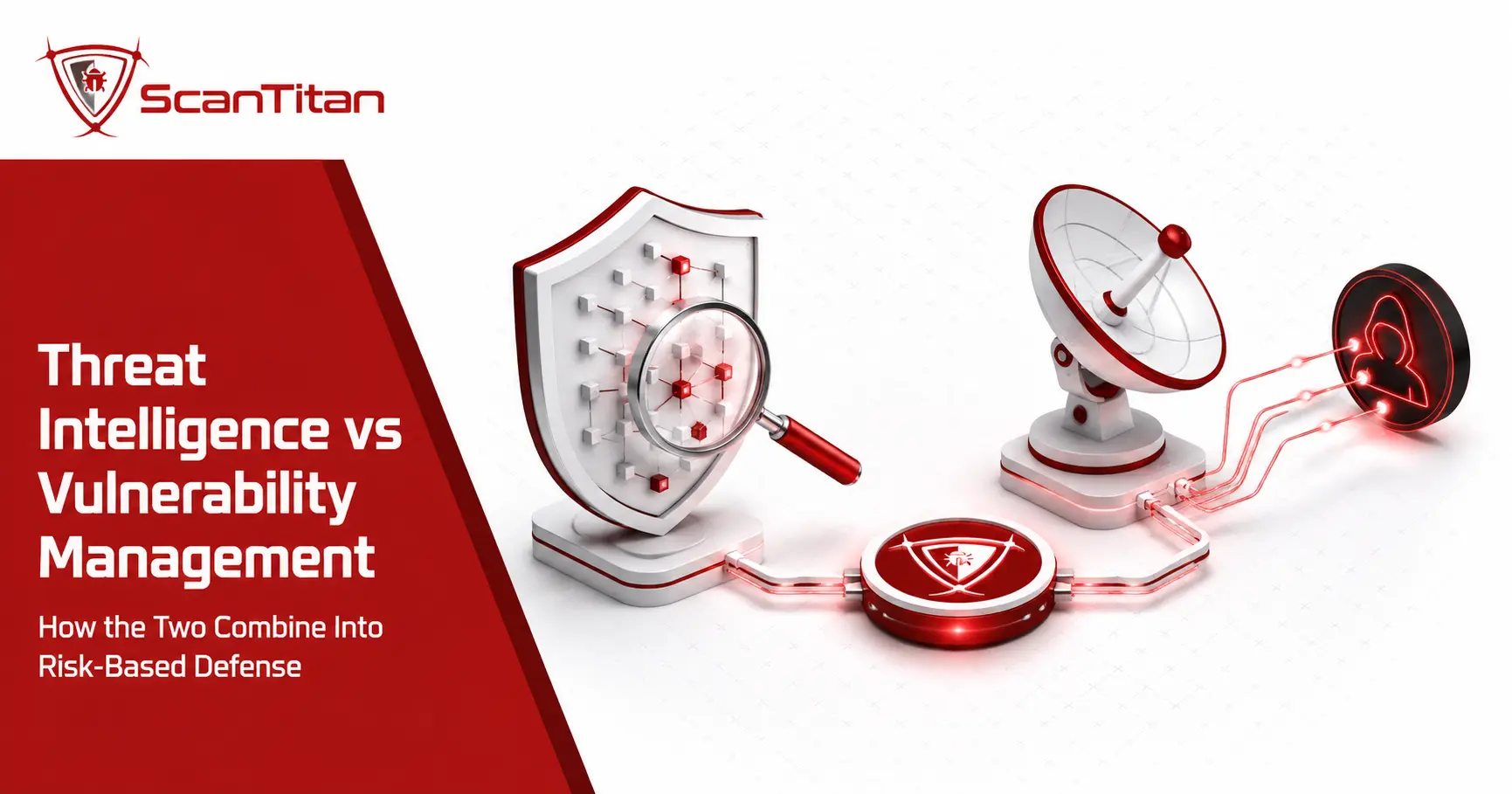
Threat Intelligence vs Vulnerability Management is one of the most common points of confusion in security, and the two are partners, not competitors. Vulnerability management is the internal discipline of finding, prioritizing, and fixing the weaknesses in your own systems. Threat intelligence is the external discipline of understanding attackers, their tools, and which flaws they are actually exploiting. One tells you what could go wrong; the other tells you what is going wrong in the wild. This guide explains how each works, how they differ, where vulnerability intelligence bridges them, and how combining them into threat and vulnerability management makes your program genuinely risk-based.
Threat Intelligence vs Vulnerability Management
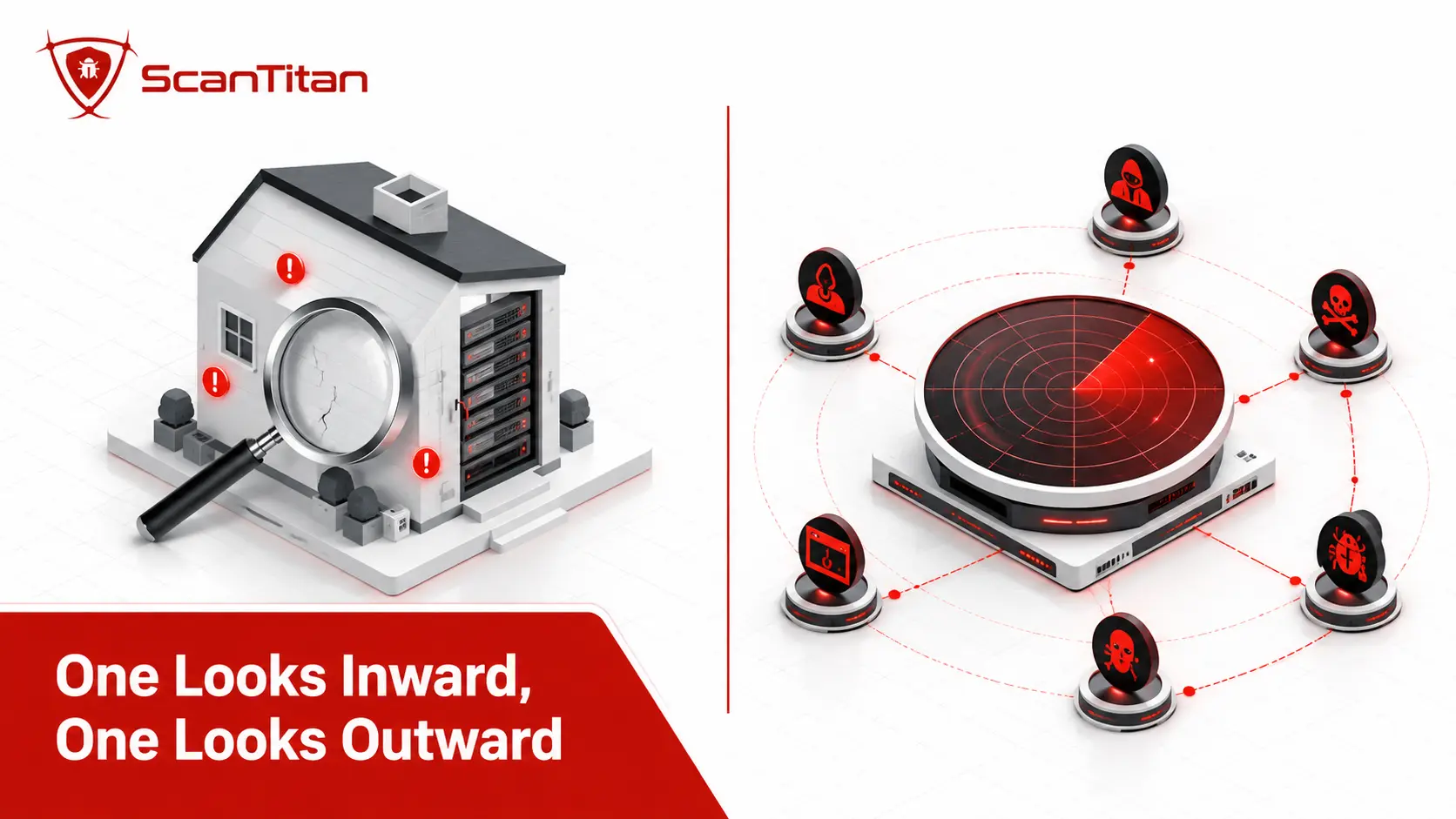
The short answer is that vulnerability management looks inward at your weaknesses, while threat intelligence looks outward at your adversaries. Vulnerability management is the process of finding the flaws in your own systems, such as unpatched software or misconfigurations, then prioritizing and fixing them before they are exploited. Threat intelligence is the practice of collecting and analyzing information about attackers, their tactics, and the vulnerabilities they are actively exploiting, so you know what to worry about. They answer different questions, as the table below shows.
| Dimension | Vulnerability Management | Threat Intelligence |
|---|---|---|
| Core question | What weaknesses do we have? | Who is attacking, and how? |
| Focus | Your own assets and flaws | Adversaries, their tools and behavior |
| Direction | Inward, at your environment | Primarily outward at the threat landscape, enriched by internal telemetry |
| Primary data | CVEs, scan results, configurations | IOCs, TTPs, campaigns, exploit activity |
| Time orientation | Proactive and preventative | Real-time and forward-looking |
| Core activities | Discover, assess, prioritize, remediate | Collect, analyze, contextualize, disseminate |
| Main output | A prioritized, remediated risk list | Actionable context on active threats |
| Typical owners | VM team, IT, DevSecOps | CTI analysts, SOC, threat hunters |
| Key references | CVE, CVSS, EPSS, KEV | MITRE ATT&CK, the intelligence cycle |
| Key metrics | MTTR, patch coverage, vulnerability density | MTTD, intel coverage, time to exploit |
A useful analogy makes the split concrete: vulnerability management is surveying your own house for unlocked doors and weak windows, while threat intelligence tells you which doors the burglars in your neighborhood are actually checking and what tools they carry. On their own, each is incomplete. A list of every weakness with no sense of which are under attack leaves you patching in the dark, and a stream of attacker activity with no view of your own exposure leaves you unable to act on it. Together, they let you fix the weaknesses attackers are actually targeting first, which is the entire point of a risk-based program.
What Is Vulnerability Management?
Vulnerability management is the continuous, cyclical process of identifying, classifying, prioritizing, remediating, and reporting on security weaknesses across your environment. It runs as a repeating lifecycle rather than a one-time project, because new assets and new flaws appear constantly.
- Discover and identify. Scan systems, applications, containers, and cloud resources to find vulnerabilities, usually catalogued as CVEs (Common Vulnerabilities and Exposures), along with misconfigurations and weak controls.
- Assess and classify. Evaluate each finding for severity, using the CVSS (Common Vulnerability Scoring System) as a baseline, and confirm whether it is a genuine risk in your environment.
- Prioritize. Rank findings by real risk so the team fixes what matters first instead of working through a flat list; our guide on how to prioritize vulnerability remediation covers this in depth.
- Remediate or mitigate. Patch, reconfigure, or apply a compensating control, and formally accept the risk where remediation is genuinely disproportionate.
- Verify and report. Rescan to confirm the fix actually closed the gap, then report on coverage and progress.
Vulnerability management is fundamentally a proactive, preventative discipline: it works to close gaps before anyone exploits them. Its raw material is your own environment, and its output is a shorter, ranked list of things to fix. You can go deeper on our vulnerability management page and on what feeds it in our guide to vulnerability assessment.
What Is Threat Intelligence?
Threat intelligence, often called cyber threat intelligence (CTI), is the practice of collecting and analyzing data about threats, from the surface, deep, and dark web and many other sources, then turning it into context that helps defenders decide what to do. Where vulnerability management studies your systems, threat intelligence studies the attackers: their tactics, techniques, and procedures (TTPs), their indicators of compromise (IOCs) such as malicious IP addresses and file hashes, the campaigns they run, and the vulnerabilities they are exploiting right now. Analysts usually split it into four types: strategic (big-picture trends for leadership), operational (specific campaigns and actors), tactical (attacker behavior and TTPs), and technical (raw IOCs for detection tools). Good intelligence is produced through the intelligence cycle, a repeating loop of setting requirements, collecting data, analyzing it, and disseminating finished intelligence to the people who need it. Mapping observed behavior to a framework like MITRE ATT&CK is a common way to make it actionable. Threat intelligence is primarily focused on the external threat landscape and adversary activity, while also incorporating relevant internal telemetry, incidents, detections, and historical security data. The goal is not more data but the context that tells a team what is worth worrying about and what is noise.
What Threat Intelligence Does Vulnerability Management Actually Need?
Vulnerability management does not need every possible threat-intelligence signal, and drowning a team in feeds is its own kind of failure. The intelligence that earns its place is the context that changes a remediation decision, and that comes down to a handful of practical questions. Are attackers exploiting vulnerabilities in the products or versions you actually run, rather than in software you do not have? Is reliable exploit code publicly available for a given flaw? Are your specific technologies or industry sector being actively targeted right now? Does the affected vulnerability sit on an internet-facing or business-critical asset, or on something isolated and low-value? And has the threat picture shifted since your last prioritization cycle, so a finding that was safe to defer last week now deserves attention? Answer those, and you have the intelligence that matters for prioritization. Everything else is background reading, and the value is in the signal that moves a decision, not in the volume of data collected.
Threat vs Vulnerability vs Risk: What Is the Difference?
These three words get used interchangeably, and they should not be. A vulnerability is a weakness, an unpatched flaw, a misconfiguration, or a weak control, that could be exploited. A threat is the actor or event that could exploit it, such as a ransomware group, a malicious insider, or an automated scanning bot. Risk is what you get when the two meet, plus what it would cost you: the likelihood that a threat exploits a vulnerability, together with the business impact if it does. As a conceptual model, risk can be thought of as the interaction between threat likelihood, vulnerability or exposure, and business impact, rather than a single universal equation. The distinction drives prioritization. A serious vulnerability with no active threat and little impact is a lower risk than a moderate one that attackers are exploiting against systems holding your customer data. Managing risk, rather than just counting vulnerabilities, is exactly what threat intelligence and vulnerability management do when they work together.
Where Does Vulnerability Intelligence Fit In?
Between the two disciplines sits a third term worth untangling: vulnerability intelligence. Vulnerability intelligence is a specific subset of threat intelligence focused on vulnerabilities themselves, whether a flaw is being exploited, by whom, with what tools, and how urgent it is. Where general threat intelligence covers adversary behavior and IOCs broadly, vulnerability intelligence hones in on the weaknesses attackers exploit, enriching each CVE with exploit availability, proof-of-concept code, threat-actor interest, and exploitation trends. It comes in several forms: raw vulnerability feeds from the National Vulnerability Database, exploit intelligence on whether working exploit code exists, threat-contextualized intelligence linking a CVE to a campaign or malware family, patch intelligence, and rare zero-day intelligence. Patch intelligence adds the remediation side of the decision: whether a vendor fix exists, which version contains it, whether a workaround is available, and whether the update carries known deployment or compatibility considerations. Threat context can explain why a team should act quickly, while patch intelligence helps explain what action is actually available. In practice, vulnerability intelligence is the bridge: it is the part of threat intelligence that plugs directly into vulnerability management to make prioritization reflect real-world risk. That connection is exactly what ScanTitan’s vulnerability and threat intelligence is built to provide.
What Is Threat and Vulnerability Management (TVM)?
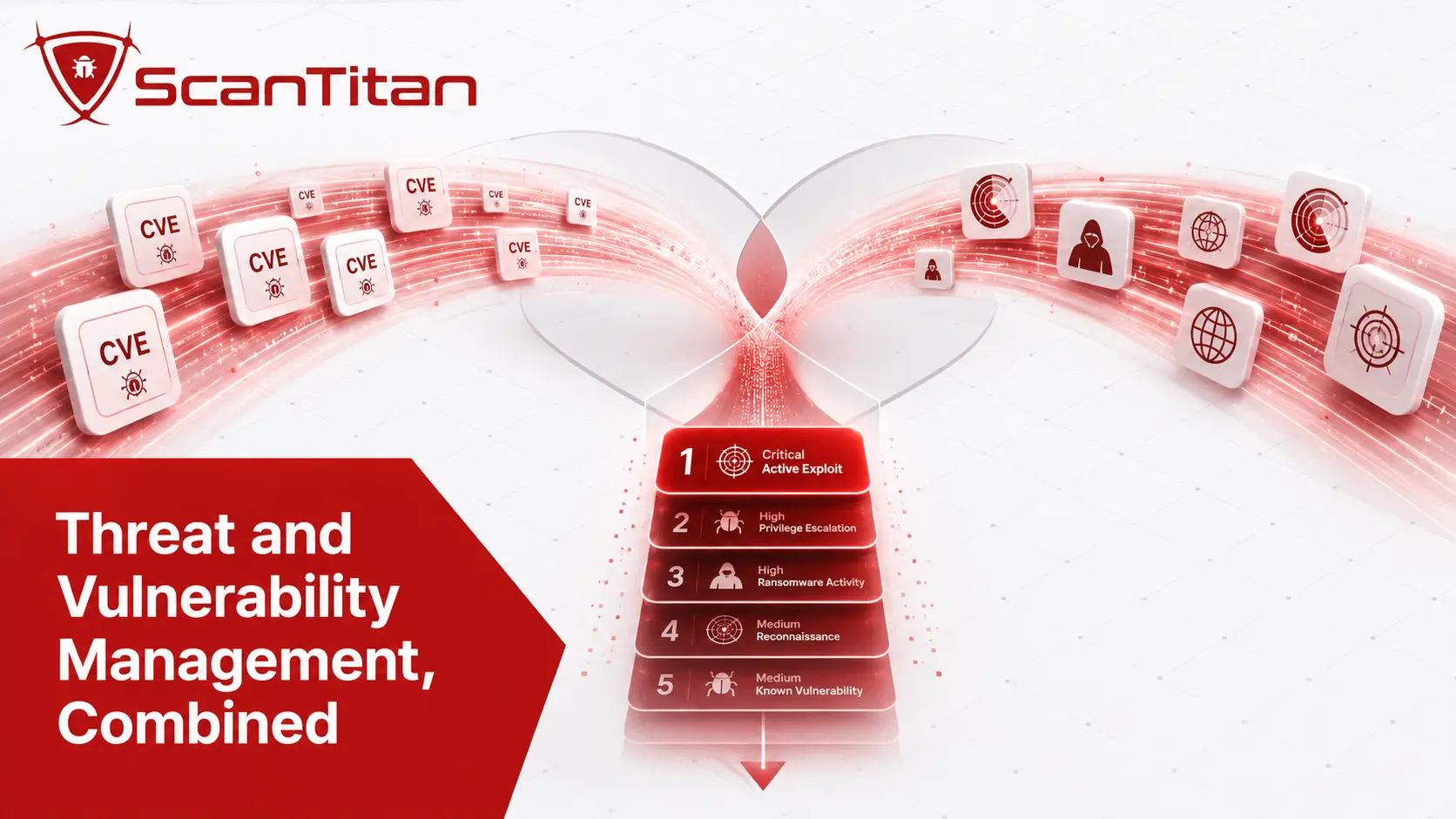
When you combine the two disciplines into one program, you get threat and vulnerability management (TVM): an integrated approach that pairs vulnerability assessment with threat intelligence to create a risk-based defense. Instead of vulnerability management ranking findings by severity in isolation while threat intelligence flags attacker activity without knowing your exposure, TVM correlates the two. A moderate vulnerability becomes urgent the moment intelligence shows it is being exploited against organizations like yours, and a critical-scored flaw on an unreachable asset drops down the queue. A mature TVM program brings together asset discovery, continuous scanning, contextual risk scoring, threat intelligence integration, threat detection, and coordinated remediation, so security effort follows actual risk rather than raw counts. For most teams, TVM is not a single product to buy but a way of connecting the tools and processes they already have into one risk-driven workflow.
How Does Threat Intelligence Improve Vulnerability Management?
Threat intelligence is what turns a flat vulnerability list into a ranked plan. The core mechanism is context: intelligence tells you which of your thousands of findings attackers are actually exploiting, so those move to the front of the queue. Several signals do this work.
- Confirming observed exploitation. The CISA KEV catalog and threat feeds provide a high-confidence signal that exploitation has been observed in the wild; when the affected product and version exist in your environment, that should trigger expedited applicability review and remediation.
- Predicting likely exploitation. Exploit-likelihood data such as EPSS estimates which vulnerabilities are most likely to be attacked soon, often before they reach any confirmed list.
- Adding adversary context. Knowing which threat actors target your industry, and mapping their behavior to MITRE ATT&CK, tells you which weaknesses actually matter for your risk.
- Cutting alert fatigue. By deprioritizing findings that pose little real-world risk, intelligence lets a small team focus on the small share of vulnerabilities that genuinely get exploited.
- Speeding response. When a new threat targets a known flaw, intelligence can trigger accelerated remediation for exactly the affected systems rather than a blanket scramble.
- Directing threat hunting and incident response. When an exploited vulnerability affects your environment, intelligence points responders toward the relevant IOCs, TTPs, MITRE ATT&CK techniques, log sources, affected systems, and indicators of successful exploitation, which is especially useful while remediation is still in progress.
Threat context is only one part of priority, not the whole of it. The same vulnerability can deserve a very different ranking depending on internet exposure, asset criticality, identity privileges, sensitive-data access, compensating controls, and whether the affected version is even present. A moderate vulnerability on an exposed production asset can outrank a critical one on an isolated, non-applicable, or low-value system, which is why intelligence works best layered on top of environmental context rather than on its own.
The result is a program that spends its limited time where the real risk is. That shift, from patching by severity to patching by evidence of exploitation, is the difference between busywork and defense.
What Happens When Threat Intelligence and Vulnerability Management Work in Silos?
Run these two disciplines separately and each loses much of its value. A vulnerability management team working without intelligence sorts by CVSS and patches top-down, which means pouring effort into high-scored flaws that no attacker is touching while a medium-rated, actively exploited vulnerability waits in the backlog. A threat intelligence team working without vulnerability context produces sharp reports on attacker activity that never connect to the specific weaknesses in their own environment, so the insight does not translate into a fix. The shared symptom is wasted effort: alert fatigue on one side, unactioned reports on the other, and a real chance that the flaw an attacker actually uses was ranked as low priority the whole time. Silos also slow response, because when a threat emerges there is no established path from intelligence to the affected assets. Integration is what closes that gap.
Is Vulnerability Management Part of Threat Intelligence?
No, and mixing them up causes real confusion. Vulnerability management and threat intelligence are distinct disciplines with different goals, data, and teams: one manages your internal weaknesses, the other studies external adversaries. They overlap through vulnerability intelligence, the subset of threat intelligence that deals specifically with vulnerabilities and feeds directly into vulnerability management. So threat intelligence informs and improves vulnerability management, but it does not contain it, and vulnerability management can run without a formal intelligence program, just far less effectively. The most accurate way to picture it is two separate disciplines that meet in the middle and are strongest when integrated.
What Are Common Misconceptions About Threat Intelligence and Vulnerability Management?
A few persistent myths get in the way. The first is that threat intelligence and vulnerability management are the same thing, or that one replaces the other; they are distinct disciplines that only reach their potential together. The second is that a threat feed equals threat intelligence: raw indicators are data, while intelligence is the analysis and context that tells you what the data means for your organization. The third is that a high CVSS score always means high priority, when an unreachable critical can matter far less than an exploited medium. The fourth is that intelligence is only for large enterprises with dedicated analysts, when free sources like the KEV catalog make it accessible to any team. Clearing up these misconceptions is often the first step toward a program that actually reduces risk.
How Do You Integrate Threat Intelligence with Vulnerability Management?
Bringing the two together is a practical exercise, not a big-budget one. Work through these steps.
- Build a complete asset inventory. You cannot match threats to exposure without knowing what you run and how critical each asset is.
- Scan continuously to keep an up-to-date list of vulnerabilities across systems, cloud, and applications.
- Enrich each finding with intelligence: exploitation status from the KEV catalog, exploit likelihood from EPSS, and threat-actor context from your feeds.
- Prioritize by combined risk, so actively exploited flaws on exposed, high-value assets rise to the top.
- Assign owners and remediation SLAs by risk tier, and route findings into the tools your team already uses.
- Measure with metrics such as mean time to remediate (MTTR) and time to exploit, then feed what you learn back into the next cycle.
The integration point is the asset inventory: ScanTitan’s website security scanner supplies what you actually run, and the intelligence feed supplies what is actually being exploited.
High-confidence enrichment and routing can be automated, so the mechanical work scales, while risk acceptance, major remediation decisions, and exception approval should stay accountable to human owners. Start small. Even adding KEV and EPSS enrichment to your existing scanner output is enough to make prioritization noticeably sharper, and you can mature toward a full threat and vulnerability management program from there.
What If a Vulnerability Cannot Be Patched Immediately?
Sometimes the highest-priority fix has to wait, and a mature program plans for that rather than pretending it never happens. A patch may be blocked by a change freeze, a legacy system that cannot be updated, compatibility concerns, downtime constraints, or a vendor fix that simply does not exist yet. When remediation cannot happen now, the goal shifts to reducing risk in the meantime. Useful temporary responses include restricting network access to the affected system, applying WAF or IPS controls where relevant, disabling the vulnerable feature, adding enhanced monitoring, and rotating credentials that could be exposed. Pair the technical mitigation with process: assign formal ownership of the exception, document a risk acceptance, set an expiry and review date, and schedule a retest for when a permanent fix becomes available. The important distinction is that a compensating control is temporary risk reduction, not a permanent substitute for remediation, and treating it as permanent is how a short-term workaround quietly becomes a standing exposure.
How Do You Build a Threat and Vulnerability Management Program?
Integration is a starting point; a mature threat and vulnerability management program is what it grows into. Build it in phases rather than trying to stand up everything at once. In the first 90 days, focus on the foundation: inventory your most critical assets, get continuous vulnerability scanning running on them, and add basic exploitation context by enriching findings with the KEV catalog and EPSS. That alone moves you from severity-based to evidence-based prioritization. Over the next 6 to 12 months, widen coverage to the rest of the environment, formalize threat intelligence sources relevant to your industry and technology stack, and define risk-based remediation SLAs with clear owners, so the program becomes repeatable rather than reactive. Beyond 12 months, mature toward automation: contextual risk scoring that blends exposure and threat data, automated ticket routing, and reporting that ties vulnerability risk to business impact for leadership. A practical way to anchor SLAs is to tie deadlines to risk tier rather than raw severity.
| Risk tier | Example criteria | Target remediation |
|---|---|---|
| Critical | Actively exploited (KEV) or internet-facing critical | Days |
| High | Exploitable on important systems | Around 30 days |
| Medium | Lower exploitability or less critical assets | 60 to 90 days |
| Low | Difficult to exploit or minimal impact | Scheduled or by exception |
Set these numbers with your IT and application teams so they are realistic, because unachievable SLAs get ignored. Threat urgency determines how quickly a decision is needed, but the remediation plan still has to account for patch availability, compatibility, downtime, rollback, and production change risk; a risk-based program expedites the decision without implying that every urgent vulnerability should be pushed straight to production with no change control.
What Metrics Show Your Program Is Working?
You cannot improve what you do not measure, and the right metrics reveal whether threat intelligence and vulnerability management are actually reducing risk together. Track mean time to remediate (MTTR), the average time from detecting a vulnerability to verifying its fix, broken out by risk tier so a healthy critical MTTR does not hide a low-tier backlog. Track mean time to detect (MTTD) for how quickly new vulnerabilities and threats surface. Watch patch coverage, the share of systems fixed within their SLA, and vulnerability density, the number of open findings per asset over time. On the intelligence side, time to exploit, how quickly a disclosed vulnerability starts being exploited in the wild, tells you how much urgency to attach to new CVEs. Above all, trend your overall risk reduction rate, because the point of the program is fewer exploitable exposures, not a busier dashboard. Report these in business terms so security effort stays funded and aligned with what leadership cares about.
Do Small Teams Need Both Threat Intelligence and Vulnerability Management?
Yes, and arguably they need the combination more than large ones, because small teams have the least time to waste. A five-person team cannot patch thousands of findings, so working by CVSS alone guarantees they will spend scarce hours on flaws no attacker is touching. That is precisely the problem threat intelligence solves: it points limited effort at the small share of vulnerabilities actually being exploited. The good news is that the entry cost is low. You do not need a dedicated intelligence team or an expensive platform to start; the CISA KEV catalog and EPSS are free, and adding them to your existing scanner output already sharpens prioritization. For a small organization, the goal is not a full security operations center but a simple, consistent loop: scan, enrich with exploitation context, fix what is exploited and exposed first, and repeat.
Which Should You Invest in First, Threat Intelligence or Vulnerability Management?
If you are building from scratch and have to sequence the two, start with vulnerability management. You cannot act on intelligence about exploited flaws if you do not yet know which of those flaws exist in your environment, so a working asset inventory and a scanning cadence come first. Once you can see your own weaknesses, layer in threat intelligence, beginning with the free, high-value sources: the CISA KEV catalog for confirmed exploitation and EPSS for exploitation likelihood. That order gives you a usable program at each step rather than an expensive intelligence capability you cannot yet operationalize. Mature teams eventually run both continuously and feed each into the other, but for anyone starting out, visibility precedes intelligence.
What Tools Support Threat Intelligence and Vulnerability Management?
A handful of tool categories do the heavy lifting, and most teams already own several. Vulnerability scanners and vulnerability assessment tools find the weaknesses. Vulnerability management and prioritization platforms consolidate and rank them. Threat intelligence platforms (TIPs) aggregate, deduplicate, and correlate intelligence from many sources, while threat feeds, including the CISA KEV catalog, supply the exploitation data. SIEM and SOAR platforms tie detection and automated response into the same workflow. On the commercial intelligence side, providers such as Recorded Future, Mandiant, and Bitsight are common market examples, mentioned here as illustrations rather than recommendations. For smaller teams, the priority is not owning every category but connecting exploitation context to your scanner output. ScanTitan’s Vulnerability and Threat Intelligence is designed to enrich detected vulnerabilities with real-world exploitation context so you can prioritize what genuinely matters, with contextual evidence and remediation guidance where available.
Frequently Asked Questions
What is the difference between threat intelligence and vulnerability management?
Vulnerability management is the internal process of finding, prioritizing, and fixing weaknesses in your own systems. Threat intelligence is the external practice of understanding attackers, their tactics, and which vulnerabilities they are actively exploiting. One is inward-looking and preventative; the other is outward-looking and threat-focused. They work best together.
What is threat and vulnerability management (TVM)?
TVM is an integrated discipline that combines vulnerability assessment with threat intelligence to create a risk-based approach to security. It correlates your weaknesses with real-world attacker activity so remediation follows actual risk rather than raw severity scores, prioritizing the vulnerabilities that are both present in your environment and being exploited.
What is the difference between a threat, a vulnerability, and a risk?
A vulnerability is a weakness that could be exploited. A threat is the actor or event that could exploit it. Risk is the combination: the likelihood a threat exploits a vulnerability, multiplied by the business impact. A vulnerability with no active threat and low impact is a lower risk than a moderate one being actively exploited against sensitive systems.
How does threat intelligence improve vulnerability management?
It adds the real-world context that severity scores lack. By showing which vulnerabilities are being exploited (through the KEV catalog and threat feeds), which are likely to be (through EPSS), and which threat actors target your industry, intelligence moves the genuinely dangerous findings to the front of the queue and reduces alert fatigue.
Is vulnerability management part of threat intelligence?
No. They are distinct disciplines that overlap through vulnerability intelligence, the subset of threat intelligence focused on vulnerabilities. Threat intelligence improves vulnerability management but does not contain it, and vulnerability management can operate on its own, though far less effectively without intelligence.
What is vulnerability intelligence?
Vulnerability intelligence is a subset of threat intelligence focused specifically on vulnerabilities: whether a flaw is being exploited, by whom, with what tools, and how urgent it is. It enriches each CVE with exploit availability, threat-actor interest, and exploitation trends, and it is the bridge that makes vulnerability management risk-based.
What is risk-based vulnerability management?
Risk-based vulnerability management prioritizes remediation by the actual risk a vulnerability poses, combining severity with exploitation intelligence, asset exposure, and business context, rather than treating every finding of the same CVSS score as equal. Threat intelligence supplies the real-world risk signal that makes the approach work.
What is time to exploit?
Time to exploit is the gap between public disclosure of a vulnerability and the first known exploitation of it in the wild. As that window shrinks, the urgency of intelligence-driven prioritization rises, because teams have less time to patch before a flaw is actively attacked.
Do you still need threat intelligence if you already run a vulnerability scanner?
Yes. A scanner tells you what is vulnerable, but not which of those vulnerabilities attackers are exploiting or likely to exploit. Threat intelligence adds that context, so the scanner’s output becomes a ranked plan rather than an overwhelming flat list. The two are complementary, not alternatives.