
What Is API Security Testing?
API security testing evaluates the endpoints, requests, responses, authentication mechanisms, authorization rules, data flows, and business logic exposed by an API. Unlike testing that focuses only on a browser interface, API testing sends requests directly to the service layer so testers can examine what the backend accepts, rejects, returns, and changes. A test may alter object identifiers, reuse expired tokens, submit unexpected properties, send malformed payloads, call privileged functions from a low-privilege account, or invoke operations in an unusual sequence. The objective is to identify behavior that violates the API’s intended security rules.
Short answer: API security testing asks whether an API correctly enforces who can call it, what each identity is allowed to access, what data it accepts, what data it returns, how much work a client can force it to perform, and whether attackers can abuse legitimate workflows.
Why API security testing matters
APIs often sit directly between users, mobile applications, web front ends, partners, microservices, and sensitive backend systems. That makes failures in authentication, authorization, input handling, and business logic especially important. An API can be technically reachable only through an application and still expose endpoints that the front end never calls, which means browser-focused testing may leave part of the attack surface untouched. Black Duck notes that API testing starts by describing the API through specifications or captured traffic so tools can generate requests against the actual endpoints and expected inputs. That endpoint-level coverage is essential for finding weaknesses that ordinary application crawling may miss.
For broader numbers on API incidents, adoption, and attack trends, see ScanTitan’s API security statistics research.
Common API Vulnerabilities: OWASP API Security Top 10
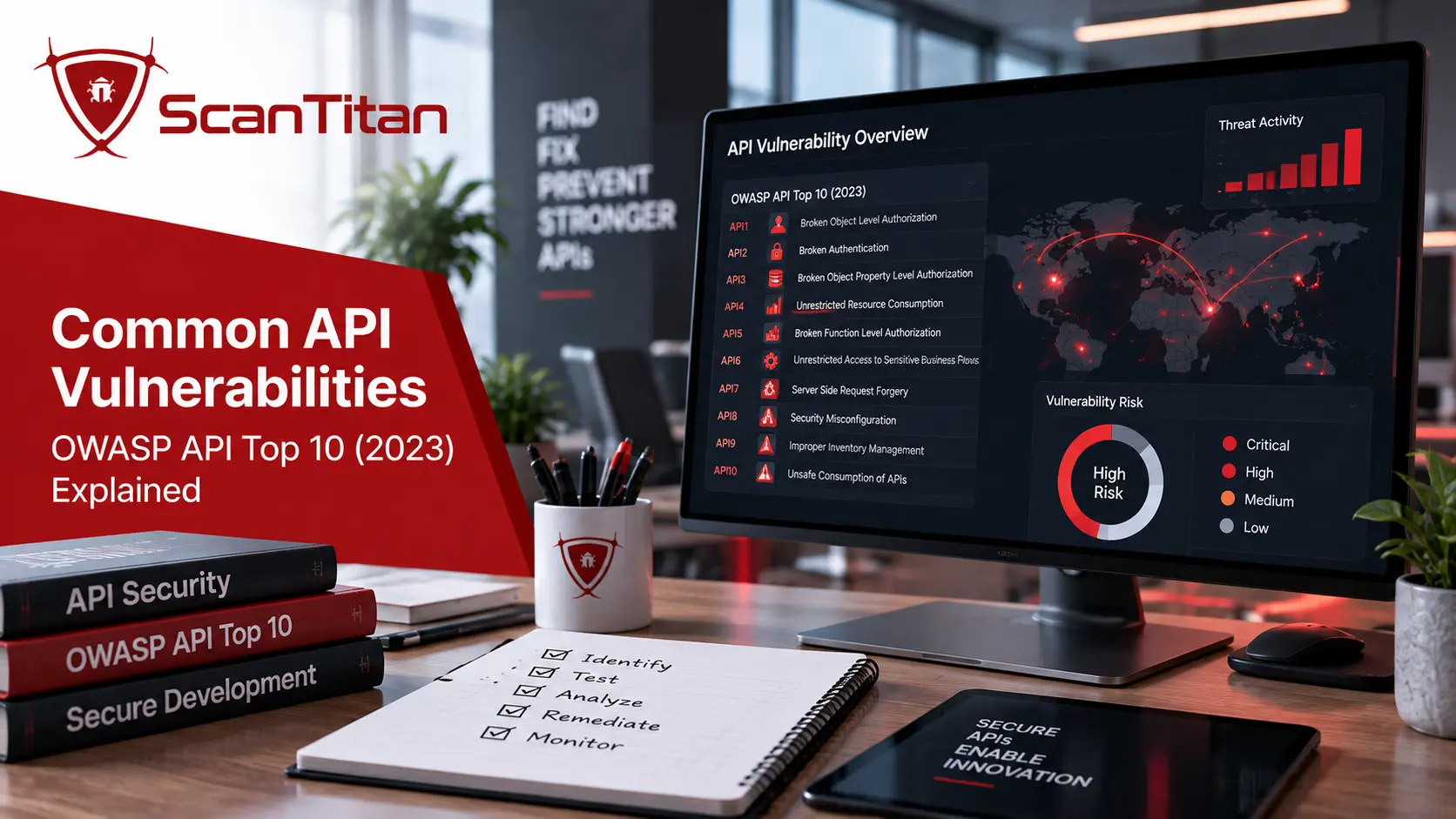
The OWASP API Security Top 10 2023 is the most useful starting taxonomy for API-specific testing. It covers authorization failures, authentication weaknesses, excessive resource use, sensitive business-flow abuse, server-side request forgery, inventory problems, and unsafe trust in third-party APIs. A good test program maps each risk to a concrete test case instead of treating the list as a compliance checklist.
| OWASP API risk | What it means | How to test it |
|---|---|---|
| API1 Broken Object Level Authorization | A user can access another user’s object by changing an identifier. | Use two test accounts and swap object IDs, UUIDs, or resource references. |
| API2 Broken Authentication | Weak credential, token, or session handling allows impersonation. | Test expired, revoked, malformed, missing, and incorrectly scoped credentials. |
| API3 Broken Object Property Level Authorization | A client can read or modify properties it should not control. | Add protected fields to requests and inspect responses for excessive properties. |
| API4 Unrestricted Resource Consumption | Requests can consume excessive CPU, memory, bandwidth, or paid resources. | Test rate limits, payload sizes, pagination, query complexity, and repeated expensive calls. |
| API5 Broken Function Level Authorization | A normal user can invoke privileged functions. | Call administrative or role-restricted endpoints with lower-privilege identities. |
| API6 Unrestricted Access to Sensitive Business Flows | Attackers automate a legitimate workflow for abuse. | Repeat or reorder actions such as signup, checkout, booking, voting, or coupon use. |
| API7 Server Side Request Forgery | The server fetches an attacker-controlled URL or resource. | Supply controlled URLs and verify destination restrictions and response handling. |
| API8 Security Misconfiguration | Unsafe headers, CORS, debug output, defaults, or transport settings create exposure. | Review headers, errors, TLS behavior, CORS policies, and exposed management endpoints. |
| API9 Improper Inventory Management | Old, undocumented, or forgotten APIs remain exposed. | Compare live traffic and routes against the official API inventory and specifications. |
| API10 Unsafe Consumption of APIs | The application trusts third-party API data too much. | Validate how upstream responses are parsed, trusted, sanitized, and authorized. |
API testing should also cover classic application weaknesses when the API exposes the relevant attack surface, including SQL injection, command injection, path traversal, insecure file upload, unsafe deserialization, information disclosure, and authentication bypass.
What Should You Test in an API Security Assessment?
A complete API assessment should test security controls, not just individual payloads. The most important question is whether the API consistently enforces its intended rules across users, roles, objects, properties, endpoints, and workflows. That requires authenticated and unauthenticated requests, multiple test identities, negative test cases, and enough business context to know what the API should allow. The table below gives a practical testing map that can be reused across REST, GraphQL, and other API styles.
| Security area | What to test | Example check |
|---|---|---|
| Authentication | API keys, OAuth 2.0, JWTs, bearer tokens, refresh tokens, expiry, revocation, and session handling | Verify an expired or revoked token is rejected everywhere it should be. |
| Object-level authorization | Horizontal access between users or tenants | Request another user’s object with a valid token from the wrong account. |
| Function-level authorization | Vertical privilege boundaries and administrator-only functions | Invoke an admin route using a standard-user identity. |
| Property-level authorization | Mass assignment and excessive data exposure | Add an internal field such as a role or status property to an update request. |
| Input validation | Types, length, format, encoding, injection, path handling, and file uploads | Send malformed or unexpected values and verify safe rejection. |
| Rate limiting | Per-user, per-IP, per-token, and expensive-operation controls | Send controlled bursts and confirm limits trigger without bypass through alternate endpoints. |
| Business logic | Workflow order, replay, duplicate actions, quantity limits, and race conditions | Repeat a one-time action or skip a required step and verify the server blocks it. |
| Data exposure | Response fields, error messages, metadata, and sensitive identifiers | Compare the API response with the minimum data the client actually needs. |
| Server-side requests | URL fetchers, webhooks, callbacks, importers, and proxy functions | Verify destination allowlists and protections against SSRF-style abuse. |
| Inventory | Shadow, zombie, deprecated, and undocumented endpoints | Compare gateway or traffic logs with OpenAPI documents and the approved inventory. |
Authenticated API security testing
Many high-value API vulnerabilities only appear after authentication. A scanner that tests only public endpoints may never reach object-level authorization, role checks, property restrictions, or business workflows. Use dedicated test identities representing different roles and, where possible, different tenants. That lets you test horizontal privilege escalation, where one normal user accesses another user’s resources, and vertical privilege escalation, where a lower-privilege account reaches administrative functions. Authentication coverage should include OAuth 2.0 flows, JWT validation, API keys, bearer tokens, token expiration, revocation, audience and scope handling, and refresh-token behavior.
API Security Testing Methods
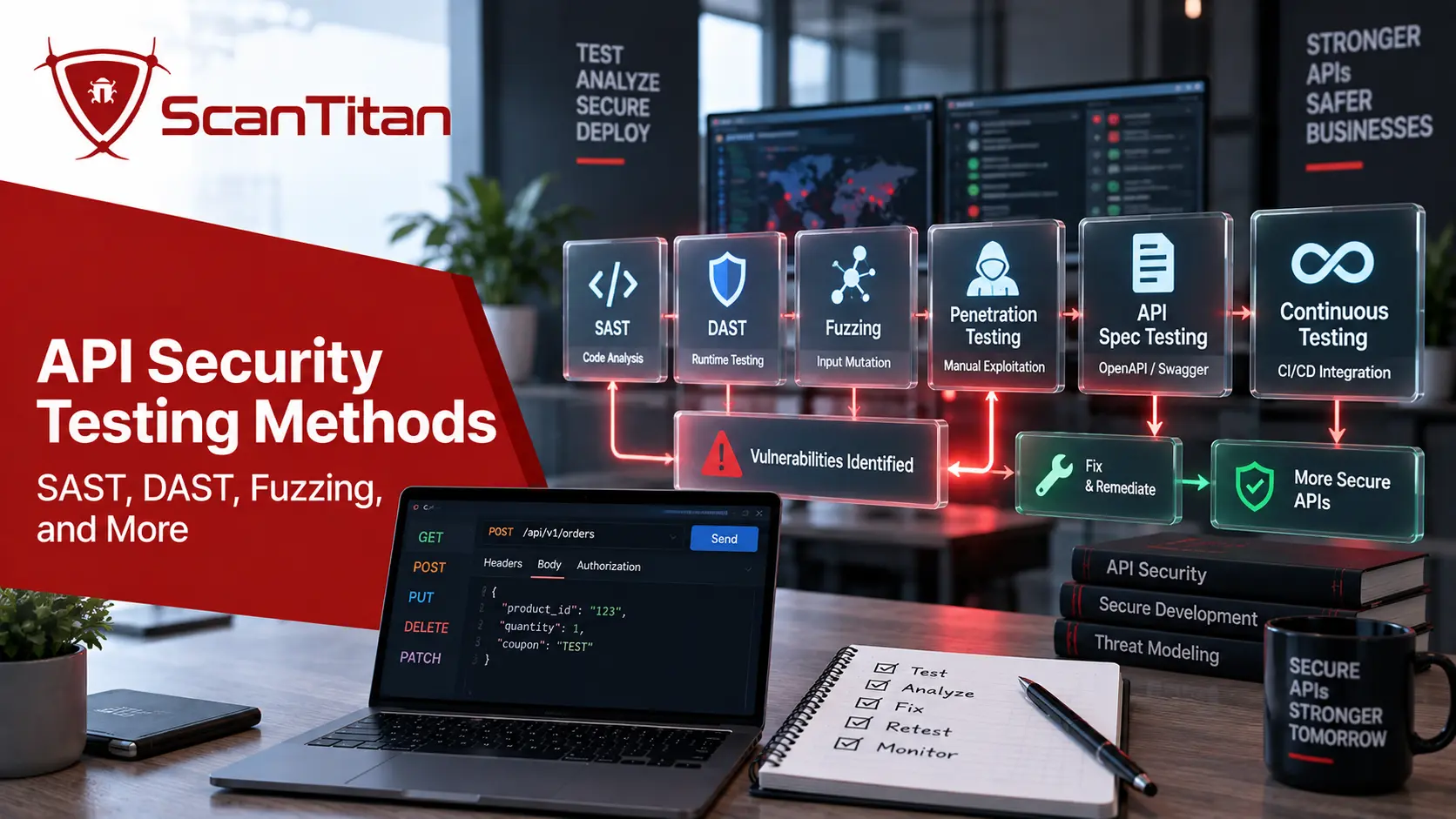
No single testing technique sees the entire API attack surface. Static analysis can catch risky code before deployment, while dynamic testing sees runtime behavior. Fuzzing explores malformed input, specification-based testing uses an API contract to generate coverage, and human penetration testing finds contextual business-logic flaws that automation may not understand. A mature API security testing methodology combines these approaches at different points in the software lifecycle.
Static Application Security Testing (SAST)
Static Application Security Testing analyzes source code without executing it. It can detect insecure coding patterns such as hardcoded secrets, unsafe query construction, weak cryptographic usage, missing validation, and dangerous functions before an API is deployed. SAST fits naturally into IDEs, pull requests, and build pipelines, which makes it useful for shifting security left. Its main limitation is context: code analysis alone cannot reliably prove whether a live authorization rule works correctly for a particular user, object, or workflow. Use SAST as an early code-level layer, not as a replacement for runtime API testing.
Dynamic Application Security Testing (DAST)
Dynamic Application Security Testing probes a running API from the outside and evaluates the responses. Because it tests actual runtime behavior, DAST can detect issues that depend on deployed configuration, routing, authentication, authorization, and request handling. API-focused DAST should be given enough information to reach the endpoints directly rather than relying only on browser crawling. Black Duck specifically notes that traditional DAST may miss endpoints that a front end never invokes, which is why API-aware scanning benefits from specifications such as OpenAPI, Postman collections, or captured traffic.
Interactive Application Security Testing (IAST)
Interactive Application Security Testing instruments the running application and observes what happens inside the code while tests execute. It combines runtime evidence with code-level context, which can help developers trace a security finding to the exact execution path that produced it. IAST is especially useful in QA and automated test environments where the application is already exercised by functional tests. The trade-off is that it requires instrumentation and sufficient test coverage to reach the vulnerable code paths.
Software Composition Analysis (SCA)
Software Composition Analysis identifies third-party packages, frameworks, and libraries used by the API and checks them against known vulnerability data. This matters because an API may be securely designed but still inherit risk from a vulnerable dependency. SCA belongs in CI/CD and should continue after release because new vulnerabilities can be disclosed in components that were considered safe when the build shipped. SCA is complementary to API testing: it finds known component risk, while dynamic API tests verify how the deployed service actually behaves.
API fuzzing
Fuzzing sends malformed, unexpected, boundary, or automatically generated inputs to an API to reveal crashes, validation mistakes, inconsistent states, and other unexpected behavior. Schema-aware fuzzers can use an OpenAPI or GraphQL definition to generate values that are structurally valid but deliberately unusual, improving coverage compared with random input alone. Stateful fuzzers can also chain requests so later tests depend on resources created earlier. For deeper coverage of techniques and tooling, see ScanTitan’s guide to API fuzzing.
Penetration testing
API penetration testing adds human judgment to the assessment. A skilled tester can model business intent, chain multiple weaknesses, recognize privilege boundaries, and abuse a legitimate workflow in ways that a scanner may not infer. It is especially valuable for BOLA, BFLA, multi-step business logic, tenant isolation, race conditions, and complex authorization scenarios. Because manual testing is slower and periodic, it works best alongside continuous automated testing rather than instead of it. See ScanTitan’s comparison of penetration testing and automated vulnerability scanning for the role of each.
Specification-based API security testing
Specification-based testing uses machine-readable API definitions to understand available routes, methods, parameters, authentication requirements, schemas, and expected responses. Common inputs include OpenAPI or Swagger files, GraphQL schemas, Postman collections, HAR traffic captures, RAML documents, and WSDL files for SOAP services. Black Duck describes API testing as beginning with a definition of the API so security tools can generate inputs tailored to what each endpoint expects. The specification can also be tested as a contract: undocumented routes, unexpected status codes, or responses that contain properties outside the schema may indicate security or governance problems.
Manual business-logic and negative testing
Negative testing deliberately asks the API to do things the normal client would never request. That includes calling actions out of order, repeating one-time operations, changing quantities or prices, using stale state, mixing identities across a workflow, or modifying server-controlled fields. Business-logic weaknesses often return perfectly valid HTTP responses, so they are difficult to detect through signature-based scanning alone. A tester needs to understand the expected business rule, then verify that the API enforces it on the server rather than trusting the client to behave correctly.
API Security Testing by API Type
The core security principles stay the same across API styles, but the test mechanics change. REST APIs emphasize resource authorization and HTTP semantics, GraphQL introduces query-level complexity and resolver authorization, and SOAP adds XML-specific parsing and WS-Security concerns. Treating every API as generic HTTP traffic can leave protocol-specific weaknesses uncovered.
REST API security testing
REST API testing should cover HTTP methods, path and query parameters, JSON or form bodies, object identifiers, authentication headers, caching, pagination, rate limits, and response codes. Authorization tests are especially important because resource-oriented URLs make object-level access a common boundary. Test whether PUT, PATCH, DELETE, and less frequently used routes enforce the same permissions as GET and POST. Also check versioned and deprecated paths because older REST endpoints are a common source of zombie API exposure. For broader design and defensive guidance, see ScanTitan’s REST API security guide.
GraphQL API security testing
GraphQL security testing should evaluate resolver-level authorization, introspection exposure, nested query depth, aliases, batching, query complexity, field-level data exposure, and mutations. A single GraphQL endpoint can expose many logical operations, so endpoint counting alone is not a useful measure of coverage. Test whether each resolver applies authorization independently and whether users can request sensitive fields that the normal client does not display. Resource-consumption controls are also important because deeply nested or repeated queries can create disproportionate backend work.
SOAP API security testing
SOAP testing should cover authentication and authorization as well as XML-specific issues such as unsafe entity handling, oversized XML structures, schema validation, WSDL exposure, and WS-Security configuration. Testers should verify that the service rejects unexpected XML elements and that security controls are applied consistently across operations defined in the WSDL. SOAP services are often older or enterprise-facing, which makes lifecycle and inventory checks particularly important when deprecated versions remain reachable.
Open-Source API Security Testing Tools
Open-source API security testing tools can cover dynamic scanning, known-vulnerability checks, schema-driven testing, stateful fuzzing, traffic interception, and specification linting. The best choice depends on the type of API and the testing objective. A practical free toolkit usually combines a dynamic scanner with a schema-aware or fuzzing tool rather than expecting one product to find every class of weakness.
ZAP
ZAP is a free, open-source web application scanner that can import API definitions and run active and passive tests against documented routes. It supports automation through Docker, command-line workflows, and scripting, making it useful as a DAST baseline in CI/CD. ZAP is strongest when it receives an accurate API definition and authentication context so it can reach more than public endpoints.
Nuclei
Nuclei is a template-based scanner that checks web and API targets against community and vendor-authored detection templates. It is useful for rapidly identifying known exposures, misconfigurations, and CVE-related conditions across many targets. Because templates look for defined patterns, Nuclei complements rather than replaces authorization testing, business-logic review, and stateful fuzzing.
Schemathesis and RESTler
Schemathesis generates tests from API schemas and uses property-based techniques to explore inputs that violate expected behavior. RESTler, developed by Microsoft Research, focuses on stateful REST API fuzzing and can build request sequences in which one call creates data used by later calls. These tools are especially useful when an accurate OpenAPI specification exists and the API contains multi-step resource workflows.
Burp Suite Community Edition and mitmproxy
Manual testers often use an intercepting proxy to inspect, replay, and modify API requests. Burp Suite Community Edition provides hands-on request manipulation, while mitmproxy offers a scriptable open-source proxy for capturing and transforming traffic. These tools are useful for authorization testing because a tester can capture a legitimate request, substitute another identity or object reference, and directly compare the server’s response.
Open-Source vs Commercial API Security Testing Tools
Open-source tools provide strong building blocks, but teams must usually assemble discovery, authentication handling, scheduling, deduplication, reporting, and triage themselves. Commercial platforms can add continuous API discovery, centralized asset inventory, authenticated scanning workflows, evidence, integrations, and lifecycle management. The decision is therefore less about whether open-source tools can find vulnerabilities and more about how much engineering effort the team wants to invest in operating the testing program.
| Tool | Type | License | Best fit |
|---|---|---|---|
| ZAP | DAST / API scanning | Open source | Automated dynamic testing baseline |
| Nuclei | Template-based scanner | Open source | Fast checks for known exposures and misconfigurations |
| Schemathesis | Schema-based property testing | Open source | OpenAPI and GraphQL schema-driven test generation |
| RESTler | Stateful REST API fuzzer | Open source | Multi-request workflow and stateful fuzzing |
| Burp Suite Community Edition | Intercepting proxy / manual testing | Free edition | Hands-on request manipulation and authorization testing |
| ScanTitan | API vulnerability scanning and discovery | Commercial | Continuous testing, API discovery, and centralized findings |
How to Perform API Security Testing Step by Step
A repeatable API security testing process starts with discovery and test context, not payloads. You need to know which APIs exist, how clients authenticate, which roles and tenants should be isolated, what the specification says, and which workflows matter to the business. From there, testing can move from broad coverage into authentication, authorization, input handling, business logic, automation, and retesting.
- Discover and inventory the API attack surface. Identify documented, undocumented, deprecated, internal, partner, and public APIs from specifications, gateways, traffic, repositories, and cloud logs.
- Collect specifications and test context. Gather OpenAPI files, GraphQL schemas, Postman collections, WSDLs, authentication flows, role definitions, and expected business rules.
- Create controlled test identities. Use accounts with different roles and, where relevant, different tenants so authorization boundaries can be tested safely.
- Validate authentication. Test missing, malformed, expired, revoked, incorrectly scoped, and replayed credentials across protected routes.
- Test authorization at object, property, and function level. Compare what different identities can read, modify, create, and delete.
- Test input handling and resource controls. Exercise malformed data, boundary values, file handling, rate limits, pagination, query complexity, and server-side URL fetching.
- Test business logic and multi-step workflows. Repeat actions, reorder calls, skip required stages, and verify server-side enforcement of limits and state.
- Automate repeatable tests in CI/CD. Run SAST and SCA early, then schema-aware and DAST checks against safe test environments on relevant builds.
- Retest fixes and monitor production exposure. Confirm remediation, watch for new endpoints, and repeat testing when APIs, identities, or dependencies change.
1. Discover and inventory every API
You cannot test an endpoint you do not know exists. Start with API gateways, ingress logs, cloud logs, service catalogs, repositories, mobile or web traffic, DNS and host inventories, OpenAPI documents, and deployment manifests. Compare discovered routes with the official inventory to identify shadow APIs, zombie APIs, deprecated versions, and unmanaged partner integrations. OWASP classifies this as Improper Inventory Management because old or undocumented endpoints often escape normal patching and monitoring. For a deeper workflow, see ScanTitan’s guide on how to scan your API for vulnerabilities.
2. Prepare authentication and test identities
Document how the API authenticates callers and which authorization relationships matter. That may include OAuth 2.0 authorization codes, client credentials, JWT bearer tokens, API keys, cookies, mTLS, or service accounts. Create test identities that represent realistic roles such as anonymous user, standard user, manager, administrator, and separate tenant accounts. Two equivalent users are essential for BOLA tests because the question is whether User A can access User B’s resources, not whether an unauthenticated visitor can reach them.
3. Validate authentication controls
Check whether protected endpoints reject missing credentials, malformed tokens, expired tokens, revoked sessions, invalid signatures, incorrect audiences, and insufficient OAuth scopes. Verify that logout or revocation behaves consistently and that refresh tokens cannot be reused beyond the intended lifecycle. Authentication tests should also look for brute-force resistance, account enumeration through response differences, and inconsistent enforcement between API versions or equivalent routes.
4. Test authorization boundaries
Authorization testing should cover object-level, function-level, and property-level decisions. For object-level checks, use one valid user’s credential while requesting another user’s resource identifier. For function-level checks, call administrator or staff functions as a lower-privilege identity. For property-level checks, add server-controlled fields to update requests and inspect responses for fields the caller should not receive. Repeat these tests across methods and API versions because a secure GET route does not prove the corresponding PATCH or DELETE route is protected correctly.
Simple BOLA test case: authenticate as User A, request User A’s resource successfully, then change only the resource identifier to one belonging to User B. The API should deny access unless cross-user access is explicitly part of the application’s design.
5. Test inputs, limits, and business logic
Send unexpected data types, boundary values, oversized input, unusual encodings, duplicate parameters, additional JSON properties, and invalid state transitions. Then test the business rules behind the API: whether one-time actions can be replayed, whether quantities or prices can be altered, whether an approval can be skipped, whether a coupon can be reused, or whether a resource can be modified after it should be locked. These tests often reveal weaknesses that return valid-looking responses and therefore evade signature-based scanners.
6. Automate testing in CI/CD
Move repeatable tests into the development pipeline so changes are evaluated before release. SAST and SCA can run on pull requests, while specification-based tests and DAST can run against ephemeral or staging environments once the service starts. Security gates should be based on verified impact and policy rather than blindly failing every build on every scanner alert. Running these checks as continuous vulnerability scanning keeps coverage aligned with fast API release cycles.
7. Retest and monitor the live API
After remediation, repeat the exact test that originally demonstrated the weakness and verify that equivalent routes are also protected. Production monitoring should then watch for new routes, changed authentication behavior, repeated authorization failures, traffic anomalies, and configuration drift. Monitoring is not a substitute for security testing, but it provides new test cases and helps detect attack patterns that only become visible over time.
API Security Testing vs API Penetration Testing
API security testing is the broader practice. It includes automated and manual techniques that can run continuously throughout development and operations. API penetration testing is one deeper, usually time-bounded form of security testing in which a human tester actively tries to chain weaknesses and demonstrate impact. Teams typically need both: automation provides repeatable coverage at deployment speed, while penetration testing adds contextual reasoning for complex authorization and business logic.
| Area | API security testing | API penetration testing |
|---|---|---|
| Scope | Broad program covering code, dependencies, runtime behavior, schemas, and workflows | Focused adversarial assessment of selected APIs and scenarios |
| Frequency | Can run continuously or on every build | Usually periodic or milestone-based |
| Automation | Often heavily automated | Human-led with supporting tools |
| Strength | Repeatability and scale | Business logic, chaining, and contextual judgment |
| Best use | Continuous coverage and regression testing | Deep validation of high-risk APIs and trust boundaries |
Can You Run API Security Testing in Production?
Some API security checks can run safely in production, but destructive testing should not be treated the same way as passive monitoring or low-impact validation. A production test may create records, trigger emails, modify accounts, invoke billable operations, consume resources, or interfere with customer workflows. The testing plan therefore needs explicit scope, safe test accounts, request-rate controls, and clear rules for which methods and endpoints can be exercised.
Use production-safe controls. Run destructive or high-volume fuzzing in staging first. In production, favor non-destructive checks, dedicated test identities, controlled request rates, approved endpoints, reversible actions, and monitoring that can detect unexpected impact.
Production testing is most useful for confirming real configuration, authentication behavior, exposure, and regression after deployment. Staging remains the safer environment for aggressive fuzzing, large payloads, rate-limit stress, destructive methods, and tests that may alter business state.
Supporting API Security Capabilities
Some technologies commonly grouped with API security testing are better understood as supporting controls rather than testing methods. Runtime Application Self-Protection can detect or block malicious behavior inside a running application. API security posture management evaluates inventory, ownership, configuration, policy, and program-level gaps. Traffic monitoring and anomaly detection look for suspicious activity in production. These capabilities strengthen the overall API security program, but they do not replace active testing that deliberately exercises authentication, authorization, inputs, and business logic.
API Security Testing Best Practices
The strongest programs make testing repeatable, authenticated, specification-aware, and tied to actual business rules. The goal is not to run the largest number of scans; it is to keep security coverage aligned with the APIs that are actually deployed and to verify that critical trust boundaries continue to work after every meaningful change.
- Test early and continuously. Run code and dependency checks before deployment and runtime tests whenever the deployed API changes.
- Use multiple identities. Authorization testing needs accounts with different users, roles, and tenants, not one generic token.
- Keep API specifications current. Accurate OpenAPI, GraphQL, Postman, or WSDL definitions improve coverage and expose undocumented drift.
- Test authorization before chasing rare payloads. BOLA, BFLA, and property-level authorization failures can expose sensitive data through otherwise valid requests.
- Include business logic. Test workflow order, replay, limits, quantities, state transitions, and abuse of legitimate operations.
- Validate rate and resource controls. Check request limits, expensive queries, pagination, file sizes, and operations with monetary cost.
- Separate staging and production test profiles. Aggressive fuzzing belongs in a safe environment; production testing should be tightly controlled.
- Retest every verified fix. A remediation is not complete until the original test case and equivalent routes no longer reproduce the issue.
How ScanTitan Automates API Security Testing
Manual API testing is valuable for deep business-logic analysis, but it does not scale well across a large and frequently changing endpoint inventory. ScanTitan’s API vulnerability scanner is designed to support repeatable API testing and discovery so teams can find exposed endpoints, assess runtime behavior, and centralize findings rather than relying only on periodic manual checks. Use automated testing for broad and continuous coverage, then escalate high-risk authorization and business-logic areas for deeper human review where necessary.
API Security Testing FAQ
What is API security testing?
API security testing is the process of evaluating an API for vulnerabilities, authorization failures, unsafe input handling, misconfigurations, and business-logic weaknesses. Testers send controlled requests directly to endpoints and analyze how the API authenticates callers, authorizes access, validates data, limits resources, and protects sensitive workflows.
What should be tested in API security?
Test authentication, object-level authorization, function-level authorization, property-level authorization, input validation, rate limits, business logic, data exposure, inventory, and third-party API trust. High-quality testing also uses multiple identities and covers both documented and discovered endpoints.
What is the best free API security testing tool?
ZAP is a strong free DAST starting point, but no single free tool covers every API security risk. Pair a dynamic scanner with tools such as Nuclei for known exposures, Schemathesis for schema-driven testing, RESTler for stateful REST fuzzing, and an intercepting proxy for manual authorization checks.
What is the difference between SAST and DAST for APIs?
SAST analyzes source code without running the API, while DAST sends requests to a running API and evaluates real runtime behavior. SAST is useful before deployment for code-level weaknesses. DAST is better suited to deployed configuration, request handling, authentication, authorization, and other runtime conditions.
How often should API security testing be performed?
API security testing should be continuous for repeatable automated checks and periodic for deeper manual testing. Run SAST and SCA on code changes, DAST and schema-based tests on relevant builds or deployments, retest verified fixes, and perform deeper penetration testing when high-risk APIs or major architecture changes justify it.
Is API security testing automated or manual?
It is both. Automated tools provide repeatable coverage for code, dependencies, runtime behavior, schemas, known vulnerabilities, and fuzzing. Manual testing is particularly important for authorization, tenant isolation, business logic, chained weaknesses, and workflows that require an understanding of what the application is supposed to allow.
Can API security testing be done in production?
Yes, but production testing should be tightly controlled. Use non-destructive checks, approved test accounts, rate limits, reversible actions, and explicit scope. Run aggressive fuzzing, destructive methods, large payloads, and resource-exhaustion tests in staging or another isolated environment first.
How is REST API security testing different from GraphQL testing?
REST testing focuses heavily on routes, HTTP methods, resource identifiers, and per-endpoint authorization, while GraphQL testing also needs resolver-level authorization, field exposure, query depth, batching, aliases, and query-complexity controls. Both still require authentication, authorization, input validation, business-logic, and rate-limit testing.
Build API Security Testing Around Real Trust Boundaries
The most effective API security testing program does not begin with a scanner. It begins with knowing which APIs exist, which identities use them, which objects and functions each identity should reach, and which business rules the server must enforce. SAST, DAST, SCA, fuzzing, specification-based testing, and penetration testing then provide different views of that same attack surface. When those methods are combined with continuous discovery, CI/CD automation, controlled production validation, and retesting, API security becomes a repeatable engineering process rather than a point-in-time exercise.