
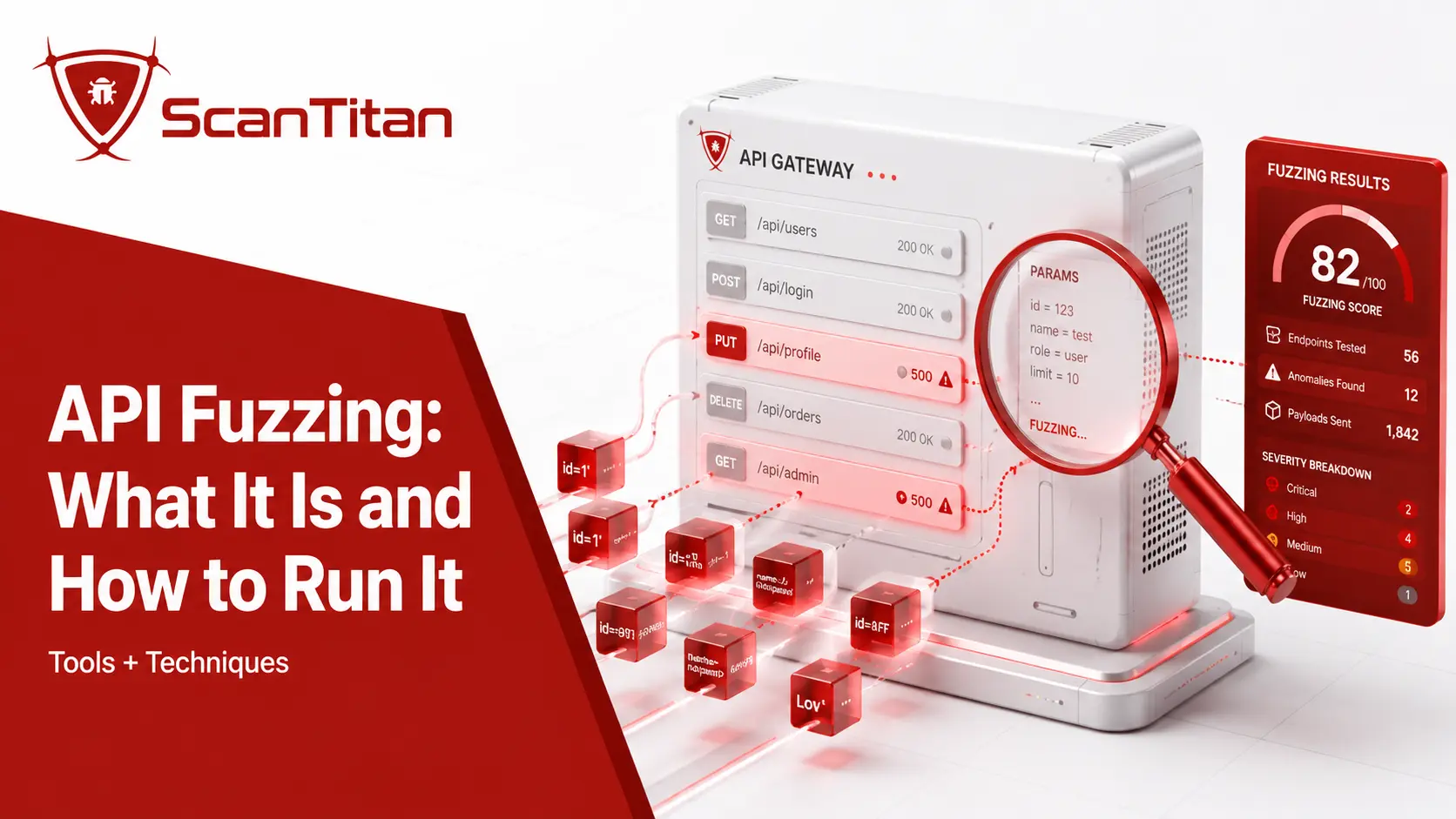
API fuzzing is an automated security testing technique that floods your API endpoints with malformed, random, and unexpected inputs to find the bugs and vulnerabilities that normal testing never triggers. Instead of checking whether an endpoint returns the right answer for valid data, an API fuzzer asks what breaks when the data is wrong. This guide explains what API fuzzing is, how the techniques differ, which tools run it, and how to wire it into your pipeline so flaws surface before attackers reach them, not after they have already walked through the gap.
What is API fuzzing?
API fuzzing, also called API fuzz testing, is a dynamic testing method where a fuzzer generates thousands of invalid, random, and boundary inputs and sends them to a running API to expose crashes, errors, and security flaws. It targets the unknown. Unit tests confirm what a developer expected; a fuzzer probes what nobody thought to check. This matters because APIs now carry roughly 83 percent of web traffic, which makes them the surface attackers reach for first (AppSecSanta, 2026). Fuzzing exercises that surface at machine speed, sending edge cases a human tester would never have time to type by hand.
API fuzzing vs traditional API testing
Traditional API testing verifies known behavior. A functional test confirms that a POST to the users endpoint creates a user when you send valid JSON. Integration tests check that services talk to each other correctly. Both rely on cases a developer wrote in advance, so both share one blind spot: they only test what someone already imagined. API fuzzing inverts that. The fuzzer sends a name field with 10,000 characters, an email field holding an integer instead of a string, or a body encoded in a format the server never expected. Those are exactly the conditions where injection flaws, memory errors, and data leaks hide. Fuzzing does not replace functional testing; it covers the space functional testing leaves untouched.
A plain-English analogy
Picture a vending machine that expects a coin. Functional testing checks that the right coin returns the right snack. Fuzzing is the person who feeds it a bent coin, a button, a folded receipt, and a stream of water, then watches which of those makes the machine jam, hand out free snacks, or spill its cash tray. The API is the machine, and the fuzzer is a tireless tester trying every wrong input in seconds. The goal is not cruelty for its own sake. Every jam the fuzzer finds is a flaw a real attacker would have found later, on your production system, at a far worse moment.
How API fuzzing works: the four-step loop
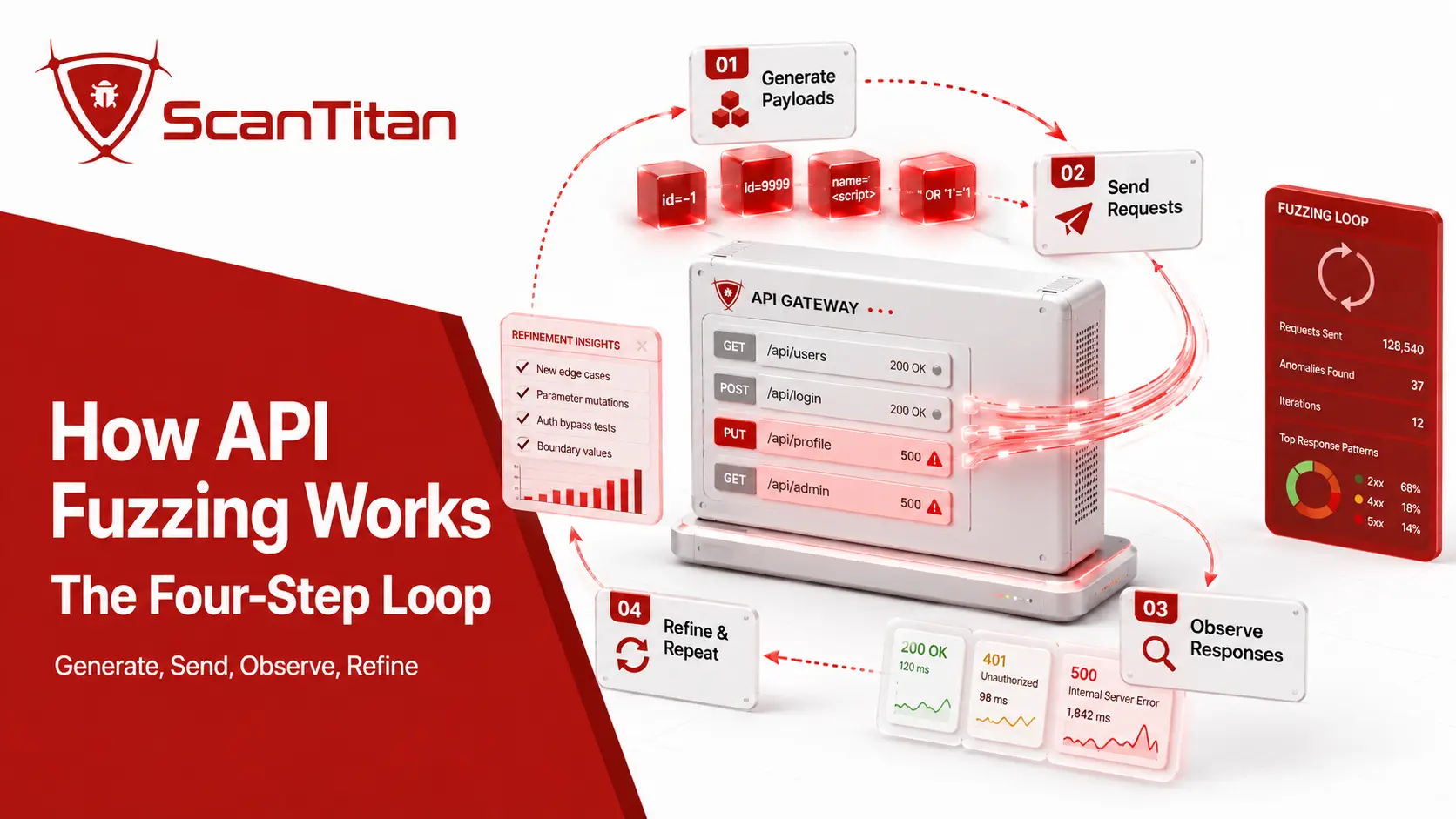
Every API fuzzer, from a free command-line tool to a commercial platform, runs the same core loop. Understanding it helps you read results and tune the process for your own endpoints.
- Define the target endpoints, usually by pointing the fuzzer at an API specification such as an OpenAPI or Swagger file so it learns every route, method, and parameter.
- Generate the inputs automatically, creating thousands of mutated requests that alter data types, inject special characters, send oversized payloads, or drop required fields.
- Send the requests to the running API and record every response, including status code, latency, headers, and body.
- Analyze the output for anomalies: 500 server errors, stack traces in error messages, unusual delays, or any behavior that signals a weakness.
Types of API fuzzing techniques
Not every fuzzer works the same way, and the technique you pick decides how deep it reaches. Random-only fuzzing wastes cycles bouncing off input validation; schema-aware and stateful approaches reach the code paths that actually matter. Most mature teams combine two or three techniques rather than betting on one.
Mutation-based fuzzing
Mutation-based fuzzing starts with a valid request and systematically breaks it. The fuzzer takes a working call, then flips bits, swaps data types, truncates values, or replaces clean strings with special characters. It sets up fast because it needs almost no knowledge of your API schema; a captured request is enough to begin. The tradeoff is depth. If the seed requests are shallow, the mutations rarely reach far into application logic, so mutation-based fuzzing shines for quick, broad coverage rather than surgical exploration. Many bug-bounty hunters start here because a single recorded request in Burp Suite or Postman becomes hundreds of test cases in minutes.
Generation-based fuzzing
Generation-based fuzzing builds requests from scratch using the API schema instead of mutating existing ones. When you hand the fuzzer an OpenAPI specification, it reads the expected parameters, data types, and constraints, then deliberately violates them in structured ways. Because the tool understands the shape of a valid request, it produces inputs that are wrong in interesting places rather than wrong everywhere, which lets it reach more meaningful code paths than blind mutation. The cost is setup effort: generation-based fuzzing depends on an accurate, current specification. Teams that keep their OpenAPI files in sync get sharp results, while teams with stale docs get noise.
Schema-aware fuzzing
Schema-aware fuzzing treats your API schema as a map of exactly which inputs are just wrong enough to be dangerous. It knows which fields are required, what types they accept, and what relationships link them, so it can send a required field holding the wrong type, an integer set to its maximum value plus one, or a string packed with SQL metacharacters. Schemathesis is the best-known open-source example, and it frames fuzzing as property-based testing driven directly by an OpenAPI or GraphQL schema. This is the sane default for most REST and GraphQL APIs because it balances coverage against precision without demanding that you script every case yourself.
Stateful REST API fuzzing
Many API flaws only appear across a sequence of calls, not inside a single request. You cannot fuzz a checkout endpoint without first creating a cart and adding an item, so a single-shot fuzzer never reaches the interesting logic. Stateful fuzzing solves this by learning the dependencies between requests, then chaining them into realistic workflows while it fuzzes the parameters at each step. Microsoft RESTler pioneered this approach and remains the reference tool; it reads your OpenAPI specification, infers which endpoints produce values that later endpoints consume, and builds chained sequences automatically (RESTler, ICSE 2019). Stateful fuzzing costs the most to set up and reaches authorization and business-flow bugs the others miss.
Coverage-guided and property-based fuzzing
Coverage-guided fuzzing watches which code paths each input reaches and steers new inputs toward the parts of the application it has not exercised yet, so it explores deeper on its own instead of firing blindly. Property-based fuzzing, the model behind Schemathesis and its underlying Hypothesis library, asserts rules that must always hold true, such as a valid request never returning a 500 error, then hunts for any input that breaks the rule. Both approaches trade raw speed for intelligence, and both suit teams that want the fuzzer to find the hard cases rather than repeat easy ones. They are the most advanced options on this list and the least covered by competing guides.
| Technique | Best for | Input source | Setup effort |
|---|---|---|---|
| Mutation-based | Quick broad coverage | Existing valid requests | Low |
| Generation-based | Schema-aware exploration | API specification | Medium |
| Schema-aware | Targeted boundary testing | OpenAPI or GraphQL schema | Medium |
| Stateful | Multi-step workflow bugs | Spec plus learned dependencies | High |
| Coverage-guided | Deep autonomous exploration | Instrumented code plus feedback | High |
Vulnerabilities API fuzzing uncovers, mapped to the OWASP API Top 10 2023
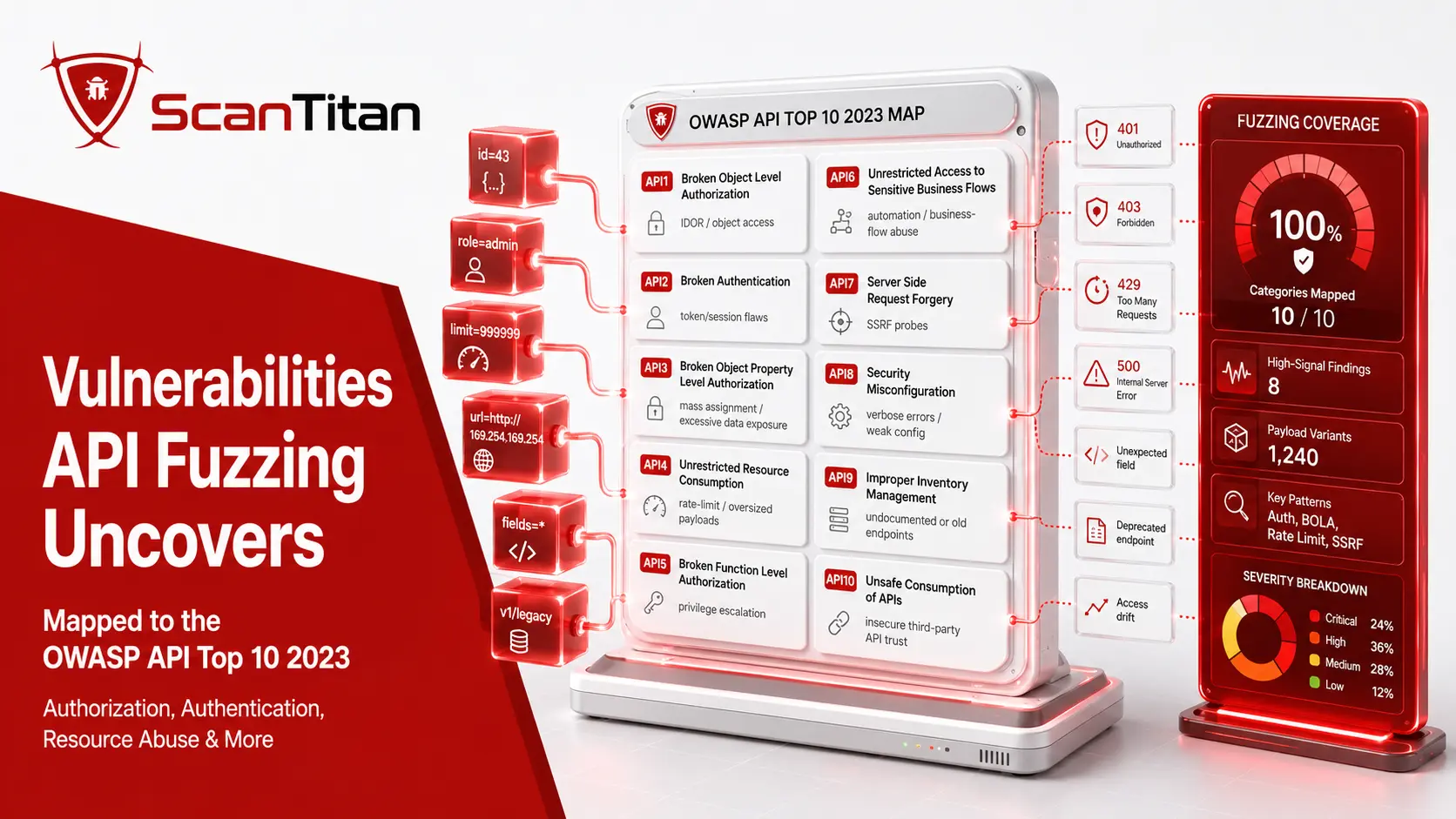
API fuzzing is strong at input-handling flaws and weaker at pure logic flaws, so it helps to know where it lands against the OWASP API Security Top 10 2023. The categories below are the ones fuzzing reaches most often.
- Injection flaws. Trigger SQL, NoSQL, and command injection by pushing special characters and escape sequences into every parameter, which is how attackers reach the database behind the API.
- Security misconfiguration (API8:2023). Surface verbose error pages, stack traces, and debug modes when malformed inputs make the server fail loudly. Salt Security found that 65 percent of API attacks now exploit security misconfiguration (Salt Security, 1H 2026).
- Unrestricted resource consumption (API4:2023). Expose weak rate limiting and denial-of-service exposure by flooding an endpoint with oversized or high-volume payloads and watching whether it throttles.
- Broken authorization (API1 and API5:2023). Reach some BOLA and function-level authorization gaps through stateful fuzzing that swaps object IDs or replays expired tokens across a chained sequence.
- Sensitive data exposure. Catch APIs that leak internal file paths, database schema, or tokens in their error responses, handing an attacker a map of the system.
- Input validation failures. Bypass any client-side checks entirely, since the fuzzer sends raw requests straight to the server and shows how the API behaves without a front end protecting it.
Fuzzing is far less effective against categories that need human judgment, such as unrestricted access to sensitive business flows (API6:2023) or improper inventory management (API9:2023). Those need discovery and business-logic testing, which is why fuzzing pairs best with a runtime scanner rather than standing alone.
How to run API fuzzing: a step-by-step tooling walkthrough
Running your first fuzz test takes minutes, not days. The path below moves from the easiest schema-driven scan to a stateful chain, then to hands-on manual fuzzing. Start with whichever matches the API you have in front of you.
- Locate your API specification, because most modern fuzzers read an OpenAPI or Swagger file and generate tests from it automatically.
- Run a schema-aware pass first to get broad coverage quickly across every documented endpoint.
- Add stateful fuzzing for your critical flows, especially anything touching authentication, payments, or personal data.
- Fuzz individual high-risk fields by hand when you want to confirm and demonstrate a specific finding.
Fuzzing from an OpenAPI spec with Schemathesis
Schemathesis reads your OpenAPI or GraphQL schema and generates property-based tests with almost no configuration, which makes it the fastest way to start. Install it with pip, point it at your live schema, and it takes over from there. Teams at Red Hat, Spotify, WordPress, and JetBrains use it in exactly this way (Schemathesis, 2026). A first run looks like this:
pip install schemathesis
schemathesis run https://api.example.com/openapi.json
The tool then generates malformed requests against every documented endpoint, checks each response for server errors and schema violations, and prints a report grouping the failures it found. From there you can narrow the run to one endpoint, raise the number of examples per case, or add authentication so it can reach protected routes.
Stateful fuzzing with Microsoft RESTler
RESTler goes deeper by chaining requests, so it reaches the multi-step bugs a single-request fuzzer cannot. It works in two phases. First you run RESTler in compile mode against your OpenAPI file, which produces a grammar describing every request and the dependencies between them. Then you run it in fuzz mode, where it walks those chains, sending sequences such as create a resource, read it back, then modify it with hostile input at each step. RESTler flags any response in the 500 range as a bug and learns from earlier responses to explore deeper states. Its lean mode hits every endpoint once for a fast pass, while its full mode searches harder for reliability and security defects. Treat the aggressive mode with care, since it can strain a fragile staging service.
Manual fuzzing with Burp Suite Intruder and Postman
Sometimes you want to prove one specific weakness rather than scan everything, and manual fuzzing is faster for that. In Burp Suite, capture a request, send it to Intruder, mark the field you want to attack, load a payload list of malicious or malformed values, and launch. Burp records the response to every permutation and highlights the ones that deviate from the baseline by status code, length, or error text. Postman offers a lighter path that many people start with: capture a request, build a collection, define a variable for the value you want to vary, then use the Collection Runner to replay the request with different inputs while a test script checks each status code. This is the approach a beginner can run today with free tools.
Open-source vs commercial API fuzzing tools
The market splits into free tools that give you full control and commercial platforms that add discovery, triage, and evidence. Most teams run both: an open-source fuzzer for exploration and a runtime scanner for repeatable, provable results. The table below compares the ones worth knowing.
| Tool | Type | Spec support | Stateful | License |
|---|---|---|---|---|
| Schemathesis | Schema-aware, property-based | OpenAPI, GraphQL | Partial | Open-source |
| RESTler | Stateful, generation-based | OpenAPI, Swagger | Yes | Open-source |
| Burp Suite Intruder | Manual payload fuzzing | Any HTTP request | No | Commercial |
| OWASP ZAP | DAST with API scan | OpenAPI import | No | Open-source |
| APIFuzzer | Generation-based, no-code | OpenAPI, Swagger | No | Open-source |
| ffuf | Fast endpoint and parameter fuzzer | Wordlists | No | Open-source |
| EvoMaster | Coverage-guided, evolutionary | OpenAPI | Yes | Open-source |
| ScanTitan | Runtime DAST with API testing | Web, API, network | Runtime validation | Commercial |
Fuzzing GraphQL, gRPC, and SOAP APIs
REST is not the only target, and each API style needs a fuzzer that understands its structure. For GraphQL, Schemathesis fuzzes directly against the schema, probing queries and mutations for resolver errors and injection, which matters because a single malicious query can force expensive nested lookups. For gRPC, the fuzzer needs the protobuf definitions to build valid message frames before it can distort them, so tools that ingest proto files or reflection data fit best. For SOAP, the WSDL file plays the role the OpenAPI spec plays for REST, and Burp extensions parse it to enumerate operations before fuzzing their parameters. The principle holds across all three: feed the fuzzer the contract, then let it break the contract on purpose.
Because SOAP is XML-based, security testing should also account for unsafe parser behavior such as XXE testing when external entity or resource resolution may be enabled.
Adding API fuzzing to your CI/CD pipeline
The biggest shift in modern API security is moving fuzzing from a quarterly exercise into a check that runs on every change. Quarterly fuzzing is theatre when developers ship code daily and new CVEs drop constantly. Wire your fuzzer into the pipeline so it runs on every pull request, or at least on every merge to the main branch, and fails the build when it finds a high-severity issue. Point it at a staging environment that mirrors production, and start with the endpoints that handle authentication, payments, or personal data. When a finding surfaces, route it into the same channel developers already watch for broken builds, so a security bug feels no different from a failing unit test and gets fixed just as fast.
Reducing false positives and triaging results
Raw fuzzing output is noisy, and that noise is the fastest way to lose a lean team’s trust in the process. A single 500 error might be a genuine memory-handling flaw or just a missing validation message, and if every alert looks equally urgent, your two-person security team will start ignoring all of them. Build a triage habit: group findings by severity, confirm each one reproduces, and rank fixes by real exposure rather than raw count. This is where evidence matters most. When a finding ships with the exact HTTP request and response that triggered it, plus clear steps to reproduce, a developer can verify and fix it in minutes instead of arguing about whether it is real. Proof-based results turn fuzzing from an alert generator into a fix generator.
Limitations of API fuzzing
Fuzzing is powerful, but selling it as a complete solution sets teams up to miss real risk. Be clear about where it falls short.
- Produces false positives and negatives, generating so many cases that some flagged issues are not real and some real bugs slip through untested inputs.
- Covers a limited slice of all possible inputs, so a run focused on certain fields or types can leave whole categories unexamined.
- Runs slowly on large APIs, since thorough fuzzing of hundreds of endpoints takes time and compute that a small team has to budget for.
- Misses pure logic and design flaws, because a fuzzer that does not understand your business rules cannot tell that a discounted price should never go negative.
The honest takeaway: fuzzing finds input-handling and reliability bugs well, and it needs a partner for authorization logic and design flaws. That partner is usually dynamic application security testing.
Why API fuzzing matters more in the age of AI-generated code
AI coding assistants ship functional code fast, but they leave the edge cases, error handling, and input validation that fuzzing is built to catch. The volume of new code has jumped while the amount of review has not, and the numbers show where that lands. Salt Security reports that 99 percent of organizations hit an API security problem in the past year (Salt Security, 2025), and Wallarm found that 98.9 percent of AI-related vulnerabilities are API-related (via AppSecSanta, 2026). AI-generated endpoints often handle the happy path and skip the hostile one, they follow assumptions no human reviewer verified, and they can reproduce insecure patterns learned from training data. Fuzzing exercises that code without trusting any of its assumptions, which is exactly the safety net AI-assisted development needs.
Where ScanTitan fits: fuzzing plus runtime DAST
Fuzzing is the exploratory layer; ScanTitan is the deterministic layer that proves and tracks what matters. A fuzzer is excellent at surfacing unexpected input handling, but it leaves you with a pile of findings to sort and no repeatable record. ScanTitan runs api vulnerability scanner against your live API, confirms the common flaws fuzzing hints at, such as injection and broken access control, and ships every finding with the HTTP request and response evidence plus remediation steps your developers need. Its API testing runs inside your pipeline on every change, and its discovery makes sure you are scanning every exposed endpoint, not only the ones in your documentation. Pair open-source fuzzing for breadth with ScanTitan for provable, developer-ready results.
Frequently asked questions
Is API fuzzing automated? Yes. An API fuzzer automatically generates and sends thousands of malformed and random requests to your endpoints, then analyzes the responses for crashes and anomalies. Modern tools like Schemathesis and RESTler run from the command line and slot into a CI/CD pipeline, so the whole loop, from generating inputs to reporting bugs, needs no manual effort once you point it at your API specification.
Does API fuzzing find real vulnerabilities? It finds many of them, especially injection flaws, security misconfiguration, weak rate limiting, and input validation failures from the OWASP API Top 10 2023. It also catches unknown, implementation-specific bugs that signature-based scanners miss. It is weaker at pure business-logic flaws, which is why teams pair fuzzing with dynamic application security testing for full coverage.
What is the difference between API fuzzing and penetration testing? API fuzzing is automated and broad: it fires thousands of malformed inputs at endpoints to find input-handling bugs at scale. Penetration testing is manual and deep: a human tester uses judgment to chain flaws and reach business-logic issues a fuzzer cannot reason about. Fuzzing runs continuously in your pipeline; a pentest is a point-in-time engagement. They complement each other rather than compete.
Which is the best free API fuzzing tool to start with? Schemathesis is the best starting point for most REST and GraphQL APIs, because it reads your OpenAPI schema and generates tests with a single command. If your API relies on multi-step workflows, add Microsoft RESTler for stateful fuzzing. For hands-on testing of one specific field, Burp Suite Intruder or Postman gives you direct control.
How often should I run API fuzzing? Run it on every pull request, or at minimum on every merge to your main branch. APIs change constantly and AI-generated code adds untested surface quickly, so a quarterly scan leaves long windows where new flaws sit exposed. Continuous fuzzing in CI/CD catches issues while the code is still fresh in the developer’s mind.
Ready to prove what your APIs are exposing?
Open-source fuzzing shows you where to look; ScanTitan shows you what is actually exploitable and how to fix it. If you want continuous API security testing that runs in your pipeline and ships every finding with request-and-response evidence, start a free ScanTitan scan and see your API attack surface the way an attacker would.