
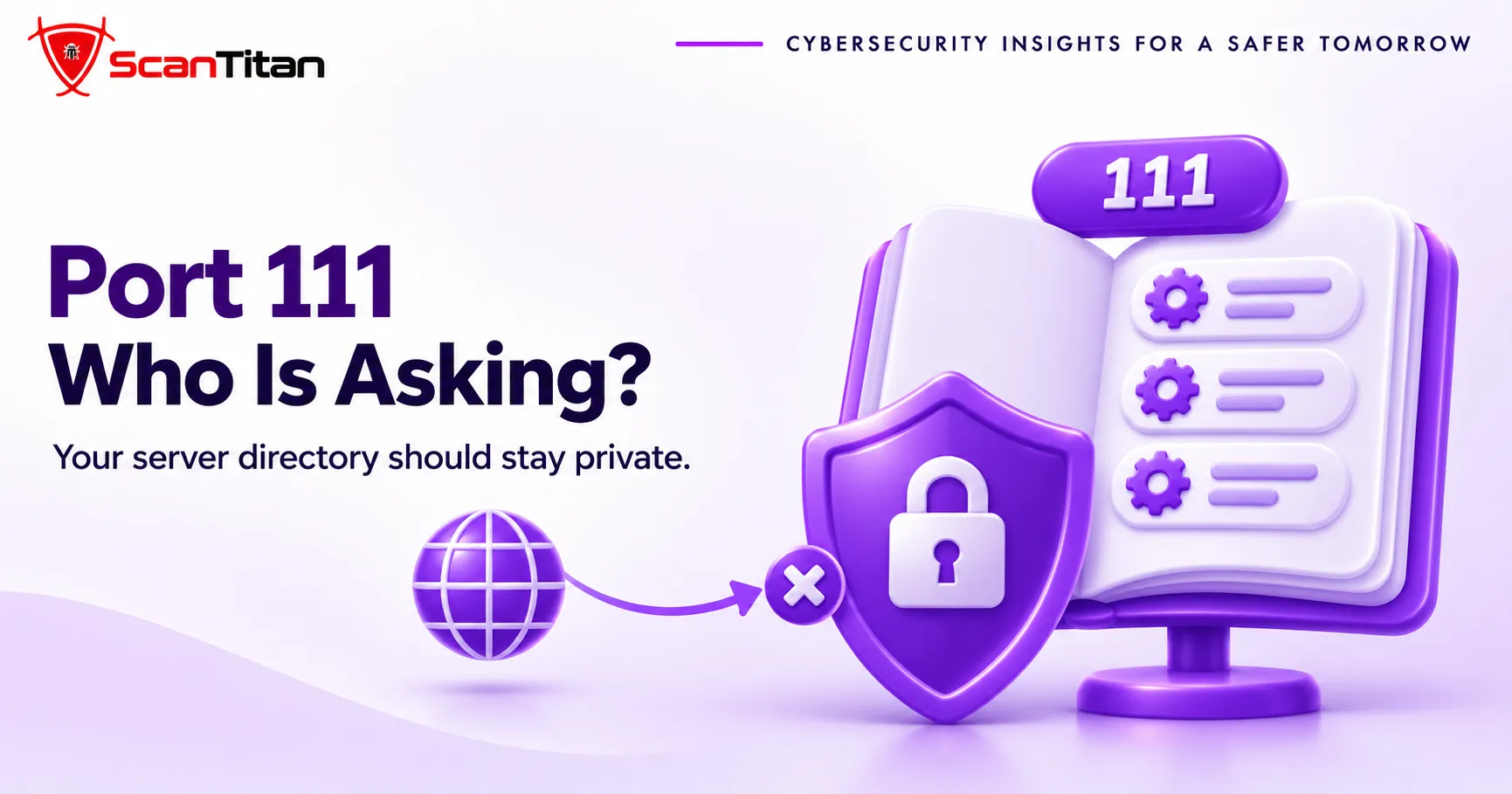
Port 111 is the port used by rpcbind, also called portmapper, a service that tells clients where other remote procedure call services are listening. It is common on Linux and Unix systems that share files with NFS, and it should never answer the open internet. This guide explains what the port does, which risks are real, how to check what yours reveals and how to disable or restrict it without breaking file shares.
What Is Port 111?
Port 111 is the network port that the IANA port registry assigns to SUN Remote Procedure Call, listed as sunrpc, for both TCP and UDP. Remote procedure call, or RPC, lets a program on one computer ask another computer to run a task. Many RPC services do not sit on fixed port numbers, so clients need one predictable place to ask where each service is. Port 111 is that place. A server that answers here is running a directory of its RPC services. That directory is useful to your own file clients and equally useful to a stranger mapping your server, which is why the question of who can reach it matters more than the number itself.
What Is rpcbind on Port 111?
The rpcbind service on port 111 is the program that converts RPC program numbers into the network addresses where those programs listen, according to its Linux manual page. Older systems call a similar program portmap or portmapper, and many tools still use that name. When an RPC service starts, it registers with rpcbind. A client then asks rpcbind for the program it wants and connects to the port in the reply. If rpcbind stops, clients that depend on that lookup can fail even though the other services are still running. By default it listens on all addresses unless its configuration or a firewall says otherwise, so check this on every server where it appears.
What Protocol Does Port 111 Use: TCP or UDP?
The protocol on port 111 is ONC RPC, the SUN remote procedure call standard, and it runs over both TCP and UDP. This catches many administrators out, because a firewall rule written for TCP alone leaves UDP 111 open. UDP matters most for abuse, since it needs no connection handshake and the sender’s address can be forged. TCP is used for queries as well, and some environments can work with TCP only. Check both protocols whenever you scan, and block both whenever you block. If you plan to keep UDP closed while leaving TCP open to trusted clients, test every dependent share afterwards, because older clients may expect UDP to answer and fail quietly when it does not.
What Is Port 111 Used For?
Port 111 is used for service discovery, so that RPC clients can find the current port of a service before they connect to it. The best known user is the Network File System, or NFS, in its version 3 form, where helper services for mounting, locking and status can take changing port numbers. The older Network Information Service, or NIS, which distributes account and configuration data, relies on RPC too. Monitoring or quota tools built on RPC can also register there. Many servers run rpcbind simply because an NFS package installed it, even though nothing uses it today. Before you remove it, list the registered programs and confirm which ones your users depend on. An empty or surprising list tells you what to do next.
Why Does Veeam Use Port 111?
Veeam uses port 111 for NFS connections between backup components, hosts and storage. Its port documentation lists TCP and UDP 111 from an ESXi host to a mount server running the vPower NFS Service, which lets a virtual machine start directly from a backup. It also lists the port, usually together with 2049, for NFS backup repositories and several storage systems. That means a Windows mount server can legitimately listen on 111, and blocking it can break mounts during a restore test. Allow the port only between the backup components named in the documentation. If another program on the same machine already holds port 111, identify it before you change either one.
What Are the Port 111 rpcbind Vulnerabilities?
The port 111 rpcbind vulnerabilities that matter are information disclosure, abuse for traffic amplification and software flaws in rpcbind and its tools. Disclosure is the quiet one: anyone who can query the port can list registered programs, versions and port numbers, which shows an attacker where to look next, such as an NFS share with weak access rules. The other two have names and numbers, covered below. None of them requires you to panic about a server on a private network with current packages and a tight firewall. All of them become more serious when the port faces the internet. India’s Cyber Swachhta Kendra advisory recommends disabling the service on internet facing systems, or restricting it to trusted clients where it is needed.
Can Port 111 Be Used in DDoS Attacks?
Yes, port 111 can be used in DDoS attacks when rpcbind answers UDP requests from the internet. An attacker sends a small request with the victim’s address forged as the sender, and your server sends the larger reply to the victim. CISA lists portmap among UDP amplification services with a factor of 7 to 28, meaning each byte sent can produce up to 28 bytes of traffic. Your server becomes a participant, your bandwidth is consumed and your address may be reported for abuse. The fix is simple: stop unsolicited UDP 111 traffic from reaching the service, or disable rpcbind where nothing needs it. Check cloud security groups too, since a broad rule there exposes the service.
Which rpcbind Flaws Should You Patch?
The rpcbind flaws you should patch first include CVE-2017-8779, known as rpcbomb. Scored 7.5 out of 10, it lets a remote attacker exhaust memory with a crafted UDP packet to port 111, affecting rpcbind through version 0.2.4 and related libraries. A newer one, CVE-2026-16277, published in July 2026 and scored 6.5 by Red Hat, sits in the rpcinfo client tool: a malicious or compromised rpcbind server can crash it when you run rpcinfo with the l option. Update through your Linux distribution, which often backports fixes without changing the headline version number, and check its advisory instead of judging by version alone.
For the wider picture on flaws in Linux software, see our Linux vulnerabilities statistics.
How Do You Run Port 111 Enumeration on Your Own Systems?
You run port 111 enumeration on your own systems by asking rpcbind what it has registered, then checking which of those services strangers could reach.
- Confirm that you own the system or have written permission to test it.
- Check the listener on the server with
sudo ss -tulnp | grep ':111 'and note the process and the address it binds to. - List registered programs with
rpcinfo -p server-address, which shows program numbers, versions, protocols and ports. - Scan from another machine with
nmap -sS -sU -sC -p 111 server-address, so the default scripts test TCP and UDP. - Review any NFS exports with
showmount -e server-addressand check who is allowed to mount each one. - Test from outside your network, because an internal result says nothing about your internet edge.
- Record which services are needed, who uses them and what you will remove.
Nmap’s rpcinfo script connects to the portmapper and fetches its program list, so a full list from an outside address means the whole internet can read it too. Treat unexpected programs as a question to answer before you close the ticket.
How Do You Disable or Restrict Port 111?
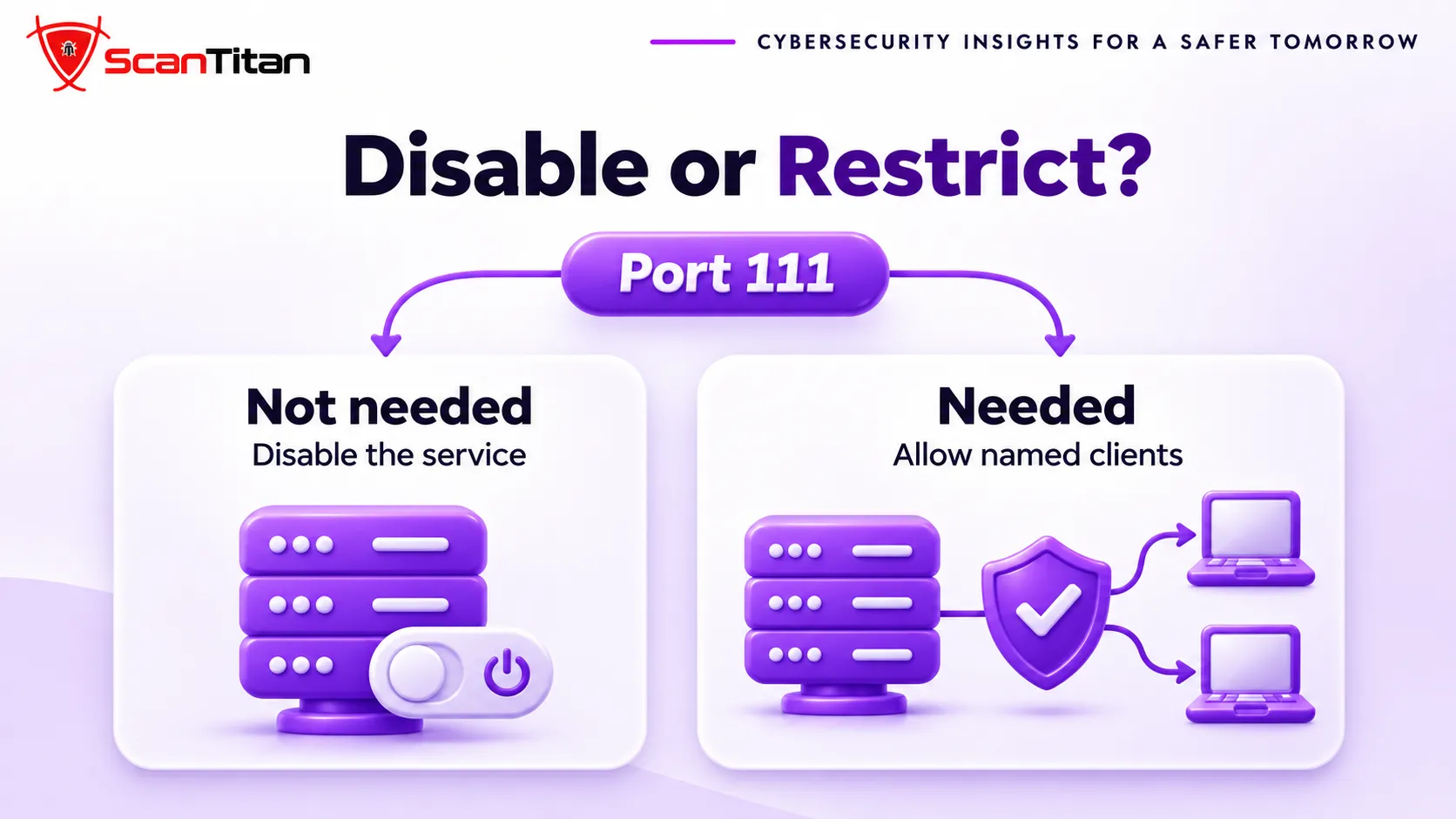
You disable or restrict port 111 by removing rpcbind where nothing depends on it, and by limiting it to named clients where something does.
- Check for NFS mounts and exports with
findmnt -t nfs,nfs4andshowmount -e, and ask application owners. - Stop the service and its socket with
sudo systemctl stop rpcbind.socket rpcbind.serviceif nothing needs them. - Disable both at boot with
sudo systemctl disable rpcbind.socket rpcbind.service. - Mask both units with
sudo systemctl mask rpcbind.socket rpcbind.serviceif another package keeps starting them. - Restrict a service you must keep, for example
sudo ufw allow from 10.0.1.0/24 to any port 111, thensudo ufw deny 111, using your own client range. - Block TCP and UDP 111 at the internet firewall and in cloud security groups.
- Verify with a new outside scan, and test every file mount that matters.
Add the allow rule before the deny rule, because UFW uses the first match. To change the listening address, note that the manual page says the h option is ignored under systemd socket activation, so edit the listen lines in the socket unit instead. This video walks through finding open ports and, in step 6, disabling rpcbind.
How Do Ports 111 and 2049 Work With NFS?
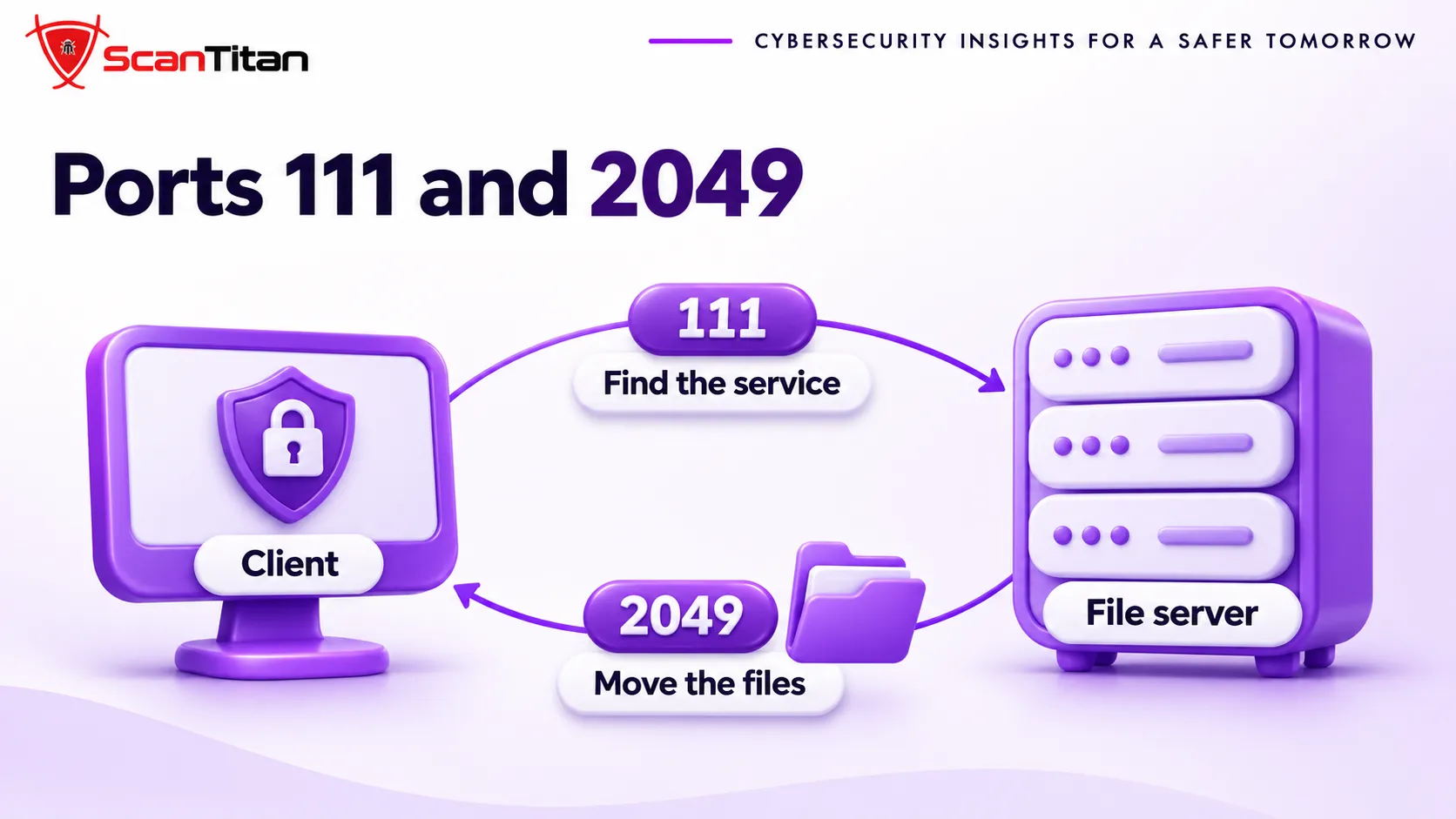
Ports 111 and 2049 work together in NFS version 3, where 111 tells the client where the helper services are and 2049 carries the file traffic.
- Register the NFS helper services with rpcbind when the server starts.
- Ask rpcbind on port 111 for the mount service, which is the client’s first lookup.
- Request the share from the mount service on the port returned in that reply.
- Transfer files over the NFS service, normally on port 2049.
- Coordinate file locks and recovery through the lock and status services, whose ports can also come from rpcbind.
| Port or service | Role | NFSv3 | NFSv4 only |
|---|---|---|---|
| 111 (rpcbind) | Finds RPC services | Needed | Not required |
| 2049 (NFS) | File access | Needed | Needed |
| mountd, statd, lockd | Mounting, status and locking | Needed, ports can be fixed | No separate client connections |
A firewall that allows only 2049 therefore breaks many version 3 mounts. Assign fixed ports to the helper services so that your rules can name them.
Does NFSv4 Need Port 111?
No, NFSv4 does not need port 111, because a version 4 client connects to the server on port 2049 without asking rpcbind for helper ports. Red Hat’s guide to an NFSv4 only server disables version 3 in the NFS configuration and then masks rpcbind and the status service. First confirm that no client still mounts with version 3, since those mounts will stop working. Check each client with nfsstat and the m option, which shows the version in use. Plan a maintenance window, change the server, restart NFS and test mounting from a real client. Keep port 2049 restricted to your own hosts, because removing 111 does not secure the shares themselves.
Port 111 FAQ
What is the difference between port 111 and port 135?
The difference between port 111 and port 135 is the system they serve. Port 111 is the SUN RPC directory used mainly on Linux and Unix, while port 135 is the endpoint mapper for Microsoft RPC on Windows. Neither should face the internet.
Is port 111 safe to leave open?
No, port 111 is not safe to leave open to the internet. It can disclose your RPC services and take part in amplification attacks. On a private network it can be acceptable when specific clients need it and your packages are current.
Can I block port 111 without breaking anything?
Yes, you can block port 111 without breaking anything if no client uses NFSv3, NIS or another RPC service through it. Check mounts and registered programs first, block from the internet at once, then test internal rules in a maintenance window.
Does Windows use port 111?
Windows does not rely on port 111 for its own remote procedure calls, which use port 135. A Windows machine can still listen on 111 when installed software provides NFS, such as the Veeam vPower NFS Service, so check which process owns it.
How do I check what is listening on port 111?
You check what is listening on port 111 with sudo ss -tulnp on Linux, or netstat -ano and findstr :111 on Windows. The Windows search also matches longer numbers such as 1110, so read the local address column carefully.
How do I remove rpcbind completely?
You remove rpcbind completely with your package manager, for example apt remove rpcbind on Debian or Ubuntu. Read the list of packages it plans to remove first, because NFS packages may depend on it, and cancel if anything important appears.
Sources. IANA Service Name and Port Number Registry; rpcbind(8) manual page; CISA, UDP-Based Amplification Attacks; Cyber Swachhta Kendra, exposed portmapper service; NIST, CVE-2017-8779 and CVE-2026-16277; Nmap rpcinfo script; Red Hat, Deploying an NFS server; Veeam, Ports.
Related reading: the port 445 vulnerability, port 3306 and MySQL, what an open port is and the open ports security risk assessment. To find which of your public addresses expose ports like this one, see our network vulnerability scanner.