Joomla vulnerability statistics show two very different security stories in 2026: Joomla core continues to receive coordinated fixes for access-control, authentication, XSS, and file-handling flaws, while third-party extension research has uncovered a concentrated group of critical SQL injection, file-upload, and remote-code-execution vulnerabilities. The numbers below separate Joomla core, extensions, CVE records, and confirmed exploitation so journalists and researchers can cite each statistic with the correct scope and denominator.
Joomla Vulnerability Statistics 2026: Key Findings
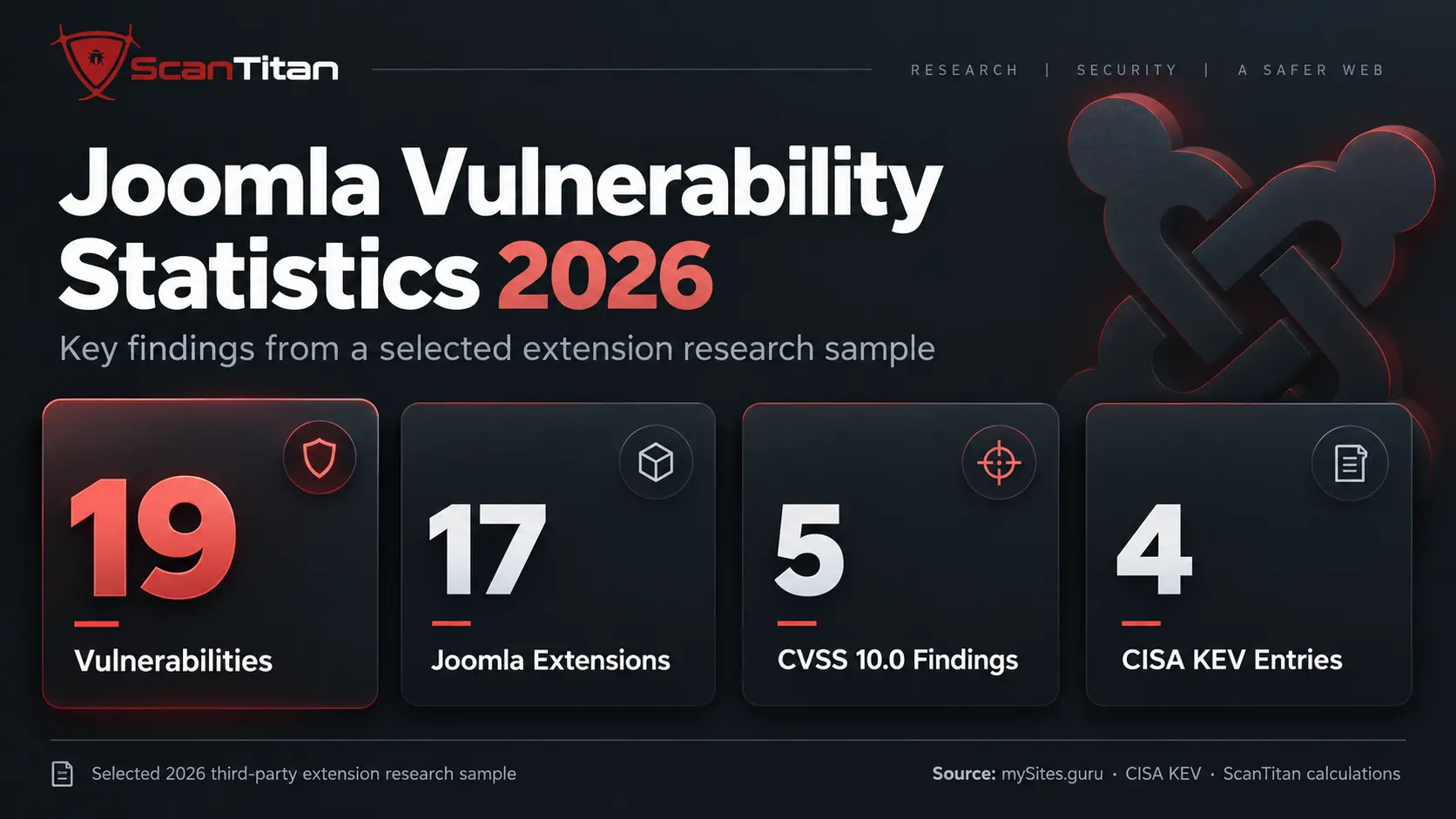
Quick statistics: Independent researchers disclosed 19 vulnerabilities across 17 Joomla extensions in one 2026 research campaign. Of those findings, 47.4% involved file upload leading to RCE or arbitrary file write, 26.3% were unauthenticated SQL injection, and 26.3% received CVSS 10.0 scores. Four of the 19 findings were later added to CISA’s Known Exploited Vulnerabilities catalog.
| Joomla security statistic | 2026 figure | What the number means |
|---|---|---|
| Joomla extension vulnerabilities disclosed in one research campaign | 19 | 19 vulnerabilities across 17 third-party Joomla extensions between mid-June and late July 2026. |
| File upload / RCE-class vulnerabilities | 9 of 19 — 47.4% | Nearly half of the selected extension research sample involved file upload leading to remote code execution or arbitrary file write. |
| Unauthenticated SQL injection vulnerabilities | 5 of 19 — 26.3% | Five findings in the selected extension sample allowed SQL injection without authentication. |
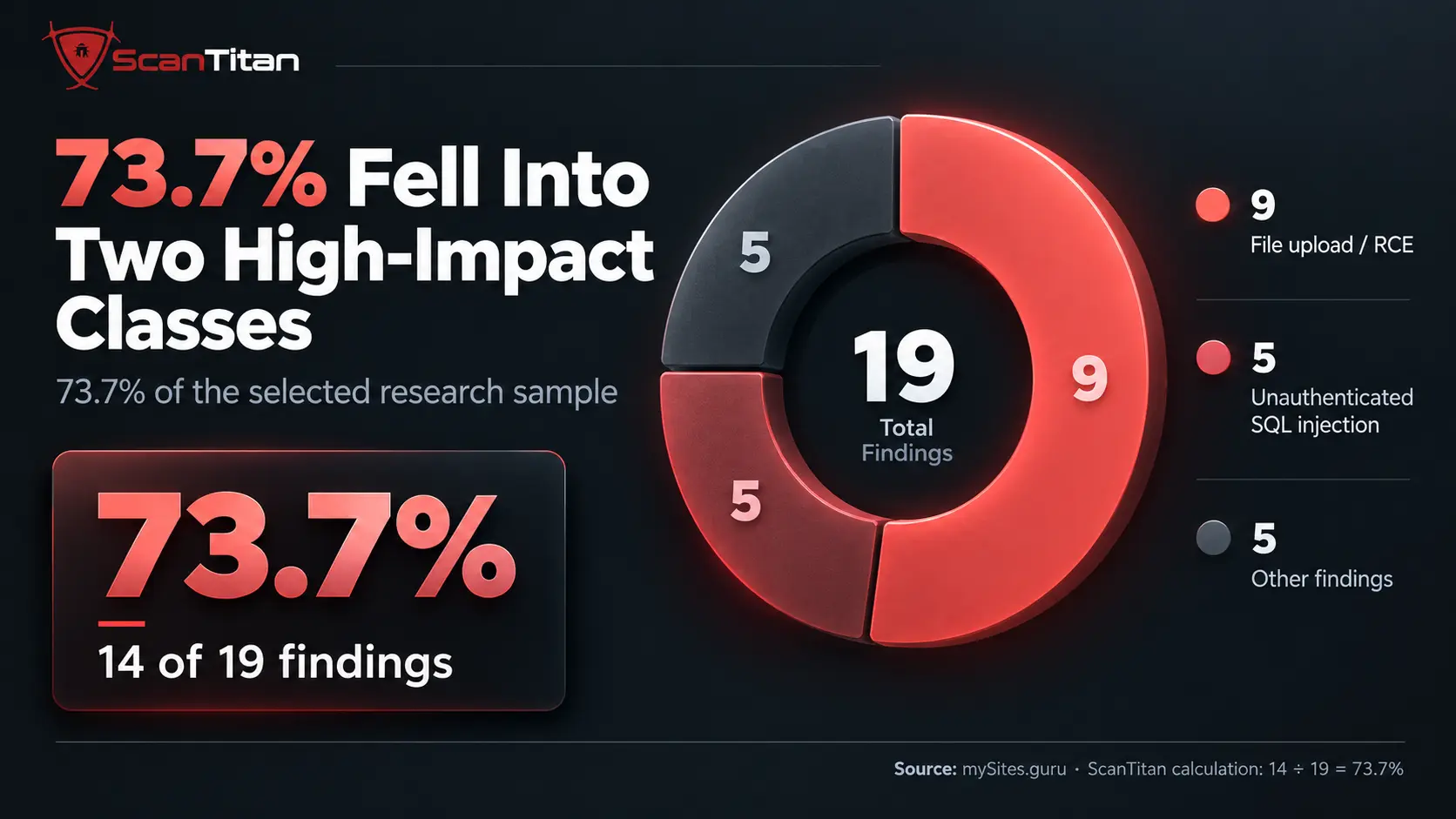
| RCE/file-upload + SQL injection combined | 14 of 19 — 73.7% | ScanTitan calculation showing that almost three quarters of the selected sample fell into these two high-impact vulnerability classes. |
| Maximum-severity CVSS findings | 5 of 19 — 26.3% | Five vulnerabilities in the research sample received CVSS 10.0 scores. |
| Known-exploited vulnerabilities | 4 of 19 — 21.1% | Four findings from the research campaign were later included in CISA’s Known Exploited Vulnerabilities catalog. |
| Joomla security announcements in the expanded research archive | 54+ | The research archive had expanded beyond the original 19 findings to more than 50 Joomla security announcements by late August 2026. |
| Major Joomla core MFA bypass | CVE-2026-73337 | Affected Joomla 4.0.0–5.4.7 and 6.0.0–6.1.2 before being fixed in Joomla 5.4.8 and 6.1.3. |
| Joomla core dangerous-file upload vulnerability | CVE-2026-73373 | A dangerous SHTML upload issue affecting Joomla versions dating back to the 1.x branch under relevant server configurations. |
Sources:
mySites.guru vulnerability research,
Joomla Security Centre,
and
CISA Known Exploited Vulnerabilities Catalog.
Important context for citing these numbers: the 19-vulnerability dataset is a selected third-party Joomla extension research sample, not the total number of Joomla vulnerabilities disclosed in 2026. Joomla core vulnerabilities, third-party extension vulnerabilities, CVE database records, and known-exploited vulnerabilities are measured separately throughout this report.
How Many Joomla Vulnerabilities Are There?
There is no single defensible number for “all Joomla vulnerabilities” unless the dataset is defined first. A search of the National Vulnerability Database can return CVEs mapped through a Joomla CPE, but that measures records associated with the selected Joomla product definition. Joomla’s own Security Centre tracks resolved issues in Joomla CMS, Joomla Framework, and Joomla-operated infrastructure. Independent extension databases then add vulnerabilities found in third-party components, modules, plugins, templates, and frameworks. These datasets overlap in places but are not interchangeable.
That is why this report does not add an NVD total, Joomla advisory total, and extension-database total together. Doing so would create duplicates and mix different software scopes. The same methodological issue appears throughout our broader Vulnerability Statistics research: a CVE disclosure, a vendor advisory, a database record, and a known-exploited vulnerability are different measurements.
Four Different Questions Produce Four Different Joomla Counts
| Question | Best source |
|---|---|
| How many security flaws has Joomla officially fixed? | Joomla Security Centre |
| How many standardized Joomla CVEs exist? | CVE.org / NVD |
| How many vulnerabilities exist in Joomla extensions? | Extension-specific vulnerability databases and researchers |
| Which Joomla vulnerabilities are confirmed exploited? | CISA KEV plus primary exploitation research |
A page claiming one absolute Joomla vulnerability total without explaining these differences should be treated cautiously.
Joomla Core Vulnerabilities in 2026
The official Joomla Security Centre shows that 2026 has not been a quiet year for the CMS core. The August 18 security release alone addressed multiple vulnerability classes affecting current Joomla 5 and 6 branches. These included incorrect access control, authentication bypass, cross-site scripting, CORS validation problems, response-header injection, and an unsafe file-upload condition.
CVE-2026-73373: Unrestricted SHTML File Upload
Joomla classified CVE-2026-73373 as an Unrestricted Upload of File with Dangerous Type issue. The default dangerous-file list did not include SHTML, meaning an affected server configured to execute SHTML could potentially turn the upload into code execution. The advisory affected Joomla CMS versions 1.0.0 through 5.4.7 and 6.0.0 through 6.1.2. Joomla fixed the issue in versions 5.4.8 and 6.1.3. Joomla rated the impact High but the severity and probability Low, illustrating why impact and exploitability should not be collapsed into one number.
CVE-2026-73337: MFA Authentication Bypass
CVE-2026-73337 involved insufficient state checks that could allow an attacker to bypass two-factor authentication checks. It affected Joomla 4.0.0 through 5.4.7 and Joomla 6.0.0 through 6.1.2 before being fixed in 5.4.8 and 6.1.3. Joomla assigned High impact, Moderate severity, and Moderate probability. Authentication vulnerabilities deserve particular attention because Joomla’s built-in MFA is one of its strongest defensive controls. A weakness that affects the enforcement of that control can matter more operationally than a generic medium-severity bug.
CVE-2026-48898: Privilege Escalation
CVE-2026-48898 was a Joomla core privilege-escalation flaw in the com_users batch task. Joomla rated both its impact and severity High, though exploitation probability was Low. The issue affected Joomla 4.0.0 through 5.4.5 and 6.0.0 through 6.1.0 and was fixed in Joomla 5.4.6 and 6.1.1.
The common thread among these disclosures is not that Joomla is uniquely insecure. It is that even a mature CMS continues to find and fix authorization, state-management, input-validation, and file-handling mistakes.
Access Control Is One of Joomla Core’s Most Visible 2026 Themes
Authorization and access-control mistakes appear repeatedly in Joomla’s 2026 advisories. The July security batch included CVE-2026-48958 in com_fields, CVE-2026-48957 in com_privacy, CVE-2026-48956 in com_modules, CVE-2026-48955 in workflow functionality, CVE-2026-48948 in contact exports, and CVE-2026-48947 affecting media webservice behavior. Joomla classified all of these under incorrect access control.
The August release continued the pattern. CVE-2026-72531 affected custom-fields webservice endpoints, while CVE-2026-72532 affected category webservices. CVE-2026-71574 involved inconsistent ACL checks on mutating webservice endpoints, allowing operations through the API that were restricted in the backend UI.
What the pattern means: a permission model is only as strong as every endpoint that enforces it. When a backend interface blocks an operation but an API route fails to apply the same policy, the API can become the weaker path.
Joomla Webservice Vulnerabilities Deserve Their Own Category
Several 2026 advisories specifically involve Joomla webservice endpoints. CVE-2026-48958 allowed unauthorized users to create custom fields through webservices, while CVE-2026-72531 concerned similar ACL failures affecting custom-field endpoints. CVE-2026-71574 addressed inconsistent ACL checks for mutating API operations.
The pattern matters because a CMS no longer exposes only conventional page requests. Modern Joomla installations can expose API functionality used by applications, integrations, automation, and administrative tooling. Historically, Joomla has already seen the consequences of webservice access-control failures. ScanTitan’s existing assessment of whether Joomla is secure discusses CVE-2023-23752, a Joomla 4 webservice information-disclosure flaw that became a major real-world exploitation case.
The 2026 data therefore supports a broader conclusion: API and webservice permissions should be treated as part of the Joomla attack surface rather than as a separate security discipline.
Cross-Site Scripting Remains Common in Joomla Core
Cross-site scripting also appears repeatedly in the 2026 Joomla Security Centre feed. The July batch included XSS vulnerabilities affecting language overrides, generic image output, com_installer, modal-return layouts, com_templates, and MFA management interfaces. CVE-2026-48954, for example, involved improper validation in the language-override feature. Joomla rated its impact and severity Moderate and its probability Low.
The May disclosures also included framework-level content-filtering problems, including CVE-2026-48905 and CVE-2026-48903. August added CVE-2026-73336 affecting schema.org output.
XSS is often dismissed because many individual findings do not score as Critical. That is too simplistic. A CMS administrator operates with privileges that can modify templates, install extensions, manage users, and change configuration. An XSS flaw that executes in a privileged administrator context can therefore become part of a more serious attack chain.
Joomla Core vs Joomla Extensions: The Most Important Distinction
The biggest mistake in Joomla vulnerability statistics is treating a vulnerable extension as evidence of a Joomla core defect. Third-party extensions execute inside Joomla, often with substantial access to the database, file system, user sessions, uploads, and administrative functions. But the extension vendor controls that code, not the Joomla core project.
This difference becomes very obvious in 2026. Official Joomla core advisories frequently involve incorrect access control, XSS, MFA and authentication logic, privilege escalation, webservices, content filtering, and configuration or header handling. The independent extension research collected by mySites.guru instead uncovered a heavy concentration of unauthenticated file upload, remote code execution, SQL injection, authentication bypass, arbitrary file write, and sensitive-data exposure.
That does not prove Joomla extensions as a whole are more dangerous than core. The extension research was targeted rather than random. But it does demonstrate that the observed vulnerability profiles are materially different and should not be merged into one undifferentiated Joomla total. A useful analogy appears in ScanTitan’s WordPress Plugin Vulnerability Statistics research, where plugin vulnerabilities are separated from WordPress core because they represent a different ownership and attack-surface layer.
Joomla Extension Vulnerability Statistics
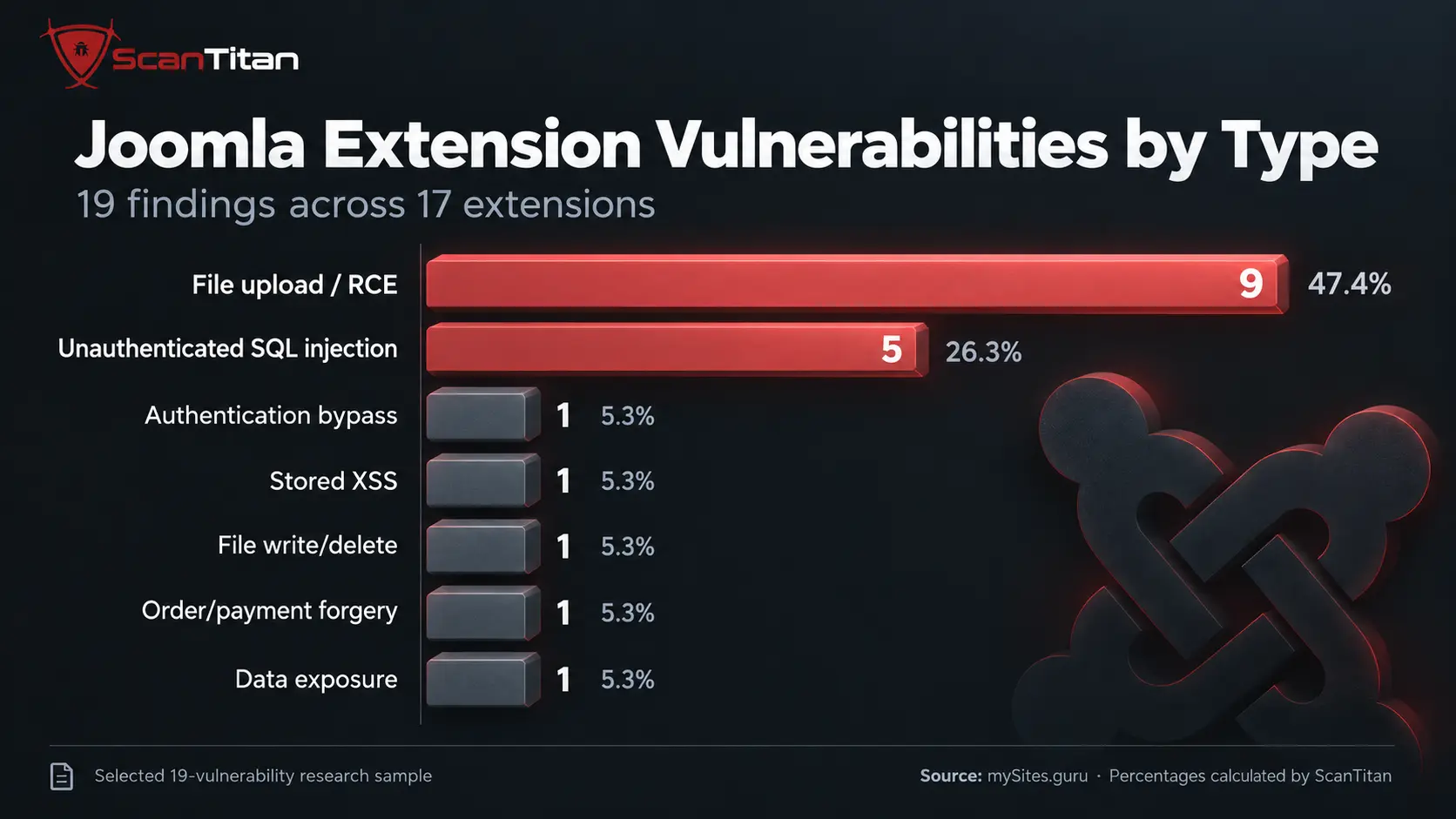
Between mid-June and late July 2026, mySites.guru reported finding 19 separate vulnerabilities across 17 popular Joomla extensions.
| Vulnerability class | Findings | Share of 19 |
|---|---|---|
| File upload leading to RCE or arbitrary write | 9 | 47.4% |
| Unauthenticated SQL injection | 5 | 26.3% |
| Authentication bypass to Super User | 1 | 5.3% |
| Unauthenticated write leading to stored XSS | 1 | 5.3% |
| File write/delete | 1 | 5.3% |
| Order/payment forgery | 1 | 5.3% |
| Cross-customer order/invoice disclosure | 1 | 5.3% |
| Total | 19 | 100% |
The percentages above are ScanTitan calculations from the researcher’s published 19-vulnerability sample. They should not be generalized to the entire Joomla extension ecosystem.
Two findings stand out. First, 9 of 19, or about 47.4%, were file-upload flaws leading to remote code execution or arbitrary file write. Second, another 5 of 19, or 26.3%, were unauthenticated SQL injection. Combined, 14 of 19 findings, or 73.7%, fell into those two high-impact classes.
Why the 19-Vulnerability Sample Should Not Be Treated as Ecosystem Prevalence
Do not cite this as “47% of Joomla vulnerabilities are RCE.” The 47.4% figure applies only to the selected 19-vulnerability mySites.guru research sample.
mySites.guru intentionally investigated popular Joomla extensions and was actively looking for security bugs. The sample is therefore affected by researcher selection, extension selection, testing methodology, and disclosure timing.
The statistically valid statement is: In mySites.guru’s 19-vulnerability research sample from mid-June through late July 2026, nine findings, or 47.4%, were file-upload flaws capable of leading to remote code execution or arbitrary file write.
This distinction is especially important because the same researcher later expanded its Joomla security archive considerably. The current vulnerability database tracks many more rules and CVEs across extensions, and the original roundup now references 54 security announcements, meaning the initial 19 are a research snapshot rather than a complete current total.
Critical Joomla Extension Vulnerabilities in 2026
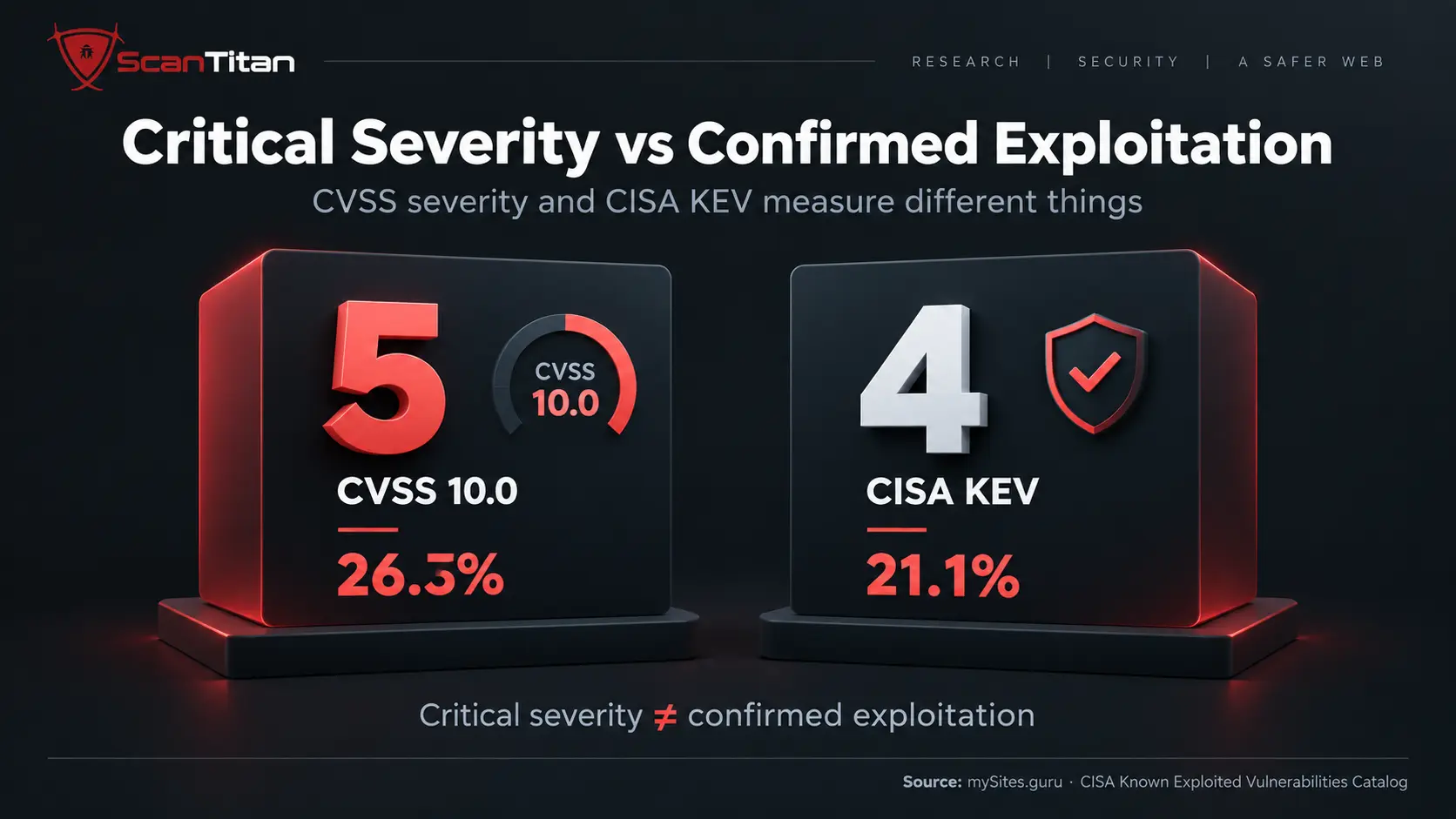
Five of the original 19 extension findings received the maximum CVSS 4.0 score of 10.0 according to the researcher. Examples included unauthenticated upload-to-RCE issues affecting RSFiles! (CVE-2026-57827), Balbooa Forms (CVE-2026-56291), PageBuilder CK (CVE-2026-56290), and SP Page Builder (CVE-2026-48908).
The significance is not simply that the CVSS number is high. These flaws combine several characteristics attackers value: no authentication requirement, remote reachability, straightforward request paths, and the ability to write or execute content on the server.
Since the original roundup, additional critical extension issues have continued to appear. mySites.guru reports further findings affecting products including Gridbox, Fabrik, SP Page Builder, ZOO, YOOtheme, J2Store/J2Commerce, Page Builder CK, and others.
Joomla Vulnerabilities Exploited in the Wild
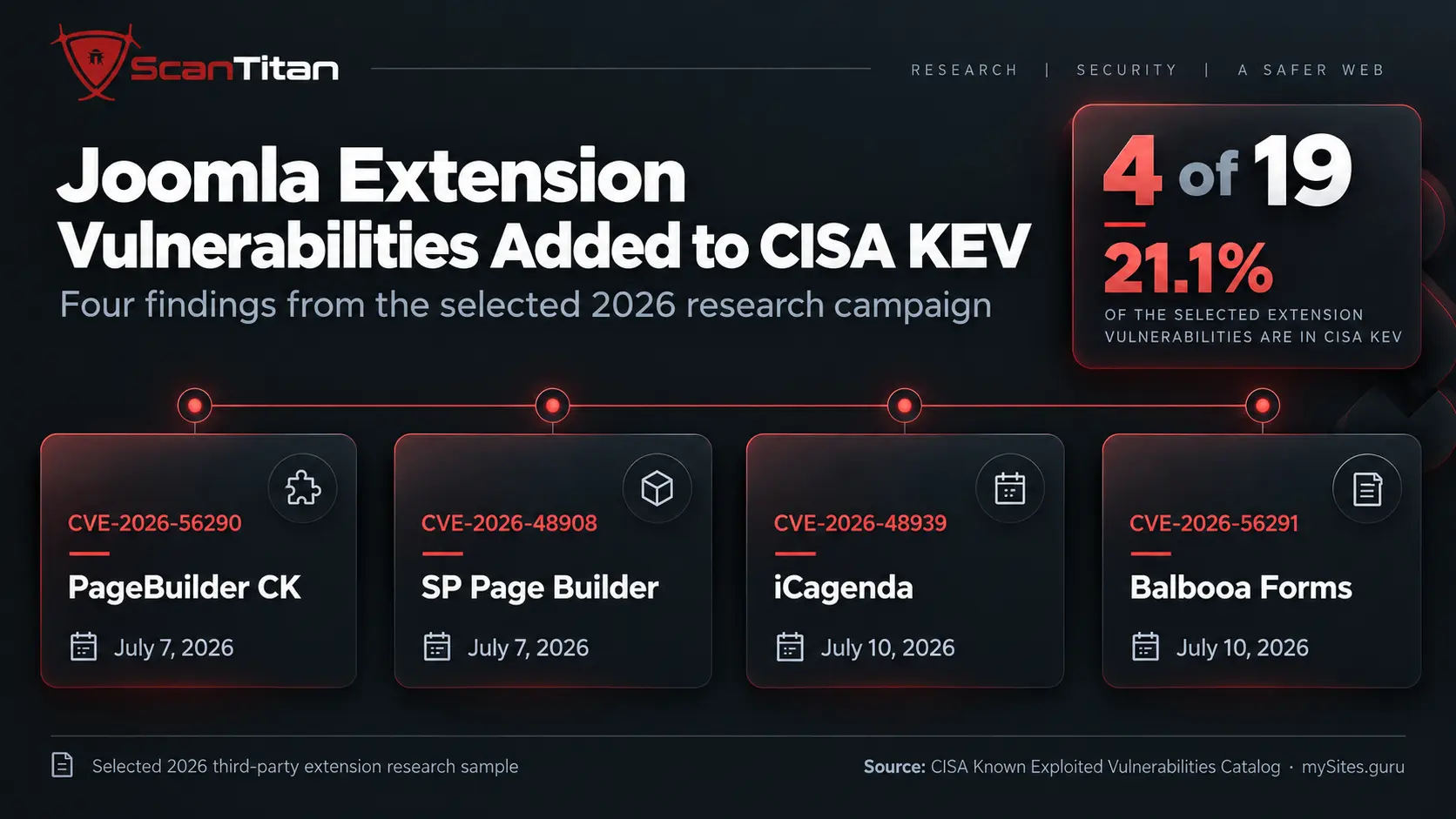
The gap between a disclosed vulnerability and a genuinely exploited vulnerability is one of the most important distinctions in security statistics. Four findings from mySites.guru’s 2026 research campaign were subsequently included in CISA’s Known Exploited Vulnerabilities catalog.
| CVE | Joomla extension | CISA KEV addition |
|---|---|---|
| CVE-2026-56290 | PageBuilder CK | July 7, 2026 |
| CVE-2026-48908 | SP Page Builder | July 7, 2026 |
| CVE-2026-48939 | iCagenda | July 10, 2026 |
| CVE-2026-56291 | Balbooa Forms | July 10, 2026 |
CISA KEV inclusion is qualitatively different from a CVSS score. CVSS estimates technical severity. KEV indicates that exploitation has been observed and confirmed sufficiently for CISA to add the vulnerability to its remediation catalog.
In this sample, 4 of 19, or about 21.1%, reached KEV. Again, that percentage applies only to the selected research sample, not to all Joomla vulnerabilities.
The Joomla Patch-to-Exploit Window Can Be Very Short
Some 2026 extension incidents show attackers moving almost immediately after patches or public visibility. According to mySites.guru, PageBuilder CK exploitation was observed within hours of a fix becoming available, while iCagenda and SP Page Builder activity was detected in live access logs.
When the window is measured in days, a monthly manual review is too slow. A website scanner running continuously is what closes that gap.
This produces a practical Joomla security lesson: a patch being available does not mean defenders have a long period to deploy it. Automated attackers can monitor releases, diff extension code, read CVE feeds, and scan internet-facing Joomla sites shortly after a vulnerability becomes recognizable.
That makes extension inventory and version detection much more important than manually reading advisory feeds. A team cannot prioritize a new Joomla vulnerability if it does not know whether the vulnerable extension is installed.
SQL Injection in Joomla Extensions
SQL injection represented 5 of the 19 findings, or 26.3%, in the selected mySites.guru sample. Reported examples affected extensions including DPCalendar, EDocman, Quix Page Builder, and AcyMailing, with some findings allowing unauthenticated database access.
SQL injection remains especially dangerous in a CMS because the same database can contain user accounts, password hashes, session data, configuration data, extension settings, personal information, ecommerce records, and API credentials or tokens stored by extensions.
The actual impact therefore depends on both the SQL injection primitive and the data available to the Joomla database user. A vulnerability that allows an anonymous request to extract arbitrary database rows can become the starting point for credential theft, account takeover, privacy exposure, or a chained compromise.
File Upload and Remote Code Execution Are the Standout Extension Risk
The strongest signal from the selected extension research is file handling. Nine of the 19 original findings involved file-upload behavior leading to remote code execution or arbitrary file write. That is nearly half of the sample.
- Trusting file extensions
- Incomplete MIME validation
- Exposing upload endpoints without authentication
- Storing uploads in executable locations
- Checking login without checking authorization
- Leaving development or test endpoints accessible
- Allowing dangerous file types
- Failing to generate unpredictable filenames
The final outcome can be similar: an attacker places a file on the server and then reaches it through the web. This is particularly severe on conventional PHP hosting because a single uploaded PHP webshell can turn an application vulnerability into persistent server-level control.
Joomla core’s CVE-2026-73373 shows that dangerous file handling is not purely an extension problem either. The core advisory concerned SHTML files omitted from the dangerous-file list, although Joomla rated actual exploitation probability Low because server configuration determines whether SHTML execution is possible.
Authentication and Privilege Escalation Matter More Than Raw Counts
The 2026 Joomla data also contains several vulnerabilities that target trust boundaries rather than input parsing. In core, Joomla fixed MFA bypass issues and privilege escalation. CVE-2026-73337 allowed bypassing 2FA state checks, while CVE-2026-48898 affected privilege handling in com_users.
In extensions, researchers found authentication-bypass paths capable of producing Super User access. One Gridbox vulnerability was described as allowing an unauthenticated attacker to become a Super User by manipulating a cookie; later research into Gridbox uncovered a much larger batch of issues, including critical findings.
These bugs show why “requires no authentication” is one of the most important pieces of context alongside CVSS. A vulnerability that grants administrator access before login can remove the need to chain several weaker issues together.
Joomla Vulnerabilities by Version
Version ranges in Joomla advisories also reveal a structural risk: some flaws span multiple major branches. CVE-2026-73373 reached back to Joomla 1.0.0 in the affected range. CVE-2026-73337 affected Joomla 4, 5, and 6 branches. CVE-2026-71572 affected Joomla 3 through current branches. Several 2026 XSS and ACL flaws affected Joomla 3, 4, 5, and 6-era code paths.
But an affected-version label does not mean every old branch receives a new patch. That is where support status matters. ScanTitan’s Joomla security review identifies Joomla 3 as end of life since August 2023 and Joomla 4 as end of life since October 2025, while Joomla 5 remains maintained and Joomla 6 is the current line.
An end-of-life site creates a different risk profile because finding a vulnerability is no longer followed by the normal expectation of an official fix for that branch.
Unsupported Joomla Versions Turn Vulnerability Management Into Migration
Running an unsupported Joomla branch changes the nature of the remediation problem. For a current Joomla 5 or 6 installation, a core advisory generally leads to a conventional response: identify, test, update, and verify. For an end-of-life Joomla 3 or 4 site, the same process may end with no supported patch.
That converts vulnerability management into a migration decision. This distinction is particularly relevant for extensions. Some extension vendors backport security fixes to old Joomla branches, others support only current releases, and others may have abandoned older code entirely.
A site can therefore be exposed in two different ways: core lifecycle risk from running an unsupported Joomla version, and extension lifecycle risk from running an unsupported component even on a current Joomla core. Those risks should be assessed independently.
Does the 2026 Data Mean Joomla Is Insecure?
No single vulnerability count can support that conclusion. A mature platform with a functioning disclosure process will accumulate CVEs because researchers are finding and reporting flaws. A platform with fewer published vulnerabilities may be safer, or it may simply receive less research.
The 2026 Joomla data actually shows both sides of the security model. The core continues to receive coordinated fixes through the Joomla Security Strike Team, including fixes across Joomla 5 and 6. At the same time, the extension ecosystem contains independently developed code with very different security maturity, and 2026 research has uncovered serious unauthenticated RCE, SQL injection, authentication bypass, and data-exposure flaws.
Best interpretation: a current Joomla core has an active security-maintenance process, but the security of a real Joomla site depends heavily on its extensions, version lifecycle, exposed webservices, authentication configuration, and patch speed.
Joomla vs WordPress Vulnerability Statistics
Raw vulnerability totals between Joomla and WordPress are particularly easy to misuse because the ecosystems differ enormously in size and data coverage. ScanTitan’s WordPress plugin research cites more than 42,000 cataloged WordPress vulnerabilities in Patchstack’s database and attributes the overwhelming majority to plugins. That does not automatically mean WordPress is thousands of times less secure than Joomla.
The Joomla extension ecosystem is smaller and its vulnerability databases do not have identical collection methodology. A better comparison asks what proportion sits in core vs third-party code, how many vulnerabilities require authentication, how many are exploitable remotely, how quickly vulnerabilities are fixed, how many reach confirmed exploitation, and how many affected sites remain on unsupported versions.
The same counting principle is visible in ScanTitan’s WooCommerce Vulnerability Statistics research, where WooCommerce core records differ substantially across Wordfence, Patchstack, WPScan, and CVE-oriented datasets because the databases use different counting rules.
Joomla Vulnerability Statistics You Should Stop Citing Without Context
“Joomla has X vulnerabilities.”
Not useful unless the source, date, scope, and counting methodology are named.
“19 Joomla vulnerabilities were found in one month.”
Too broad. The accurate statement is that one research campaign found 19 vulnerabilities across 17 selected third-party Joomla extensions over roughly five weeks.
“47% of Joomla vulnerabilities lead to RCE.”
Incorrect. The 47.4% figure applies only to nine upload/RCE-class findings within that selected 19-vulnerability research sample.
“A CVSS 10 vulnerability is definitely being exploited.”
CVSS measures severity characteristics, not observed exploitation.
“A vulnerability in a Joomla extension is a Joomla core vulnerability.”
False. Third-party extension flaws and Joomla CMS core flaws should be separated.
“Joomla has fewer CVEs than WordPress, therefore it is more secure.”
Unsupported without normalizing ecosystem size, research coverage, deployment, database methodology, and third-party software scope.
Good statistics answer what the number measures before explaining what the number means.
What Joomla Site Owners Should Take From the Data
The statistics point to a relatively simple priority order. The first question is whether the site runs a supported Joomla core. The second is which third-party extensions are installed and whether each version has a known vulnerability. The third is whether exposed APIs, webservices, upload endpoints, and administrative functionality enforce the same authorization model expected in the user interface.
The fourth is exploitation status. A known-exploited vulnerability affecting an installed extension should generally outrank a large backlog of theoretical findings that do not apply to the actual site.
That is where a Joomla vulnerability scanner becomes useful: the purpose is not to produce the largest vulnerability count, but to match the Joomla core, extensions, templates, exposed endpoints, and known vulnerability records to the specific installation.
Methodology
Joomla Core and Framework
Core vulnerability details are taken from the Joomla Security Centre, which publishes resolved security issues for Joomla CMS and Framework releases. We use the exploit type, affected versions, impact, severity, probability, report date, fix date, and CVE identifier supplied by Joomla.
Third-Party Extensions
The detailed 19-vulnerability sample comes from mySites.guru’s 2026 research campaign. Percentages in this report are ScanTitan calculations based on the researcher’s published categorization: 9 upload/RCE or arbitrary-write findings, 5 unauthenticated SQL injection findings, 5 findings across other classes, and 19 total findings. Those proportions describe that sample only and are not extrapolated to the entire Joomla ecosystem.
CVE and NVD Data
CVE and NVD records are treated as standardized vulnerability records rather than as an authoritative count of all Joomla ecosystem weaknesses. NVD/CPE matching and Joomla advisories have different scope and may not produce identical totals.
Exploitation
CISA Known Exploited Vulnerabilities status is treated separately from vulnerability severity. KEV inclusion indicates evidence of exploitation, while CVSS measures technical characteristics.
Date Sensitivity
Extension vulnerability databases and disclosure archives continue to change. The mySites.guru roundup began with 19 findings but its security archive has expanded substantially, including more than 50 announcements by late August 2026. Any live database total should therefore be date-stamped rather than presented as permanent.
Joomla Vulnerability Statistics FAQ
How many Joomla vulnerabilities are there?
There is no single authoritative total because different sources measure different scopes. Joomla’s Security Centre covers Joomla CMS, Framework, and Joomla infrastructure issues, while NVD/CVE databases use standardized vulnerability records and third-party databases track Joomla extension vulnerabilities. Adding those totals together would risk both scope mixing and duplicate counting.
What are the most common Joomla vulnerabilities?
In Joomla core’s 2026 advisories, incorrect access control and cross-site scripting appear repeatedly, alongside authentication bypass, privilege escalation, webservice authorization failures, and unsafe uploads. In a separate 19-vulnerability third-party extension research sample, file-upload/RCE flaws accounted for 9 findings and unauthenticated SQL injection for 5. The two datasets should not be treated as the same population.
Are Joomla extensions more vulnerable than Joomla core?
The available 2026 evidence shows that serious extension vulnerabilities are an important attack surface, but it does not provide a statistically complete denominator that would let us claim all extensions are more vulnerable than core. The independent research sample contained multiple unauthenticated RCE and SQL injection flaws, while Joomla core advisories were more heavily represented by XSS and access-control issues.
How many critical Joomla extension vulnerabilities were found in 2026?
One mySites.guru campaign disclosed 19 vulnerabilities across 17 extensions between mid-June and late July 2026, with five receiving CVSS 10.0 scores. The researcher continued finding additional vulnerabilities afterward, so five should not be interpreted as the total number of critical Joomla extension vulnerabilities for the entire year.
Which Joomla vulnerabilities were actively exploited in 2026?
Four findings from the 19-vulnerability extension campaign were added to CISA’s Known Exploited Vulnerabilities catalog: CVE-2026-56290 in PageBuilder CK, CVE-2026-48908 in SP Page Builder, CVE-2026-48939 in iCagenda, and CVE-2026-56291 in Balbooa Forms.
Is Joomla 3 secure in 2026?
Joomla 3 is end of life and no longer receives normal official security maintenance. ScanTitan’s Joomla security assessment lists Joomla 3 support as ended in August 2023 and Joomla 4 as ended in October 2025. Sites on unsupported branches should treat migration as a security requirement rather than assuming every new issue will receive a branch-specific fix.
Does a Joomla CVE mean my site is vulnerable?
Not necessarily. Exposure depends on the affected Joomla or extension version, installed software, endpoint accessibility, configuration, authentication requirements, and sometimes server behavior. A CVE identifies a vulnerability record; it does not prove that every Joomla installation is exploitable.
What is the best way to check a Joomla site for known vulnerabilities?
Inventory the Joomla core version and every installed component, module, plugin, and template, then compare those versions with current vulnerability and exploitation data. ScanTitan’s Joomla scanner performs core and extension checks and reports unsupported branches so known vulnerabilities can be mapped to the actual installation rather than assessed generically.
The Data Points to Extension Visibility, Not Panic
The strongest conclusion from the 2026 Joomla vulnerability statistics is not that Joomla suddenly became unsafe. It is that risk is distributed across layers. Joomla’s Security Strike Team continues to patch the core, including significant access-control, authentication, XSS, and upload issues. Meanwhile, independent researchers are finding highly exploitable vulnerabilities in popular third-party extensions, including flaws that reached CISA’s Known Exploited Vulnerabilities catalog within days of disclosure.
For defenders, the useful security question is not “How many Joomla vulnerabilities exist?” but “Which vulnerable Joomla code is running on this site, and which of those vulnerabilities is actually exploitable or already being exploited?”
That is the measurement that matters.