

VPN vulnerabilities make up 79 of the 1,769 entries (4.5%) in CISA’s Known Exploited Vulnerabilities catalog, by ScanTitan’s count of entries whose description names a VPN or a remote-access VPN product, and CISA flags 49.4% of them as used in ransomware campaigns, against 19.1% of other entries. The share is rising slowly, from 3.6% of the entries added in 2021 and 2022 to 5.3% since 2023, and 6.0% of 2026 additions, while the speed of listing has changed sharply: for entries added since 2023, the median VPN flaw was listed 0 days after its CVE was published, against 20 days for other entries. Three vendors account for 50 of the 79 entries (Citrix 18, Ivanti 17 and SonicWall 15). Most pages on this topic explain VPN risk in general terms or repeat one Verizon figure. This research counts the exploited catalog, labels vendor figures, and says where a popular number does not hold up. Data last checked: 24 November 2026.
Key VPN Vulnerability Statistics for 2026
Executive Benchmark: VPN Vulnerabilities in 2026
| Metric | Latest figure | Period | Trend / context | Source |
|---|---|---|---|---|
| CISA catalog entries that name a VPN | 4.5% (79 of 1,769) | Added 2021 to 6 Nov 2026 | 50 are SSL VPN gateways, 24 firewalls, 3 routers and 2 clients | CISA KEV feed, counted by ScanTitan |
| VPN entries added per year | 17 | 2026 to 6 Nov | 13 in 2025, 11 in 2024, 7 in 2023, 14 in 2022, 17 in 2021 | CISA KEV feed, counted by ScanTitan |
| VPN share of each year’s additions | 6.0% (17 of 285) | 2026 to 6 Nov | 3.6% in 2021 and 2022, 5.3% since 2023 | CISA KEV feed, counted by ScanTitan |
| VPN entries flagged as used in ransomware | 49.4% (39 of 79) | Added 2021 to 6 Nov 2026 | 19.1% (322 of 1,690) of other entries | CISA KEV feed, counted by ScanTitan |
| Median days from CVE publication to CISA listing | 0 | Added 2023 to 6 Nov 2026 | 20 days for other entries, 585 days for VPN entries added in 2021 and 2022 | CISA KEV feed and CVE Services API, counted by ScanTitan |
| Edge devices and VPNs as the target in exploitation breaches | 22% | Verizon 2025 report | 3% the year before; 54% of those flaws were fully fixed, with a median of 32 days | Verizon DBIR |
| VPN access share of initial-access-broker offers | 44% (of 876 offers) | Four years, Verizon 2026 report | Remote desktop access close behind | Verizon 2026 DBIR |
| Median days to fully remediate CISA-listed exploited flaws | 43 | 2025 | 32 days and 38% fully remediated in the prior dataset, against 26% in 2025 | Verizon 2026 DBIR |
| Exploited edge device flaws that appear in CISA’s catalog | 23.7% | VulnCheck, 2025 exploitation | The 79 here is a floor, not the whole picture | VulnCheck, vendor-only |
| Exploited edge device flaws on end-of-life or likely end-of-life products | 42.5% | VulnCheck, 2025 exploitation | 65% of flaws exploited by botnets | VulnCheck, vendor-only |
| CISA directive on unsupported edge devices | BOD 26-02 | Issued 5 Feb 2026 | Federal agencies must inventory and remove end-of-support edge devices | CISA |
Methodology: What Counts as a VPN Vulnerability
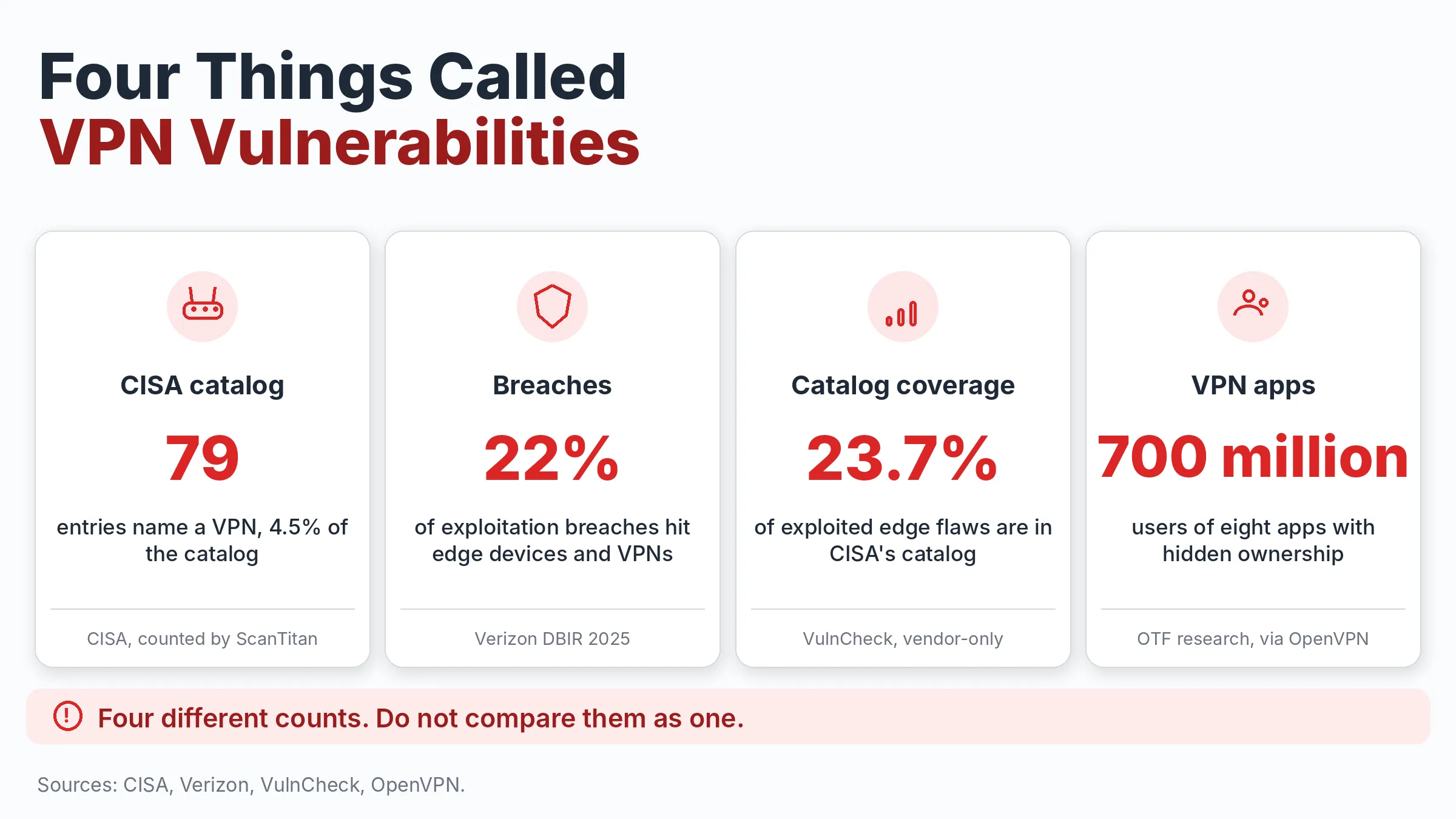
“VPN vulnerabilities” is used for four different things. Each answers a different question, and mixing them is the most common way to quote a wrong number.
| Count | What it matches | Example 2026 figure | Source type | What it cannot tell you |
|---|---|---|---|---|
| Exploited VPN flaws in CISA’s catalog | Entries whose name, product or description names a VPN or VPN product | 79 entries, 4.5% | Government catalog, counted by ScanTitan | Flaws that were exploited but never listed, or listed without the word VPN |
| Edge devices and VPNs in breaches | Breaches that began with an exploited vulnerability and hit an edge device or VPN | 22% | Verizon incident data | How many distinct flaws, or which vendors |
| Exploited edge flaws that reach the catalog | VulnCheck’s list of exploited edge flaws that CISA also lists | 23.7% | Vendor research | VPN only, since edge includes routers and firewalls |
| Consumer VPN app risks | Hidden ownership and logging by VPN app providers | Eight apps, 700 million users | Advocacy research quoted by a VPN vendor | Anything about gateway flaws |
Rule used in this report. An entry counts when CISA’s vulnerability name, product field or description contains “VPN” or “virtual private network”, or names a remote-access VPN product line: Ivanti Connect Secure and Pulse Connect Secure, Citrix NetScaler Gateway, SonicWall SMA and Secure Remote Access, Cisco AnyConnect, Palo Alto GlobalProtect or Array Networks AG. We removed 3 matches that are not remote-access VPN flaws: a Cisco IOS XE Ethernet VPN routing protocol flaw, a Cisco IOS module for VPN and a Cisco IOS GET VPN flaw. That leaves 79 entries.
What the rule misses. CISA often describes a firewall flaw without saying VPN. Fortinet has 32 catalog entries and only 6 meet the rule, because most FortiOS descriptions name the operating system and not the SSL VPN service. Treat vendor counts as a floor.
Where the data comes from. The CISA Known Exploited Vulnerabilities feed, version 2026.11.06, holds 1,769 entries. CVE publication dates come from the CVE Services API. ScanTitan’s own CISA KEV catalog guide explains the catalog. “Others” means the 1,690 entries that do not meet the rule.
How Many Exploited Flaws Are VPN Vulnerabilities?
By the rule above, 79 of 1,769 entries (4.5%) are VPN vulnerabilities, so about 1 in 22 flaws on the exploited list. All 79 carry a weakness tag, so no entry was left out for missing data.
The headline figures from other sources measure something else:
- Verizon’s 22% is a share of breaches that began with an exploited vulnerability, not a share of flaws.
- VulnCheck’s 23.7% means only about a quarter of the exploited edge device flaws it tracks are in CISA’s catalog, so the true number of exploited VPN flaws is larger than 79.
- The catalog only lists flaws CISA has evidence for and a clear fix for, so it favors well-known vendors with public advisories.
Read the 79 as the VPN flaws that were exploited and confirmed, not as every VPN flaw that has ever been attacked.
Gateways, Firewalls, Routers and Clients: Where VPN Flaws Live
Most VPN flaws in the catalog are in the server side of remote access, not in apps on users’ devices. We grouped the 79 entries by the kind of product CISA names.
| Product group | Entries | Share of 79 | Flagged for ransomware | Who is in it |
|---|---|---|---|---|
| SSL VPN gateways and remote access appliances | 50 | 63.3% | 20 of 50 (40.0%) | Citrix 18, Ivanti and Pulse Secure 17, SonicWall SMA and SRA 14, Array Networks 1 |
| Firewalls with a VPN function | 24 | 30.4% | 17 of 24 (70.8%) | Fortinet 6, Palo Alto Networks 5, Cisco ASA and FTD 4, Check Point 3, Zyxel 3, SonicWall SonicOS 1, WatchGuard 1, Juniper 1 |
| VPN routers | 3 | 3.8% | 0 of 3 | Cisco Small Business RV series and VPN routers |
| VPN client software | 2 | 2.5% | 2 of 2 | Cisco AnyConnect |
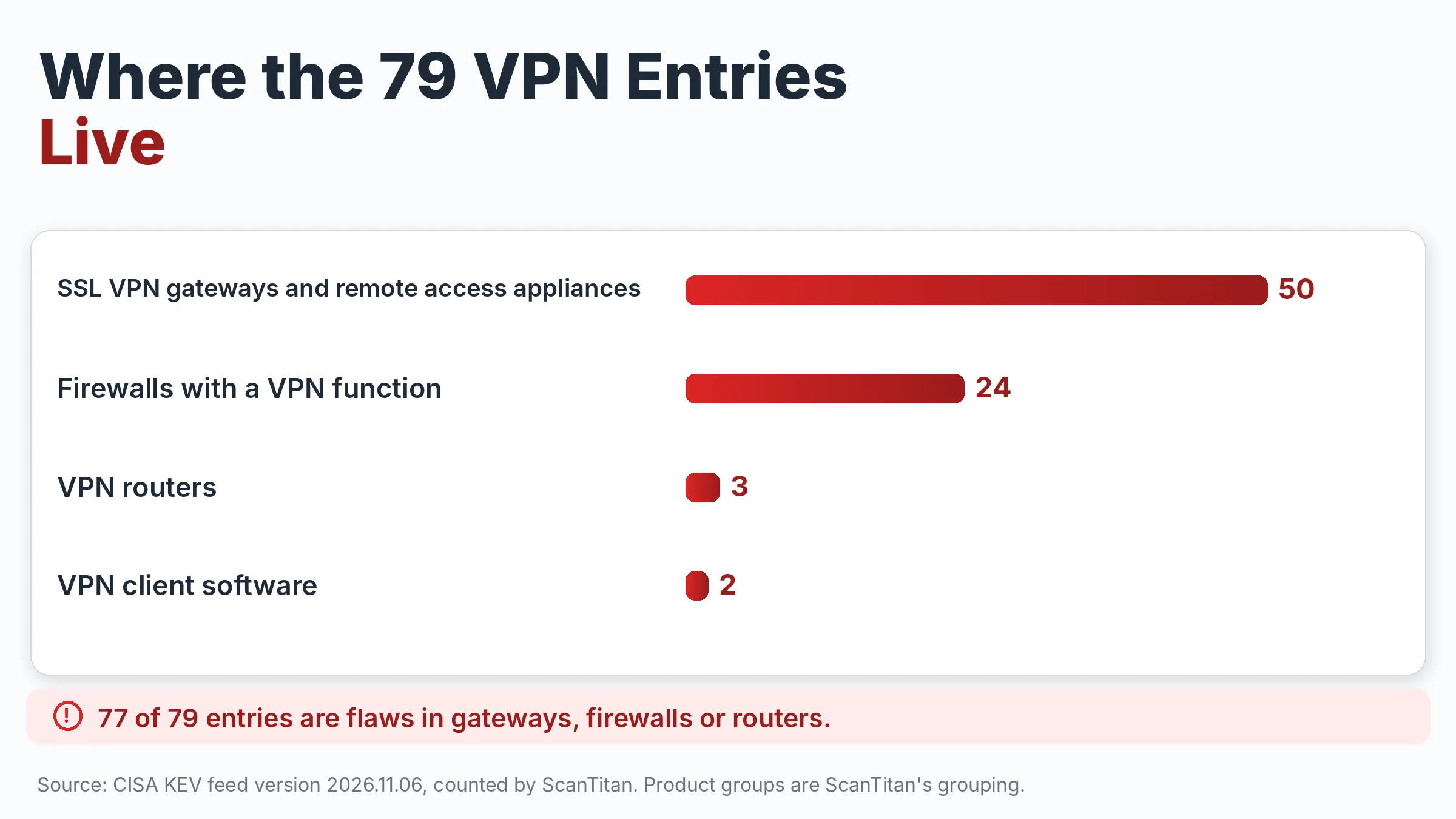
Two readings matter. First, 77 of 79 entries are flaws in gateways, firewalls or routers, which is where an attacker reaches the device from the internet with no user involved. Only 2 are client software flaws. Second, firewall-type entries are flagged for ransomware far more often (70.8%) than dedicated gateway entries (40.0%), but the firewall group is 24 entries, so treat the gap as a pattern worth watching and not a precise rate.
Many sources call firewalls and VPN gateways separate products. In the catalog the line is thin: Palo Alto’s PAN-OS, Fortinet’s FortiOS and Cisco’s ASA all run the VPN service on the firewall itself. That is why firewall and VPN flaws belong in the same exposure review, a point our attack surface management statistics develop.
VPN Vulnerabilities by Year: Rising or Falling?
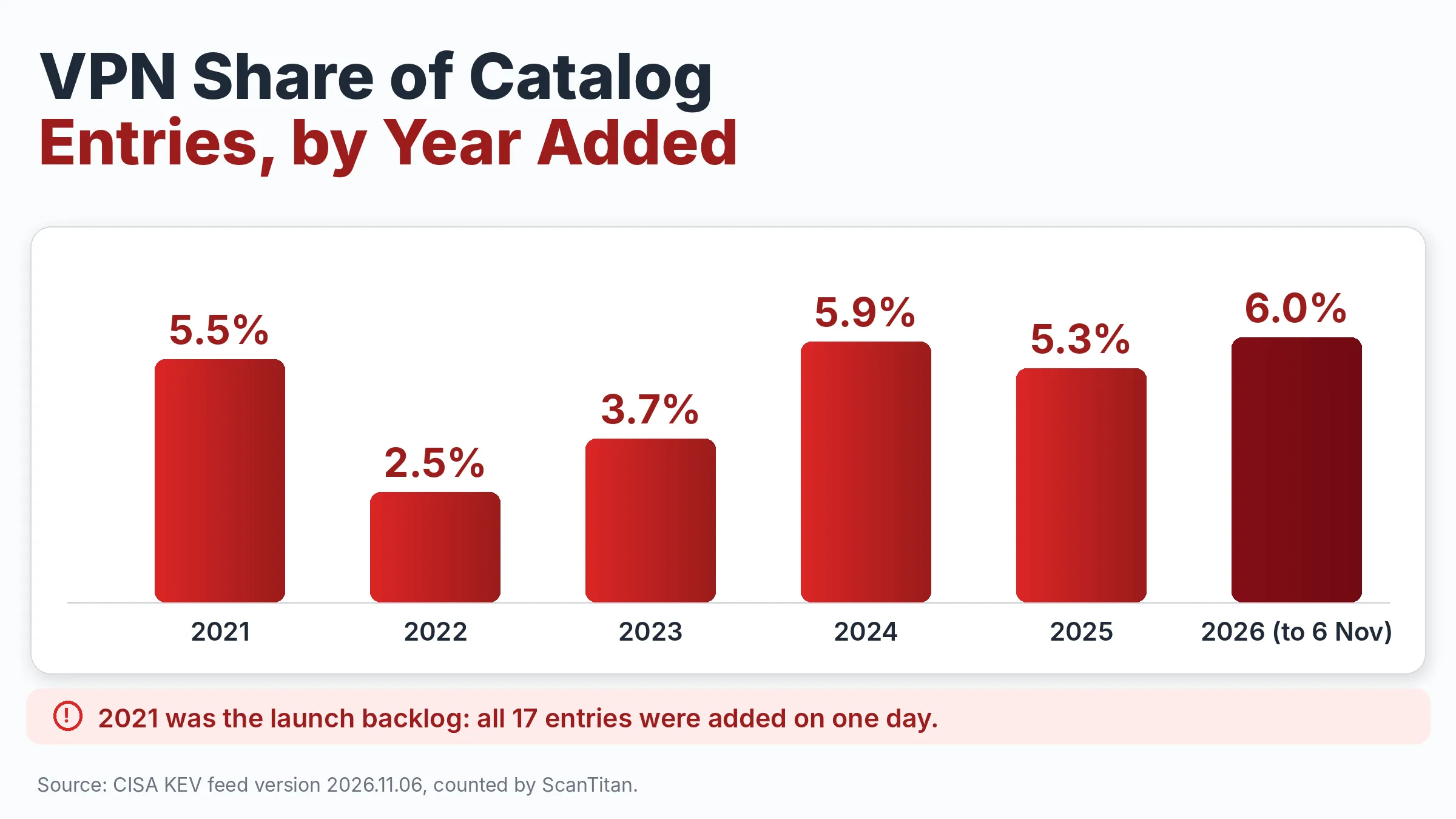
VPN entries are a steady part of the catalog and a growing share of it.
| Year added | VPN entries | All entries | Share |
|---|---|---|---|
| 2021 | 17 | 311 | 5.5% |
| 2022 | 14 | 555 | 2.5% |
| 2023 | 7 | 187 | 3.7% |
| 2024 | 11 | 186 | 5.9% |
| 2025 | 13 | 245 | 5.3% |
| 2026 (to 6 Nov) | 17 | 285 | 6.0% |
Two cautions. All 17 entries for 2021 were added on 3 November 2021, the day the catalog launched, so 2021 is a backlog and not a year of new attacks. Excluding it, 2022 to 2026 shows 62 entries in 1,458, or 4.3%, with the highest shares in 2024 and 2026. Counting from 2021, the share was 3.6% in 2021 and 2022 combined (31 of 866) and 5.3% since (48 of 903).
Outside research points the same way for edge devices as a whole. A 2024 WithSecure study, reported by SecurityWeek, found edge-related additions to the catalog rising from 2 a month in 2022 to 4.75 a month in 2024, while additions for other products fell from 5.36 a month in 2023 to 3. The VPN count here adds that these flaws are not fading: 2026 has already matched the 17 entries of the launch backlog year, with the year not yet over.
Which Vendors Have the Most VPN Vulnerabilities?
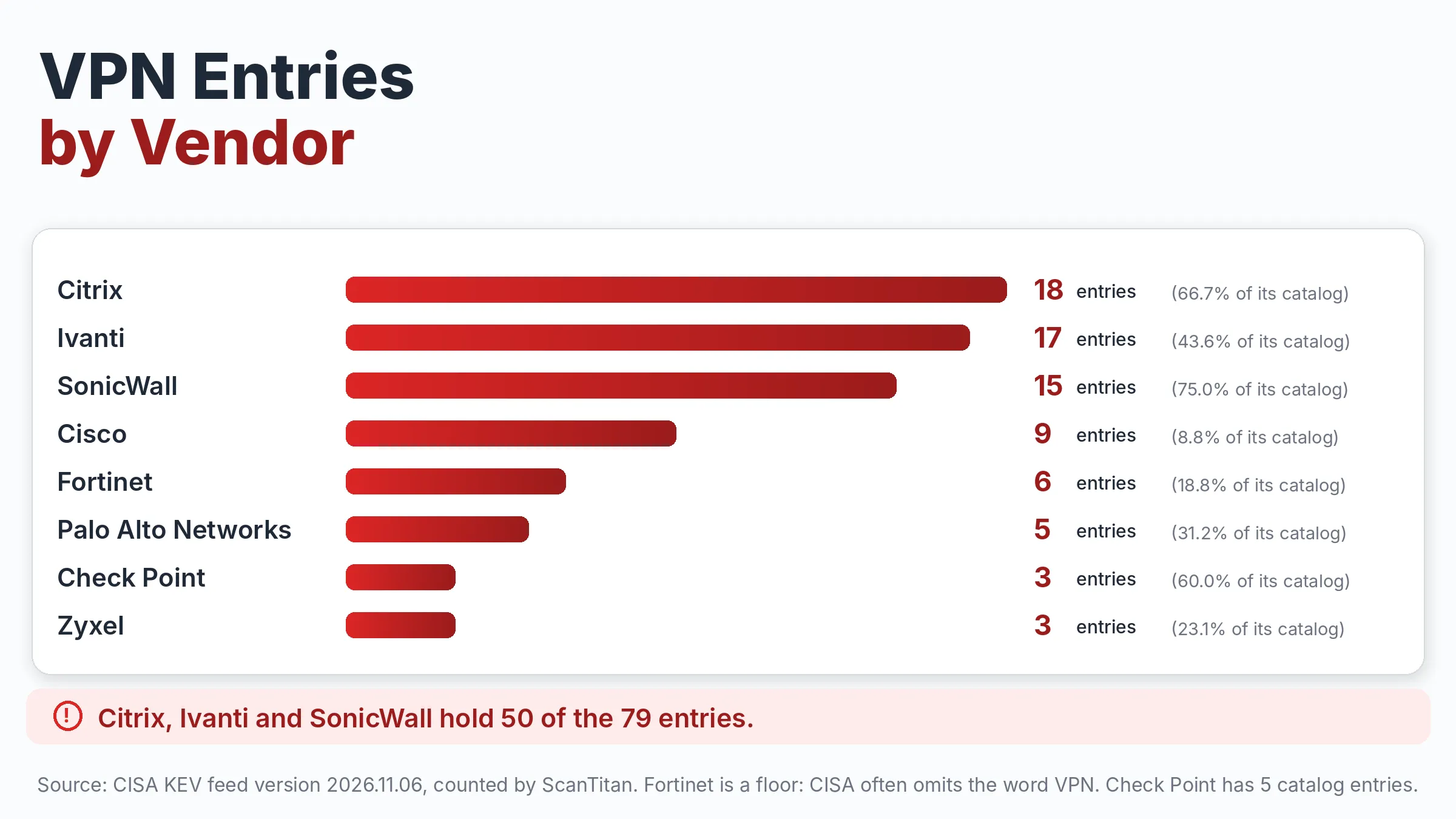
Three vendors hold 50 of the 79 entries.
| Vendor | VPN entries | Share of the vendor’s catalog entries | Flagged for ransomware | Median days to listing | Added in 2026 |
|---|---|---|---|---|---|
| Citrix | 18 | 66.7% (of 27) | 4 | 6 | 6 |
| Ivanti (includes Pulse Secure) | 17 | 43.6% (of 39) | 8 | 160 | 3 |
| SonicWall | 15 | 75.0% (of 20) | 8 | 40 | 5 |
| Cisco | 9 | 8.8% (of 102) | 4 | 978 | 0 |
| Fortinet | 6 | 18.8% (of 32) | 6 | 675 | 0 |
| Palo Alto Networks | 5 | 31.2% (of 16) | 5 | 0 | 1 |
| Check Point | 3 | 60.0% (of 5) | 2 | 2 | 2 |
| Zyxel | 3 | 23.1% (of 13) | 0 | 12 | 0 |
| WatchGuard, Array Networks, Juniper | 1 each | 25.0%, 50.0%, 12.5% | 1, 1, 0 | 0, 621, 690 | 0 |
How to read this table:
- Citrix, Ivanti and SonicWall are VPN-heavy vendors. In each, more than 40% of catalog entries name a VPN product, because the gateway is the product.
- Cisco is the opposite case. It has the most catalog entries of any vendor in this table, 102, and only 9 name a VPN, because most Cisco entries are routers, switches and phones.
- Fortinet’s 6 is a floor. Its other 26 entries mostly name FortiOS or FortiProxy without the SSL VPN service.
- Check Point has 5 entries and SonicWall 20. Treat their shares as small samples.
- 2026 is a three-vendor story. Citrix has 6 of the 17 entries added this year, SonicWall 5 and Ivanti 3. Since 2023, those three account for 31 of the 48 entries (64.6%).
- Ransomware flags are concentrated. Every Fortinet and Palo Alto entry in the set is flagged (6 of 6 and 5 of 5), while Citrix is 4 of 18.
What VPN Flaws Let Attackers Do
CISA’s descriptions show what each flaw permits. We searched the text for common phrases and compared VPN entries with all other entries.
| What the description says | VPN entries (79) | Other entries (1,690) |
|---|---|---|
| No login needed (unauthenticated, or no authentication required) | 40.5% (32) | 15.8% |
| Code execution or command injection | 51.9% (41) | 47.2% |
| Authentication bypass or missing authentication | 17.7% (14) | 11.4% |
| Data disclosure or file read | 10.1% (8) | 7.3% |
| Privilege escalation | 3.8% (3) | 13.4% |
| Mentions multi-factor authentication | 1.3% (1) | 0.1% |
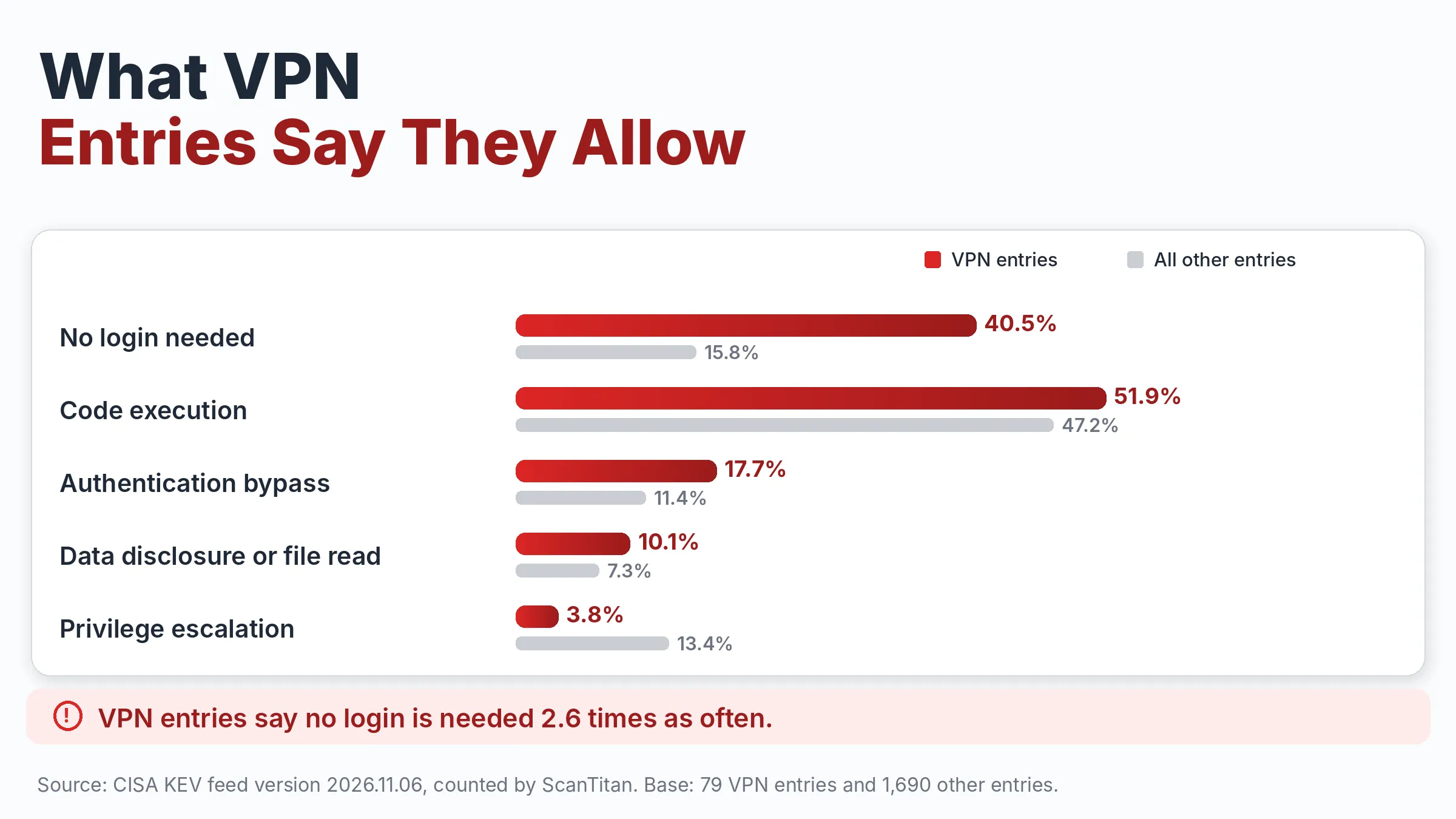
The pattern is consistent: VPN flaws are about getting in without a login, not about escalating after you are in. Entries describing privilege escalation are 3.8% for VPN against 13.4% elsewhere, and entries saying no login is needed are 2.6 times as common. Code execution is common everywhere (51.9% against 47.2%), so the notable difference is how often it happens before authentication. Our report on remote code execution statistics shows how common code execution is across the whole catalog, and the privilege escalation statistics show the opposite profile.
Only one VPN entry mentions MFA: SonicWall’s CVE-2026-19868, added on 6 November 2026, which CISA describes as letting a user with valid credentials for another sign-in method bypass SAML authentication, including SAML-enforced MFA. It is a reminder that MFA on one door does not protect a device that accepts other doors.
What Kinds of Weakness Sit Behind VPN Flaws
All 79 entries carry a weakness tag. Three families make up most of them, and they overlap because 6 entries carry more than one tag.
| Weakness family | Entries | Share of 79 | Common tags |
|---|---|---|---|
| Memory corruption (overflows, out-of-bounds read or write) | 19 | 24.1% | CWE-119 (8), CWE-120 (3), CWE-121 (3), CWE-787 (2), CWE-125 (2) |
| Injection (command, code, SQL) | 19 | 24.1% | CWE-94 (7), CWE-78 (5), CWE-77 (4), CWE-89 (3) |
| Authentication and access control | 18 | 22.8% | CWE-287 (5), CWE-306 (3), CWE-862 (3), CWE-284 (3), CWE-288 (2) |
| Path traversal | 5 | 6.3% | CWE-22 (5) |
| Server-side request forgery | 3 | 3.8% | CWE-918 (3) |
Roughly a quarter each go to memory corruption, injection and authentication, so a VPN gateway can fail in three quite different ways. For the weaknesses that are not about login, see our reports on SSRF statistics and path traversal statistics, and for the login family see our authentication bypass statistics.
How Fast Are VPN Vulnerabilities Listed?
Listing speed splits into two eras: before 2023 and since.
| Group | Entries | Median days from CVE to listing | Listed within 30 days | Listed on or before CVE publication day | Listed over a year after |
|---|---|---|---|---|---|
| VPN entries, all years | 79 | 15 | 54.4% | 34.2% | 32.9% |
| Other entries, all years | 1,690 | 246 | 31.8% | 12.2% | 45.1% |
| VPN entries added 2021 and 2022 | 31 | 585 | 6.5% | 6.5% | 71.0% |
| Other entries added 2021 and 2022 | 835 | 910 | 10.3% | 5.3% | 68.1% |
| VPN entries added since 2023 | 48 | 0 | 85.4% | 52.1% | 8.3% |
| Other entries added since 2023 | 855 | 20 | 52.7% | 18.9% | 22.7% |
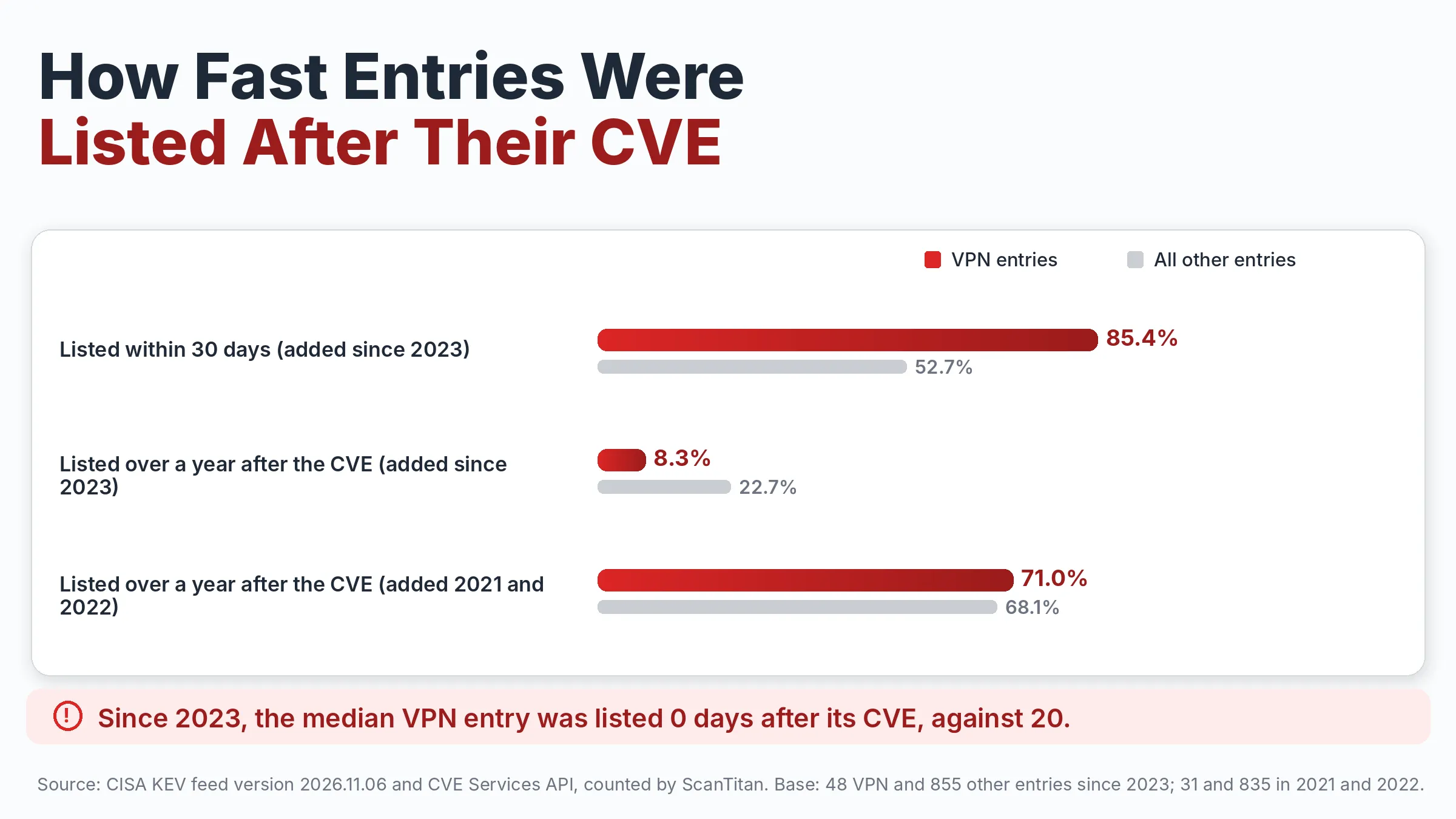
Three findings stand out:
- Since 2023, half of VPN entries were listed on or before the day the CVE was published. That is 25 of 48 entries, against 18.9% of other entries. In 2026 the median is 0 days and the longest wait is 57 days.
- Before 2023, the picture was the reverse. In 2021 and 2022, 22 of 31 VPN entries were listed more than a year after their CVE, because the catalog launched with a backlog of old flaws such as Pulse Secure CVE-2019-11510.
- Old VPN flaws still appear. Four entries added since 2023 are more than a year old: SonicWall CVE-2023-44221 (513 days), SonicWall CVE-2021-20035 (1,297), Array Networks CVE-2023-28461 (621) and Cisco CVE-2020-3259 (1,380).
For how fast exploited flaws reach the catalog across all products, see our zero-day statistics. Verizon adds the other half of the gap. Its 2025 report found only 54% of edge device and VPN flaws fully remediated during the year, with a median of 32 days. Its 2026 report covers all CISA-listed flaws, not edge devices alone: the median time to fully remediate was 43 days in 2025, up from 32, and only 26% were fully remediated, down from 38%. The 2026 report does not publish an edge-specific time, so the 2025 edge figure is the latest one. A flaw listed on the day it is published leaves a defender no window to patch before attacks begin.
VPN Vulnerabilities and Ransomware
CISA flags 49.4% of VPN entries (39 of 79) as known to be used in ransomware campaigns, against 19.1% of other entries (322 of 1,690). VPN flaws are 4.5% of the catalog but 10.8% of all entries with the ransomware flag (39 of 361).
| Group | Entries | Flagged for ransomware | Share |
|---|---|---|---|
| All VPN entries | 79 | 39 | 49.4% |
| Added 2021 and 2022 | 31 | 16 | 51.6% |
| Added 2023 to 6 Nov 2026 | 48 | 23 | 47.9% |
| SSL VPN gateways and appliances | 50 | 20 | 40.0% |
| Firewalls with a VPN function | 24 | 17 | 70.8% |
| Fortinet | 6 | 6 | 100% |
| Palo Alto Networks | 5 | 5 | 100% |
| Ivanti and Pulse Secure | 17 | 8 | 47.1% |
| SonicWall | 15 | 8 | 53.3% |
| Citrix | 18 | 4 | 22.2% |
| Cisco | 9 | 4 | 44.4% |
The rate did not fall over time (51.6% before 2023 and 47.9% since), which differs from SSRF, where the ransomware share fell. The flag is CISA’s and records known use, not how many victims. For how ransomware groups choose entry points, see our ransomware statistics.
What Outside Data Says About VPN and Edge Exploitation
Several outside datasets measure edge devices more broadly than VPN. Each is labeled by what it covers and who published it.
- Verizon (2025 report). Edge devices and VPNs were the target in 22% of breaches that began with an exploited vulnerability, up from 3% the year before, a rise of roughly seven to eight times depending on rounding. Only about 54% of those flaws were fully remediated, with a median of 32 days. Some pages label these figures “2026”; they come from the 2025 report, which covers incidents to October 2024.
- Verizon (2026 report). Exploitation of vulnerabilities became the most common first step in breaches, at 31%. Of 876 initial-access-broker offers over four years, 44% were for VPN access, with remote desktop close behind. Among small and medium business ransomware victims, 38% were reached through compromised credentials and 29% through unpatched vulnerabilities in edge devices. VPN as a vector in the System Intrusion pattern stays around 16%. The report also notes end-of-life internet-facing cellular routers in utilities and mining.
- VulnCheck (vendor-only). Of exploited edge device flaws tracked for 2025, 42.5% affected end-of-life or likely end-of-life devices, 65% of those exploited by botnets did, and consumer and global networking products were 56%. Only 23.7% appear in CISA’s catalog.
- Mandiant (as reported by Halo Security). In M-Trends 2025, exploits were the most common way in at 33% of intrusions, and the most exploited flaws were all in edge devices: Palo Alto PAN-OS CVE-2024-3400, Ivanti CVE-2023-46805 and CVE-2024-21887, and Fortinet FortiClient EMS CVE-2023-48788. Three of those four are in the VPN set counted here; the FortiClient EMS flaw is a management server flaw.
- Eclypsium (vendor-only). A basic search of internet scan data returns roughly 575,000 internet-facing Fortinet devices, many on older firmware, a measure of exposure and not of exploitation.
- Consumer VPN apps (OpenVPN, vendor-only). Research by the Open Technology Fund and the Internet Citizens’ Rights Project found eight popular commercial VPN apps hid ownership and operations details, affecting more than 700 million users. That is a trust problem with VPN providers, not a gateway flaw, and is not part of the 79.
End-of-Support Devices and CISA’s BOD 26-02
Unpatchable devices are a separate problem from unpatched ones. CISA’s Binding Operational Directive 26-02, issued 5 February 2026, tells federal civilian agencies to inventory edge devices that are no longer supported by their vendors, remove them on a schedule, and set up continuous discovery. Reports of the directive give 12 months to decommission listed devices.
The directive applies to federal agencies, but VulnCheck’s finding shows why it matters to everyone: 42.5% of the exploited edge flaws it tracked affected end-of-life or likely end-of-life products, and consumer networking equipment was 56%. The VPN set here shows the same problem on the enterprise side: SonicWall’s SMA 100 line, Pulse Connect Secure and older Cisco and Fortinet products appear for flaws that were years old when listed. A device with no patch path cannot be fixed by waiting for a patch.
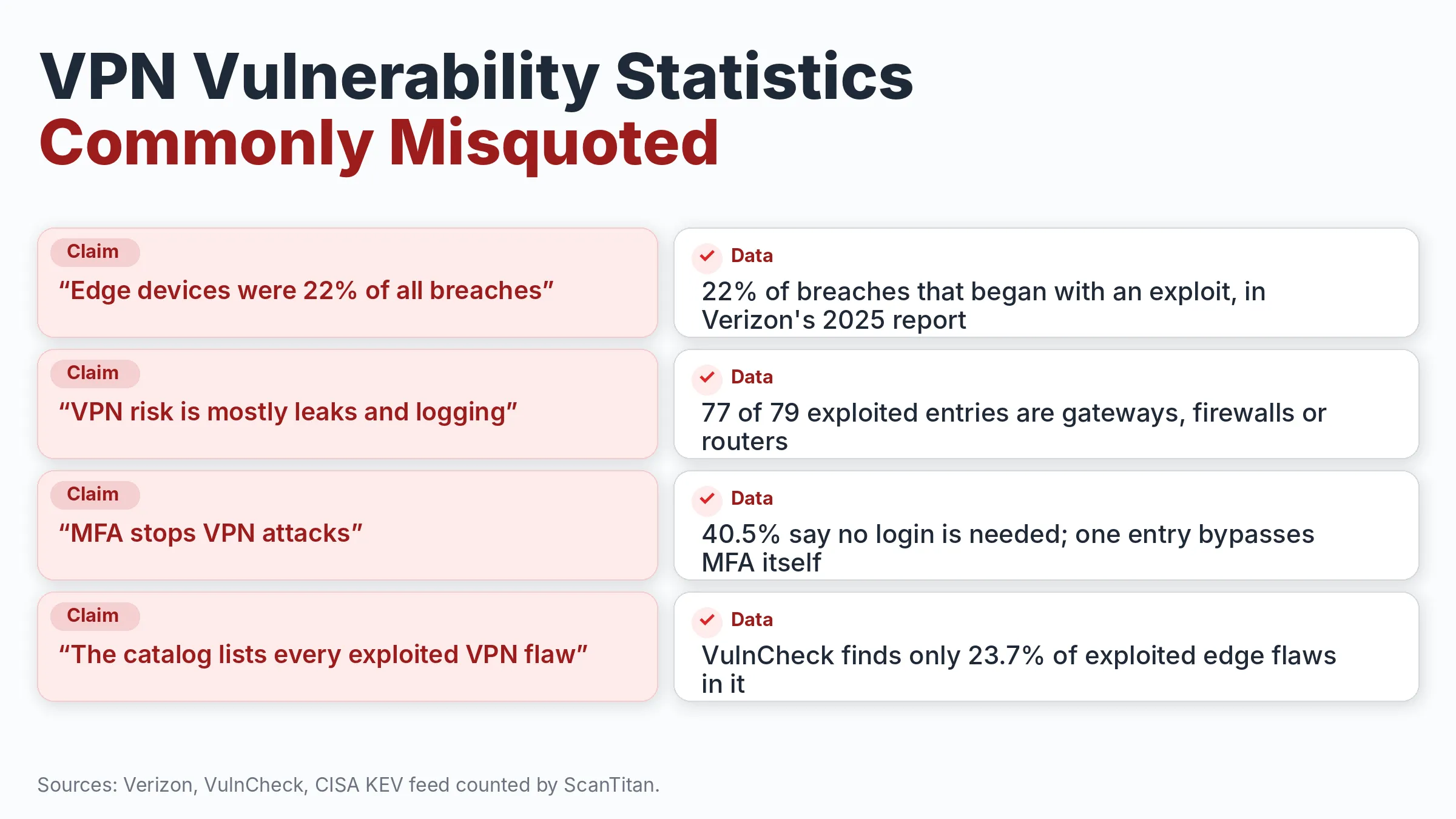
VPN Vulnerability Statistics Commonly Misquoted
| Claim | What the data shows | Source |
|---|---|---|
| “Edge devices were 22% of all breaches” | 22% of breaches that began with an exploited vulnerability, and it is the 2025 report, not 2026 | Verizon DBIR 2025 |
| “Eightfold increase” | 3% to 22% is about 7.3 times by the rounded figures | Verizon DBIR 2025 |
| “VPN risk is mostly leaks and logging” | 2 of 79 exploited VPN entries are client software; 77 are gateways, firewalls and routers | CISA KEV feed, counted by ScanTitan |
| “MFA stops VPN attacks” | 40.5% of VPN entries say no login is needed; one entry bypasses MFA itself | CISA KEV feed, counted by ScanTitan |
| “Patch within 30 days and you are safe” | 85.4% of VPN entries added since 2023 were listed within 30 days of the CVE, and 52.1% on or before its publication day | CISA KEV feed and CVE Services API |
| “The catalog lists every exploited VPN flaw” | VulnCheck finds only 23.7% of exploited edge flaws in it | VulnCheck, vendor-only |
| “VPN flaws are how attackers sell access” | 44% of 876 broker offers were for VPN access, which measures what is sold and not how the access was gained | Verizon DBIR 2026 |
| “Fortinet has few VPN flaws” | 6 meet the rule, but Fortinet has 32 entries and CISA often omits the word VPN | CISA KEV feed, counted by ScanTitan |
How to Check Your Own VPN Exposure With ScanTitan
The catalog tells you which VPN flaws are exploited. It does not tell you which of them your own servers expose. ScanTitan’s IP vulnerability scanner tests a public IPv4 or IPv6 address the way a remote attacker would: it maps the services listening on the address, fingerprints each service’s software version, and matches it against the CVE database, the CISA catalog and exploit probability scores (EPSS), with the evidence and a specific fix behind each finding.
For a VPN, that means the login page or portal on your gateway is treated as any other public service. A practical check takes five steps:
- List every public address that serves a VPN portal, a firewall login page or a remote-access service, including ones managed by an outside provider.
- Run the IP vulnerability scanner against each one. A limited public check is free and needs no account, while server vulnerability scanning needs the Business or Consultant plan.
- Read which services and versions are exposed, and note any management interface that answers from the internet.
- Compare the versions with the entries in this report. The CVE priority checker shows known exploitation next to severity for a given CVE.
- Rank the fixes by exploitation first, then repeat on a schedule, since a VPN portal that was safe in March can match an entry by November.
Limits matter. A scan from outside cannot see inside a device and cannot tell you that an attacker has already planted a backdoor, and a version match depends on what the device reveals to the internet. Check only addresses you own or have permission to test. Exposed VPN portals are one slice of a larger map, which our attack surface management page explains, and our open ports statistics show how many exposed services are tied to exploited flaws.
What the Numbers Mean for a Lean Team
For an IT team of one to five people, three habits follow from the data:
- Treat the VPN gateway as the first patch, not the last. Since 2023, half of VPN entries were listed on or before their CVE day, so waiting for the next maintenance window is a bet against the median.
- Know your vendor. Citrix, Ivanti and SonicWall account for 63.3% of entries, and every Fortinet and Palo Alto entry in this set is flagged for ransomware. If you run one of these, subscribe to its advisories and check them weekly.
- Retire devices that cannot be patched. End-of-life gateways are the part of this problem no patch process can fix.
Where patching is slow for good reasons, patch management statistics show how deadlines compare with reality. None of this is advice for a specific environment; match it to your own exposure.
How We Compiled and Verified These Statistics
All counts come from CISA’s Known Exploited Vulnerabilities feed, version 2026.11.06, holding 1,769 entries. We matched entries by the rule in the methodology section, listed all 82 matches, removed 3 that are not remote-access VPN flaws, and read the descriptions of borderline entries (for example the PAN-OS management interface flaws, which CISA says affect firewalls and VPN concentrators, and the Zyxel entries, which name VPN series firewalls) before keeping them. Publication dates come from the CVE Services API, and all 1,769 entries had one. Wording shares search the entry name and description for the phrases listed in the tables. Weakness tags are CISA’s own. Percentages show their counts so you can recompute them. Vendor, Verizon, VulnCheck, Mandiant and Eclypsium figures are labeled and are never mixed with ScanTitan’s counts. Verizon’s 2026 figures are as cited, with report page numbers, in ScanTitan’s open ports statistics research. We did not use figures we could not trace to a page we had read.
Primary Sources
- CISA Known Exploited Vulnerabilities feed (version 2026.11.06)
- CISA BOD 26-02, Mitigating Risk From End-of-Support Edge Devices
- Verizon Data Breach Investigations Report (2025 edition)
- Verizon 2026 Data Breach Investigations Report
- VulnCheck, 2026 State of Exploitation: Exploiting the Network Edge (vendor-only)
- SecurityWeek, Edge Devices: The New Frontier for Mass Exploitation Attacks (reporting a WithSecure study)
- Halo Security, CISA BOD 26-02 and the Risk of Unsupported Edge Devices (reporting Mandiant M-Trends 2025)
- Eclypsium, Firewall Vulnerability Exploitation (vendor-only)
- OpenVPN, VPN Vulnerabilities: Why the VPN You Choose Is as Important as Using One at All (vendor-only)
Frequently Asked Questions
What are VPN vulnerabilities?
VPN vulnerabilities are flaws in a VPN service or product that let an attacker bypass login, run code or read data. In CISA’s exploited catalog they are mostly flaws in SSL VPN gateways, firewalls with a VPN function and VPN routers, not flaws in apps on users’ devices.
How many VPN vulnerabilities are exploited?
By ScanTitan’s count, 79 of the 1,769 entries in CISA’s Known Exploited Vulnerabilities catalog name a VPN or a remote-access VPN product, 4.5%, or about 1 in 22. The count is a floor, because VulnCheck finds only 23.7% of the exploited edge device flaws it tracks in the catalog.
Which vendors have the most exploited VPN vulnerabilities?
Citrix has 18 entries, Ivanti 17 (including Pulse Secure), SonicWall 15, Cisco 9, Fortinet 6 and Palo Alto Networks 5. Citrix, Ivanti and SonicWall together hold 50 of the 79, or 63.3%.
Are VPN vulnerabilities increasing?
Slowly. VPN entries were 3.6% of the entries added in 2021 and 2022, 5.3% since 2023 and 6.0% of 2026 additions to 6 November, with 17 entries this year, the most since the catalog’s launch backlog in 2021.
Are VPN vulnerabilities used in ransomware?
CISA flags 49.4% of VPN entries as used in ransomware, 39 of 79, against 19.1% of other entries. Firewall-type entries are flagged more often (17 of 24) than SSL VPN gateway entries (20 of 50).
How fast are VPN vulnerabilities exploited?
For entries added since 2023, the median was listed 0 days after the CVE was published, and 52.1% were listed on or before that day. That means exploitation often starts before a patch exists.
Is a VPN safer than no VPN?
For protecting traffic on public networks, a trusted VPN helps. For a company, an internet-facing VPN gateway is also an attack surface: 77 of the 79 exploited VPN entries are flaws in gateways, firewalls or routers that an attacker can reach without any user involved.
Does multi-factor authentication stop VPN attacks?
Not by itself. 40.5% of VPN entries say no login is needed, and CISA’s CVE-2026-19868 for SonicWall SSL VPN lets a user with valid credentials for another sign-in method bypass SAML authentication, including SAML-enforced MFA.
What does CISA’s BOD 26-02 require?
Issued 5 February 2026, it tells federal civilian agencies to inventory edge devices that are no longer supported by their vendors, remove them on a set schedule and keep discovering edge devices. It binds federal agencies only, but VulnCheck reports that 42.5% of exploited edge flaws in 2025 hit end-of-life or likely end-of-life products.
What is the difference between an edge device and a VPN?
An edge device is any system at the boundary between a network and the internet, including firewalls, routers and VPN gateways. A VPN gateway is one kind of edge device. Verizon’s 22% covers edge devices and VPNs together, while the 79 entries counted here are limited to VPN wording.
How can I check whether my VPN is exposed?
List the public addresses that serve VPN portals and firewall login pages, scan each one from outside, read which services and versions answer, and compare them with currently exploited flaws. ScanTitan’s IP vulnerability scanner does this for public addresses you own or have permission to test.
What does Verizon’s 2026 report say about VPNs?
Verizon’s 2026 Data Breach Investigations Report found that 44% of 876 initial-access-broker offers over four years were for VPN access, that exploitation of vulnerabilities became the most common way into breaches at 31%, and that only 26% of CISA-listed flaws were fully remediated in 2025, with a median of 43 days. It does not publish an edge-device-specific fix time.
Where does this data come from?
From CISA’s Known Exploited Vulnerabilities feed (version 2026.11.06), the CVE Services API and the outside sources named beside each figure, which include Verizon, VulnCheck, SecurityWeek, Halo Security, Eclypsium and OpenVPN.