

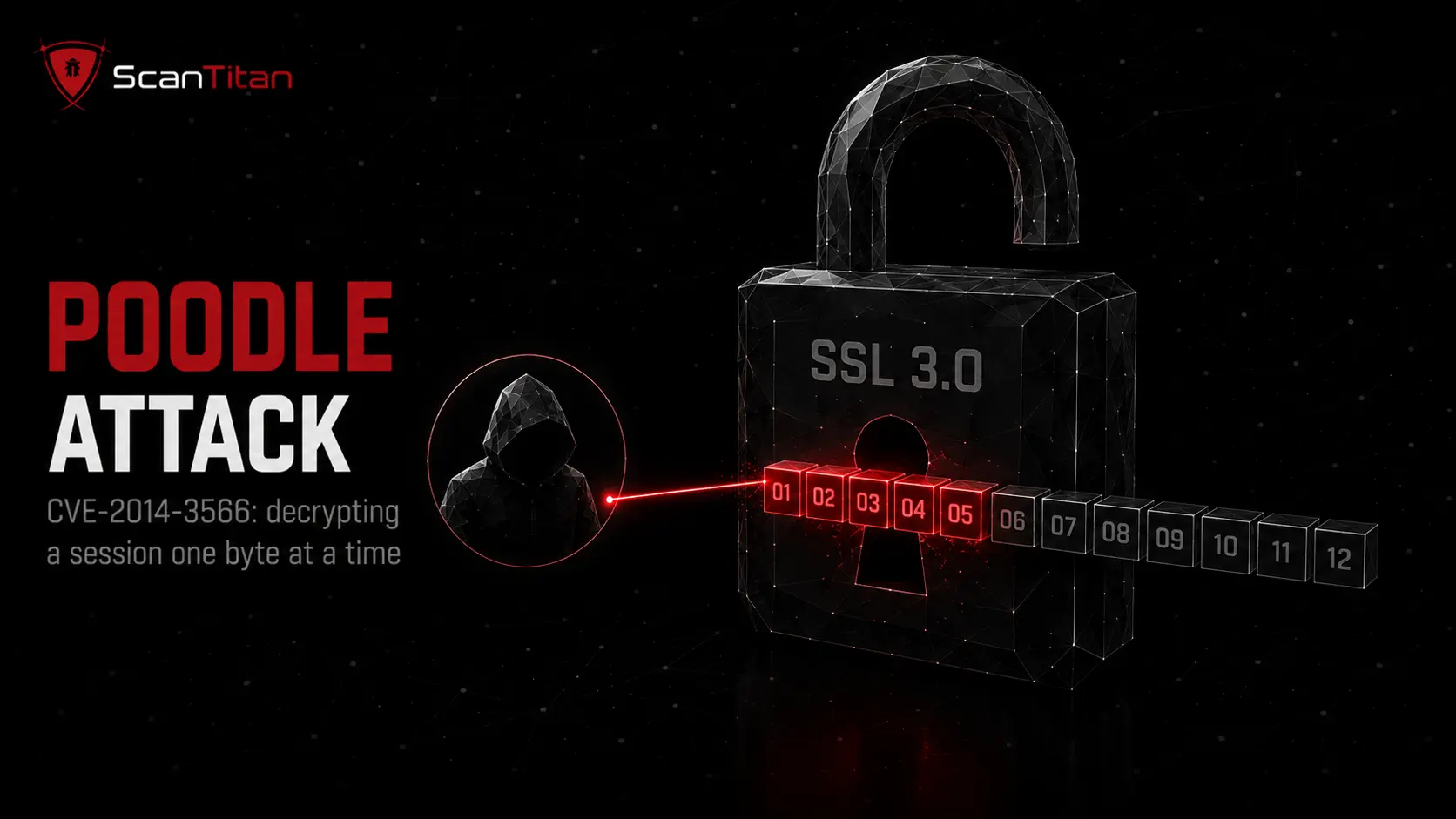
What Is POODLE Vulnerability ?
POODLE is an attack that forces your browser and a server to fall back from modern TLS down to obsolete SSL 3.0, then abuses a padding weakness in that old protocol to read encrypted data byte by byte. It never breaks the encryption key. Instead it tricks the server into revealing whether a guess was correct, and enough correct guesses reconstruct the plaintext. It is one of the more consequential vulnerabilities in cyber security precisely because the fix is not a patch, it is switching off a protocol you should not be running anyway.
POODLE, definedPadding Oracle On Downgraded Legacy Encryption (CVE-2014-3566): an attack that downgrades a connection to SSL 3.0, then exploits that protocol’s unchecked padding to decrypt data one byte at a time.
What Does POODLE Stand For? (Padding Oracle On Downgraded Legacy Encryption)
The name is an acronym that describes the whole attack chain, and unpacking it is the fastest way to understand the flaw. “Padding oracle” refers to a server that unintentionally acts as an oracle, answering yes or no about whether the padding on a tampered message was valid. “Downgraded” points to the protocol downgrade the attacker forces first, dropping the connection from TLS to SSL 3.0. “Legacy encryption” is SSL 3.0 itself, a protocol from 1996 that most servers kept enabled purely for backward compatibility with ancient clients. Put together, the name reads as a set of instructions: downgrade the victim to old encryption, then use the server’s padding responses as an oracle to decrypt the traffic.
The SSL POODLE Vulnerability: Why SSL 3.0 Is the Root Cause
The SSL POODLE vulnerability exists because of two design decisions in SSL 3.0 that looked reasonable in 1996 and are indefensible now. First, SSL 3.0 uses cipher block chaining (CBC mode), which pads data to fill fixed-size blocks, but it never verifies the contents of that padding, only the final length byte. Second, it uses a mac-then-encrypt construction, calculating the integrity checksum before encryption rather than after, so a server must decrypt attacker-modified data before it can detect tampering. Those two choices together create the padding oracle. No patch fixes this, because it is the protocol, which is why this particular SSL vulnerability is only solved by disabling SSL 3.0 entirely.
Every other vulnerability on your scan report has a patch. POODLE does not. The only remediation is to stop speaking the protocol, which is why a scanner flagging SSL 3.0 in 2026 is really flagging a configuration nobody has reviewed in a decade.
How the POODLE Attack Works?
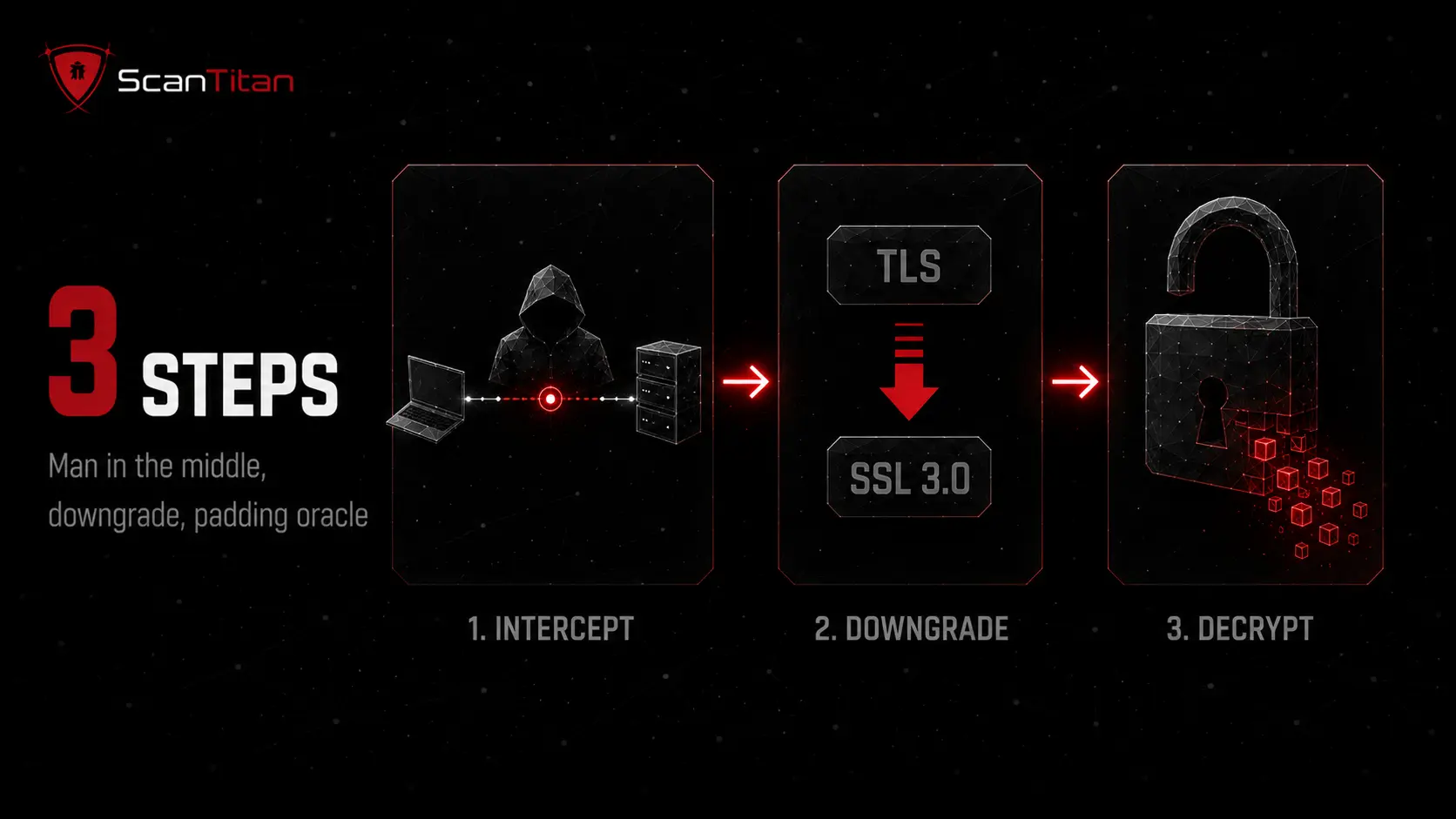
POODLE needs three things to line up. Each stage is achievable on its own, but the attacker must chain all three, which is why exploitation is realistic mainly on hostile networks.
Man-in-the-Middle Position
The attacker first has to sit between the victim and the server, able to both observe and manipulate traffic in transit. Passive eavesdropping alone is not enough, because the later stages require actively dropping connections and modifying ciphertext. In practice this means a shared or hostile network: public Wi-Fi in a cafe or airport, a compromised home router, or a rogue access point broadcasting a familiar network name. The attacker also needs the victim’s browser to generate many requests to the target site, which is usually arranged by getting the browser to run attacker-controlled JavaScript from an unrelated page. None of this breaks encryption yet; it simply puts the attacker in position to start.
Protocol Downgrade to SSL 3.0
Next the attacker forces the connection down to SSL 3.0, exploiting a compatibility behavior rather than a cryptographic flaw. When a modern handshake fails, many clients historically retried with an older protocol, walking down the version list until something connected. Security researchers call this the downgrade dance, and it exists because some old servers terminated connections rather than negotiating politely. The attacker simply drops the first handshakes. After a few failures the client obligingly offers SSL 3.0, the server accepts, and the session is now running on a protocol with a known padding weakness. This step only works if the server still accepts SSL 3.0, which is exactly why disabling it stops the attack dead.
Padding Oracle Exploitation
With the session downgraded, the real decryption begins. The attacker’s JavaScript makes the browser send repeated requests containing the session cookie, adjusting the request length so the target byte lands in a predictable position. The attacker then copies the block containing the secret into the final padding block and submits it. The server either rejects it as bad padding or accepts it, and that single yes or no leaks one byte of plaintext. On average it takes about 256 attempts to resolve each byte, so a 16-byte session cookie falls after roughly 4,096 requests, typically a matter of minutes. The attacker never needs the key.
POODLE Attack Example: Stealing a Session Cookie
Here is a concrete POODLE attack example. A user opens a laptop in an airport and joins an open Wi-Fi network the attacker controls. She logs into her company’s web application over HTTPS, which is genuinely encrypted. The attacker cannot read that traffic, so instead he serves her an unrelated page containing JavaScript, then repeatedly kills her handshakes until her browser retries with SSL 3.0. Now the script quietly fires thousands of background requests to the application, each carrying her session cookie. Byte by byte, the attacker resolves that cookie from the server’s padding responses. Within minutes he replays it in his own browser and is logged in as her, with no password ever stolen and no failed login recorded.
What Can an Attacker Steal With POODLE?
POODLE recovers small amounts of plaintext, so attackers aim it at short, high-value data rather than bulk downloads.
- Hijack the session, because session cookies are short, predictable in position, and sent with every request, making them the ideal POODLE target and an instant path to account takeover.
- Capture authentication tokens, including bearer tokens and CSRF tokens that ride along in requests and grant access without any credential prompt.
- Recover credentials, where a password sits in a known position inside a repeated request, though this takes longer than lifting a cookie.
- Escalate to full control, since a stolen administrator session can mean database access, user data, or persistent backdoors in the application itself.
Is POODLE Still a Threat in 2026?
For most of the internet, no, and it is worth being honest about that. Every major browser removed SSL 3.0 support within months of disclosure, and RFC 7568 formally prohibited SSL 3.0 and any fallback to it back in June 2015. Without a client willing to speak SSL 3.0, the downgrade cannot land. The catch is that servers are slower to change than browsers. Industry scans were still finding a small share of public web servers accepting SSL 3.0 years after deprecation, and legacy appliances, embedded devices, mail servers, and internal tools are the usual offenders. It also remains an automatic audit failure, since frameworks from PCI DSS to NIS2 compliance expect deprecated protocols to be switched off.
Low exploit risk is not the same as low audit riskEven where no modern browser will negotiate SSL 3.0, an enabled SSLv3 endpoint fails compliance scans, signals unmaintained infrastructure, and often sits alongside other legacy weaknesses on the same host.
How to Check If Your Server Is Vulnerable to POODLE?
Checking is straightforward, because the test is simply whether your server still accepts SSL 3.0. Four checks cover it, and the last one is what keeps the fix from quietly regressing months later with continuous vulnerability scanning.
Scan your public endpointsLet a vulnerability scanner negotiate each protocol version against every exposed service and report anything still offering SSLv3 or other deprecated versions.
Cover more than the websiteMail servers, VPN gateways, load balancers, admin panels, and embedded appliances all terminate TLS, and they are where SSL 3.0 usually survives.
Review your protocol logsMost servers can log the negotiated TLS version. An SSL 3.0 negotiation from a modern user agent is a strong signal someone is attempting a downgrade against you.
Re-test on a scheduleA rebuilt server or a restored backup can reintroduce SSL 3.0 silently. Recurring scans catch the regression before an auditor does.
POODLE Vulnerability Fix: Disable SSL 3.0 on Apache, Nginx, and IIS

The POODLE vulnerability fix is the same everywhere: stop accepting SSL 3.0, then confirm it is actually gone. Modern best practice is to allow only TLS 1.2 and TLS 1.3. Work through the steps below on every host that terminates TLS.
Apache: restrict the SSLProtocol directive
Open your SSL configuration file, commonly ssl.conf or your virtual host file, and replace any permissive value such as all with an explicit allow list. Then restart Apache.
SSLProtocol -all +TLSv1.2 +TLSv1.3Nginx: restrict the protocol list
Edit nginx.conf or the relevant server block so only modern versions are offered, then reload Nginx to apply the change without dropping connections.
ssl_protocols TLSv1.2 TLSv1.3;IIS: disable SSL 3.0 in the registry
On Windows, SSL 3.0 is controlled through SCHANNEL registry entries. Set the server-side values below, then reboot so Windows stops offering the protocol to any client.
HKLM\SYSTEM\CurrentControlSet\Control\SecurityProviders
  \SCHANNEL\Protocols\SSL 3.0\Server

Enabled            = 0   (DWORD)
DisabledByDefault = 1 (DWORD)Update your TLS libraries
Keep OpenSSL and equivalent stacks current so both ends support TLS Fallback SCSV, the signaling value that lets a client prove a downgrade was forced rather than genuine. Libraries also carry the fix for the POODLE TLS variant, CVE-2014-8730, which affects implementations that skipped padding checks.
Re-scan to confirm the change applied
Configuration changes fail silently more often than expected, especially behind a CDN, reverse proxy, or load balancer that terminates TLS separately from your origin. Re-scan every endpoint and confirm SSL 3.0 is refused before you close the ticket.
Check what you will break before you switch it offTurn on TLS version logging for a week first. It shows exactly how many real clients still negotiate SSL 3.0, which is almost always zero. That evidence turns a risky-sounding change into a five-minute maintenance task.
POODLE remediation checklist
0 / 6
POODLE vs BEAST vs Heartbleed: Related SSL Attacks
POODLE is often confused with the other famous SSL-era attacks, but they break different things and need different fixes. The table sorts them, and each belongs to one of the broader types of website security vulnerabilities you should be scanning for.
| POODLE | BEAST | Heartbleed | |
|---|---|---|---|
| CVE | CVE-2014-3566 | CVE-2011-3389 | CVE-2014-0160 |
| Type | Protocol design flaw | Protocol design flaw | Implementation bug |
| Affects | SSL 3.0 | TLS 1.0 | OpenSSL library |
| Root cause | Unchecked CBC padding plus downgrade | Predictable CBC initialization vectors | Missing bounds check in Heartbeat |
| Attacker gains | Session cookies, byte by byte | Small plaintext fragments | Server memory: keys, cookies, passwords |
| Fix | Disable SSL 3.0 | Move to TLS 1.2 or later | Patch OpenSSL, rotate keys |
How ScanTitan Detects POODLE and Legacy Protocol Risks?
ScanTitan tests every exposed service for the protocol versions it will actually negotiate, so a POODLE exposure surfaces as a concrete finding rather than a guess. The scanner attempts SSL 3.0 and other deprecated versions against your websites, mail servers, and network endpoints, reports which hosts accepted them, and ties each result to CVE-2014-3566 with a CVSS severity score and the exact configuration change that closes it. Because scanning covers your whole external footprint rather than one domain, it catches the forgotten load balancer or legacy appliance where SSL 3.0 usually survives. Continuous re-testing then confirms the fix held and flags any rebuilt server that quietly reintroduces the old protocol.
POODLE Vulnerability FAQ:
What is the POODLE vulnerability in simple terms?
POODLE is an attack that tricks your browser and a server into using obsolete SSL 3.0 instead of modern TLS, then exploits a padding weakness in that old protocol to decrypt small pieces of the session. It is most often used to steal session cookies, which lets an attacker log in as the victim. It is tracked as CVE-2014-3566 and cannot be patched, only avoided by disabling SSL 3.0.
What does POODLE stand for?
POODLE stands for Padding Oracle On Downgraded Legacy Encryption. The padding oracle is the server unintentionally revealing whether tampered padding was valid, “downgraded” refers to forcing the connection back to an older protocol, and “legacy encryption” is SSL 3.0 itself. The acronym describes the attack sequence: downgrade first, then use padding responses to decrypt.
Is POODLE still a threat in 2026?
The practical exploit risk is low, because every major browser dropped SSL 3.0 and RFC 7568 prohibited it in 2015, so the downgrade rarely succeeds. The configuration risk is not low. Legacy appliances, mail servers, and internal tools still accept SSL 3.0, and any endpoint that does will fail a compliance scan and signal unmaintained infrastructure.
How do I know if my server is vulnerable to POODLE?
Check whether the server still accepts SSL 3.0. A vulnerability scanner will negotiate each protocol version against your endpoints and flag any that offer SSLv3. Test everything that terminates TLS, not just your main site: mail servers, VPN gateways, load balancers, admin panels, and appliances. Enabling TLS version logging also shows what clients actually negotiate.
How do I fix the POODLE vulnerability?
Disable SSL 3.0 and allow only TLS 1.2 and TLS 1.3. On Apache, restrict the SSLProtocol directive; on Nginx, restrict the protocol list in nginx.conf; on IIS, disable SSL 3.0 in the SCHANNEL registry settings. Keep OpenSSL and other TLS libraries current so TLS Fallback SCSV can block forced downgrades, then re-scan to confirm the change applied.
What is the difference between POODLE and POODLE TLS?
The original POODLE (CVE-2014-3566) affects SSL 3.0 only. In December 2014, researchers found that some TLS implementations copied SSL 3.0’s habit of not verifying padding contents, making them vulnerable to the same padding oracle even on TLS. That variant is tracked as CVE-2014-8730 and is fixed by patching the affected TLS implementation, not by changing protocol versions.
POODLE Resources and References:
Work from the primary advisories rather than second-hand summaries when you assess your exposure. These are the authoritative sources behind this guide.
- CISA: SSL 3.0 Protocol Vulnerability and POODLE Attack, the official US government advisory with affected systems and mitigation.
- NVD entry for CVE-2014-3566, the authoritative vulnerability record and severity scoring.
- IETF RFC 7568, which formally deprecates SSL 3.0 and prohibits fallback to it.
- This POODLE Bites: Exploiting the SSL 3.0 Fallback, the original research paper from the Google team that found the flaw.
- CERT Vulnerability Note VU#577193, the CERT Coordination Center record with vendor status information.
Find Legacy Protocol Risks Before an Auditor Does:
POODLE is a useful canary. If SSL 3.0 is still enabled somewhere in your estate, the real problem is not the 2014 attack, it is that nobody has reviewed that server’s configuration in years, and whatever else is stale on it has gone unnoticed too. Scan every endpoint that terminates TLS, disable the deprecated protocols, and re-test to prove the change stuck. ScanTitan checks your websites, networks, and APIs for SSL 3.0 and other legacy protocol risks, with CVSS-scored, prioritized findings in one dashboard so a lean team can close them in an afternoon.