


By Obaida Al-Sulaiman, Information Security Manager (CISSP, GXPN, GWAPT). Reviewed September 2026.
REST API security is the set of methods and controls that protect RESTful APIs from unauthorized access, data theft, and abuse. It spans authentication, authorization, encryption, rate limiting, inventory, and continuous testing. In Salt Security’s Q1 2025 survey, 99 percent of respondents said their organizations had encountered API security issues in the previous 12 months. This guide explains the controls that matter most for REST APIs, how to secure JWT-based authentication, how the OWASP API Security Top 10 applies, and how to test those controls continuously.
What is REST API security?
REST API security is the practice of protecting RESTful APIs so that only authenticated clients can perform authorized actions, and so that data stays confidential and intact from the client to the server and back. It combines authentication to prove identity, authorization to enforce permissions, encryption to protect data in transit and at rest, and logging and monitoring to catch abuse. A REST API exposes resources over standard HTTP methods such as GET, POST, PUT, PATCH, and DELETE, and every one of those entry points is something an attacker can probe. Securing a REST API is not a one-time setup; it is a continuous process that has to keep pace with new endpoints and new threats.
Why REST APIs need their own security approach
REST is stateless: the server should not depend on stored client-session state from a previous request to understand the next one. Protected requests still need enough identity and authorization context to be evaluated independently, but that does not mean every REST endpoint must require authentication. REST is also resource-oriented, so identifiers commonly appear in paths such as /api/users/123. Predictable or even opaque identifiers are not a security boundary; the server must check whether the caller is authorized for the referenced object. Because REST relies heavily on HTTP methods, status codes, headers, and content types, those semantics are part of the security model rather than implementation trivia.
Why REST API security matters (the numbers)

Research note: Survey percentages below describe the respondents or customer telemetry in each cited study. They should not be generalized into a universal breach rate for every API or organization.
The business case for securing REST APIs is no longer abstract, because the breach data has caught up with the hype. Attackers have noticed that APIs are where the sensitive data lives, and they are getting in using credentials that look legitimate. The figures below, drawn from the latest API security statistics, show why REST API security has moved from a backend concern to a board-level one.
- API security problems are widespread. Salt Security’s Q1 2025 survey found that 99 percent of respondents encountered API security issues in the previous 12 months. This is a survey result, not a measurement of every organization worldwide (Salt Security, 2025).
- Authenticated traffic is a major attack source. In Salt Labs’ analysis of customer data, 95 percent of observed API attack attempts originated from authenticated sources. That supports strong authorization and behavioral monitoring after login, not authentication alone (Salt Security Q1 2025 report).
- API-related breaches repeat. Traceable’s 2025 study, based on 1,548 respondents across more than 100 countries, found that 57 percent of organizations experienced an API-related data breach in the previous two years; among organizations reporting a breach, 73 percent had at least three API-related breaches (Traceable, 2025).
- The financial impact can be material. Akamai’s 2024 API Security Impact Study found that U.S. organizations that had experienced API security incidents estimated an average financial impact of $591,404, including costs such as remediation, downtime, legal fees, and fines (Akamai, 2024).
Broken Object Level Authorization is API1:2023 in the OWASP API Security Top 10. It occurs when an endpoint accepts an object identifier but fails to verify that the caller is allowed to perform the requested action on that specific object. REST’s resource-oriented URLs make object identifiers highly visible, but sequential IDs are not required for BOLA: UUIDs and opaque strings can be vulnerable too. OWASP also notes that the 2023 Top 10 is an awareness document built from expert review and community feedback rather than a prevalence dataset, so API1 should not be described as a statistically proven “most common” flaw.
Core design principles for secure REST APIs
The strongest REST API security starts at design time, before a single endpoint ships. Bolting controls on later is slower and leakier than building on a sound foundation. Four principles carry most of the weight.
- Apply least privilege. Grant each user, service, and token only the permissions it needs for its specific task, so a compromised account reaches a small blast radius instead of your whole dataset.
- Deny by default. Make the API refuse every request unless it is explicitly permitted, so a forgotten check fails closed rather than open.
- Validate access on every request. Because REST is stateless, re-check identity and permissions at each endpoint instead of trusting a cached decision from an earlier call.
- Segregate data by sensitivity. Design roles so that access maps to the sensitivity of the data, and enforce role-based access control (RBAC) so users touch only the records their job requires.
These principles line up with a zero-trust mindset: never assume a request is safe because of where it came from, and verify everything explicitly. Running a threat-modeling exercise with a framework like STRIDE at design time helps your team find these gaps before an attacker does.
REST API authentication and authorization methods
Choosing how clients prove who they are is the central decision in REST API security, and the right method depends on who is calling and what is at stake. Authentication verifies identity; authorization decides what that identity is allowed to do. A common and costly mistake is assuming that an authenticated user is automatically an authorized one, so treat these as two separate checks. The main methods below each fit different situations.
API keys
An API key is a static token, usually sent in a request header, that identifies the application making the call. Keys are simple to issue and easy to track, which makes them a reasonable fit for server-to-server traffic and for basic usage metering. The catch is that a key identifies the app, not the individual user behind it, so a key should never be your only authorization control for user-specific data. Scope each key to a single integration, rotate keys on a schedule, and revoke them the moment one leaks. Treat an API key as a secret credential. Do not expose it in client-side code or URLs, store it securely, scope it narrowly, rotate it when required, and never rely on an API key alone to protect sensitive or high-value resources.
OAuth 2.0 and OpenID Connect
OAuth 2.0 is the standard for delegated authorization, letting a user grant an application scoped access to their data without handing over their password. It issues short-lived access tokens carrying specific scopes, so a client gets exactly the permissions it was granted and nothing more. OpenID Connect layers identity on top of OAuth 2.0, adding a verified answer to the question of who the user is, which is what makes single sign-on work. This pairing is a common choice for user-facing REST APIs, single sign-on, and delegated third-party access, but the appropriate flow and token model depend on the client type and threat model. It is also easy to implement incorrectly, so validate the token audience and scopes on every call rather than trusting that a valid-looking token is enough.
JSON Web Tokens (JWT)
A JSON Web Token (JWT) can carry identity and authorization claims in a compact format protected by a signature or MAC. A service can often validate a signed JWT locally, although some architectures also use token introspection, revocation state, or other server-side checks. On every protected request, validate the token’s integrity and the claims your trust decision depends on, including expiry, issuer, audience, and token type where applicable. A normal signed JWT is not encrypted: its payload is readable by anyone who obtains the token, so do not place passwords or other secrets in its claims.
Mutual TLS (mTLS) and HMAC
For high-trust traffic, two methods go further than a bearer token. Mutual TLS (mTLS) has the client and the server each present a certificate, so both ends authenticate each other rather than just the client trusting the server. That extra verification suits internal service-to-service calls and regulated sectors like finance and healthcare, at the cost of managing certificates. HMAC request signing takes a different angle: the client signs each request with a shared secret, and the server recomputes the signature to confirm the request came from a trusted source and was not tampered with in transit. HMAC is a strong fit for webhooks and other high-integrity server-to-server exchanges where message integrity matters as much as identity.
Here is how the main REST API authentication methods compare:
| Method | Best for | Watch-outs |
|---|---|---|
| API keys | Server-to-server, usage tracking | Identifies the app, not the user; rotate and scope tightly |
| OAuth 2.0 + OIDC | User-facing apps, SSO, third-party access | Complex to implement; validate scopes and audience |
| JWT | Stateless auth across services | Validate signature/expiry/issuer/audience; block alg none; short expiry |
| mTLS | High-trust internal, finance, healthcare | Certificate management overhead |
| HMAC | Webhooks, high-integrity server-to-server | Key distribution and replay protection |
| Server-side session tokens | Browser-based first-party apps | Introduce server-side client session state; use CSRF protections where cookies are involved |
Securing REST APIs with JWT: best practices
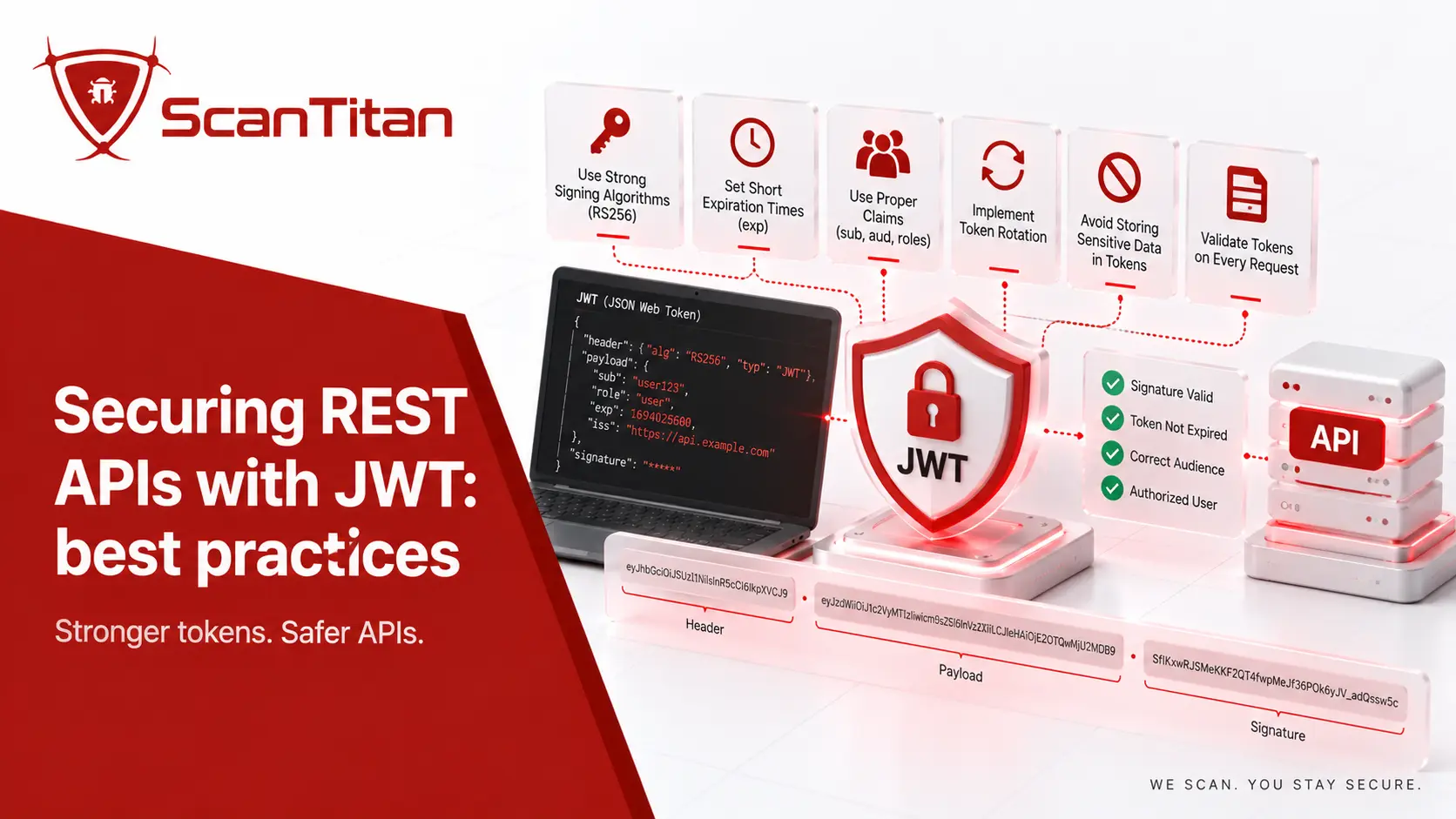
JWTs are a common way to carry identity and authorization claims in stateless API architectures, and implementation mistakes can create serious authentication or authorization failures. Most JWT failures come from trusting a token too readily rather than from breaking the cryptography. Follow these practices to keep them safe.
- Validate every token on every request. Verify the signature, expiry, issuer, and audience server-side before you trust any claim, since REST holds no session to fall back on.
- Block the algorithm confusion attack. Reject tokens using the alg none value, and pin the expected signing algorithm so an attacker cannot swap a strong asymmetric algorithm for a weak one and forge tokens.
- Keep access tokens short-lived. Issue access tokens that expire in minutes, and use longer-lived refresh tokens to mint new ones, so a stolen token is useful for a narrow window.
- Plan for revocation. Because a signed JWT is valid until it expires, add a revocation strategy such as a deny-list or OAuth 2.0 token introspection for high-risk scopes and logout events.
- Store browser tokens deliberately. Avoid exposing bearer tokens to unnecessary JavaScript access. Secure, HttpOnly, SameSite cookies can reduce token theft through XSS, but cookie-based authentication also requires an appropriate CSRF strategy. The right storage model depends on the application architecture.
- Never put secrets in the payload. A JWT is signed, not encrypted, so keep passwords, full records, and other sensitive data out of its claims.
REST API security best practices (checklist)
Beyond authentication, a handful of controls do the heavy lifting for REST API security. None is exotic, and skipping any one of them is how most breaches start. Work through these as a checklist for every API you own.
Enforce TLS 1.2+ and HSTS
Transport Layer Security (TLS) encrypts traffic between the client and the API so that passwords, API keys, and tokens cannot be read or altered in transit. For REST APIs this is non-negotiable, because every request carries credentials that a man-in-the-middle attacker would love to intercept. Require TLS 1.2 or higher, disable weak ciphers, and use certificates from a trusted authority, since older protocol versions and weak ciphers are a frequent source of SSL vulnerabilities. Add a Strict-Transport-Security (HSTS) header so browsers refuse to fall back to unencrypted HTTP. In sensitive environments, mutual TLS adds a second layer by authenticating the client as well as the server.
Validate and sanitize all input
Most API attacks arrive as malicious input, so validating everything a client sends is one of your highest-value controls. REST APIs take input through query parameters, path parameters, and request bodies, and all three are attacker-controlled. Validate against an allowlist of expected values rather than trying to blocklist bad ones. Here is the difference in practice:
// WRONG: passes user input straight to the database
const users = await User.find({ status: req.query.status });

// CORRECT: validates against an allowlist first
const allowed = ['active', 'inactive', 'pending'];
const status = allowed.includes(req.query.status) ? req.query.status : 'active';
The allowlist prevents unexpected values from reaching this query path, but input validation alone is not a complete injection defense. Use parameterized SQL queries, safe ORM/query APIs, and explicit operator allowlists for NoSQL systems as appropriate. Validate data types, lengths, and formats, reject unexpected content types, cap body sizes to reduce resource-exhaustion risk, and test for SQL injection regularly.
Rate limiting and throttling
Without limits, a single abusive client or a scripted attack can overwhelm your API in a denial-of-service (DoS) attack or quietly enumerate it. Rate limiting matters even more for REST because predictable URLs make enumeration easy: an attacker can walk /users/1, /users/2, /users/3 and harvest records one ID at a time. Layer your limits rather than relying on one rule. Set per-user limits for normal callers, per-IP limits to block aggressive scanners, and stricter limits on expensive operations like bulk exports. Enforce limits at the API gateway so malicious traffic never reaches your backend, and when a client exceeds a limit, return 429 Too Many Requests with a Retry-After header so legitimate clients know when to come back.
Never expose sensitive data in URLs
A common REST design flaw is putting credentials, keys, or tokens directly in the URL as query parameters. Even under TLS, this data leaks, because URLs are logged everywhere: in server logs, proxy logs, browser history, and analytics tools along the request path. An attacker who reads any of those logs walks away with working credentials. Keep secrets in headers or the request body, never in the URL. This one habit closes a leak that even teams with strong encryption often miss, and it costs nothing to adopt.
Error handling and logging
How your API responds to errors can hand attackers a map of your system. Verbose messages with stack traces expose your tech stack and internal paths, and inconsistent status codes can leak which accounts exist. A login endpoint that returns one code for an unknown user and another for a wrong password lets an attacker enumerate valid accounts:
// WRONG: different responses reveal which accounts exist
if (!user) return res.status(404).json({ error: 'User not found' });
if (!user.verifyPassword(password)) return res.status(401).json({ error: 'Wrong password' });

// CORRECT: identical response for both cases
if (!user || !user.verifyPassword(password)) return res.status(401).json({ error: 'Invalid email or password' });
Return generic errors in production, log full detail server-side with a request ID for correlation, and never log passwords, tokens, or card numbers.
API versioning and deprecation
Your API will change, and how you manage that change is a security matter as much as a usability one. Old versions left running quietly become unpatched attack surface. Version your API clearly when you need breaking-change boundaries, commonly through a major-version path such as /api/v1/users or through another documented versioning strategy. Maintain compatibility according to your published contract rather than assuming semantic versioning automatically fits every API. When retiring a version, set a documented deprecation and sunset window appropriate to customer contracts and security risk, publish migration guidance, signal deprecation in documentation and responses where practical, and monitor remaining callers before shutdown.
Encrypt data in transit and at rest
TLS protects data moving across the network, while sensitive data at rest needs controls matched to its threat model and regulatory requirements. Use platform or database encryption for stored data and field-level encryption where the sensitivity justifies it, with keys held separately in a managed key service or hardware security module. Passwords should be stored with a modern password-hashing function rather than reversible encryption. For API keys or long-lived secrets, prefer storing a one-way hash when the original value does not need to be recovered; otherwise store the secret in an appropriate secrets-management system. Do not place reusable credentials in application logs or source code.
Common REST API vulnerabilities, mapped to the OWASP API Top 10 2023
OWASP scope note: The 2023 OWASP API Security Top 10 is an awareness and prioritization document. OWASP states that the edition was not built from a contributed prevalence dataset, so the ordering should not be presented as a measured frequency ranking.
The OWASP API Security Top 10 2023 is the definitive list of what goes wrong with APIs, and REST APIs are exposed to every entry on it. The table below maps each risk to what it means for a REST API and the control that addresses it.
| OWASP API risk (2023) | What it means for a REST API | Primary defense |
|---|---|---|
| API1 Broken Object Level Authorization | Caller accesses another user’s object by changing an ID in the URL | Check resource ownership on every request |
| API2 Broken Authentication | Weak or missing auth lets attackers impersonate users | Strong auth, short-lived tokens, JWT validation |
| API3 Broken Object Property Level Authorization | Mass assignment or over-exposed fields leak or overwrite data | Allowlist writable and returned fields |
| API4 Unrestricted Resource Consumption | No limits let a client exhaust CPU, memory, or cost | Rate limiting, body-size caps, pagination |
| API5 Broken Function Level Authorization | A user reaches an admin action they should not | Enforce role checks per function |
| API6 Unrestricted Access to Sensitive Business Flows | Automation abuses a legitimate flow like checkout | Behavioral limits and bot controls |
| API7 Server Side Request Forgery | API fetches an attacker-supplied URL | Validate and allowlist outbound URLs |
| API8 Security Misconfiguration | Verbose errors, open CORS, missing headers | Harden config, generic errors, HSTS |
| API9 Improper Inventory Management | Shadow and zombie APIs run unmonitored | Continuous API discovery and inventory |
| API10 Unsafe Consumption of APIs | Blindly trusting data from third-party APIs | Validate and sanitize upstream responses |
Use an API gateway and a zero-trust model
An API gateway gives you one place to enforce REST API security consistently, instead of scattering the same controls across every service. The gateway sits at the edge and handles token validation, rate limiting, TLS termination, mutual TLS, CORS policy, and request validation, rejecting malformed or unauthenticated traffic before it reaches your code. Managed options include AWS API Gateway, Azure API Management, and Google Cloud API Gateway, while Kong and WSO2 API Manager give self-managed teams more control. Pair the gateway with a zero-trust model: authenticate and authorize every request regardless of origin, apply least privilege, enforce multi-factor authentication (MFA) for administrative access, segment your network to limit lateral movement, and assume a breach will happen. Even internal REST APIs should enforce authentication, because a compromised internal service is just as dangerous as an external attacker.
Continuous API discovery: kill shadow and zombie APIs
You cannot secure an API you do not know exists, and most organizations are running more than they think. Shadow APIs get deployed outside normal process, and zombie APIs are old versions left running in forgotten infrastructure, often unpatched and unmonitored. Both are exactly where attackers look first, and they map directly to OWASP API9, Improper Inventory Management. Build continuous, enterprise-wide API discovery by pulling activity data from every available source: API gateways, content delivery networks, cloud provider logs, and log management systems. Analyze that data to surface every endpoint in use, then bring each discovered API into a formal inventory or decommission it. Discovery is not a one-off audit; APIs change weekly, so treat inventory as a live feed rather than a spreadsheet you refresh once a quarter.
Test REST API security continuously (DAST, SAST, CI/CD)
Implementing controls is only half the job; you have to verify they actually hold, on every change. A periodic penetration test provides depth at a point in time, but teams that ship frequently also need repeatable security checks in the delivery pipeline. Combine several methods for real coverage.
- Run DAST against your running API. Dynamic testing can expose injection, misconfiguration, and runtime behavior that static analysis cannot see. Authorization flaws such as BOLA usually require authenticated context, multiple identities or roles, and deliberate object-level test cases, so confirm that your scanner is configured for those workflows. Pair DAST with API fuzzing to push malformed and boundary-case inputs at endpoints.
- Add SAST in the pull request. Static analysis reads your source code for vulnerable patterns before the code ever runs.
- Scan dependencies and schemas. Check libraries for known CVEs, and validate that your OpenAPI or Swagger spec matches what the API actually does.
- Shift testing left. Wire these checks into CI/CD as continuous vulnerability scanning so every merge is scanned and issues surface while the code is fresh and cheap to fix.
The teams that stay ahead treat a failed security test like a failed unit test: it blocks the merge, and it gets fixed the same day.
Where ScanTitan fits: continuous REST API security testing
Best practices only protect you if they hold in production, and that is the gap ScanTitan closes. Testing authorization across a large REST API is difficult to sustain manually, and point-in-time assessments leave gaps between releases. ScanTitan’s API vulnerability scanner supports REST and GraphQL testing from OpenAPI/Swagger definitions and can test for issues including BOLA, injection, excessive data exposure, and missing rate limits. ScanTitan also documents CI/CD integration and attaches HTTP request and response evidence to confirmed findings. Use API scanning alongside manual review and threat modeling for business-logic cases that require application context.
Frequently asked questions
Is a REST API secure by default? No. REST defines an architectural style, not a security model. A REST API is only as secure as the controls you add: TLS encryption, authentication, per-request authorization, input validation, and rate limiting. Left unprotected, REST’s stateless design and predictable, resource-based URLs actually make it easier for attackers to enumerate data, which is why security has to be designed in rather than assumed.
What is the most secure REST API authentication method? There is no single winner; the best method depends on the caller. For user-facing REST APIs, OAuth 2.0 with short-lived JWTs is the standard, because it issues scoped, expiring tokens. For high-trust service-to-service traffic, mutual TLS adds certificate-based verification on both ends. API keys suit basic server-to-server identification but should never be your only authorization control for user data.
What is the difference between an API key and a JWT? An API key is a static token that identifies the calling application and carries no built-in information. A JSON Web Token is a signed token that carries a user’s identity and permissions as claims, which the server validates on every request without a database lookup. Keys are simple identifiers; JWTs are verifiable, expiring credentials that fit REST’s stateless design far better for user authentication.
How do you secure REST API endpoints against BOLA? Broken Object Level Authorization is stopped by checking ownership, not just authentication. On every request that references an object by ID, confirm that the authenticated user is actually allowed to access that specific object, rather than assuming a valid token grants access to any ID. Enforce this in your application code, and add automated runtime testing to catch any endpoint that forgets the check.
How is securing a REST API different from a GraphQL or SOAP API? The principles are shared, but the attack surface differs. REST’s resource-based URLs make enumeration and object-level authorization flaws its defining risk. GraphQL concentrates risk in a single flexible endpoint where query depth and complexity matter. SOAP relies on XML and its own WS-Security standards. Match your controls to the style: for REST, focus hardest on per-object authorization, rate limiting, and input validation.
Ready to prove your REST APIs are actually secure?
A checklist is only as good as the testing that verifies it. If you want continuous REST API security testing that runs in your pipeline, discovers the endpoints you forgot, and ships every finding with request-and-response evidence, start a free ScanTitan scan and see your API attack surface the way an attacker would.