Memory safety statistics depend on what is counted, because “memory safety” is not a field in CVE, NVD or CISA data: in ScanTitan’s count of CISA’s Known Exploited Vulnerabilities catalog, 24.2% of entries carry a memory-safety weakness tag, 21.5% describe a memory bug in their name or description, and the tagged share has fallen from 29.2% of entries added in 2022 to 15.4% of those added in 2026 so far. The count of such entries did not fall, so the share moved because the catalog filled with other kinds of flaws. Google reports that memory safety bugs fell below 20% of Android vulnerabilities in 2025, from 76% in 2019. Most memory safety statistics pages still repeat the 70% figure from Chromium and Microsoft as if it were current. This research shows each count separately, explains how ScanTitan counted from public data, labels vendor figures, and says where a popular number does not hold up. Data last checked: 18 November 2026.
Key Memory Safety Statistics for 2026
Executive Benchmark: Memory Safety Statistics for 2026
| Metric | Latest figure | Period | Trend / context | Source |
|---|---|---|---|---|
| CISA catalog entries carrying a memory-safety weakness tag | 24.2% (428 of 1,769) | Added 2021 to 6 Nov 2026 | 19.9% (180 of 903) since 2023 | CISA KEV feed, counted by ScanTitan |
| Entries describing a memory bug in the name or description | 21.5% (381 of 1,769) | Added 2021 to 6 Nov 2026 | 20.4% (361) say it in the name | CISA KEV feed, counted by ScanTitan |
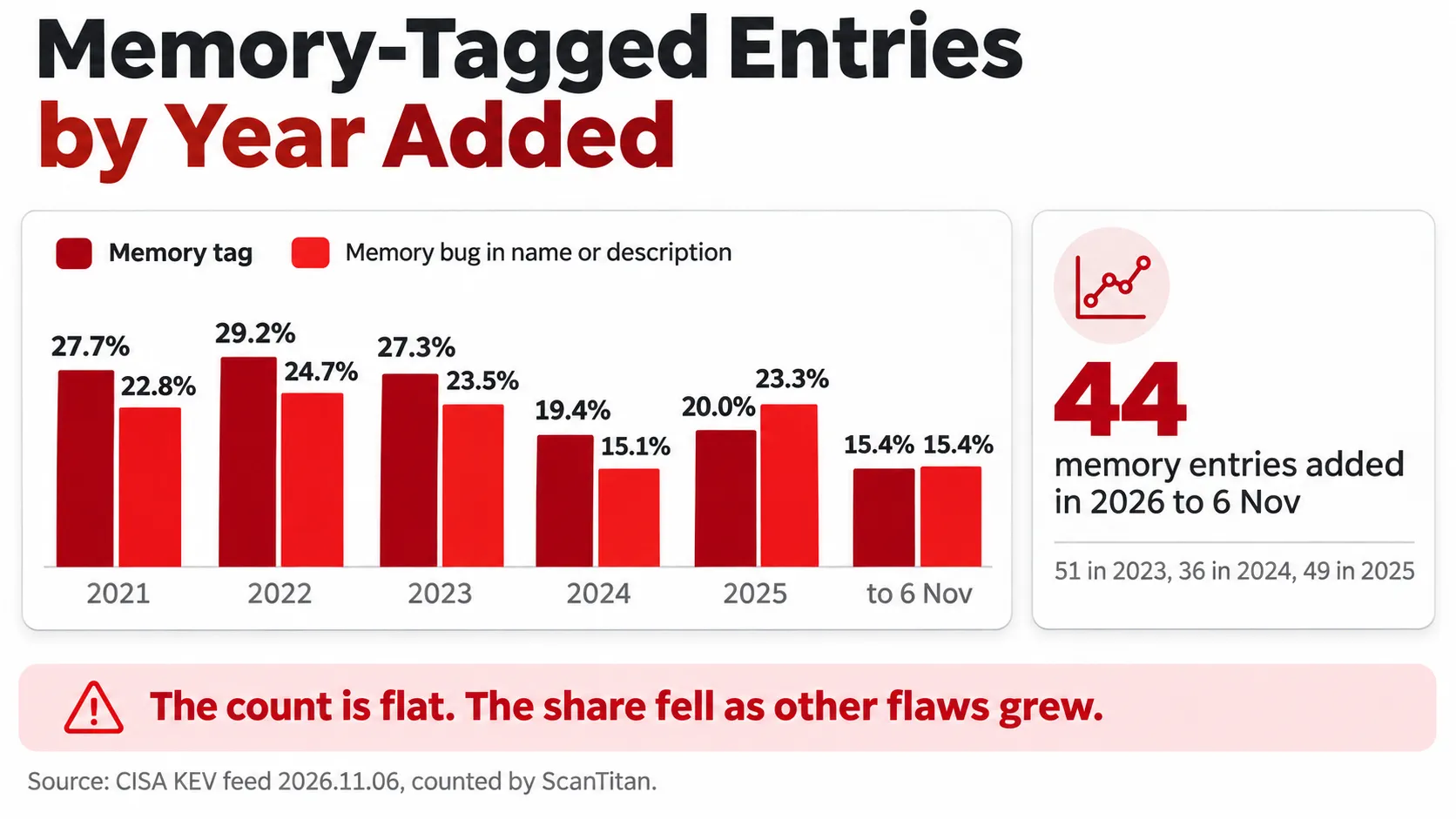
| Memory entries added per year | 44 | 2026 to 6 Nov | 51 in 2023, 36 in 2024, 49 in 2025 | CISA KEV feed, counted by ScanTitan |
| Memory safety share of Android vulnerabilities | Under 20% | 2025 | 24% in 2024, 76% in 2019 | Google, vendor-only |
| Memory safety vulnerability density, Rust vs C and C++ in Android | 1000x lower | 2025 | Rust changes have about 4x lower rollback rate | Google, vendor-only |
| Memory safety share of Chromium’s serious security bugs | About 70% | 912 bugs since 2015 | About half are use after free | Chromium, vendor-only |
| Memory safety share of 2025 zero-days | About 35% | 2025 | Use after free and out-of-bounds write lead | Google Threat Intelligence Group |
| Memory corruption share of 2021 zero-days | 67% (39 of 58) | 2021 | Reported in CISA’s memory safety article | CISA |
| Out-of-bounds write rank in MITRE’s CWE Top 25 | 5th (12 CVEs in KEV) | 2025 list | 2nd last year | MITRE |
| Median days from CVE publication to CISA listing, memory entries | 2 | Added 2023 to 6 Nov 2026 | 27 days for other entries | CISA KEV feed and CVE Services API, counted by ScanTitan |
Methodology: Four Ways to Count Memory Safety
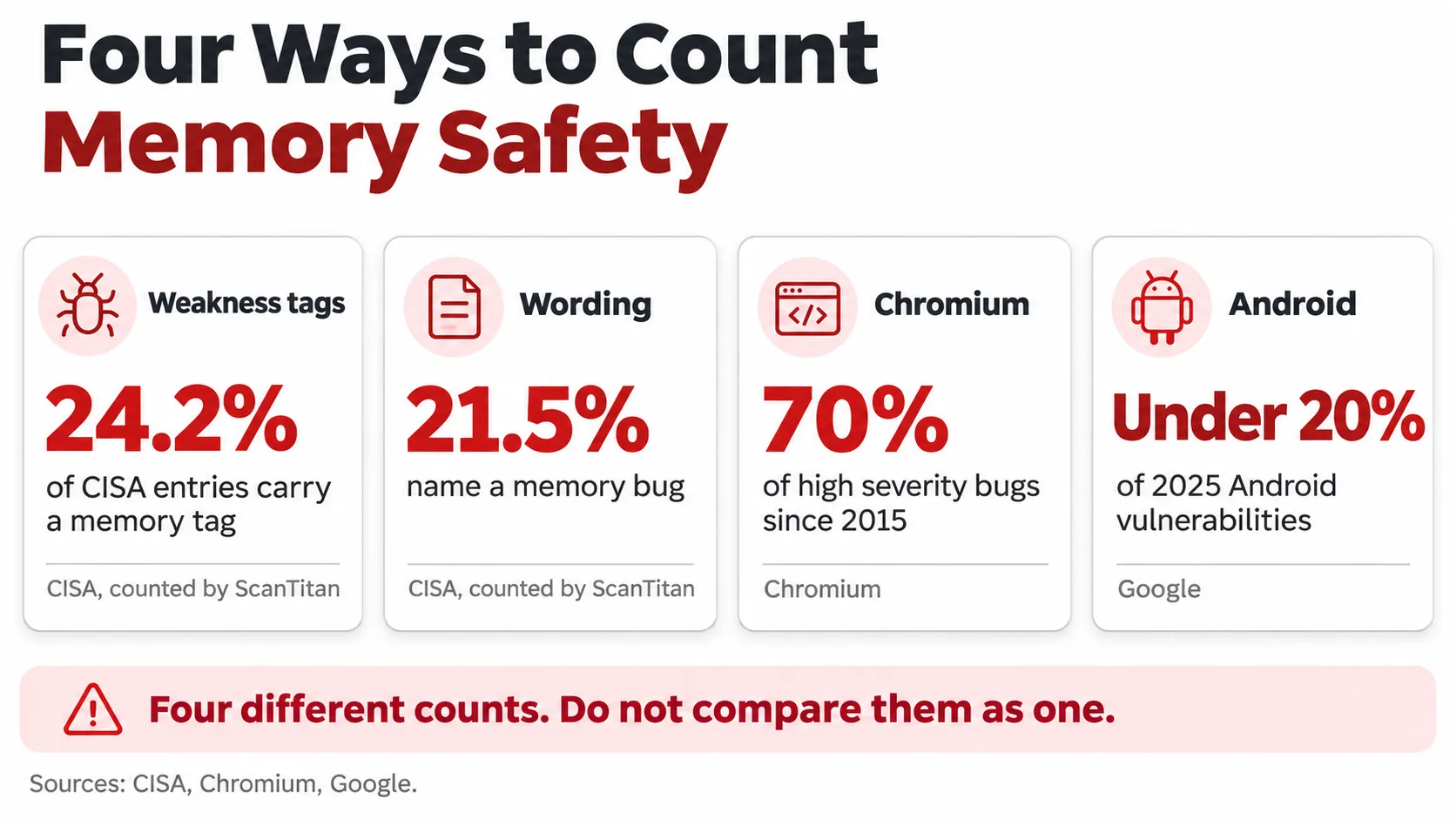
“Memory safety statistics” is used for four different counts. Each answers a different question and can be wrong in a different way.
| Count | What it matches | Example 2026 figure | Source type | What it cannot tell you |
|---|---|---|---|---|
| Weakness tag | A memory-safety weakness type (CWE) on a catalog entry | 24.2% of the CISA catalog | Catalog weakness tags | Whether the bug is the whole story of the attack |
| Description wording | An entry whose name or description names a memory bug | 21.5% of the CISA catalog | ScanTitan text match | Entries described only by outcome, such as “code execution” |
| Vendor project share | A project’s own share of its serious or total vulnerabilities | Android under 20%, Chromium about 70% | Vendor reports | Other products, or exploited versus unexploited flaws |
| Zero-day share | A review’s share of in-the-wild zero-days | About 35% of 2025 zero-days | Google review | The wider catalog of known exploited flaws |
How ScanTitan counted. We downloaded the CISA Known Exploited Vulnerabilities feed, version 2026.11.06 with 1,769 entries. A memory-safety tag means any of 35 weakness types such as out-of-bounds write (CWE-787), use after free (CWE-416), memory buffer bounds (CWE-119), type confusion (CWE-843), heap and stack overflows (CWE-122, 121), out-of-bounds read (CWE-125) and integer overflow (CWE-190). The wording count searches each entry’s name and short description for terms such as “use-after-free”, “buffer overflow”, “out-of-bounds”, “type confusion” and “memory corruption”. CISA lists weakness tags on 1,594 of the 1,769 entries, so the tag share of tagged entries is 26.9%. These are text and tag matches, not CISA classifications. CVE publication dates come from the CVE Services API.
What the vendors count. Google counts memory safety bugs as a share of the vulnerabilities in the Android platform each year. Chromium counts its high and critical severity bugs. Microsoft’s 2019 figure, about 70%, counted the CVEs it assigned each year. Each denominator is different, so none of them equals a share of exploited flaws.
How Many Exploited Flaws Are Memory Safety Bugs?
| Definition (ScanTitan count) | Entries | Share of 1,769 |
|---|---|---|
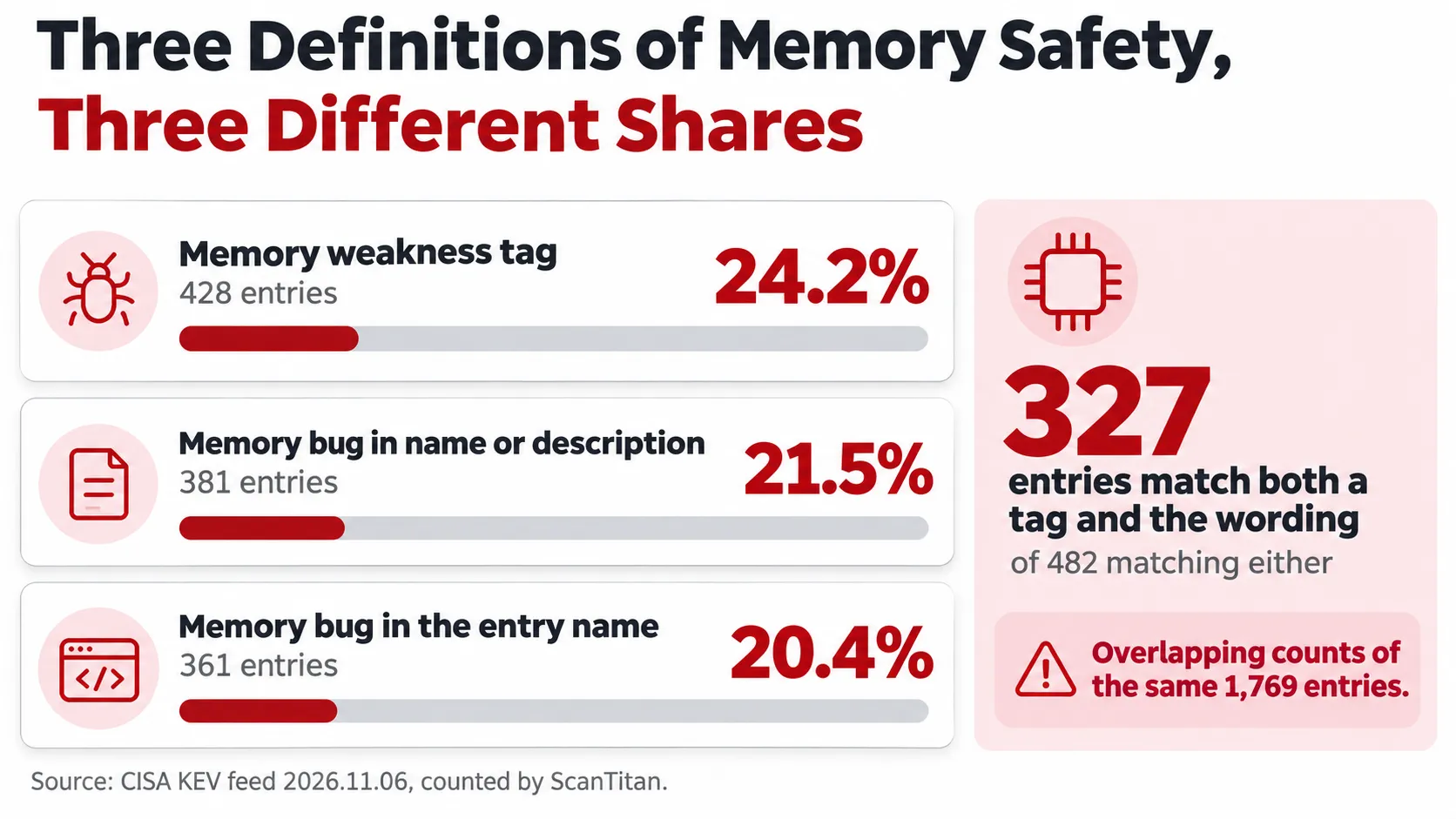
| Carries a memory-safety weakness tag | 428 | 24.2% |
| Name or description names a memory bug | 381 | 21.5% |
| Memory bug named in the entry name | 361 | 20.4% |
| Either a tag or the wording | 482 | 27.2% |
Source: CISA KEV feed version 2026.11.06, counted by ScanTitan. The counts overlap: 327 entries match both a tag and the wording.
About one in four exploited flaws in the catalog is a memory safety bug by weakness tag. The tag count is the largest because many entries describe only the outcome, such as “allows remote code execution”, and name no bug, while their weakness tag shows the cause. That is the reverse of privilege escalation, where the name hides the outcome. Among entries that carry any tag, 26.9% have a memory-safety tag.
The catalog share is well below the 70% that vendors quote, and the gap is expected. Chromium and Microsoft count their own products, which are written mostly in C and C++, while the catalog holds flaws from every kind of software, including web applications, scripts and appliance interfaces where memory safety is rarely the problem.
Is Memory Safety Rising or Falling?
| Year added | Entries | Memory-tagged | Share | Memory bug in name or description | Share |
|---|---|---|---|---|---|
| 2021 | 311 | 86 | 27.7% | 71 | 22.8% |
| 2022 | 555 | 162 | 29.2% | 137 | 24.7% |
| 2023 | 187 | 51 | 27.3% | 44 | 23.5% |
| 2024 | 186 | 36 | 19.4% | 28 | 15.1% |
| 2025 | 245 | 49 | 20.0% | 57 | 23.3% |
| 2026 to 6 Nov | 285 | 44 | 15.4% | 44 | 15.4% |
Source: CISA KEV feed version 2026.11.06, counted by ScanTitan.
By share, memory safety is falling in the catalog: from 27% to 29% of entries added in 2021 to 2023 to 19% to 20% in 2024 and 2025, and 15.4% in 2026 so far. The 2021 and 2022 rows are the launch backlog, when CISA listed old flaws in bulk. But the count tells a different story. Memory-tagged entries added each year were 51 in 2023, 36 in 2024, 49 in 2025 and 44 so far in 2026, so the count is flat while the catalog grew. Entries from vendors other than Microsoft, Google and Apple rose from 132 in 2023 to 226 in 2026 so far, and those added entries are mostly not memory bugs. The share fell because other flaw types were added faster, not because fewer memory bugs are being exploited.
Vendor data shows a real decline in one place. Google reports that memory safety bugs were 76% of Android vulnerabilities in 2019, 24% in 2024 and below 20% in 2025, which it ties to writing new code in Rust and other memory-safe languages. Source: Google, vendor-only. Google’s 2025 zero-day review put memory safety at about 35% of zero-days, down from the 67% of 2021 zero-days that CISA reported, though the two counts use different definitions. Our zero-day statistics research covers how the catalog lists new flaws.
What Causes Memory Safety Bugs: The Weaknesses Behind the Flaws
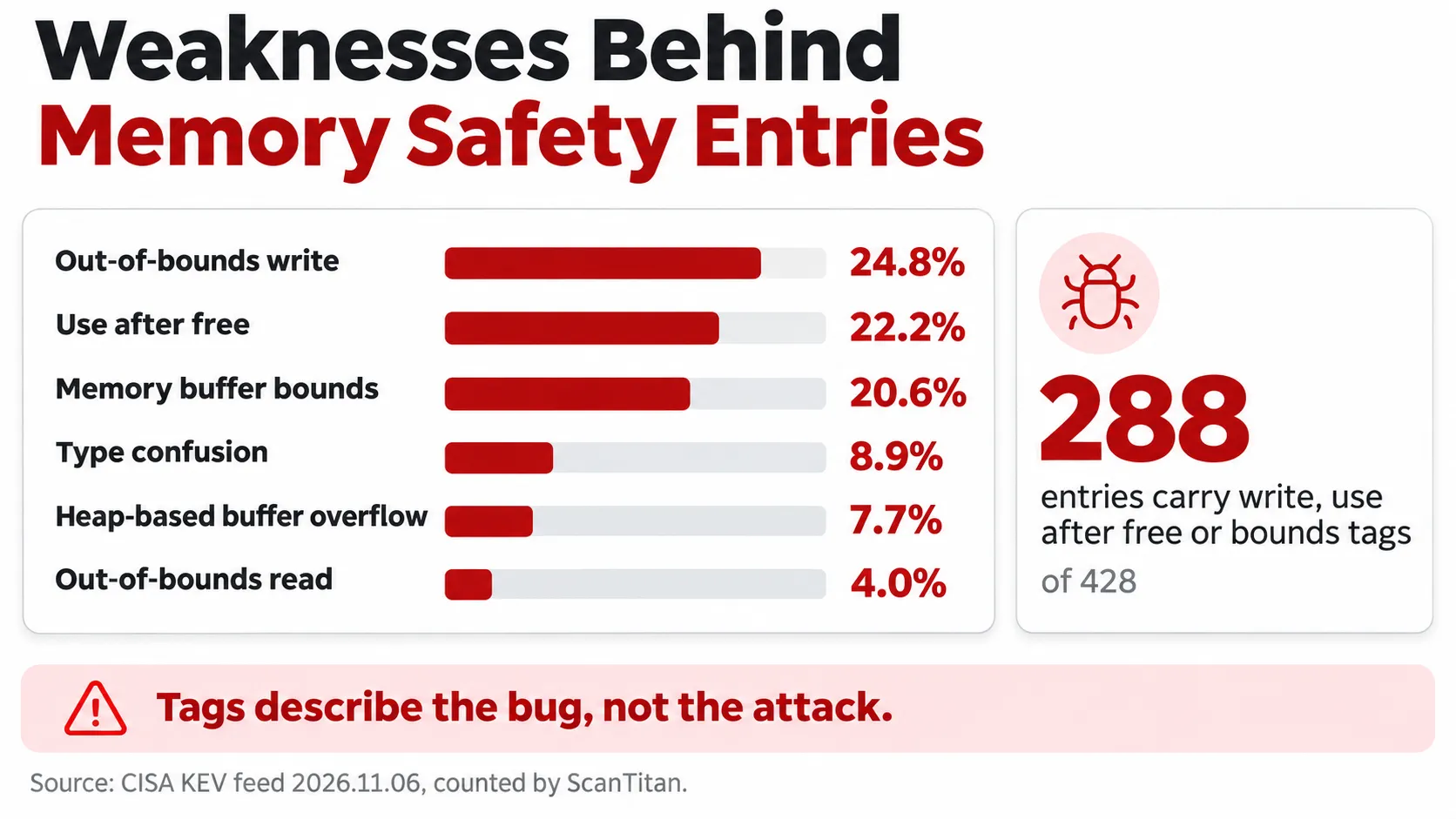
| Weakness | Memory entries with the tag | Share of 428 |
|---|---|---|
| Out-of-bounds write (CWE-787) | 106 | 24.8% |
| Use after free (CWE-416) | 95 | 22.2% |
| Memory buffer bounds (CWE-119) | 88 | 20.6% |
| Type confusion (CWE-843) | 38 | 8.9% |
| Heap-based buffer overflow (CWE-122) | 33 | 7.7% |
| Out-of-bounds read (CWE-125) | 17 | 4.0% |
| Integer overflow (CWE-190) | 17 | 4.0% |
| Stack-based buffer overflow (CWE-121) | 12 | 2.8% |
| Classic buffer overflow (CWE-120) | 12 | 2.8% |
Source: CISA KEV feed version 2026.11.06, counted by ScanTitan. An entry can carry more than one tag, so the rows are not exclusive.
Three weaknesses lead: out-of-bounds write, use after free and the general memory buffer bounds tag. 288 of the 428 memory entries (67.3%) carry at least one of the three, and type confusion, a bug typical of browser and script engines, adds a fourth group. Use after free is the bug Chromium reports as about half of its memory safety problems. Our use after free guide explains it.
MITRE’s 2025 CWE Top 25 ranks the same weaknesses by how often they appear in CVEs and how severe they are, and reports how many of each type are in the catalog:
| Weakness | MITRE 2025 rank | Rank last year | CVEs in KEV (MITRE count) |
|---|---|---|---|
| Out-of-bounds write (CWE-787) | 5 | 2 | 12 |
| Use after free (CWE-416) | 7 | 8 | 14 |
| Out-of-bounds read (CWE-125) | 8 | 6 | 3 |
| Stack-based buffer overflow (CWE-121) | 14 | Not ranked | 4 |
| Heap-based buffer overflow (CWE-122) | 16 | Not ranked | 6 |
Source: MITRE 2025 CWE Top 25. MITRE’s counts come from its own data window and differ from ScanTitan’s whole-catalog counts.
Which Vendors and Products Show Up
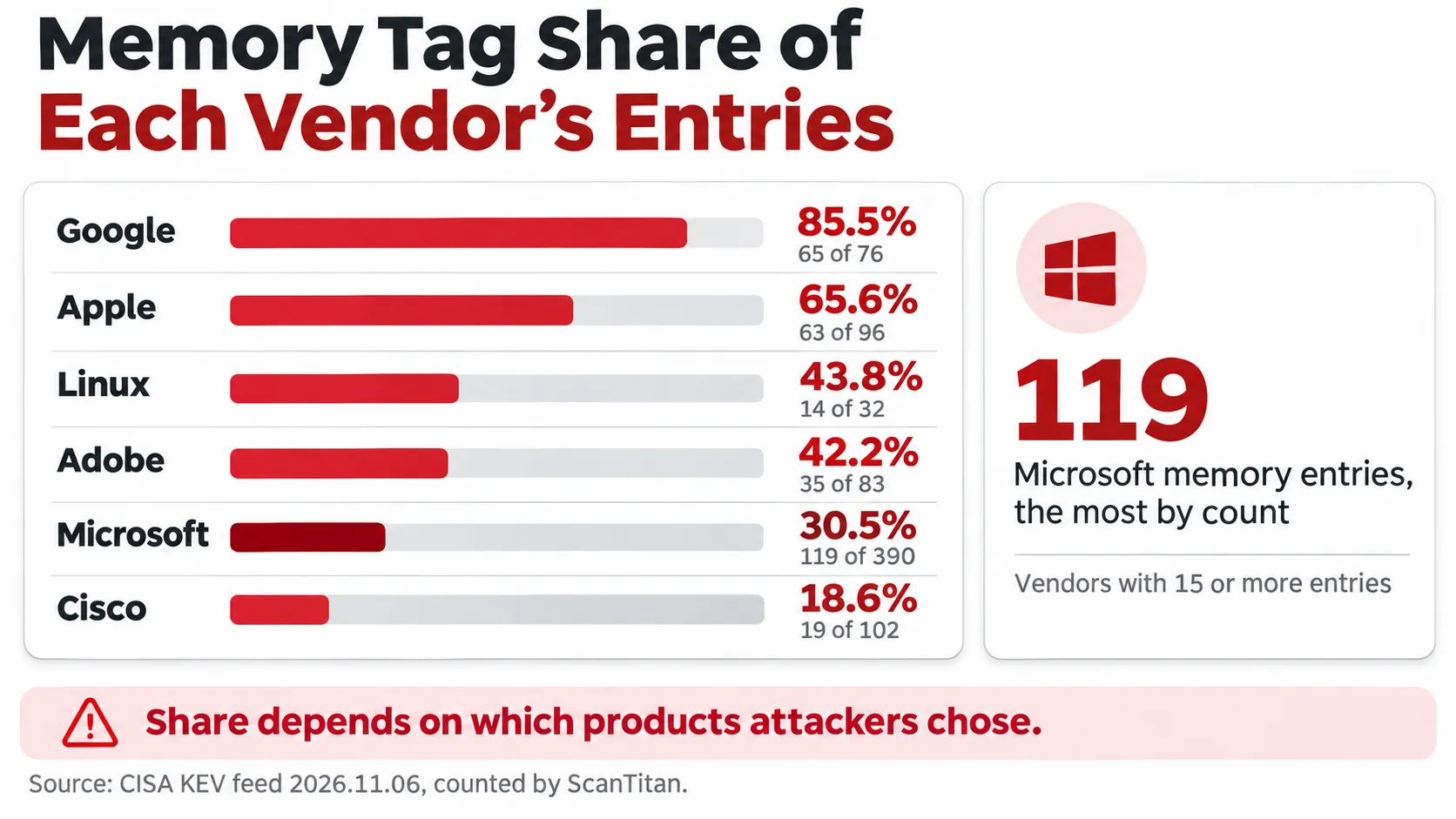
| Vendor | Memory-tagged entries | Vendor’s catalog entries | Share of its entries |
|---|---|---|---|
| 65 | 76 | 85.5% | |
| Apple | 63 | 96 | 65.6% |
| Linux | 14 | 32 | 43.8% |
| Adobe | 35 | 83 | 42.2% |
| Citrix | 10 | 27 | 37.0% |
| Android | 6 | 17 | 35.3% |
| Microsoft | 119 | 390 | 30.5% |
| Fortinet | 7 | 32 | 21.9% |
| Cisco | 19 | 102 | 18.6% |
Source: CISA KEV feed version 2026.11.06, counted by ScanTitan. Vendors with at least 15 catalog entries, sorted by share; the vendor field is the catalog’s own. Linux and Android are listed as vendors in the catalog.
Microsoft has the most memory entries by count, 119, and Google leads by share, 85.5%, because its catalog entries are mostly Chromium and its related components. Apple follows at 65.6%. In entries added in 2025 and 2026 the leaders are Microsoft with 23 of 93, Google with 12 and Apple with 11. Only 53 of the 291 vendors in the catalog have a memory entry.
Browsers, Phones and Kernels vs Servers and Edge
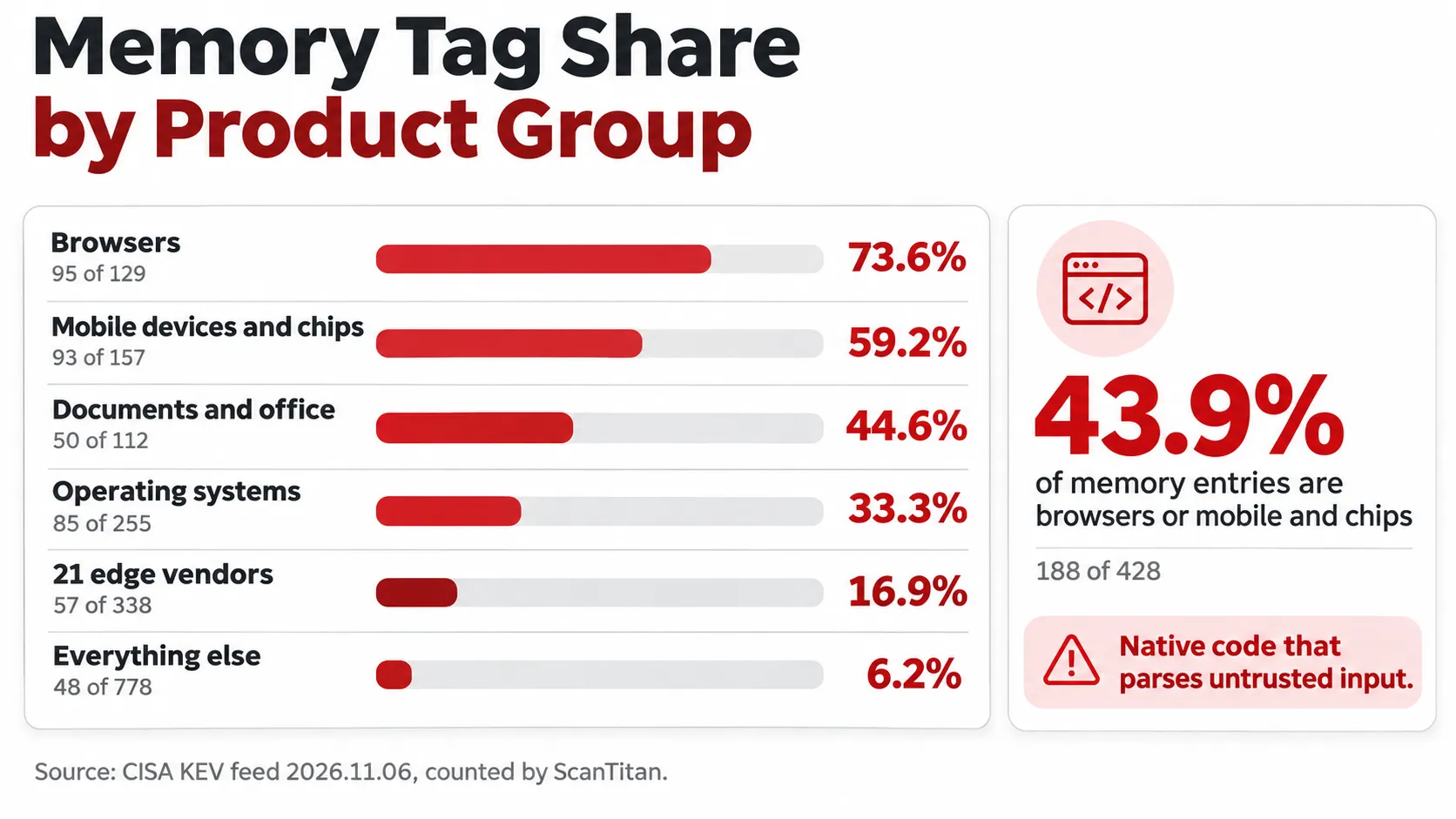
ScanTitan grouped catalog entries by product, giving each entry one group in this order: the 21 firewall, VPN, router and gateway vendors first (Cisco, Fortinet, Palo Alto Networks, Ivanti, Citrix, SonicWall, F5, Juniper, Check Point, Zyxel, D-Link, TP-Link, MikroTik, NETGEAR, Ubiquiti, WatchGuard, Barracuda, Sophos, Pulse Secure, Array Networks and DrayTek), then browsers, mobile and chip products, operating systems, document and office software, and everything else.
| Group | Entries | Memory-tagged | Share |
|---|---|---|---|
| Browsers | 129 | 95 | 73.6% |
| Mobile devices and chips | 157 | 93 | 59.2% |
| Documents and office | 112 | 50 | 44.6% |
| Operating systems | 255 | 85 | 33.3% |
| 21 edge vendors | 338 | 57 | 16.9% |
| Everything else | 778 | 48 | 6.2% |
Source: CISA KEV feed version 2026.11.06, counted by ScanTitan. The groups are keyword based and each entry is in one group.
Memory bugs belong to software that parses untrusted input in native code. Browsers (73.6%) and mobile and chip products (59.2%) lead, and together they hold 188 of the 428 memory entries, 43.9%. Operating systems are lower at 33.3% because many of their entries are logic and permission flaws. Edge devices sit at 16.9%, where login and command injection flaws dominate, and everything else, mostly web applications and servers, is at 6.2%. Our privilege escalation statistics show memory corruption as the largest cause behind escalation entries, at 36.5% of those with a tag.
How Fast Are Memory Safety Flaws Listed?
ScanTitan compared each entry’s CVE publication date with the date CISA added it, for entries added since 2023.
| Group | Entries | Median days to listing | Listed on or before CVE day | Listed within 30 days | Older than one year when listed |
|---|---|---|---|---|---|
| Memory-tagged | 180 | 2 | 37.8% | 67.8% | 15.0% |
| All other entries | 723 | 27 | 16.5% | 51.2% | 23.7% |
Source: CISA KEV feed version 2026.11.06 and the CVE Services API, counted by ScanTitan, entries added 2023 to 6 November 2026.
Memory flaws reach the catalog fast: a median of 2 days against 27, and 37.8% were listed on or before the day the CVE was published, which fits browser and phone flaws exploited as zero-days and fixed in an emergency update. Only 15.0% were over a year old when listed, against 23.7% for other entries. This is the fastest group in our reports. Our patch management statistics cover how long fixes take once a flaw is listed.
Memory Safety and Ransomware
CISA flags a catalog entry when it learns a flaw was used in a ransomware campaign.
| Group | Entries | Flagged as used in ransomware | Share |
|---|---|---|---|
| Memory-tagged, all vendors | 428 | 52 | 12.1% |
| All other entries | 1,341 | 309 | 23.0% |
| Memory-tagged, Microsoft | 119 | 25 | 21.0% |
| Memory-tagged, other vendors | 309 | 27 | 8.7% |
Source: CISA KEV feed version 2026.11.06, counted by ScanTitan.
Memory flaws are flagged for ransomware about half as often as other flaws, 12.1% against 23.0%. We did not test why. One reading is that browser and phone flaws are used in targeted attacks, while ransomware groups lean on login flaws, command injection and Windows privilege escalation. The 25 Microsoft memory entries that are flagged are the exception. Our ransomware statistics research covers the flagged flaws by vendor and the entry-point data.
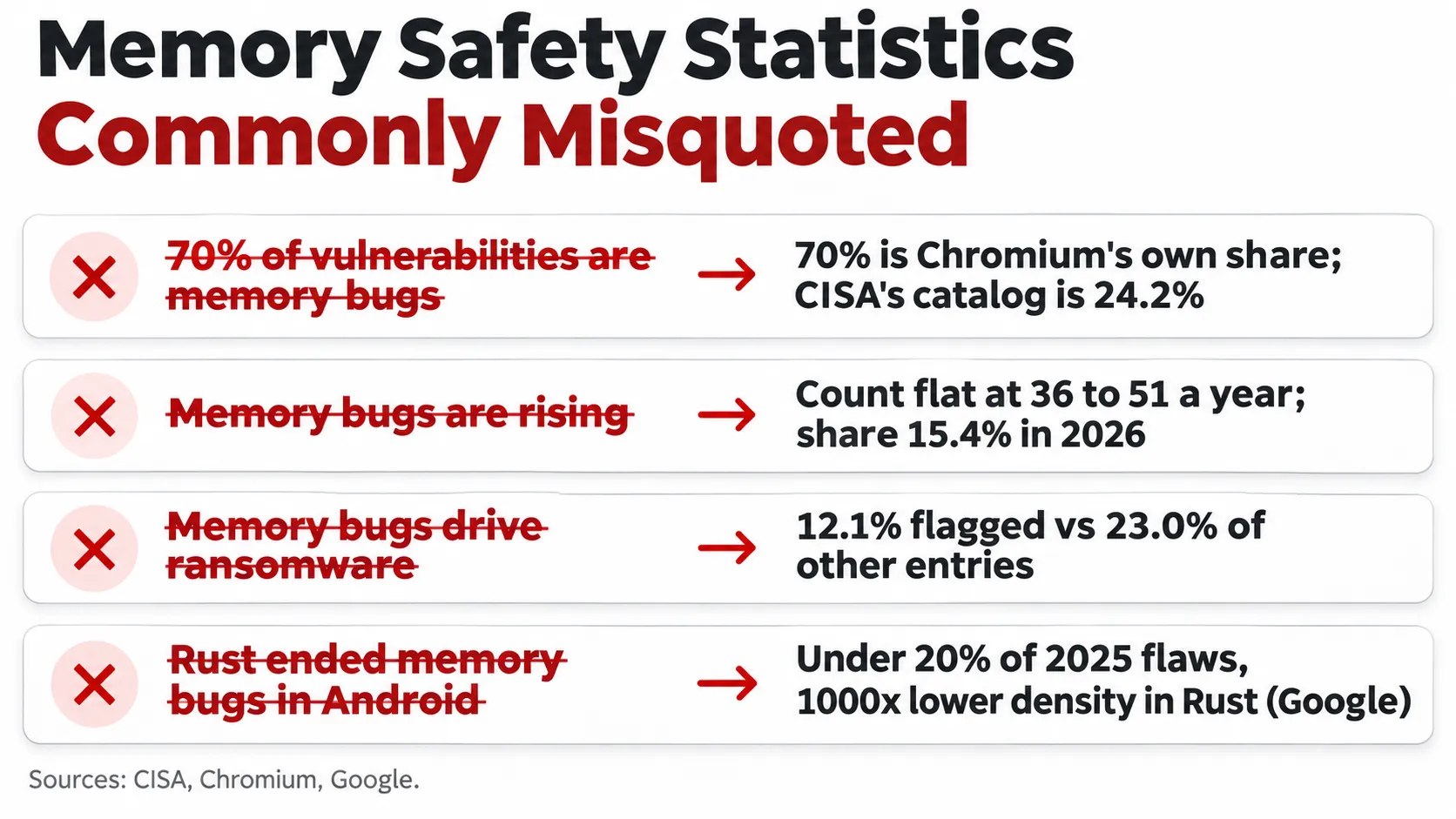
Memory Safety Statistics Commonly Misquoted
| Common claim | Correct context |
|---|---|
| “70% of vulnerabilities are memory safety bugs.” | About 70% is the share of Chromium’s high severity bugs (912 since 2015) and the figure in Microsoft’s 2019 post. In CISA’s exploited catalog it is 24.2% by weakness tag, and Google puts Android under 20% for 2025. |
| “Memory safety bugs are rising.” | In the catalog the yearly count is flat, 36 to 51 entries, and the share fell from 29.2% in 2022 to 15.4% in 2026 so far. Android’s share fell from 76% to under 20%. |
| “Rust has ended memory safety bugs in Android.” | Google reports a 1000x lower density of memory safety vulnerabilities in Rust code than in C and C++ code and a share under 20%. Native code is still over 70% of the platform, and Google documented a near-miss in unsafe Rust. |
| “Most zero-days are memory safety bugs.” | 39 of 58 zero-days in 2021 were memory corruption (67%, CISA). Google’s 2025 review put memory safety at about 35%. The years and definitions differ. |
| “Memory bugs are an operating system problem.” | 73.6% of browser entries and 59.2% of mobile and chip entries carry a memory tag, against 33.3% of operating-system entries. |
| “Memory bugs drive ransomware.” | 12.1% of memory entries are flagged for ransomware, against 23.0% of other entries. |
What the Numbers Mean for a Lean Team
Memory bugs concentrate in browsers, phones and document software, and they reach the exploited list within days, so the work is fast updates on those products and memory-safe choices for new code.
- Update browsers and phones the same week. Memory entries are listed a median of 2 days after the CVE, and 37.8% on or before it. Turn on automatic updates for Chrome, Edge, Firefox, Safari, iOS and Android. The CVE priority checker shows whether a flaw is listed.
- Treat document and image handlers as untrusted input. Document and office software carries a memory tag on 44.6% of its entries, so disable features you do not use and open unknown files in a sandbox.
- Keep libraries current. One memory bug in a shared parser reaches every application that bundles it, so track and update dependencies, not only applications.
- If you write software, choose memory-safe languages for new code. Google found most vulnerabilities live in new or recently changed code, and that 5-year-old code has 3.4 to 7.4 times lower vulnerability density than new code, so changing the language for new code pays back quickly.
- Test native code you keep. Run fuzzing and sanitizers, build with hardening flags, and treat parsers of untrusted input as the highest risk.
- Do not expect memory bugs at the network edge. Firewalls and gateways are mostly hit by login and command flaws, so patch them for those reasons.
- Know what you expose. A website vulnerability scanner finds known flaws on the assets you list.
How We Compiled and Verified These Statistics
- Used: the CISA Known Exploited Vulnerabilities feed (version 2026.11.06), CVE publication dates from the CVE Services API, Google’s November 2025 Android memory safety post, Chromium’s memory safety page, Microsoft’s 2019 MSRC post, CISA’s 2023 memory safety article, Google Threat Intelligence Group’s 2025 zero-day review and MITRE’s 2025 CWE Top 25. Vendor figures are labeled vendor-only.
- Method: each entry’s weakness tags and its name and short description were searched for memory-safety weaknesses and terms, and counts were split by year added, weakness, vendor, product group, listing gap and ransomware flag. Every other figure was read on its own page.
- Limits: the counts are tag and text matches, not a CISA classification. The product groups are keyword based. Vendor shares use different denominators and cannot be compared with the catalog share.
- Excluded: a claim that over 80% of exploited zero-days target memory unsafety and a 60 to 70% figure for iOS and macOS, because the source page would not open in our browser, a regex-engine study, a $5 billion outage cost claim from a secondary PDF, and any figure without a primary source.
- Refresh: reviewed every 90 days. Catalog counts change daily.
How to cite this research. ScanTitan, “Memory Safety Statistics 2026: Flaws, Vendors & Trends,” 18 November 2026. For single figures, cite the primary source beside each number.
Primary Sources
- CISA Known Exploited Vulnerabilities catalog data feed
- CVE Program
- Google, Rust in Android: move fast and fix things, vendor-only
- Google Security Blog, Eliminating Memory Safety Vulnerabilities at the Source, vendor-only
- Android Open Source Project, Memory safety, vendor-only
- Chromium, Memory safety, vendor-only
- Microsoft MSRC, We need a safer systems programming language, vendor-only
- CISA, The Urgent Need for Memory Safety in Software Products
- Google Threat Intelligence Group, 2025 Zero-Days in Review
- MITRE, 2025 CWE Top 25 Most Dangerous Software Weaknesses
Frequently Asked Questions
What is memory safety?
Memory safety means a program cannot read or write memory it should not access. Memory safety bugs, such as buffer overflows and use after free, let attackers corrupt data or run code, and they are common in software written in C and C++.
How many vulnerabilities are memory safety bugs?
It depends on what is counted. About 70% is the long-quoted share for Chromium’s serious bugs and Microsoft’s CVEs, Google reports under 20% for Android in 2025, and in ScanTitan’s count of CISA’s exploited catalog 24.2% of 1,769 entries carry a memory-safety weakness tag.
Are memory safety bugs increasing?
Not in the exploited catalog. Tagged entries added each year have stayed between 36 and 51 since 2023, and their share fell from 29.2% in 2022 to 15.4% in 2026 to 6 November. Android’s share fell from 76% in 2019 to under 20% in 2025.
What are the most common memory safety weaknesses?
In CISA’s catalog, out-of-bounds write (CWE-787) is on 24.8% of memory entries, use after free (CWE-416) on 22.2% and memory buffer bounds (CWE-119) on 20.6%. Chromium reports about half of its memory bugs are use after free.
Which vendors have the most memory safety flaws exploited?
Microsoft has the most catalog entries, 119, followed by Google (65) and Apple (63). By share of its own entries, Google leads at 85.5%.
Do firewalls and VPNs have memory safety flaws?
Some do, but less often: 16.9% of the 21 edge vendors’ catalog entries carry a memory tag, against 73.6% for browser entries and 59.2% for mobile and chip entries.
How fast are memory safety flaws added to CISA’s catalog?
For entries added since 2023, memory flaws were listed a median of 2 days after the CVE was published, against 27 days for other entries, and 37.8% were listed on or before the CVE day.
Are memory safety bugs linked to ransomware?
Less than other flaws. CISA flags 12.1% of memory entries as used in ransomware against 23.0% of other entries, and one reading is that many are browser and phone flaws used in targeted attacks.
Does Rust fix memory safety?
It cuts the problem sharply. Google reports a 1000x lower density of memory safety vulnerabilities in Android’s Rust code than in its C and C++ code. Rust does not remove them entirely, because unsafe code can still contain bugs.
How do I protect against memory safety bugs?
Update browsers, phones and document software quickly, keep libraries current, and open unknown files in a sandbox. If you write software, use memory-safe languages for new code and fuzz the native code you keep.
Where does this data come from?
From CISA’s Known Exploited Vulnerabilities feed (version 2026.11.06), the CVE Services API and primary reports from Google, Chromium, Microsoft, CISA and MITRE, as named beside each figure.