
Is Drupal secure? Yes, when it runs on a supported branch, receives security updates promptly, and is configured and maintained correctly. Drupal provides a strong security foundation through a dedicated Security Team, coordinated vulnerability disclosure, granular permissions, secure rendering defaults, configuration management, and public security advisories. But a secure Drupal core does not automatically make every Drupal website secure. Contributed modules, custom code, administrator access, server configuration, unsupported versions, and patching speed can still create exploitable weaknesses.
Short answerDrupal is generally a secure CMS, particularly for organizations that need granular access control and structured security governance. The larger risk on real Drupal sites often comes from outdated modules, custom code, excessive permissions, unsupported branches, weak credentials, and the surrounding hosting environment rather than from a fully patched supported Drupal core installation.
Last reviewed: September 15, 2026. Drupal version-support information and 2026 security data are date-sensitive and should be rechecked as new releases and advisories are published.
Is Drupal Secure? The Short Answer
Yes. Drupal is generally considered a secure content management system when it runs on a supported branch, receives security updates promptly, and is configured correctly.
Drupal is widely used for government, higher-education, financial, nonprofit, media, and enterprise websites where granular permissions, structured content governance, configuration control, and security oversight matter.
However, the platform’s reputation does not automatically make every Drupal installation secure. Platform security establishes the foundation. The modules you install, the permissions you grant, the code you customize, the infrastructure underneath the site, and the speed at which you apply security updates determine how secure your specific Drupal website remains.
Why Is Drupal Considered Secure? How Drupal Security Works
Drupal’s security reputation comes less from claiming that vulnerabilities never occur and more from the processes and architectural controls used to prevent, identify, disclose, and remediate them.
A Dedicated Drupal Security Team and Coordinated Disclosure
Drupal has a formal Security Team made up of volunteers and security professionals from consultancies, agencies, hosting companies, and organizations that use the platform.
When a researcher privately reports a vulnerability, the team evaluates the issue, coordinates with affected maintainers, prepares fixes, and publishes a security advisory with remediation information. This coordinated process can reduce the period between public disclosure and the availability of a security update.
The existence of a Security Team does not mean every line of Drupal core or every contributed module is continuously audited. Drupal’s own documentation explicitly notes that the team does not generally review all core and contributed-project code. The strength is the organized system for receiving, assessing, coordinating, and communicating security issues after they are identified.
Security Advisories, Drupal Risk Scores, CVEs, and Drupal Steward
Drupal publishes numbered security advisories such as SA-CORE for Drupal core and SA-CONTRIB for contributed projects.
Drupal advisories use the project’s own security risk score, which ranges from 0 to 25 and considers factors such as access complexity, privileges, impact, exploit availability, and the population potentially affected.
This Drupal risk score is separate from the Common Vulnerability Scoring System, or CVSS. A vulnerability may also receive a CVE identifier and a CVSS score from the relevant vulnerability-data ecosystem.
A useful 2026 example is SA-CORE-2026-004, which addressed CVE-2026-9082. The flaw was a highly critical SQL injection vulnerability affecting Drupal websites using PostgreSQL. Anonymous exploitation was possible, and Drupal updated the advisory on May 22, 2026 after exploitation attempts were detected in the wild.
CISA subsequently added CVE-2026-9082 to its Known Exploited Vulnerabilities catalog. That distinction matters because CVSS severity describes potential technical impact, while CISA KEV identifies vulnerabilities with evidence of real-world exploitation.
Drupal also operates Drupal Steward for certain highly critical, mass-exploitable vulnerabilities. During coordinated disclosure, protective network rules can be prepared and moved into enforcement before the vulnerability is publicly disclosed, reducing the exposure window while organizations test and deploy the permanent security update.
Drupal Steward does not replace patchingDrupal Steward is a temporary network-level mitigation for qualifying vulnerabilities. The permanent fix is still to install the security update.
Why Open Source Can Be a Security Advantage
A common concern is that publicly available source code gives attackers a map of the platform. Public code also allows independent researchers, maintainers, agencies, developers, and users to inspect implementation details, report weaknesses, and verify how fixes work.
Open source does not make software automatically secure. Poorly maintained open-source projects can remain vulnerable just as proprietary software can.
The security advantage comes from the practices around the software: active maintenance, responsible disclosure, public advisories, peer review, reproducible fixes, and a community able to inspect changes independently.
For organizations with formal security and development processes, that transparency can also make vulnerability assessment, change review, and software governance easier.
Where Does Drupal’s Real Security Risk Live?
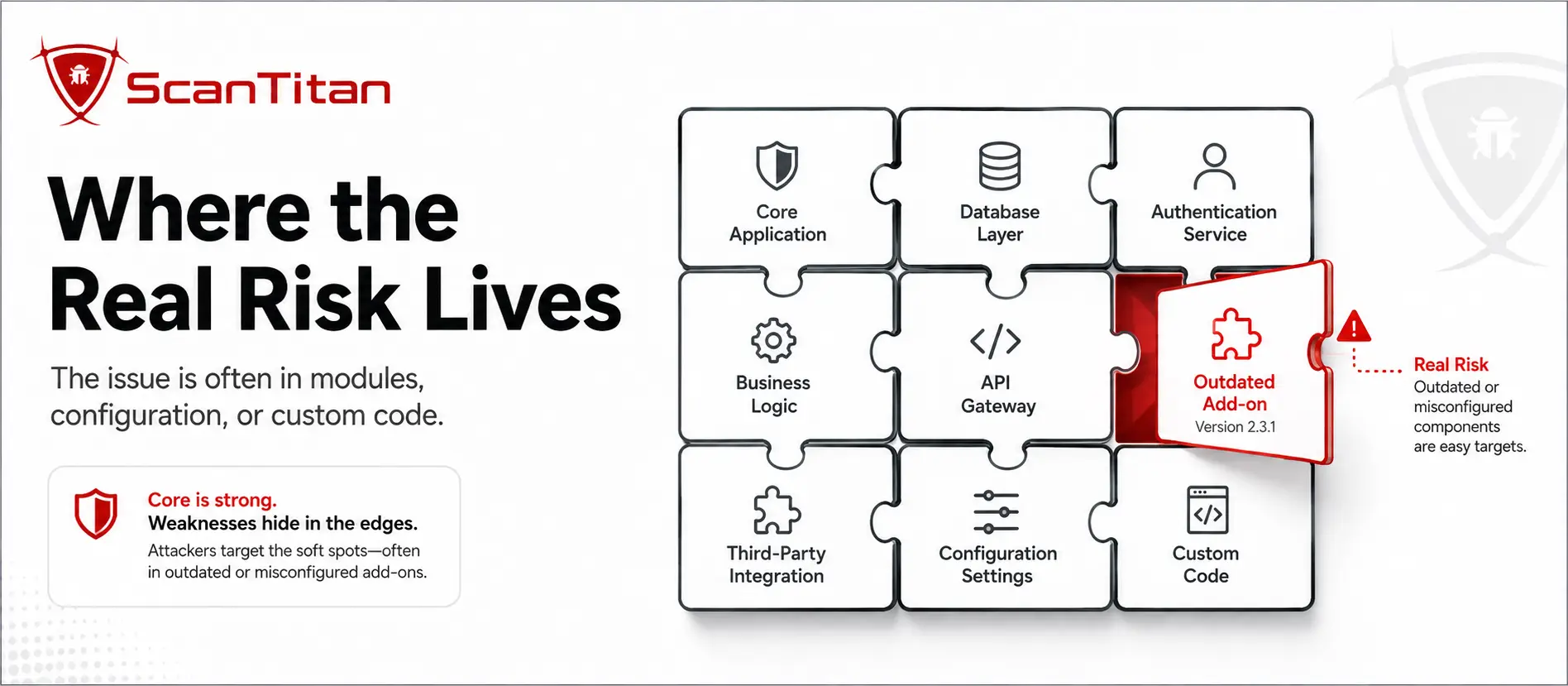
For many Drupal websites, the largest security risk is not the supported core platform. It is the collection of contributed modules, custom modules, themes, integrations, permissions, credentials, and infrastructure added around it.
Drupal’s own security documentation states that professional audits of live Drupal websites have generally found 90% or more of identified security holes in site-specific custom themes or modules.
That figure needs context. It is an observation from professional audits cited by Drupal.org; it does not mean that 90% of every Drupal vulnerability worldwide is caused by custom code. The audited sites represent specific deployed environments rather than the entire Drupal ecosystem.
The operational lesson is still important: custom code does not receive the same broad public scrutiny as Drupal core and heavily used contributed projects.
Contributed modules create another layer of risk. Maintenance quality ranges from widely deployed, actively maintained projects to extensions that may not have received a release in years. A module that is abandoned, unsupported, or outside Drupal’s security-advisory policy may require additional review before being trusted in production.
Misconfiguration creates a second major category of Drupal security risk. Common examples include:
- Excessive permissions for authenticated or anonymous users.
- Administrative accounts without multi-factor authentication.
- Unsupported contributed modules or themes.
- Exposed backups or configuration copies.
- Weak file-system permissions.
- Unsafe text formats that allow untrusted HTML.
- Verbose error messages that expose internal information.
- Publicly reachable administrative or development functionality.
- Unsupported PHP, database, web-server, or operating-system components.
- Secrets or credentials exposed in code, repositories, or configuration files.
A secure core installation can therefore still be compromised if one contributed module, custom feature, privileged account, or server setting creates an exploitable path.
Which Vulnerabilities Commonly Affect Drupal Websites?
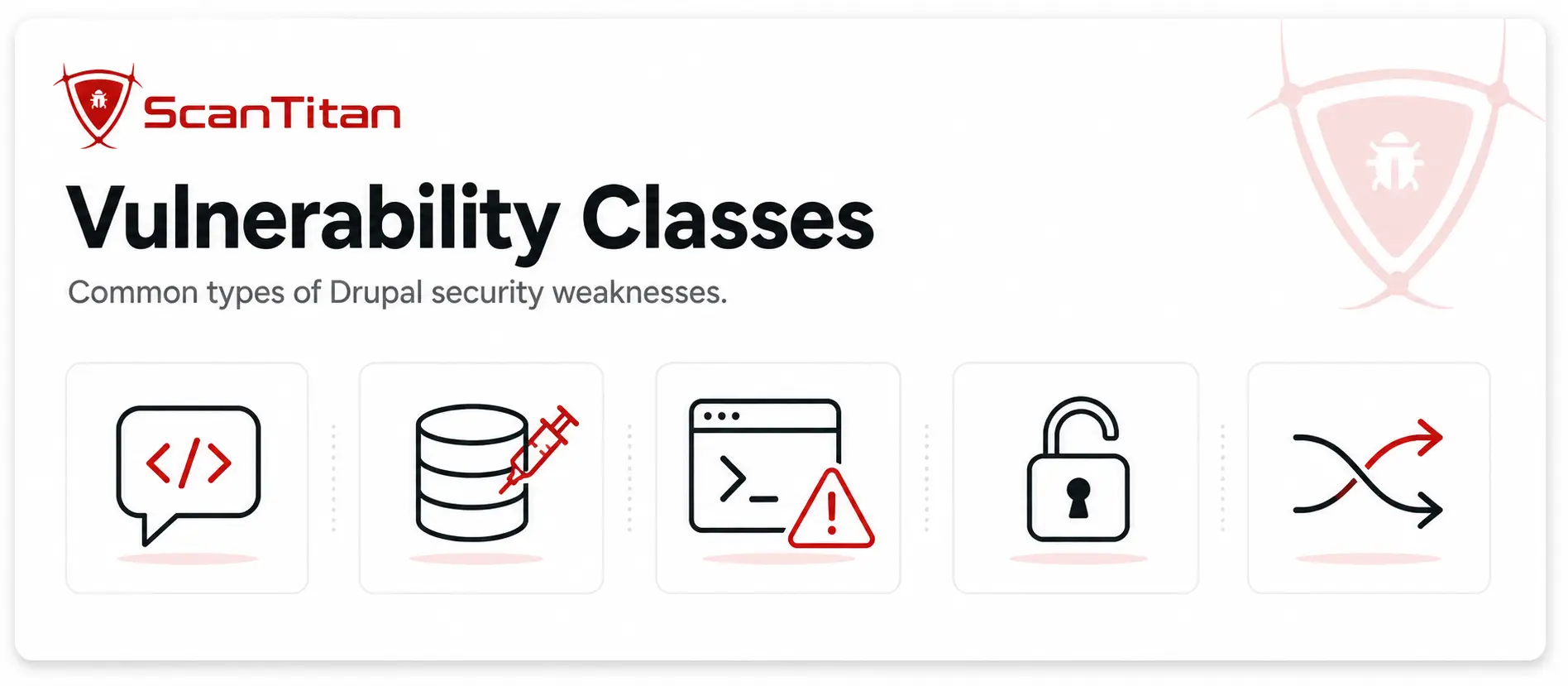
Drupal security vulnerabilities are not one single class of flaw. Vulnerabilities can occur in Drupal core, contributed modules, themes, custom code, dependencies, authentication flows, or infrastructure.
Many map to broader web application categories represented in the OWASP Top 10. For a wider technical overview beyond Drupal, ScanTitan’s guide to the types of website security vulnerabilities explains the main application-level weakness categories.
1. Cross-Site Scripting (XSS)
Cross-site scripting allows malicious JavaScript or HTML to be inserted into content viewed by another user.
A successful XSS vulnerability may be used to steal session data, modify visible content, redirect visitors, or perform actions using the victim’s privileges.
Drupal’s Twig templating engine automatically escapes normal template output by default, creating an important framework-level guardrail against many common XSS mistakes.
However, custom themes, unsafe filters, incorrectly marked output, contributed modules, JavaScript code, and custom rendering logic can still reintroduce XSS weaknesses. Drupal’s secure-coding documentation specifically warns developers about cases where automatic escaping is bypassed.
2. SQL Injection
SQL injection occurs when untrusted data becomes part of a database query without the required parameterization or safe query handling.
Drupal provides a database abstraction API designed to help prevent SQL injection, but vulnerabilities can still occur in core, contributed modules, or custom code when assumptions or implementation details break down.
The historical Drupalgeddon vulnerability, CVE-2014-3704, was a severe SQL injection issue affecting Drupal 7.
A much newer example is CVE-2026-9082. The vulnerability occurred in Drupal’s database abstraction layer and allowed specially crafted requests to trigger arbitrary SQL injection on websites using PostgreSQL. Drupal reported that anonymous exploitation was possible and later confirmed attempts to exploit the vulnerability in the wild.
For the testing methodology behind this vulnerability class, see ScanTitan’s guide on how to test for SQL injection vulnerabilities.
3. Remote Code Execution
Remote code execution, or RCE, allows an attacker to execute code or commands on the affected server.
Drupalgeddon 2, CVE-2018-7600, was an unauthenticated remote-code-execution vulnerability that could allow attackers to compromise vulnerable Drupal websites.
RCE vulnerabilities are particularly dangerous because successful exploitation can lead to data theft, malware installation, website defacement, persistence, credential theft, or movement into other systems.
4. Access Bypass and Broken Access Control
Access-bypass vulnerabilities allow a user to view, edit, delete, administer, or invoke functionality that should be outside their authorization level.
These weaknesses can appear when a module performs an incomplete permission check, trusts a user-controlled identifier, exposes an administrative route, or applies authorization inconsistently across different interfaces.
Drupal’s granular role and permission system provides a strong authorization foundation, but custom and contributed code still has to enforce those rules correctly.
5. Cross-Site Request Forgery
Cross-site request forgery, or CSRF, tricks an authenticated user into performing an action they did not intend to perform.
Drupal core provides CSRF tokens and form-protection mechanisms, but custom routes, controllers, forms, and contributed modules can still introduce CSRF weaknesses if those controls are bypassed or incorrectly implemented.
What Does Drupal’s 2026 Security Record Show?
Drupal’s 2026 security data is useful, but it needs the correct denominator. The official Drupal Security Team security track record listed 12 Drupal core security advisories and 73 contributed-project advisories through July 8, 2026.
| 2026 security measure | Figure | What it actually measures |
|---|---|---|
| Drupal core advisories | 12 | Official Drupal core security advisories in the Security Team’s published 2026 snapshot through July 8. |
| Contributed-project advisories | 73 | Official contributed-project security advisories in the same published snapshot. |
| Highest-profile exploited 2026 core issue | CVE-2026-9082 | PostgreSQL-specific SQL injection vulnerability with exploitation attempts detected in the wild. |
These figures do not mean that 85 websites were compromised, that Drupal had exactly 85 CVEs, or that every advisory had the same severity. A security advisory, CVE record, vulnerable website, and successful compromise are different units.
The advisory count itself should also not be treated as a simple security score. Drupal argues that an active disclosure and remediation process can produce more visible advisories because vulnerabilities are being identified, coordinated, and fixed rather than remaining undisclosed.
For the deeper dataset—including core-versus-contributed trends, severity, exploitation, historical advisories, and Drupalgeddon vulnerabilities—see ScanTitan’s Drupal vulnerability statistics. For cross-platform context, our CMS vulnerability statistics research compares security data across major content-management systems without treating incompatible CVE datasets as equivalent.
Drupal Security Features in Drupal 10 and Drupal 11
Supported Drupal 10 and Drupal 11 releases include several security controls and architectural guardrails that provide a stronger starting point than legacy branches.
| Drupal security feature | What it helps protect | Important limitation |
|---|---|---|
| Twig automatic output escaping | Reduces many common cross-site scripting mistakes in normal template output. | Unsafe filters, JavaScript contexts, custom code, or intentionally unescaped content can still create XSS. |
| Granular roles and permissions | Allows detailed control over what different user roles can view, edit, administer, and configure. | Excessive or incorrectly assigned permissions can still create privilege and data-exposure risks. |
| CSRF and form protections | Provides tokens and framework controls for protecting state-changing requests. | Custom routes and forms must use the framework correctly. |
| Flood control | Provides basic controls for repeated actions such as login attempts. | It is not a replacement for MFA, identity monitoring, rate limiting at other layers, or bot protection. |
| Trusted host configuration | Helps restrict the hostnames Drupal will accept. | It needs to be configured correctly for the deployed environment. |
| Security update reporting | Helps administrators identify available Drupal and project updates. | Notifications only help if someone reviews them and deploys updates promptly. |
| Configuration management | Allows configuration to be exported, reviewed, version-controlled, tested, and deployed between environments. | It does not prevent insecure configuration from being deliberately approved and deployed. |
Drupal’s configuration management system is particularly useful for larger teams. Settings such as enabled modules, content types, fields, views, and other configuration can be exported to files and reviewed through development and staging workflows rather than changed directly in production.
That does not make configuration automatically secure, but it can improve governance by making changes reviewable and reproducible.
Drupal does not currently provide a universal full two-factor authentication system as a standard core feature. MFA is normally implemented through a maintained contributed module, an external identity provider, single sign-on, hosting controls, or another access-management layer.
Privileged accounts should use multi-factor authentication regardless of how it is implemented.
Which Drupal Versions Still Receive Security Updates in 2026?
A Drupal website can continue functioning after its branch loses security support, which makes version lifecycle one of the most important Drupal security checks.
As of September 15, 2026, Drupal’s official core release schedule lists these stable branches inside the current security-release window:
- Drupal 11.4.x
- Drupal 11.3.x
- Drupal 10.6.x
Drupal 11.2.x, Drupal 10.5.x, and earlier minor branches have already left normal security coverage.
Drupal 10.6 is the final Drupal 10 minor release. Drupal 10 reaches end of life on December 9, 2026, when its regular security support ends. Organizations still running Drupal 10 should therefore treat 10.6 as a migration bridge rather than a long-term destination.
Older major releases are already unsupported:
- Drupal 7 reached end of life on January 5, 2025.
- Drupal 8 reached end of life in November 2021.
- Drupal 9 reached end of life in November 2023.
Once a branch reaches end of life, the Drupal Security Team no longer provides normal security coverage for it even though researchers may continue discovering vulnerabilities.
Commercial extended-support services may temporarily reduce some risks for older installations, but extended support should normally be treated as a migration bridge rather than a permanent replacement for moving to a supported Drupal branch.
If you are unsure what release a site is running, ScanTitan’s guide on how to check the Drupal version of a website covers dashboard, command-line, file-access, and authorized external-identification methods.
Drupal Security Best Practices: How Do You Secure a Drupal Website?
The following Drupal security checklist focuses on the controls that have the greatest practical effect on a production website. A secure platform can still become exposed if these operational controls are ignored.
Drupal core is strong, but contributed modules are not covered by the same review. A website security scanner tests what is actually deployed rather than what the advisory list says should be safe.
- Keep Drupal core supported and fully patched. Track both major and minor branch support instead of checking only whether you are running Drupal 10 or Drupal 11.
- Update contributed modules and themes promptly. Security responsibility extends beyond core.
- Remove extensions you no longer need. Unused software can remain part of the attack surface.
- Review module maintenance before deployment. Check whether a project remains maintained, supported, security-advisory-covered, and compatible with your core branch.
- Review custom code separately. Custom modules and themes have not received the same broad public review as Drupal core.
- Apply least privilege. Give roles only the permissions required for their actual tasks.
- Review anonymous-user permissions. Unauthenticated users should not have unnecessary access to restricted content, unsafe text formats, administrative functionality, or sensitive data.
- Protect privileged accounts with MFA. Include Drupal administrators, hosting accounts, SSO identities, repositories, and infrastructure accounts.
- Enforce HTTPS correctly. Protect credentials and sessions with current TLS configuration.
- Secure file storage. Keep database backups, private files, configuration exports, archives, and sensitive uploads outside publicly reachable locations.
- Separate development from production. Review and test code and configuration before deploying changes to the live site.
- Use a WAF where appropriate. A web application firewall can reduce exposure to some attack patterns but is not a replacement for patching.
- Maintain tested backups. Backups should be protected from public access and tested for restoration before an incident occurs.
- Monitor Drupal security advisories. Someone should have explicit responsibility for evaluating advisories affecting every installed project.
- Scan the deployed website regularly. Do not assume the production site matches the intended configuration.
How Should You Monitor Drupal Security Updates?
Drupal’s own site-security guidance recommends enabling the core Update Manager and configuring it with a monitored email address so administrators can be notified about available updates.
Composer-managed Drupal deployments can add another layer by running composer audit on a schedule. Composer audits installed dependencies against known security-advisory data, helping detect vulnerable packages beyond Drupal modules alone.
The contributed Security Review module can also inspect aspects of a Drupal site’s security configuration. Like any contributed project, it should itself be evaluated for maintenance status, compatibility, and advisory coverage before deployment.
Drupal’s current core release schedule normally places the main core security-release window on the third Wednesday of the month, although Drupal notes that emergency releases can occur outside scheduled windows. Monitoring therefore needs to be continuous rather than limited to one calendar day.
What Security Does Drupal Not Handle for You?
Drupal secures the CMS application layer, but it cannot independently secure the entire technology stack around the website.
A fully patched Drupal website can still be compromised through:
- An outdated PHP runtime.
- A vulnerable web server or database.
- Weak hosting or cloud configuration.
- Exposed management interfaces or services.
- Compromised administrator or hosting credentials.
- Leaked API keys, database passwords, or other secrets.
- Unsafe filesystem permissions.
- Publicly accessible backups.
- Insecure TLS configuration.
- Missing logging and monitoring.
- Third-party integrations or JavaScript dependencies.
Drupal.org itself notes that server-level weaknesses can be a more likely compromise path than Drupal core on well-maintained sites. Website security therefore needs to cover the deployed application and its surrounding infrastructure rather than treating the CMS as the entire security boundary.
ScanTitan’s website security statistics research provides broader 2026 context on vulnerability exploitation, security configuration, automated attack traffic, CMS exposure, and other web-layer risks.
Scan the Drupal Site You Actually Deployed
Configuration documentation tells you how a Drupal site should be built. Security testing helps verify what is actually reachable in production.
ScanTitan’s Drupal Vulnerability Scanner checks identifiable Drupal core versions, contributed modules, themes, exposed files, and configuration weaknesses against relevant vulnerability information and available scan evidence.
Authenticated scanning can identify components and weaknesses that an external unauthenticated check may not see. Results should still be prioritized using exposure, active exploitation, business importance, available fixes, and manual validation where needed.
A raw severity score is only one prioritization signal. ScanTitan’s guide to vulnerability remediation prioritization explains how CVSS, CISA KEV, EPSS, asset exposure, and business context can be combined to decide which findings should be fixed first.
A vulnerability scan is also not equivalent to a penetration test. Scanning provides broad, repeatable detection of known weaknesses, while a penetration test uses human-led exploitation and attack chaining to prove what an attacker can actually accomplish. Our vulnerability scanning vs penetration testing comparison explains when each approach is appropriate.
So, Is Drupal Safe?
Drupal is a secure platform when it is current, maintained, and configured correctly.
Its dedicated Security Team, coordinated disclosure process, granular permission model, Twig auto-escaping, structured configuration management, security-advisory system, and predictable support lifecycle provide a strong foundation for security-sensitive websites.
But Drupal security is not created by the platform name alone.
A website can still become vulnerable when it runs an unsupported branch, depends on abandoned modules, contains insecure custom code, grants excessive permissions, exposes backups or services, uses weak administrator authentication, or leaves its underlying server stack unpatched.
The most useful security question is therefore not simply whether Drupal is secure. It is whether the specific Drupal deployment is supported, patched, correctly configured, minimally privileged, monitored, and tested.
Keep the core branch supported, vet every extension, review custom code, protect privileged access, monitor advisories, maintain the surrounding infrastructure, and verify the running website rather than assuming it is secure. With those controls in place, Drupal can provide a strong foundation for high-security and complex publishing environments.
Frequently Asked Questions
Is Drupal secure?
Yes. Drupal provides a strong security foundation when it runs on a supported version, receives security updates promptly, and is configured correctly. A live Drupal site’s security also depends on contributed modules, custom code, permissions, administrator access, hosting, server software, and operational maintenance.
Why is Drupal considered secure?
Drupal has a dedicated Security Team, coordinated vulnerability disclosure, public security advisories, granular permissions, secure framework defaults such as Twig auto-escaping, configuration management, and predictable security-support lifecycles. These controls reduce risk, but they do not make every Drupal installation automatically secure.
Is Drupal 11 secure?
Supported Drupal 11 branches receive security coverage and benefit from Drupal’s current framework protections and security process. However, a Drupal 11 website can still be vulnerable through outdated contributed modules, custom code, excessive permissions, weak administrator access, configuration errors, or insecure infrastructure.
Is Drupal more secure than WordPress?
Drupal generally provides stronger security and governance defaults for complex multi-user environments, especially around permissions, configuration management, secure templating, and release lifecycles. WordPress core also has a mature security process and can achieve a very high security level when professionally managed. The final security posture depends more on extensions, configuration, hosting, access control, patching, and operations than on the CMS name alone. See our WordPress vs Drupal security comparison for the full analysis.
What is the most common security risk on Drupal websites?
There is no single universal cause, but common risks include vulnerable or abandoned contributed modules, insecure custom modules and themes, unsupported Drupal branches, excessive permissions, weak administrator credentials, exposed files, and server misconfiguration. Drupal.org notes that professional audits of live sites have often found most identified security holes in site-specific custom code rather than Drupal core.
How often does Drupal release security updates?
Drupal’s current core schedule normally places the core security-release window on the third Wednesday of each month, although not every window produces a release and emergency security releases can occur outside the scheduled window. Administrators should monitor security advisories continuously rather than waiting for a specific date.
Does Drupal have two-factor authentication?
Drupal core does not provide a universal full two-factor authentication system as a standard core feature. MFA is commonly added through a maintained contributed module, an external identity provider, SSO, or another access-management system. Privileged accounts should use MFA regardless of the implementation method.
Is Drupal 7 still safe to use?
Drupal 7 reached end of life on January 5, 2025 and no longer receives normal security fixes from the Drupal Security Team. Commercial extended support may temporarily reduce some risks, but migration to a currently supported Drupal branch remains the appropriate long-term security strategy.
When does Drupal 10 reach end of life?
Drupal 10 reaches end of life on December 9, 2026. Drupal 10.6 is the final Drupal 10 minor release, so organizations still running Drupal 10 should already be preparing their upgrade path to a supported newer major version.
How do I check whether my Drupal website has vulnerabilities?
Start by confirming the exact Drupal core version and whether its branch is still supported. Review SA-CORE and SA-CONTRIB advisories affecting the installed core, modules, and themes; audit custom code and permissions; check Composer dependencies; and run an authorized vulnerability scan against the deployed website. Some weaknesses require authenticated testing or manual validation before exploitability can be confirmed.