

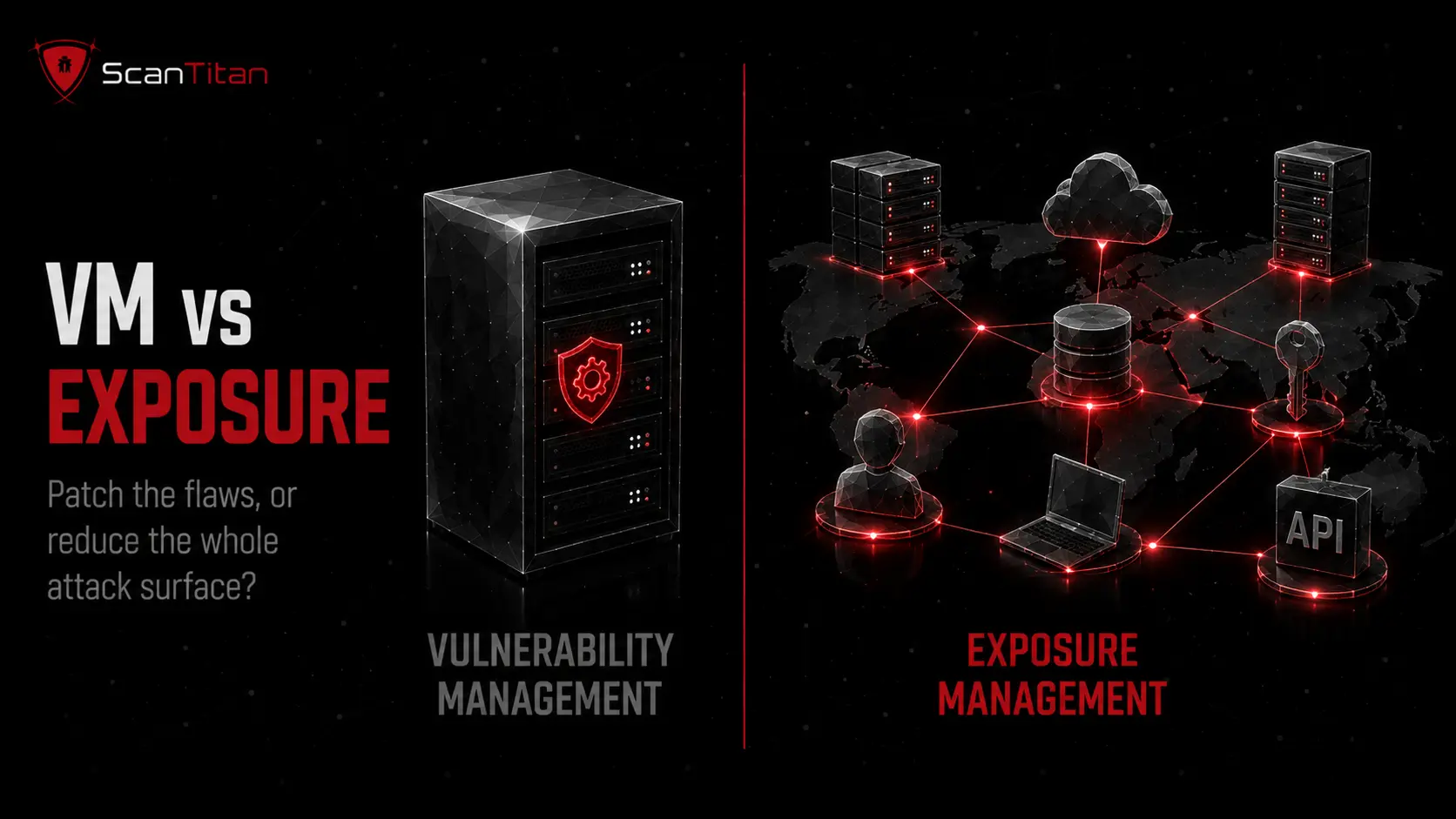
Vulnerability Management vs Exposure Management: Quick Comparison
Here is the fast version before the detail. Vulnerability management is a mature, CVE-centric process; exposure management is the broader, continuous practice it sits inside. The table contrasts them across the dimensions that actually change how you spend your time and budget.
| Aspect | Vulnerability management | Exposure management |
|---|---|---|
| Primary focus | Known software flaws (CVEs) | The whole exploitable attack surface |
| Scope | Operating systems, software, libraries | Plus misconfigurations, identities, shadow IT, third parties |
| Core question | Where are we unpatched? | Where are we exposed to a real attack? |
| Cadence | Periodic scans, weekly or monthly | Continuous monitoring |
| Prioritization | Severity, mostly CVSS | Exploitability plus business context |
| Remediation | Patch or upgrade the asset | Patch, reconfigure, revoke access, or segment |
| Example finding | An outdated library with a known CVE | A public storage bucket with no CVE at all |
What Is Vulnerability Management? (CVE-Focused Security)
Vulnerability management is the continuous process of identifying, assessing, prioritizing, and remediating known security weaknesses across your operating systems, software, and network. It has been the backbone of defensive security since CVEs (Common Vulnerabilities and Exposures) were first catalogued around the turn of the millennium. A scanner checks each asset against a database of known flaws, scores them, and feeds a patch queue. Those flaws are the concrete vulnerabilities in cyber security most teams picture: an unpatched library, an outdated CMS, or a protocol-level issue like an SSL vulnerability or the POODLE vulnerability. Vulnerability management does this one job well, but it answers only one question: where are we unpatched?
The 4-Stage Vulnerability Management Lifecycle
Traditional vulnerability management runs on a repeating four-stage loop. Each pass finds and closes known flaws, then starts again on a schedule.
Discover and assess assets
Inventory the systems to be checked, from servers and endpoints to cloud instances and containers. You cannot secure what you have not counted, so accurate, ongoing discovery is the foundation of the whole cycle.
Identify and score weaknesses
Scan each asset against known-vulnerability databases, then rank findings with the Common Vulnerability Scoring System (CVSS) to get a first read on how serious each flaw could be.
Act on each finding
For every vulnerability, decide to remediate (patch or upgrade), mitigate (make exploitation harder with a compensating control), or accept the risk when the asset and impact are genuinely low.
Reassess and repeat
Re-scan to confirm fixes held and to catch new flaws that appeared since the last pass. The loop never really ends, because new CVEs are published every day.
What Is Exposure Management? (Whole-Attack-Surface Risk)
Exposure management is the practice of finding, assessing, and reducing every weakness an attacker could use to reach your data, not just the ones with a CVE attached. It starts from the attacker’s view of your attack surface and includes things a vulnerability scanner never flags: a misconfigured storage bucket, an over-privileged user account, a forgotten staging server, an exposed API, or a risky third-party integration. Where vulnerability management asks whether you are patched, exposure management asks whether you are exposed, which is a much bigger question. It maps far more than the classic types of website security vulnerabilities, layering identity, configuration, and business context on top of raw flaws.
How CTEM (Continuous Threat Exposure Management) Fits In
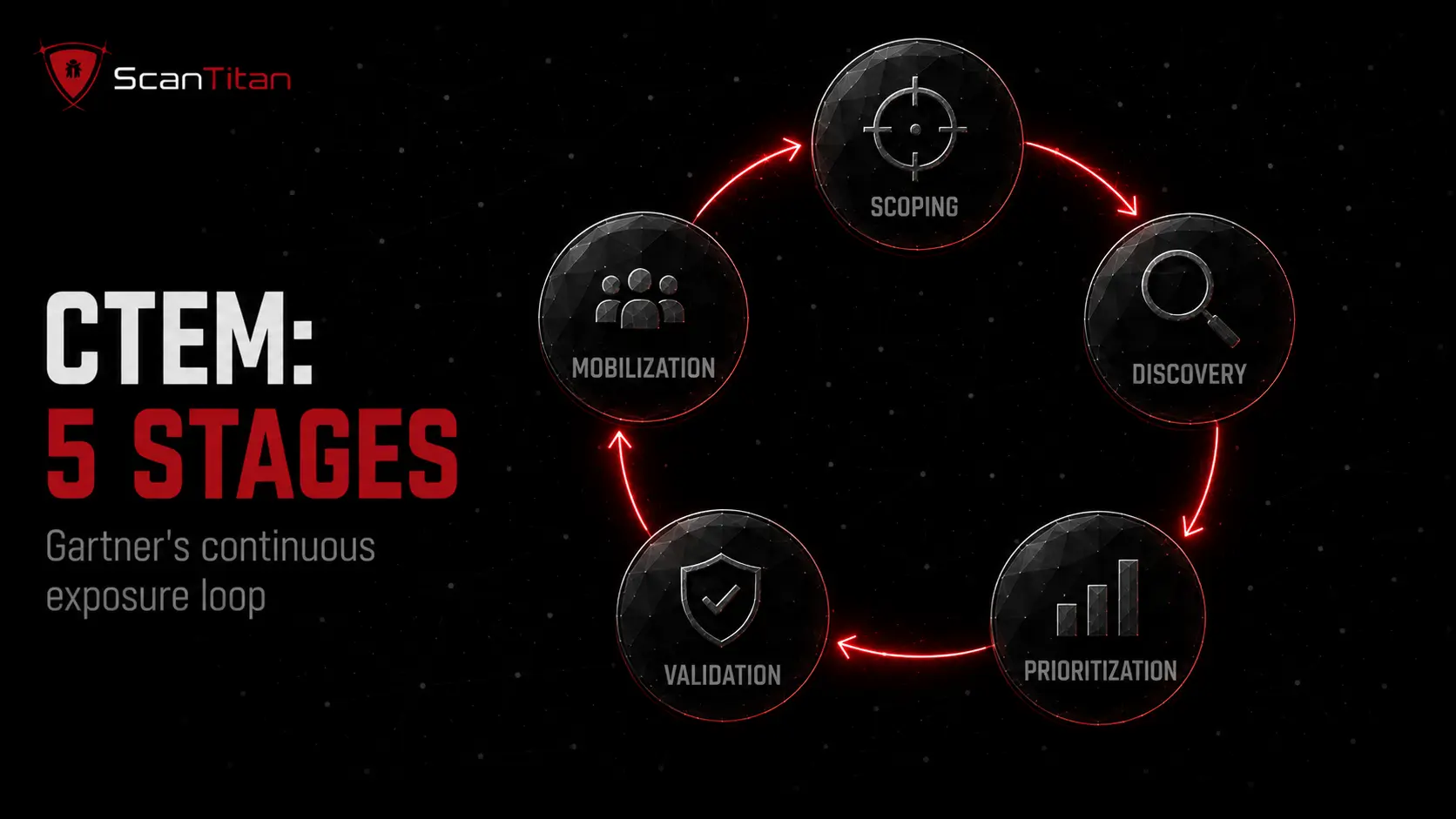
CTEM is Gartner’s framework for running exposure management as a continuous program rather than a one-off project. It structures the work into five repeating stages, and it is the model most modern exposure management platforms follow.
Scoping
Define what matters most to the business, setting the boundaries of the program around the assets, data, and systems whose compromise would actually hurt.
Discovery
Map every asset and exposure inside that scope, including unknown, shadow, and third-party assets, and go beyond CVEs to misconfigurations and identity risks.
Prioritization
Rank exposures by how likely they are to be exploited and how much damage that would cause, not by raw severity alone.
Validation
Test whether the prioritized exposures can genuinely be exploited and whether your existing controls would stop the attack, confirming real risk before you spend effort.
Mobilization
Drive coordinated remediation across the teams that own the fix, turning findings into action with clear owners rather than a report nobody reads.
10 Key Differences Between Vulnerability Management and Exposure Management
At a glance the two look interchangeable, and plenty of vendors blur them on purpose. They are not the same discipline. Vulnerability management fixes known software weaknesses; exposure management reduces every route an attacker could take to your data. These ten differences are where that split shows up in real work.
- Widen the scope: because vulnerability management addresses known CVEs in operating systems, libraries, and applications, while exposure management also counts open ports, insecure protocols, weak identities, and third-party components. A misconfigured load balancer carries no CVE, so a vulnerability scan stays silent while an exposure check flags it immediately.
- Discover unknown assets: since vulnerability management scans the inventory you already maintain while exposure management goes looking for the inventory you do not. Forgotten subdomains, a staging box someone spun up last quarter, shadow SaaS, and partner connections all belong to your attack surface whether or not they appear on a spreadsheet.
- Separate configuration flaws from code flaws: because the two need different fixes. Vulnerability management deals in outdated libraries and unpatched operating systems. Exposure management deals in public storage buckets, over-permissive IAM roles, and firewall rules opened for a migration and never closed. Neither gets a CVE, and both get organizations breached.
- Treat identity as an attack path: not an afterthought. Classic vulnerability management touches identity only to confirm an account can deploy a patch. Exposure management examines credential hygiene, dormant accounts, over-privileged roles, and missing multi-factor authentication, because a valid login is quieter and more useful to an attacker than any exploit.
- Rank by exploitability: rather than raw severity. Vulnerability management sorts by CVSS, which describes how bad a flaw could be in theory. Exposure management layers exploit-likelihood and active-attack data over that score and weighs the asset behind it, so a medium-severity flaw on a customer database outranks a critical one on an isolated test server.
- Broaden the fix options: beyond patching. A vulnerability closes when you apply a patch or upgrade. An exposure may close by revoking access, rotating a key, closing a port, segmenting a network, or decommissioning a forgotten environment entirely. Some exposures have no patch at all, which is exactly why the wider toolkit matters.
- Shift from periodic to continuous: since many vulnerability programs still scan weekly or monthly, which was reasonable when servers lived for years. Cloud instances and containers now appear and vanish within hours, so exposure management assumes near-constant monitoring; anything slower means securing a picture of an environment that no longer exists.
- Validate that the risk is real: because vulnerability management largely trusts the scanner: a finding appears, it enters the queue. Exposure management adds a validation step that tests whether the exposure can actually be exploited in your environment and whether existing controls would stop the attack. That step is what turns a 500-item list into a credible short one.
- Correlate several data feeds: not one. A vulnerability program mostly consumes scanner output. An exposure program fuses scan results with threat intelligence, external footprint data, asset usage, and identity alerts, so the risk score on a single asset shifts as new exploits are published or a new account is granted access to it.
- Plan strategically, not just tactically: Vulnerability management is a queue: find a defect, fix it, take the next ticket. Exposure management asks the architectural questions behind the queue, such as why that environment is internet-facing at all, or why so many roles hold production access. It closes today’s finding and removes the condition that produced it.
Vulnerability vs Exposure: Why the Distinction Matters for Your Security Program
The words are not interchangeable, and the difference is practical. A vulnerability is a specific, definable flaw, usually with a CVE. An exposure is any condition that increases your risk of compromise, whether or not a CVE exists: an open bucket, a leaked credential, an unmanaged subdomain. Teams that measure success only by CVE count miss the misconfiguration and identity paths that attackers increasingly prefer, precisely because those paths are quiet and unpatched by definition. Framing your program around exposure, not just vulnerabilities, is what stops you from reporting a clean patch dashboard the same week an over-permissive account gets abused.
Vulnerability vs exposure, in one lineA vulnerability is a specific flaw an attacker could exploit. An exposure is any condition that puts you at risk, including flaws with no CVE, such as a misconfiguration or a leaked credential.
How Prioritization Differs: CVSS vs EPSS and Real-World Exploitability
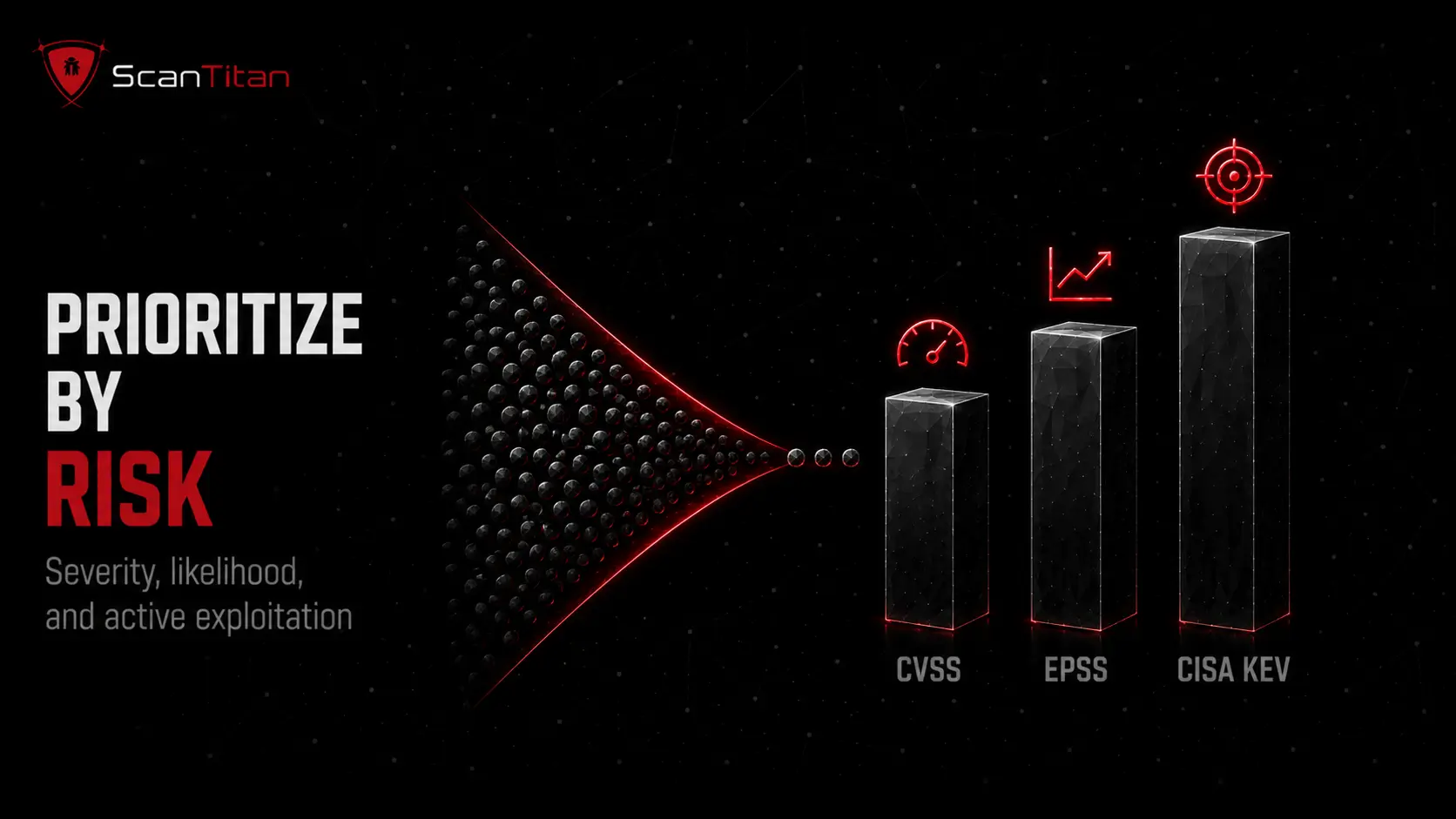
The biggest practical gap is how each discipline decides what to fix first. Classic vulnerability management leans on CVSS, which measures how bad a flaw could be in theory, not how likely it is to be exploited. Exposure management adds exploit-prediction and active-attack signals so a lean team spends its hours on the few findings that attackers genuinely use. The table shows the three signals worth combining.
| Signal | What it measures | Best use |
|---|---|---|
| CVSS | The theoretical severity of a flaw | Baseline triage and a first read |
| EPSS | The probability the flaw will be exploited soon | Rank which flaws to patch first |
| CISA KEV | Confirmed, active exploitation in the wild | Fix immediately, ahead of everything else |
Severity alone over-reports, flooding a small team with criticals it can never clear. Combining CVSS with EPSS and the CISA KEV catalog is how you cut a 500-item list down to the handful that actually put you at risk this week.
Do You Need Both Vulnerability and Exposure Management?
Yes, and it is not really a choice between them. Vulnerability management is a core component of exposure management, not a competitor to it. You still need to find and patch CVEs; exposure management simply makes patching one input among several, prioritized by real risk. For a small team, the practical path is to run solid vulnerability scanning first, then layer exposure context on top: external asset discovery, misconfiguration checks, and exploitability data. You do not need a separate department to start. Keep it continuous with continuous vulnerability scanning rather than quarterly snapshots, and remember that both disciplines feed the evidence that frameworks like NIS2 compliance expect to see.
Start with scanning that already thinks in exposureYou do not need two tools and two teams. Begin with a scanner that finds CVEs, discovers your external assets, flags misconfigurations, and prioritizes by exploitability, then grow the program from there.
When to Move From Vulnerability Management to Exposure Management
Most teams start with vulnerability management and add exposure management when the environment outgrows a patch list. These are the signals it is time.
- Scale beyond a static inventory, when cloud services and containers spin up and disappear faster than your monthly scan can track them.
- Triage an unworkable backlog, when the list of CVSS criticals is longer than your team could ever patch and you need exploitability to decide what actually matters.
- Investigate non-CVE incidents, when the scares come from misconfigurations, exposed credentials, or shadow IT rather than unpatched software.
- Answer board-level risk questions, when leadership starts asking how exposed the business is, not how many CVEs are open this month.
How ScanTitan Supports Vulnerability and Exposure Management
ScanTitan gives a lean team both disciplines in one place, without stitching tools together. On the vulnerability side, it scans your websites, networks, and APIs against known-CVE databases and scores each finding with CVSS. On the exposure side, it discovers your external assets, flags misconfigurations and weak protocols like deprecated TLS, surfaces exposed services and forgotten subdomains, and prioritizes everything with EPSS and CISA KEV data layered over raw severity. Because it runs continuously rather than on a quarterly cadence, a new asset or a freshly disclosed flaw shows up in the next scan with a clear owner and a fix, so the shortlist you work is the one that reduces real exposure.
Vulnerability Management vs Exposure Management FAQ
What is the difference between vulnerability management and exposure management?
Vulnerability management finds and fixes known software flaws (CVEs) on your systems. Exposure management is broader: it reduces every weakness an attacker could use, including misconfigurations, exposed identities, shadow IT, and third-party risk that carry no CVE. In short, vulnerability management asks whether you are patched, while exposure management asks whether you are exposed, then prioritizes by real-world exploitability.
Is exposure management the same as CTEM?
They are closely related. Exposure management is the discipline; CTEM (Continuous Threat Exposure Management) is Gartner’s framework for running it as a continuous program across five stages: scoping, discovery, prioritization, validation, and mobilization. Most exposure management platforms follow the CTEM model, so the terms are often used together, but CTEM is the structured method rather than a product.
Does exposure management replace vulnerability management?
No. Vulnerability management is a component of exposure management, not a rival to it. You still need to find and patch CVEs. Exposure management widens the lens so that patching sits alongside fixing misconfigurations, tightening identities, and reducing your attack surface, all prioritized by which exposures attackers are most likely to use.
What does exposure management cover that vulnerability scanning misses?
Anything without a CVE. That includes misconfigured cloud storage, over-permissive user accounts and leaked credentials, exposed APIs, forgotten or shadow assets, weak configurations, and risky third-party integrations. A vulnerability scanner focused on known software flaws will not flag an open storage bucket or an over-privileged identity, yet those are common paths into an organization.
How do CVSS and EPSS differ for prioritization?
CVSS scores how severe a flaw could be in theory. EPSS estimates how likely the flaw is to be exploited in the near future. CVSS alone over-reports, producing more criticals than a small team can patch. Combining CVSS with EPSS, and checking the CISA KEV catalog for confirmed active exploitation, narrows a long list down to the few findings that matter most.
Do small businesses need exposure management?
Increasingly, yes, but you can grow into it. Start with reliable vulnerability scanning, then layer on exposure context: external asset discovery, misconfiguration checks, and exploitability-based prioritization. A single platform that already thinks in terms of exposure lets a two-person team get most of the benefit without a dedicated exposure management department.
Resources and References
Work from primary, non-commercial sources when you scope your program. These references sit behind this guide, and CTEM itself is defined by Gartner.
- FIRST EPSS, the Exploit Prediction Scoring System for ranking flaws by real-world exploit likelihood.
- CISA Known Exploited Vulnerabilities catalog, the authoritative list of flaws under active exploitation.
- NIST National Vulnerability Database, the reference database for CVEs and CVSS scores.
- CVE.org, the source of record for Common Vulnerabilities and Exposures identifiers.
See Your Exposure, Not Just Your CVEs
Vulnerability management and exposure management are not rivals, they are two sizes of the same job: patch the known flaws, and close everything else an attacker could use. If your program only counts CVEs, the misconfigurations and exposed identities that cause real incidents stay invisible. ScanTitan scans your websites, networks, and APIs for vulnerabilities, discovers and monitors your external attack surface for exposures, and prioritizes both with CVSS, EPSS, and CISA KEV data in one dashboard, so a lean team fixes what actually reduces risk.