
Linux vulnerabilities statistics for 2026 point in two directions: kernel.org issued 8,778 kernel CVEs between 1 January and 25 November, already 54.7% more than in all of 2025, while CISA’s Known Exploited Vulnerabilities catalog lists only 32 Linux kernel flaws in total, 9 of them added this year. In ScanTitan’s pull of 18,740 kernel.org CVEs published from 2024 to 25 November 2026, just 12 are on the exploited list, about 1 in 1,560. Published yearly totals also disagree widely, with figures for 2024 ranging from 3,108 to 4,526 depending on how the count is made. This research counts the National Vulnerability Database and the CISA catalog directly, shows each method, and labels outside figures. Data last checked: 25 November 2026.
Key Linux Vulnerabilities Statistics for 2026
Executive Benchmark: Linux Vulnerabilities in 2026
| Metric | Latest figure | Period | Context | Source |
|---|---|---|---|---|
| Kernel CVEs issued by kernel.org | 8,778 | 1 Jan to 25 Nov 2026 | 5,675 in 2025, 4,287 in 2024 | National Vulnerability Database, counted by ScanTitan |
| Kernel CVEs tagged to the kernel product by NVD | 4,752 | 2026 to 25 Nov | 4,720 in 2025, 608 in 2023 | National Vulnerability Database, counted by ScanTitan |
| Linux kernel entries in CISA’s catalog | 32 (1.8% of 1,795) | Catalog to 24 Nov 2026 | 9 added in 2026, 7 in 2025 | CISA KEV feed, counted by ScanTitan |
| Entries in five other Linux software projects | 15 | Catalog to 24 Nov 2026 | GNU, Exim, Sudo, Polkit and OpenSSH | CISA KEV feed, counted by ScanTitan |
| Exploited kernel entries naming privilege escalation | 78.1% (25 of 32) | Catalog to 24 Nov 2026 | 15.6% (275 of 1,763) of other entries | CISA KEV feed, counted by ScanTitan |
| Median days from CVE publication to listing, kernel | 170 | Added 2023 to 24 Nov 2026 | 14 days for other entries | CISA KEV feed and CVE Services API, counted by ScanTitan |
| Kernel releases approaching 2,000 CVEs each | Over 1,500 in Linux 7.2 | August 2026 | About 500 per release from 6.9 to 6.19 | Phoronix, reporting a maintainer’s slide |
| Local privilege escalation exploits built by an AI pipeline | 948 | Mid-October 2026 run | Lab results, not attacks | OpenAI, vendor-only |
| Average time a kernel bug stays hidden | 2.1 years | Fixes from 2005 to 2025 | 125,183 bug and fix pairs | Pebblebed research |
Methodology: How We Counted Linux Vulnerabilities
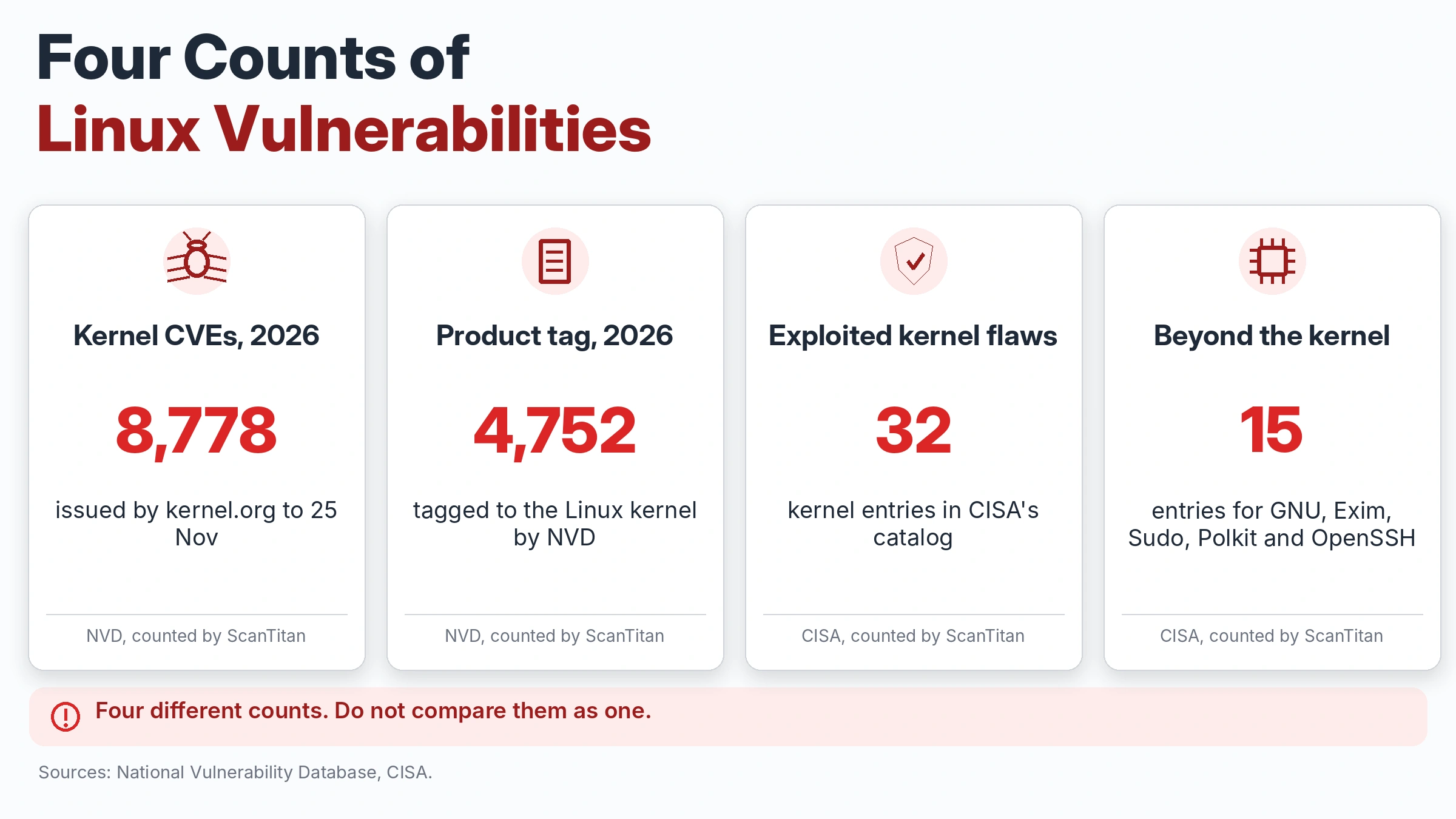
“Linux vulnerabilities” can mean at least four different things, and the gap between them is large.
| Count | What it includes | 2026 figure | What it cannot tell you |
|---|---|---|---|
| Kernel CVEs by issuer | CVEs that kernel.org issued, published in the period | 8,778 | Whether your system uses the affected code |
| Kernel CVEs by product tag | CVEs that NVD has tagged to the Linux kernel | 4,752 | Records NVD has not finished analyzing |
| Exploited kernel flaws | Entries with the vendor name Linux in CISA’s catalog | 32 in total | Exploitation that CISA has not listed |
| Linux software beyond the kernel | GNU, Exim, Sudo, Polkit and OpenSSH entries in the catalog | 15 in total | Every package a distribution ships |
Kernel CVE counts. We queried the National Vulnerability Database on 25 November 2026 and excluded rejected records. The issuer count uses records whose source is kernel.org and groups them by publication date. We read all 18,740 records published from 2024 to 25 November 2026 for severity, weakness type and subsystem label. The product count uses NVD’s tag for the Linux kernel.
Exploited counts. We used CISA’s catalog version 2026.11.24, holding 1,795 entries. “Kernel entries” are the 32 with the vendor name Linux. “Other entries” are the remaining 1,763. Our CISA KEV catalog guide explains how the list works.
Limits. NVD records change as analysis continues, so a later query will return somewhat different severity and product figures. Distributions also issue their own advisories and backport fixes, which a CVE count does not show.
Linux CVE Statistics by Year
The volume of Linux kernel CVEs changed by an order of magnitude in 2024, and 2026 has set a new high.
| Publication year | Issued by kernel.org | Tagged to the kernel by NVD |
|---|---|---|
| 2019 | Not counted | 392 |
| 2020 | Not counted | 237 |
| 2021 | Not counted | 418 |
| 2022 | Not counted | 573 |
| 2023 | Not counted | 608 |
| 2024 (from February) | 4,287 | 4,526 |
| 2025 | 5,675 | 4,720 |
| 2026 (to 25 Nov) | 8,778 | 4,752 |
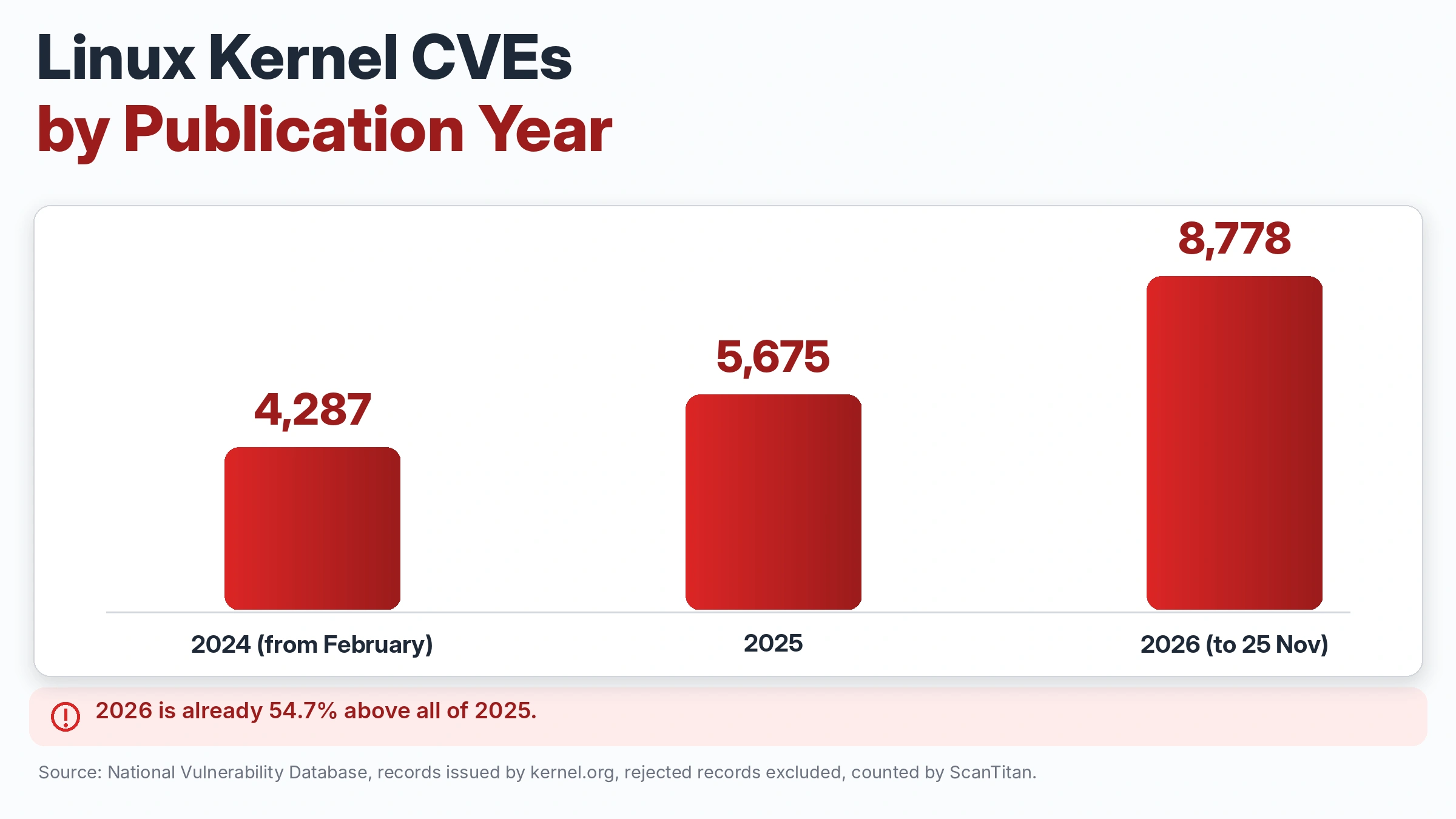
The jump follows a change in who assigns the numbers. The kernel developer team now assigns CVEs for its own code, and in our count its records begin in February 2024. Its published CVE process says the team is overly cautious and assigns a CVE to any bugfix it identifies, because it is often unclear at the time of a fix whether a bug can be exploited. The team says this explains the large number of CVEs.
Within 2026, publication sped up sharply in May.
| Month of 2026 | Kernel.org CVEs published |
|---|---|
| January | 246 |
| February | 220 |
| March | 178 |
| April | 377 |
| May | 1,027 |
| June | 513 |
| July | 836 |
| August | 1,643 |
| September | 2,106 |
| October | 1,051 |
| November (to 25th) | 581 |
January to April averaged 255 a month. May to October averaged 1,196, about 4.7 times as many. September alone, with 2,106, was larger than any month of 2025, whose peak was 1,054 in December. Monthly totals are uneven because records are often published in batches.
Per release, the trend is similar. Phoronix reported on 28 August 2026 that a slide from kernel maintainer Greg Kroah-Hartman showed about 500 CVEs fixed per release from Linux 6.9 to 6.19, more than 1,000 since Linux 7.0 and over 1,500 in Linux 7.2, with 2,000 possible soon. That article links the rise to AI models analyzing the code.
Why Sources Report Different Linux CVE Totals
Pages ranking for this topic publish very different numbers for the same year.
| 2024 kernel CVE figure | Who reports it | How it appears to be counted |
|---|---|---|
| 3,108 | A statistics article on CVE severity | Cites NVD, no query shown |
| 3,529 | Two statistics articles | Cites NVD, no query shown |
| 4,287 | ScanTitan | Issued by kernel.org, by publication date, rejected records excluded |
| 4,355 | A kernel CVE tracker | Built from NVD data |
| 4,526 | ScanTitan | Tagged to the kernel by NVD, rejected records excluded |
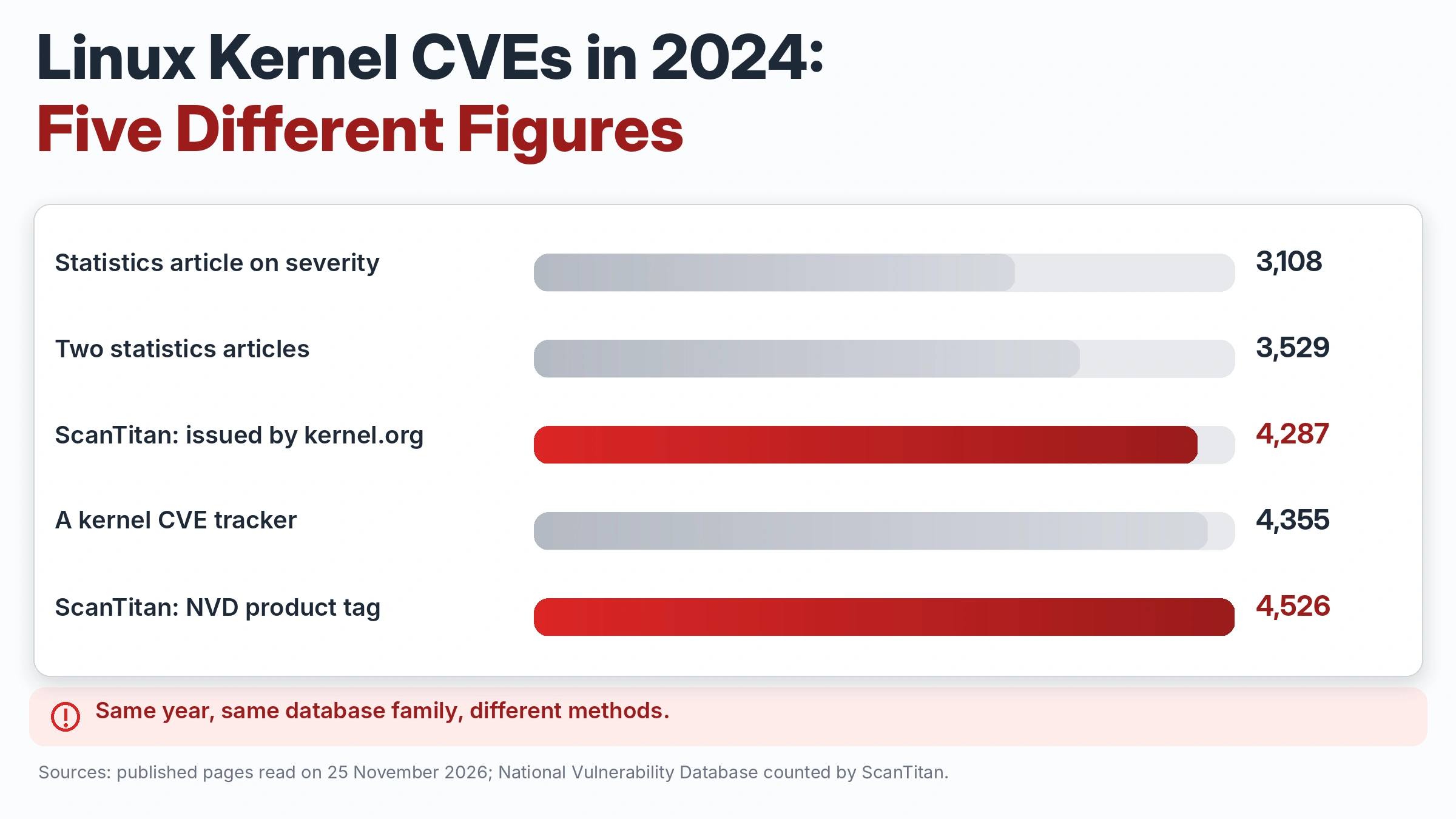
Older years differ even more. For 2023, we saw 263, 290 and 1,736 published, and our product tag count is 608. Five choices explain most gaps:
- Issuer or product. A count of records issued by kernel.org is not the same as a count of records tagged to the kernel product.
- Publication year or ID year. A CVE with a 2025 number can be published in 2026.
- Rejected records. Some counts keep withdrawn CVEs.
- Pull date. NVD keeps editing records, and product tags arrive after publication.
- Scope. Some totals include distribution packages and others only the kernel.
Before quoting a total, ask which of the five was used. If a page gives no answer, treat its number as unverified.
Linux Kernel CVE Severity
Severity depends heavily on who assigned the score. The table uses NVD’s own CVSS score where one exists, and otherwise the first other CVSS version 3 score on the record.
| Severity | 2024 (4,287) | 2025 (5,675) | 2026 to 25 Nov (8,778) |
|---|---|---|---|
| Critical | 26 (0.6%) | 47 (0.8%) | 553 (6.3%) |
| High | 1,191 (27.8%) | 1,486 (26.2%) | 3,110 (35.4%) |
| Medium | 3,036 (70.8%) | 3,240 (57.1%) | 1,777 (20.2%) |
| Low | 34 (0.8%) | 5 (0.1%) | 8 (0.1%) |
| No score | 0 (0%) | 897 (15.8%) | 3,330 (37.9%) |
Counting only NVD’s own scores changes the picture completely.
| NVD’s own score | 2024 | 2025 | 2026 to 25 Nov |
|---|---|---|---|
| Critical | 2 | 1 | 1 |
| High | 1,027 | 948 | 416 |
| Medium | 2,875 | 3,240 | 1,777 |
| Low | 29 | 4 | 8 |
| No NVD score | 354 (8.3%) | 1,482 (26.1%) | 6,576 (74.9%) |
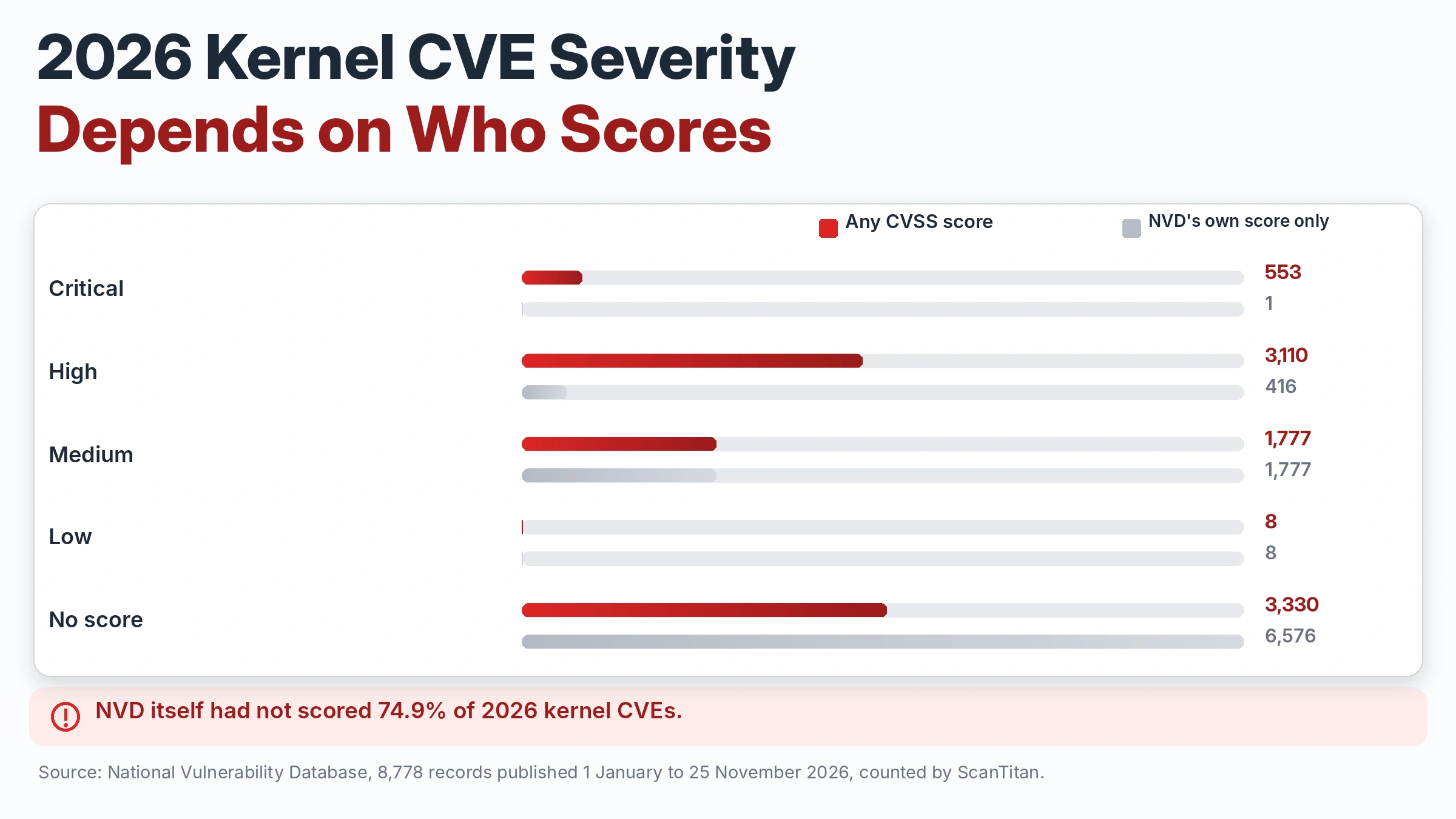
Of the 553 kernel CVEs rated critical in 2026, NVD itself scored 1 as critical; the other ratings come from other scorers. Part of the gap is timing: on the day we checked, 5,244 of the 2026 records, 59.7%, were still marked as received and not yet analyzed. A scanner or report that reads only NVD scores will miss most 2026 severity ratings.
Most Common Weakness Types and Subsystems
Of the 18,740 records, 8,894 (47.5%) carry a weakness type (CWE). Among those, memory handling and locking errors lead. One record can carry more than one type.
| Weakness type | Records | Share of 8,894 tagged |
|---|---|---|
| NULL pointer dereference (CWE-476) | 2,111 | 23.7% |
| Use after free (CWE-416) | 1,544 | 17.4% |
| Memory leak (CWE-401) | 1,154 | 13.0% |
| Out-of-bounds read (CWE-125) | 701 | 7.9% |
| Improper locking (CWE-667) | 558 | 6.3% |
| Race condition (CWE-362) | 555 | 6.2% |
| Out-of-bounds write (CWE-787) | 538 | 6.0% |
| Uninitialized resource (CWE-908) | 285 | 3.2% |
Most kernel records begin with a short label naming the area of the code that was fixed. We grouped the 18,740 records by that label.
| Subsystem label | Records | Share of 18,740 |
|---|---|---|
| net (core networking) | 1,469 | 7.8% |
| drm (graphics drivers) | 1,375 | 7.3% |
| wifi | 720 | 3.8% |
| usb | 409 | 2.2% |
| media | 401 | 2.1% |
| scsi (storage) | 388 | 2.1% |
| bluetooth | 386 | 2.1% |
| mm (memory management) | 385 | 2.1% |
| bpf | 358 | 1.9% |
| netfilter (firewall code) | 321 | 1.7% |
The four networking labels in this table (net, wifi, bluetooth and netfilter) add up to 2,896 records, 15.5%. Labels are chosen by developers, so read this as a map of where fixes land, not an exact subsystem census. Use after free flaws are explained in our guide to the use-after-free vulnerability, and our memory safety statistics compare memory flaws across vendors.
How Many Linux Vulnerabilities Are Actually Exploited?
CISA lists 32 Linux kernel flaws as exploited, 1.8% of the catalog. Counting by the year CISA added them:
| Year added | Kernel entries | Other Linux software entries | All catalog entries | Kernel share |
|---|---|---|---|---|
| 2021 | 1 | 1 | 311 | 0.3% |
| 2022 | 8 | 8 | 555 | 1.4% |
| 2023 | 3 | 2 | 187 | 1.6% |
| 2024 | 4 | 0 | 186 | 2.2% |
| 2025 | 7 | 2 | 245 | 2.9% |
| 2026 (to 24 Nov) | 9 | 2 | 311 | 2.9% |
The kernel’s share of new entries has risen each year since 2021, only slightly from 2025 to 2026, and the counts are small. The 2021 figure also reflects the catalog’s launch year.
The nine kernel flaws added in 2026:
| CVE | Date added | Days from CVE publication | Federal due date |
|---|---|---|---|
| CVE-2026-46300 | 28 Oct 2026 | 158 | 31 Oct 2026 |
| CVE-2025-39964 | 18 Sep 2026 | 340 | 21 Sep 2026 |
| CVE-2026-53266 | 18 Sep 2026 | 85 | 21 Sep 2026 |
| CVE-2025-39682 | 18 Sep 2026 | 378 | 21 Sep 2026 |
| CVE-2026-53362 | 27 Aug 2026 | 54 | 30 Aug 2026 |
| CVE-2022-0995 | 26 Aug 2026 | 1,615 | 29 Aug 2026 |
| CVE-2022-0492 | 2 Jun 2026 | 1,552 | 5 Jun 2026 |
| CVE-2026-31431 | 1 May 2026 | 9 | 15 May 2026 |
| CVE-2018-14634 | 26 Jan 2026 | 2,680 | 16 Feb 2026 |
Seven of the nine gave federal agencies only three days to act. Three of the nine are from CVE numbers of 2022 or earlier.
CVSS score is a weak filter here. Of the 12 kernel.org CVEs from 2024 onward that appear in the catalog, CVE-2024-50302 and CVE-2025-39964 are scored 5.5, a medium rating. A patch rule that skips medium findings would skip both.
What Exploited Linux Kernel Flaws Let Attackers Do
We searched CISA’s name and description for each entry and compared kernel entries with all others.
| What the description says | Kernel entries (32) | Other entries (1,763) |
|---|---|---|
| Privilege escalation | 78.1% (25) | 15.6% |
| Mentions a local attacker or local access | 43.8% (14) | 5.9% |
| Denial of service or crash | 9.4% (3) | 6.1% |
| Code execution or command injection | 3.1% (1) | 48.3% |
| No login needed | 0% (0) | 17.4% |
| Uses the word remote | 0% (0) | 47.4% |

The profile is the reverse of most exploited software. Kernel flaws are mainly used after an attacker already has a foothold, to turn a limited account into full control. A missing word does not prove a flaw cannot be reached over a network, so check each advisory. Our privilege escalation statistics cover this class across all vendors, and the remote code execution statistics cover the entry side.
By weakness type, 14 of the 32 exploited kernel entries are memory safety flaws (43.8%), 5 are access control flaws, 4 are race conditions, 2 are input validation flaws, and 7 carry other tags or none.
Ransomware use is rare but real: CISA flags CVE-2017-1000253 and CVE-2024-1086.
How Long Do Exploited Linux Flaws Take to Reach CISA’s List?
Kernel flaws tend to be listed much later than other software flaws.
| Group | Entries | Median days from CVE to listing | Listed within 30 days | Listed over a year after |
|---|---|---|---|---|
| Kernel, all years | 32 | 464.5 | 3.1% | 53.1% |
| Others, all years | 1,762 | 210.5 | 34.0% | 43.9% |
| Kernel, added 2021 and 2022 | 9 | 1,939 | 0% | 77.8% |
| Others, added 2021 and 2022 | 857 | 887 | 10.3% | 68.1% |
| Kernel, added since 2023 | 23 | 170 | 4.3% | 43.5% |
| Others, added since 2023 | 905 | 14 | 56.5% | 21.0% |
One other entry had no retrievable CVE publication date and is left out of this table.
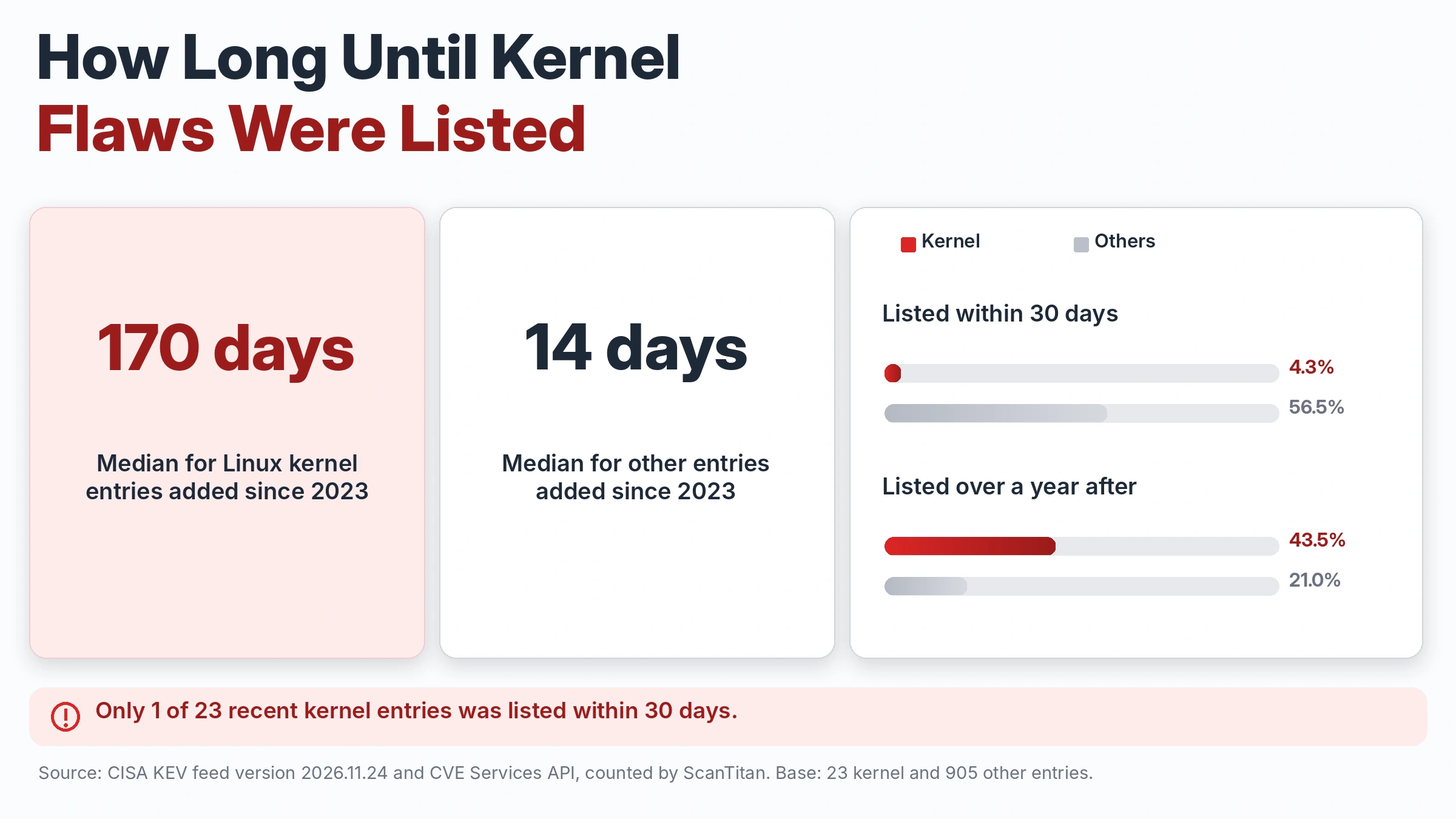
Since 2023, only 1 of 23 kernel entries was listed within 30 days of its CVE. A long gap does not mean attackers waited that long: the date records when CISA added the flaw, which can be well after first use. It does mean an old, unpatched kernel stays at risk for years. For listing speed across all software, see our zero-day statistics.
Patching is slow too. Microsoft’s data, as cited in our research from its exploited vulnerability analysis, put the median time to patch at ten or more weeks on Linux servers, against about two weeks on Windows workstations. Our patch management statistics compare deadlines with real fix times.
Beyond the Kernel: Sudo, Polkit, glibc, Bash and Exim
A Linux server is much more than its kernel. We counted catalog entries for five widely used projects. These also run on some other Unix-like systems.
| Project | Exploited entries | Examples |
|---|---|---|
| GNU (Bash, C library, InetUtils) | 5 | Shellshock (CVE-2014-6271), Looney Tunables (CVE-2023-4911) |
| Exim mail server | 5 | CVE-2019-10149, CVE-2018-6789 |
| Sudo | 2 | CVE-2021-3156, CVE-2025-32463 |
| Polkit | 2 | PwnKit (CVE-2021-4034), CVE-2021-3560 |
| OpenSSH | 1 | CVE-2026-123158, added 9 November 2026 |
Their profile differs from the kernel’s: 8 of the 15 describe code execution, compared with 1 of 32 kernel entries. CISA flags CVE-2021-4034 and CVE-2018-6789 for ransomware.
Newer additions move fast. SecurityWeek reported that the GNU telnet service flaw CVE-2026-24061 was exploited within days of disclosure, and CISA listed it five days after its CVE was published.
One well-known case is absent. The 2024 backdoor in the XZ compression library (CVE-2024-3094) is not in the catalog, because the list records confirmed exploitation, not severity or publicity.
Copy Fail: A 2026 Case Study
Copy Fail (CVE-2026-31431) is a kernel flaw that lets an unprivileged local user gain higher privileges. Theori disclosed it on 29 April 2026, after reporting it to the kernel security team five weeks earlier.
| Fact | Detail |
|---|---|
| Where it sits | The kernel’s cryptography interface, writing into cached copies of files |
| Affected range | Kernels dating back to version 4.14 (2017); confirm with your distribution |
| Severity | CVSS 7.8, local attack |
| Disclosed | 29 April 2026 |
| Added to CISA’s catalog | 1 May 2026, two days after disclosure |
| Federal due date | 15 May 2026 |
| Interim step many advised | Disable the affected kernel module until patched |
Two lessons carry over. A local flaw can be urgent, because attackers combine it with any way in. And SELinux or AppArmor reduce the risk only when they are configured to block the affected interface. A second flaw in the same interface, CVE-2025-39964, was added to the catalog in September 2026.
AI Bug Hunting and the Linux Kernel
On 4 November 2026, OpenAI described a research pipeline aimed at the kernel. These are vendor-only results from a controlled environment.
| Result of the mid-October run | Figure |
|---|---|
| Candidate findings analyzed | 2,308 |
| Vulnerabilities reproduced | 1,724 |
| Working local privilege escalation exploits | 948 |
| Information leak proofs of concept | 291 |
| Reported API cost | $1,213,430 ($1,279 per escalation exploit) |
OpenAI also said that over 100 Linux privilege escalation flaws were patched or had patches in progress from other contributors within 10 days while its scan ran, and that low-privileged access to a system that is not fully patched should be treated as close to root access against a well-resourced attacker.
Fixing is the harder step. CIQ, an enterprise Linux vendor, says only a fraction of AI-generated kernel patches can ship without changes in its experience, because each needs review for regressions, maintainability and compatibility.
Linux Vulnerability Statistics Commonly Misquoted
| Claim | What the data shows | Source |
|---|---|---|
| “Linux had 3,529 kernel CVEs in 2024” | Published figures run from 3,108 to 4,526, depending on method | NVD, counted by ScanTitan, and published pages |
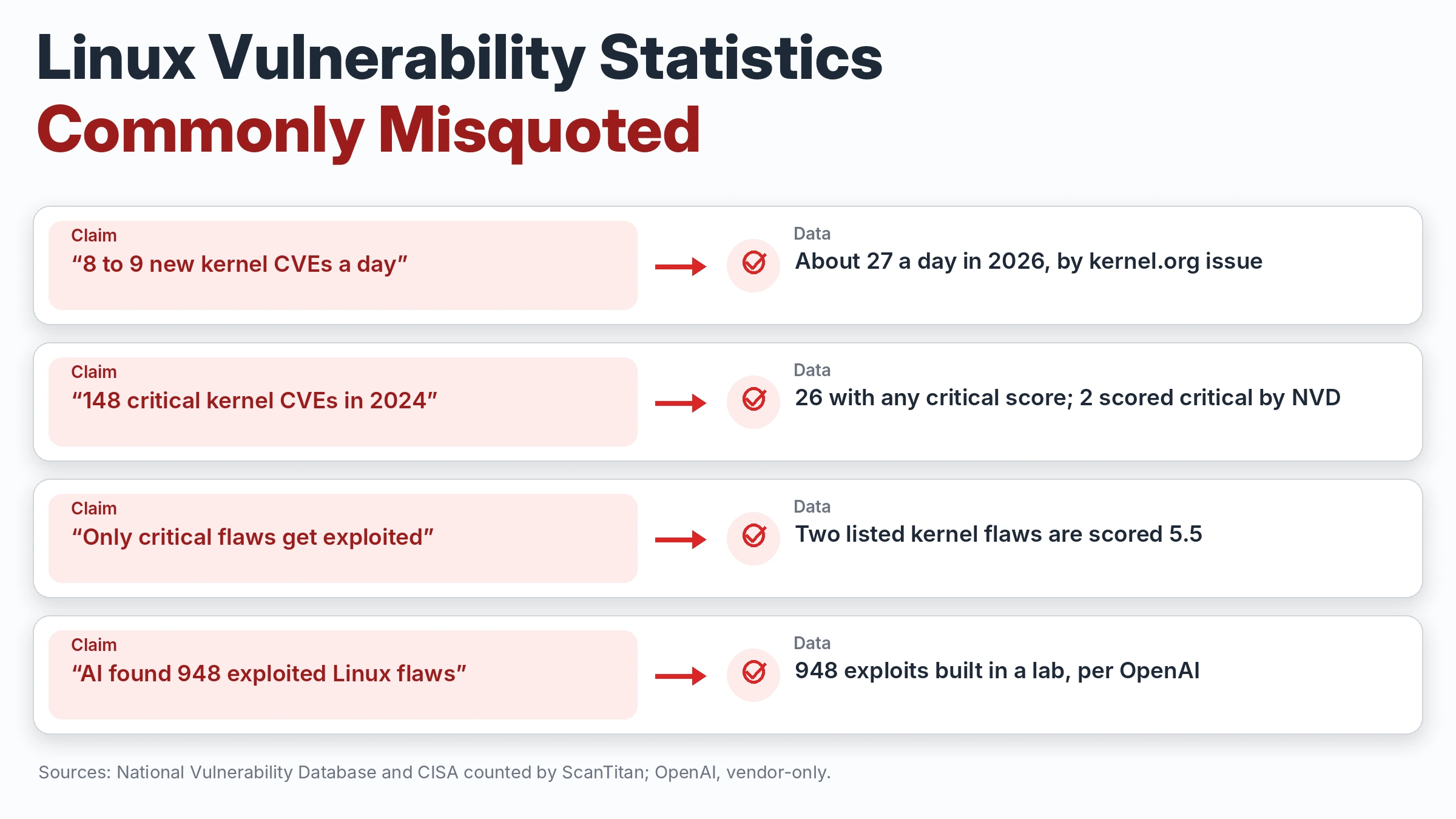
| “Linux gets 8 to 9 new kernel CVEs a day” | About 16 a day in 2025 and about 27 in 2026 to 25 November, by kernel.org issue | NVD, counted by ScanTitan |
| “There were 148 critical kernel CVEs in 2024” | We find 26 with any critical score and 2 scored critical by NVD itself | NVD, counted by ScanTitan |
| “More CVEs mean Linux is under attack more” | 12 of 18,740 kernel.org CVEs since 2024 are on the exploited list | NVD and CISA |
| “Only critical flaws get exploited” | Two listed kernel flaws are scored 5.5 | NVD and CISA |
| “Linux kernel releases carry 2,000 CVEs” | 2,000 was a projection; Linux 7.2 passed 1,500 | Phoronix |
| “AI found 948 exploited Linux flaws” | 948 exploits built in a lab, with no claim of real attacks | OpenAI, vendor-only |
How to Check Your Linux Exposure With ScanTitan
A catalog tells you which flaws are exploited, not which of them your servers carry. ScanTitan offers two ways to look.
The authenticated Linux vulnerability scanner connects over SSH with a dedicated read-access account, without sudo, reads installed operating system packages and matches them to security advisories, with CISA KEV and EPSS data when available. It also runs the public service checks. It is included in the Business and Consultant plans.
Without credentials, the IP vulnerability scanner tests a public address from outside: listening services, reported versions and matching CVEs.
A practical routine:
- List every public Linux server, including ones managed by a provider.
- Run an external scan to see which services answer.
- Run an authenticated assessment to read installed packages.
- Check any matched CVE in the CVE priority checker for known exploitation.
- Patch, reboot where the kernel requires it, and scan again.
Limits matter. Authenticated scanning covers Linux servers on public addresses that you own or are authorized to test, not private networks or address ranges. An advisory match shows that a package version is affected. It does not prove the flaw can be exploited on your server, and a scan does not show whether someone has already broken in.
Patch Priorities for a Small Linux Team
- Patch what CISA lists first. The list is short: 32 kernel entries and 15 in the five projects above. Compare your versions with all of them, old ones included.
- Treat local privilege escalation as urgent on shared and internet-facing hosts. It turns a small break-in into a full one.
- Do not filter on critical alone. Exploited kernel flaws include medium scores, and many new records have no NVD score.
- Take the distribution’s kernel updates as a set. The kernel team advises taking all released changes instead of picking individual fixes.
- Plan the reboot. An installed kernel update does not protect a server still running the old one, unless you use live patching.
For how exploited flaws feed ransomware, see our ransomware statistics, and for exposed services, our open ports statistics. The wider CVE picture is in our vulnerability statistics. None of this is advice for a specific environment.
How We Compiled and Verified These Statistics
Kernel CVE figures come from queries to the National Vulnerability Database API on 25 November 2026, excluding rejected records. The issuer totals matched between two separate pulls: 4,287 for 2024, 5,675 for 2025 and 8,778 for 2026. Severity, weakness and subsystem figures come from reading all 18,740 records. Exploited figures come from CISA’s feed, version 2026.11.24, and publication dates from the CVE Services API. Wording shares search each entry’s name and description, using the same privilege escalation rule as our earlier research. Percentages show their counts where possible. Outside figures are named beside each claim, and vendor results are labeled. The Microsoft patching figure is as cited in our privilege escalation research.
Primary Sources
- National Vulnerability Database API
- CISA Known Exploited Vulnerabilities feed (version 2026.11.24)
- Linux kernel documentation: CVEs
- Phoronix, The Linux Kernel Is Approaching 2,000 CVEs Per Release
- OpenAI, A thousand fewer paths to root (vendor-only)
- CIQ, OpenAI generated 948 Linux kernel patches (vendor-only)
- Pebblebed, Kernel bugs hide for 2 years on average
- SecurityWeek, Organizations Warned of Exploited Linux Vulnerabilities
- Wikipedia, Copy Fail
- Microsoft Security Research, What exploited vulnerabilities have in common
Frequently Asked Questions
How many Linux kernel vulnerabilities were reported in 2026?
By ScanTitan’s count, kernel.org issued 8,778 kernel CVEs that were published between 1 January and 25 November 2026. NVD had tagged 4,752 CVEs from the same period to the kernel product.
How many Linux vulnerabilities are actively exploited?
CISA’s Known Exploited Vulnerabilities catalog lists 32 Linux kernel flaws as of 24 November 2026, 9 of them added this year. It also holds 15 entries for GNU tools, Exim, Sudo, Polkit and OpenSSH.
Why does Linux have so many CVEs?
The kernel team assigns its own CVEs and says it is overly cautious, giving a number to any bugfix it identifies as a possible security issue. Recent reporting also links the 2026 surge to AI-assisted bug finding.
Does a high CVE count make Linux less secure?
Not by itself. Only 12 of 18,740 kernel.org CVEs published since 2024 are on CISA’s exploited list. What matters is whether your systems run the affected code and how quickly you patch.
What is the most common type of Linux kernel vulnerability?
Among records with a weakness type from 2024 to 25 November 2026, NULL pointer dereference leads with 23.7%, followed by use after free with 17.4% and memory leaks with 13.0%.
What do exploited Linux kernel flaws usually do?
Most raise privileges. In 25 of the 32 exploited kernel entries, 78.1%, CISA’s text names privilege escalation, so attackers typically use them after getting a first foothold.
What was Copy Fail?
Copy Fail, CVE-2026-31431, is a local privilege escalation flaw in the kernel’s cryptography interface, disclosed on 29 April 2026 and added to CISA’s catalog two days later.
How long do Linux kernel flaws take to appear on CISA’s list?
For entries added since 2023, the median was 170 days after CVE publication, compared with 14 days for other software.
Are Linux vulnerabilities used in ransomware?
Some are. CISA flags 2 of the 32 exploited kernel entries, CVE-2017-1000253 and CVE-2024-1086, as used in ransomware campaigns.
How can I check a Linux server for vulnerabilities?
Scan its public services from outside, then compare the installed packages with security advisories. ScanTitan’s authenticated scanner does the second step over SSH for public servers you are authorized to test.